All the Podcast Homilies for Trinity Season, including Sunday next before Advent. are now available in their revised versions. Each includes cross-reference to Other AIC Resources, including videos, podcastsand books, on the same words, topics and phrases. All links to previous versions of the Podcast Homilies have been deleted.
Now that this year-long task is completed, I plan to return to work on the Bible Study video series, New Testament: Gospels. Episodes on the Gospel of St. Matthew were uploaded earlier this year. With luck, next week I will begin uploading the episodes on the Gospel of St. Mark. Some are already available for uploading. Others need editing of the voice track. I am currently working on the script and slides for the final episode focused on the Gospel of St. Luke. All links to previous versions are no longer available. As of Episode Twenty-four, the number of slides in the series is more than double that of the previous version. The additional slides include more actual Scriptural quotations and many more illustrations from the artistic tradition of the Church. These revised versions will give viewers a glimpse of the latest historic art now available in the public domain. Many of these from the 10th through the 16th C. have never been available to the non-scholar general public. Many libraries are now very busy digitizing their collections. I will be watching for additional material as it becomes available. These great works of religious art have been added to our Internet presence as an aid to greater spiritual understanding of the content of Scripture.
As always, thank you for your interest and support. Please consider recommending this site to friends and family. You can received the latest information by clicking on the Follow Anglican Internet Church tab in the right column of this page. Wordpress will send notice of all new postings.
Glory be to God for all things! Amen!
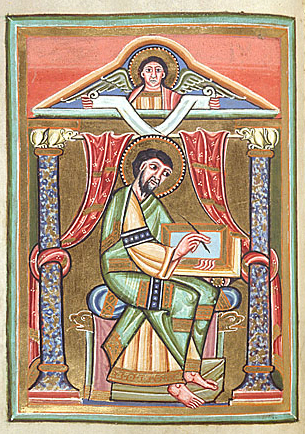
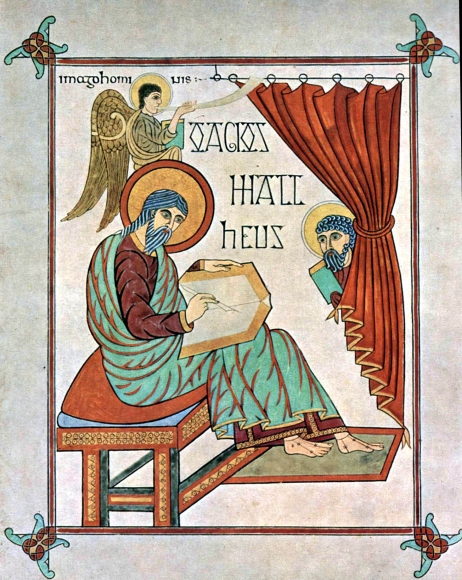 This week’s rarely seen illustration is the illumination of Matthew Writing His Gospel from the Lindisfarne Gospels, produced in England around 750 A.D., with perspective correction adjustments, from the British Library by way of the Yorck Project: 10,000 Masterworks.
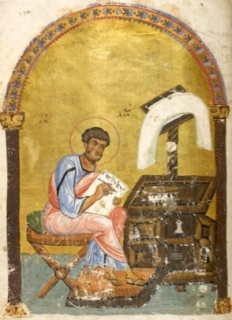
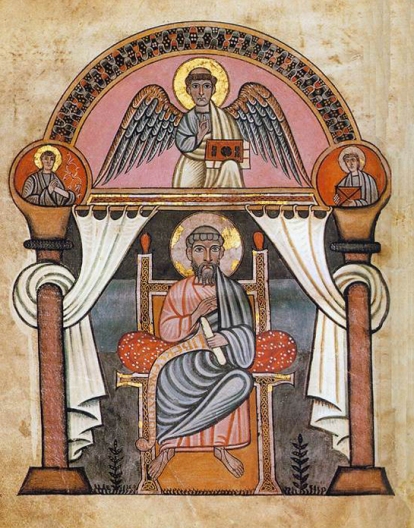 Episode Two in the revised edition of the AIC Bible Study Video series, The New Testament:Gospels, is now available in both video and podcast formats. The episode, an introduction to the Gospel of St. Matthew beginning with its history and the genealogy of Jesus, includes four images of St. Matthew not often seen by the general public. The best of these, at left, is an illumination of St. Matthew from the Codex Aureus of Canterbury, made around 750 A.D. in England in the region of Canterbury. The Codex Aureus (Golden Gospel) was stolen by Viking raiders in the 9th C. and bought back through a monetary ransom payment later the same century. Where it resided between then and its movement to Spain in the early 16th C. is unclear. Two centuries later, in 1690 A.D. it was bought by the King of Sweden and since then has resided at the Konigliga Bibliotek (Royal Library), Stockholm, Sweden. The Codex is also known as the Codex Aureus of Stockholm. The image is from the Yorck Project’s CD collection, 10,000 Masterworks through Wikipedia Commons. I adjusted the image using perspective and other correction methods in Photoshop.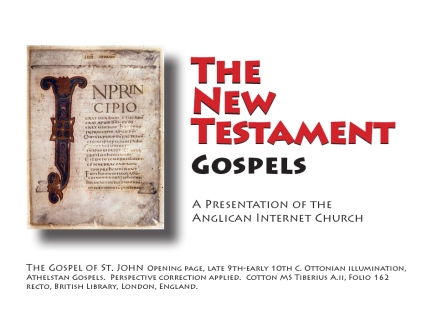
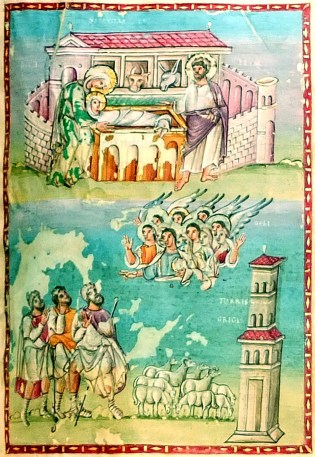 I’ve completed and uploaded Episode One in Christmas: The Nativity of Our Lord, part of the final link in our chain of teaching videos for all the seasons in the 1928 Book of Common Prayer. The series will have two episodes. Episode One offers discussion of the evolution of the Christmas tradition; Anglican traditions of Christmas; and discussion and reading of both the first and second set of Collect, Epistle and Gospel readings for Christmas Day. The series is illustrated with material from the 10th through the 20th C. The oldest is a Byzantine-style illumination of the Nativity and the Annunciation to the Shepherds from the Codex Egberti, a Gospel book prepared in the Scriptorium of the Reichenau Monastery, Reichenau, Germany, between 980 and 993 A.D. for the incumbent bishop of Trier. I applied perspective correction to the original file. The Codex is part of the collection at the Trier Library, Trier, Germany.
 Anglican Internet Church