I’ve been reviewing reader/viewer comments and various email message concerning the Anglican Internet Church, particularly its various presences on the Web. Two common threads, not actually spoken, are Why the Seasonal Videos; Why the Focus on the 1928 B.C.P.?; and Why No Actual Video of the author? I hope the following provides readers/viewer with acceptable answers.
Seasonal Videos: One of the original objectives of the AIC, when it was just the broadcast arm of St. John Chrysostom Anglican Church at St. Joseph’s Villa Chapel, Richmond, VA, was to extend the reach of traditional homilies and traditional local doctrinal teaching and Bible Study. Today, the AIC reaches a broad audience in many parts of the world. The Seasonal Videos, which will eventually include programs on the entire Church Calendar, offer viewers and listeners through the Podcast version, are a way of providing traditional teaching, easily-available, without either going over the heads of the viewers or insulting their intelligence — and giving them a glimpse of the treasures of Church art from both the Western and Eastern Church.
Why the B.C.P. Focus: The greatest treasure left to Anglicans by the English Reformation is the American 1928 Book of Common Prayer (as amended in the 1940s). The liturgies provided, especially for Holy Communion, provide a valuable link backwards in time to the early Church both at Rome and at Constantinople and at Antioch, Alexandria, Jerusalem and the many Christian communities throughout Asia Minor. Every time an Anglican hears a Collect read he or she is reminded of the continuity of the Christian heritage which came down from the Apostles through the clergy, bishops, and archbishops who defended the Nicene Creed in the face of “reform” movements. The Seasonal Videos, with their focus on how the Calendar is brought to life in Holy Communion or Morning Prayer, help Anglicans understand exactly where these beliefs came from, including the source of the Collects; provide the short summaries of the Epistle and Gospel readings, with appropriate religious art; and enrich the experience with commentary on appropriate Seasonal Music from The St. Chrysostom Hymnal, which is offered as a supplement to the 1940 Hymnal.
Why No Actual Videos of the Author: All our video series, whether in the Bible Study, Seasonal, or Christian Education categories, are intended to keep the focus on the content. Nothing would be gained by watching the author while he narrates a video. In fact, I believe, such video content would take time away from both the Script and the extensive archive of icons, frescoes, mosaics, engravings, paintings, watercolors, illuminated manuscripts, bas reliefs, statues, monuments, and church buildings, all of which, I hope, leave the viewer reminded that 21st C. Christians are not alone! We are part of a continuing legacy begun by the teaching, healing, preaching, Nativity, Crucifixion, and Resurrection of Jesus Christ and by the untiring work of His Apostles, whether of the 1st C., or the 4th when the Nicene Creed was written; or the 5th-6th-7th-8th C. when most of the Collects were composed; or in all the intervening years until the 21st C. That legacy remains alive, vibrant, and threatening to the secular world as long as modern day Christians continue to worship God the Father, God the Son and God the Holy Spirit, constantly reminded by the words of the liturgies spoken by millions of Christians who have come before us.
As always, thank you for your interest and support. May God continue to bless you in all that you do in His Name! Amen!
Glory be to God for all things! Amen!
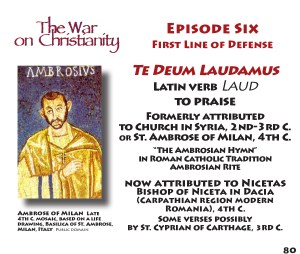 The long-delayed Episode Six in the AIC Christian Education video series The War on Christianity is now online in both video and podcast versions. Subtitled “The First Line of Defense,” the episode is focused on Part One of the Te Deum Laudamus canticle (from the opening sentence to “also the Holy Ghost, the Comforter”). The episode includes a summary of the canticle’s history and a verse-by-verse commentary on its meaning and Scriptural warrant, with illustrations from the 6th through the 21st C. This powerful and inspiring Canticle is the first suggested Canticle (or “Hymn” in the rubric in page 10) following the First Lesson in Morning Prayer.
 Episode Two in the AIC Seasonal Video series, Lent A.D. 2018, is now available on our YouTube channel. The subjects of Episode Two are other commemorations of Lent (Lenten meals, prayers and music) and the Collects, Epistle and Gospel readings, and suggested seasonal music, for First Sunday in Lent through and including the Fourth Sunday in Lent. I’ve found some additional illustrations, including a stained glass window of St. Paul in East Anglia, England (above, left), to which I applied perspective correction. I used this one because, since all four epistle readings are from the writings of St. Paul, I was running out of images not previously used (either in Episode One or in other AIC Video series). Also in the episode is a Russian Orthodox icon of St. Paul in flowing robes from the 18th C., from the iconostasis at the Church of the Transfiguration, Kizhi Monastery, Karelia, Russia. The music suggestions come from the AIC Bookstore publication, The St. Chrysostom Hymnal, which include hymns either not in the 1940 Hymnal or which are in it but set to different tunes.
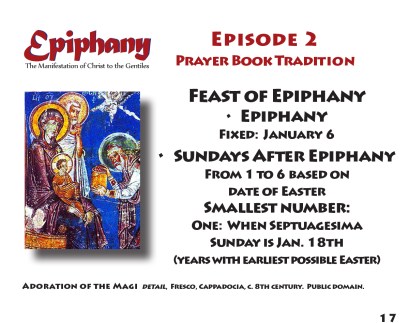 Episode Two in the revised 2018 A.D. edition of Epiphany: the Manifestation of Christ to the Gentiles is now available both on our YouTube channel and through the episode links on the Digital Library page. The focus of Episode Two has been changed since last week’s blog post. The topics are Epiphany Eve, Epiphany (Day) and the First Sunday after Epiphany, including appropriate Scripture readings from the 1928 Book of Common Prayer, the Proper for the Feast, the timeline of how and when St. Matthew’s “wise men” acquired a number and names, and seasonal music for Epiphany in The St. Chrysostom Hymnal (now available in a single volume paperback edition).
 What a busy week! Phone conversations and site visits with clients, in town and out of town, and meeting with a potential singer/chanter for The War on Christianity series Episode Six and Episode Seven. Plus putting up the family Christmas tree after Church on Sunday – and then nearly all day Monday as well. But it was truly worth it on all fronts!

 The War on Christianity series has been reorganized, with the addition of at least two and possible three new episodes that will provide a better bridge between Episode One, which examined the nature of the threat using actual examples of violence from around the world in A.D. 2016 and 2017, and the teaching episodes intended to offer self-defense through knowledge of Church doctrine and through the actual application of traditional teachings.
 Episode Thirty-one, the last episode in the Second Series, celebrates St. Catherine of Alexandria, formerly a favorite saint but in the last 300 or so years relegated to near fictional status. Among the saints of the early 2nd millennium, largely as the result of the Crusades in the Holy Land and the Western discovery of her story, she was widely popular. Her name endures today in various colleges, islands, and mountain ranges named in her honor. A strong tradition in the Eastern Church is that her remains are interred at the Monastery of St. Catherine, Sinai, built in the 6th C. under orders by, and sponsorship of, Emperor Justinian. There are many schools named after her, including St. Catherine’s here in Richmond, Va. She is the Patron Saint of Virgins and all young women. She met her death by beheading around 305 A.D. The illustration is a detail in tempera and gilt on velum of the death of St. Catherine which I extracted from a larger work from the Menologion of Basil II, a form of service book with a Synaxarion of over 400 martyrs prepared for the incumbent Archbishop of Constantinople in the late 10th C. The original is in the Vatican Library. The illustration and the larger work from which it was extracted are included in the video.
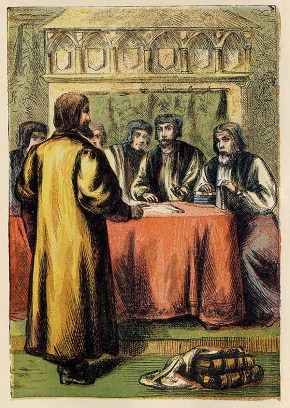 The episode features a short introduction placing the events in the historical context of the history of the Church of England from the 1620s through the accession of Elizabeth, with one picture each of Henry VIII, Edward VI, Mary I and Elizabeth I. After that is a brief biography of Hugh Latimer, Nicholas Ridley, and Thomas Cranmer. The very popular work, commonly called John Foxe’s Book of Martyrs but officially titled Acts and Monuments, is the source for many of the illustrations of the trial and executions. I’ve left the gruesome details out of this Blog entry, instead posting the attached colorized illustration by Joseph Martin Kronheim of Plate V, Latimer Before the Council, taken from an 1887 A.D. edition of Foxe’s famous work
 Anglican Internet Church