Sixth Sunday in Lent (Palm Sunday)

The Sixth Sunday in Lent, the final Sunday in the season, is commonly known as Palm Sunday but officially is labelled as “the Sunday next Before Easter” in the 1928 Book of Common Prayer. For the occasion, for the 1549 Book of Common Prayer, Archbishop Cranmer once again relied upon a prayer from the Gregorian Sacramentary. As notes in earlier posts, the Gregorian Sacramentary is one of the three primary sources in the Roman Catholic tradition.

The celebration of Palm Sunday began in the Western Church after the election of Constantine as Holy Roman Emperor, and his conversion to Christianity, in the early 4th C., the subsequent relocation of the center of gravity for the Church to Constantinople, and later still, the many good works of his mother, Helen. Her actions helped revive and expand the knowledge of Christianity’s history, but she also built many churches and basilicas in the Holy Land. It was her leadership that led to the beginning pilgrimage to the Holy Land as a Christian obligation, especially for those with the means to do so. Although known as Palm Sunday, it should be noted that New Testament Scriptural accounts of the Entry into Jerusalem refer to “tree branches” and to garments being thrown in Jesus’ path. The use of palms is of later origin and is based upon an Old Testament practice of palm usage in celebrations, especially those celebrating military victories. In regions where palm branches are not available other local flowers and branches of trees are used, such as willows, olive and yew trees. The final phrase in the Collect for Palm Sunday was written by Archbishop Cranmer.

ALMIGHTY and everlasting God, who, of thy tender love toward mankind,
hast sent thy Son, our Saviour Jesus Christ, to take upon him our flesh,
and to suffer death upon the Cross, that all mankind should follow the example of His great humility;
Mercifully grant, that we may both follow the example of His patience, and also be made partakers of His Resurrection;
through the same Jesus Christ our Lord. Amen.

The epistle reading, Philippians 2:5-11, is another of Pauline authorship and is the Scriptural source for the many Christian doctrines and of the tradition of bowing and making the sign of the Cross when approaching the altar: “Wherefore God also hath highly exalted, and given him a name which is above every name: that at the name of Jesus every knee should bow, of things in heaven and things in earth, and things under the earth; and that every tongue should confess that Jesus Christ is Lord, to the glory of God the Father (verses 9-11).

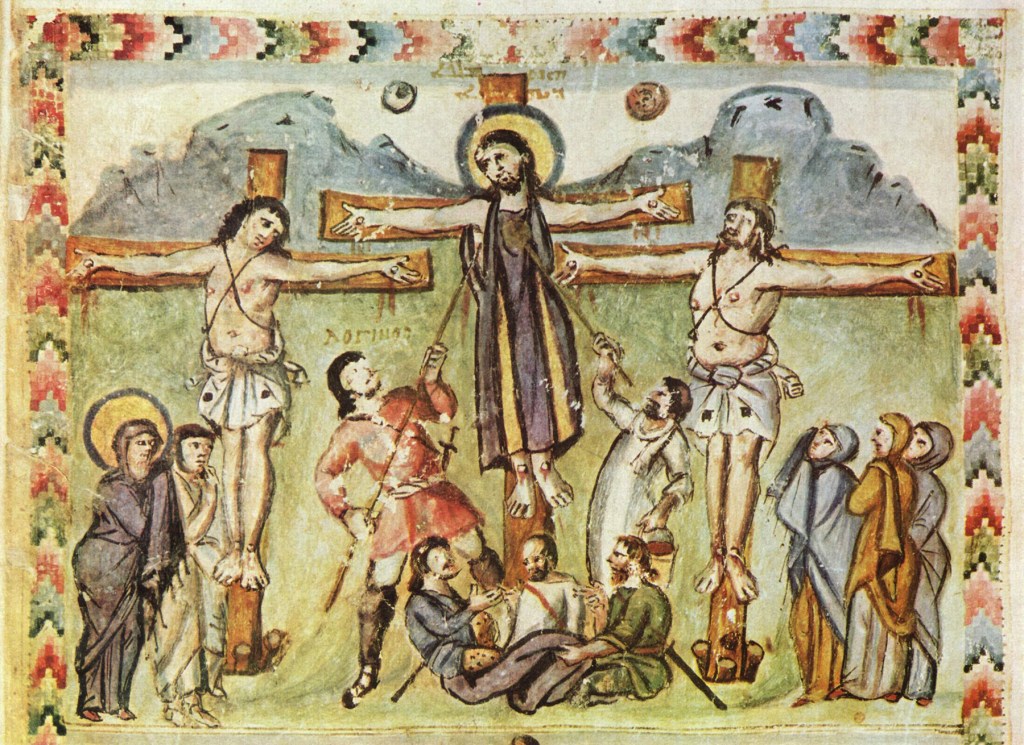
The Crucifixion of Christ, illumination in tempera and gold on parchment, Rabula Gospels, the oldest surviving image of the Crucifixion, produced in present-day Syria in 586 A.D., from the collection of the Biblioteca Medicea-Laurenziana, Florence, Italy. The image is the upper of two scenes. This version is from The Yorck Project: 10,000 Masterworks. Public Domain.

The Gospel reading, Matthew 27:1-54, is the fourth, the last, and by far the longest reading, from the Gospel of Matthew in Lent. In the Anglican tradition, unlike in most other denominations, the reading is not the Scriptural/historical account of the Entry into Jerusalem (Matthew 21:1-13, which is read on the First Sunday in Advent). It is instead the Evangelist’s long form account of the trial, sentencing, Crucifixion and death of Christ upon the Cross. As noted by Massey Sheperd in his Commentary on the Book of Common Prayer, it is the first of the New Testament accounts of the Passion of our Lord which area printed in the BCP for the days between Palm Sunday and Good Friday. The central section of the image above is Illustration No. 82 in The Gospel of John: Annotated & Illustrated, available through my Amazon Author Central page. Many other versions of the Crucifixion, including illuminations, icons, mosaics and frescoes, are included in the publications in the same series covering the Gospels of Matthew, Mark and Luke, likewise available through my Amazon Author Central page. Summary information about all four volume, including pagination, price and content is found on the AIC Bookstore page.

These readings and the Collect are discussed and illustrated in Episode Three in our Christian Education Video series, Lent: the Season of Penitence, which is linked from the Digital Library page. The episode also includes discussion of the important part St. Helen played in the discovery of plaque upon the cross (THIS IS JESUS THE KING OF THE JEWS) and remnants of the Cross in the early 4th C. and the start of pilgrimages from the Western into the Holy Land. My podcast homily for Palm Sunday is linked from the Podcast Homilies page.

As always, thank you for your interest and support. Glory be to God for all things! Amen.

Fifth Sunday in Lent (Passion Sunday)

For the Fifth Sunday in Lent, commonly known as Passion Sunday, the Collect is the fourth of five in Lent which Archbishop Cranmer adapted from the Gregorian Sacramentary, one of the three major collections of prayers in the Roman Catholic tradition. It is another in which God is given the title Almighty God. Passion Sunday marks a change in tone from the penitential focus of the season toward preparation for the Church’s celebration of the Resurrection on Easter Sunday.

WE beseech thee, Almighty God, mercifully to look upon thy people;
that by thy great goodness they may be governed and preserved evermore in body and soul;
through Jesus Christ our Lord. Amen.

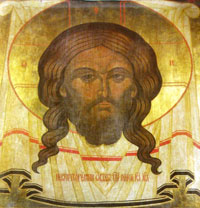
Not Made with Hands, tempera and gold on panel icon in the Russian Orthodox tradition. Public Domain.

The Epistle lesson, Hebrews 9:11-15 is the only quotation in Lent from Hebrews, traditionally credited to the Apostle Paul. In the reading, Jesus is called “High priest of good things to come,” in verse 11, an allusion to the mysterious Melchizedek (Genesis 14:18, “King of Salem” and Psalm 110:4) and “Mediator of the new covenant” in verse 15. In the Anglican worship tradition Jesus is “our only Mediator and advocate” in the prayer for the whole state of Christ’s Church in Communion liturgy in the 1928 Book of Common Prayer. The author of Hebrews adds another title for Christ in verse 11: “more perfect tabernacle not made with hands.” The illustration is a “Not Made with Hands” icon of Christ that became popular in the early Church in Syria around the 4th C. or 5th C. and continued in the Russian Orthodox worship tradition.

The Gospel lesson, John 8:46-49, is the second and last from the Gospel of John in Lent. It includes one of the best-known examples of the several “I Am” declarations which are unique to the Gospel of John: “Before Abraham was, I Am” (John 8:58), based on the Greek ego emi (Strong’s Greek words #1473 and #1510). The I AM declaration is the climax of a conflict between Jesus and a group of Temple leaders on the meaning of the word “Father.” The incident, as well as the Collect and Epistle reading is discussed in Episode Three in our video series, Lent: A Season of Penitence. All the “I AM” sayings are discussed in Episode Twenty-nine to Episode Thirty-five in our video series, The New Testament: Gospels. Episodes of both series are linked from the Digital Library page. The text box, “I Am in the Gospel of John” is printed on page 83 in The Gospel of John: Annotated & Illustrated, available through my Amazon Author Central page. A summary of the volume is included on the AIC Bookstore page. In the box is a quotation from the writings of the Venerable Bede equating the “I AM” in verse 58 with the words God spoke to Moses in Genesis 3:14.

As always, thank you for your interest and support. Glory be to God for all things! Amen!

Fourth Sunday in Lent

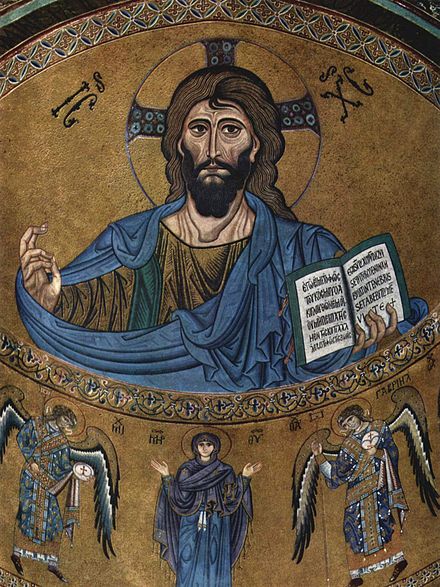
For the Fourth Sunday in Lent Archbishop Thomas Cranmer again relied upon the Gregorian Sacramentary as the source for the Collect. It is the third of five Collects in Lent to come from that source. This adaptation even more strongly than other collects in the season points toward the redemptive sacrifice of Jesus Christ for the many sins of God’s creation, mankind. In the Western Church, the word or title “Almighty,’ affirms that God is the Supreme authority over all things. In the Eastern Church tradition, especially as understood in the Russian language, His Name in this capacity is Bozhe, which literally translates as the One who can do anything He wishes. It is one of several different Russian words referring to God the Father. Strong’s Exhaustive Concordance defines the title as meaning “sufficient or all-powerful. It is used 48 times, the first in Genesis 17:1 and the last in Joel 1:15, in the King James Version of the Old Testament. The title is derived from the Hebrew Shaddah (Strong’s Hebrew word # 7706). In the New Testament, there are only nine uses, eight of which are from Revelation, based on the Greek word Pantokrator (Strong’s Greek word # 3841). In the Eastern Church tradition, the image of Christ as “Pantokrator” is commonly used in icons, mosaics and frescoes. A common colloquial translation of the title into English is “Ruler of the Universe.” An image of Christ as Pantokrator as used in the Deesis mosaic in the Hagia Sophia at Constantinople/Istanbul, appears in the blog post for First Sunday after Easter, posted on 4/6/2024.

In the English language, one of the clearest example of the meaning of Pantokrator, in the late 17th C., Bible scholar, Bishop, and spiritual advisor to Queen Elizabeth I and King James I, the Blessed Lancelot Andrewes compiled a set of prayers based on Scripture. Since there was no single English word to convey the meaning, he used this all-encompassing phrase, “Blessed, praised,. celebrated, magnified, exalted, glorified and hallowed be thy Name, O Lord; Great and marvelous are Thy works, Lord God Almighty,” which is part of the Second Antiphon in the Sixth Hour office in our publication, Hear Us, O Lord: Daily Prayers for the Laity. More of Andrewes’ writings are printed in the Introduction to Christian Spirituality: An Anglican Perspective. Both books are available through my Amazon Author Central page. A summary of each is found on the AIC Bookstore page.

GRANT, we beseech thee, Almighty God, that we, who for our evil deeds do worthily deserve to be punished,
by the comfort of thy grace may mercifully be relieved; through Jesus Christ our Lord. Amen.

The Epistle reading, Galatians 4:21-31, is part of St. Paul’s explanation of the difference between the Old Covenant and the New Covenant. This epistle was addressed in verse 2 to the several churches in the region of Galatia in Asia Minor, but St. Paul does not name any particular city. In the reading, in symbolic language St. Paul explains the important difference between the descendants of the two sons of Abraham, one born of a “bondmaid” (Hagar, or Agar in the KJV, symbolizing bondage under the law, in verses 22, 24, 25; called a “bondwoman in the NKJV text) and one born of a “freewoman” (Sarah, referred to but not named in verses 22 and 23). He uses the phrase “children of promise” (verse 28), which refers to Christians guided by the Holy Spirit under the New Covenant.

The Miracle of the Loaves and the Fishes, opaque watercolor over graphite on gray wove paper, James Tissot, 1886-1894, Brooklyn Museum, Brooklyn, NY. Public Domain.

The Gospel reading, John 6:1-14, is the first of two readings from St. John’s Gospel in Lent. The subject, with great detail including the talk of Philip and Andrew, is the miracle of the Feeding of the 5,000, which is the fourth of the seven “signs” in the Gospel of John. Discussed in detail in Episode Thirty-nine in our video series, The New Testament: The Gospel of John. The image, also commonly known as The Feeding of the 5,000, is Illustration No. 37 in The Gospel of John: Annotated & Illustrated, like the other AIC Bookstore Publications cited above, linked from my Amazon Author Central page. Full information about the book is found on the AIC Bookstore page. Tissot’s image, like his other Bible illustrations, includes great detail and a visual expression of the scale and the setting, including an extensive variety of clothing commonly worn in the 1st C.

As always, thank you for your interest and support. Glory be to God for all things! Amen!
Third Sunday in Lent

Archbishop Thomas Cranmer’s choice for the Collect for Third Sunday in Lent is the second five Collects in Lent which he sourced from the Gregorian Sacramentary, one of the three primary sacramentaries in the Roman Catholic tradition. Its most memorable phrase, “the right hand of Thy majesty,” is based on the Hebrew understanding of the “right hand” of God being the most honored position. The understanding was incorporated into Christian theology at the Council of Nicea in 325 A.D. In the Nicene Creed, written at that First Ecumenical Council and amended at the Council of Constantinople in 381 A.D. (Second Ecumenical Council, Jesus Christ sits at the right hand of the the Father. There is much more information about the Creeds of the Church in our eight-episode video series, The Nicene Creed, linked from the Digital Library page.

WE beseech thee, Almighty God, look upon the hearty desires of thy humble servants,
and stretch forth the right hand of thy Majesty, to be our defense against all our enemies;
through Jesus Christ our Lord.

The Epistle reading, Ephesians 5:1-14, continues past practice in Lent with another Pauline epistle focused on the concept of guidance for leading a Christian life, later known as the Christian Virtues. These virtues were fully developed by in the 6th through 8th C. in the Western Church. In this reading, the subject is the need for the mastery of passions, here meaning both physical and emotional. These include sexual impropriety and covetousness (verses 3 & 5); intemperate language (verse 4); and idolatry (verse 5). Other themes in the reading include “light” vs. “darkness,” with Christ as the symbol of light who countered the “darkness” of the world before His coming as Saviour. In verse 14, based on Isaiah 60:1, the Evangelist to the Gentiles calls out: “Awake, you who sleep, arise from the dead, and Christ will give you light.” The phrase was immortalized into a hymn, Sleepers Awake!, written in 1599 A.D. by German composer, Philipp Nicolai, and later a cantata of the same name by Johann Sebastian Bach. Bach’s cantata was sung for the first time at Leipzig in 1731 for the Twenty-seventh Sunday after Trinity.

Christ Healing the Mute Man, opaque watercolor over graphite on gray wove paper, James Tissot, 1886-1894, Brooklyn Museum, Brooklyn, NY. Image based upon the less-detailed account in Matthew 12:22-24. Public Domain.

The Gospel reading, Luke 11:14-28, is the first and only reading from St. Luke’s Gospel in Lent. For whatever reason, probably its complexity of its imagery, this encounter was not often illustrated in mosaics, frescoes or icons in the first millennium of Christianity. Numerous commercial examples were produced in the 20th and 21st C. As noted above, the reading is complex. I have divided it into four parts. The first (verse 14) is St. Luke’s brief record of Jesus driving out a demon, or evil spirit, from a mute man and the result: an immediate healing. The event is pictured above as interpreted by French artist James Tissot based on St. Matthew’s account (Matthew 12:22-24). In part two (verse 15) St. Luke records the criticism of Jesus by Temple authorities that He has used “demonic” powers in the manner of Beelzebub. The name roughly means “Lord of the Flies” in Hebrew. In part three (verses 17-26), Jesus offers a demonstration of His divinity: proving that He knew their thoughts (verse 17a) and offers a short sermon on spiritual warfare (verses 17b-26), referring to the possible return of demons that are driven out. Here Jesus uses the Hebrew magical number 7, referring to their return with seven other, even more powerful, spirits. In the final section, part four (verses 27-28), St. Luke offers an account of a woman from the crowd of observers, quoting her beatitude concerning the Blessed Virgin Mary: “Blessed is the womb that bore You, and the breasts which nursed You” (NKJV text). Jesus replied: “Rather, blessed are they that hear the word of God, a keep it” (NKJV text). Eastern Church scholars contend that Jesus is here stating a principle and is not commenting upon the relative worthiness of His mother. For an approximately 15 minute discussion of the important Greek words which appear in this dialogue, listen to my Podcast Homily for Third Sunday in Lent, which is linked from the Podcast Homilies page. One of these important words is “menounge” (Strong’s Greek word # 3304 in verse 28), which the King James Version translates as “rather” and the New King James Version renders as “more than that.” In The Gospel of Luke: Annotated & Illustrated I noted that Jesus made a similar declaration to the Pharisees in John 8:47. Like all our AIC Bookstore Publications, the book is available through my Amazon Author Central page. A summary of the volume is found on the AIC Bookstore page.

F.Y.I: The previously-promised soundtracks for the two new episodes in our video series, The War on Christianity, have not been recorded. Tax-filing preparation, getting my garden ready for Spring, and many other items competing for time have gotten in the way. The new target date is early April. Apologies for the delay.

As always, thank you for your interest and support. Glory be to God for all things! Amen!

First Sunday in Lent

Rather than just comment upon the Collect, Epistle & Gospel readings for First Sunday in Lent in the 1928 Book of Common Prayer, I take this opportunity to offer some insight into how and why the season of Lent came into the Christian worship cycle. Lent is one of the Church’s two seasons of penitence, the other being Advent. In the Eastern Church tradition, Lent is called “Great Lent.”

Like “Epiphany” and the “Gesima” Sundays which come immediately before the start of Lent, the name Lent is not a Scriptural term, that is, you will not find it in Strong’s Exhaustive Concordance of the Old or New Testaments. It is derived from two different sources, the Old English “Lenten” and the old High German “Lenz,” noting also that there are similar words in other European languages, including Dutch, Italian and Spanish. Lent is the preferred English title instead of the Latin “Quadragesima,” which means “Forty Days” or the Greek “Tessakoste,” or “fortieth day.” All these terms refer to a day which is forty days before Easter or to the Forty Days themselves. The number 40 appears in the Gospel reading for the First Sunday in Lent.

Numerology, or the symbolism of numbers, has always been present in Scripture, in both the Old and New Testaments. In the three Synoptic Gospel accounts Christ fasted for forty days in the Wilderness (Matthew 4:1-11; Mark 1:12-13; Luke 4:1-13). Old Testament examples of forty “days” include Moses on Mt. Sinai (Exodus 24:18); Elijah’s journey on foot to Mt. Horeb (1 Kings 19:18); days (and nights) of rain while Noah guided the Ark (Genesis 7:4); and the period of repentance specified by Jonah to the residents of Nineveh (Jonah 3:4). Expressed in “Years” is the number of years of the exile of the Hebrew people in the wilderness of Sinai (Numbers 14:33).

There is no agreement among historians or Church officials as to when Lent came into the Church’s cycle of worship; however, since the season is based upon the date of Easter, it seems logical to assume that Lent came about after the Council of Nicea, 325 A.D., when a formula for determining the date of Easter was decided upon. Some historians believe that St. Ambrose of Milan (340-397 A.D.) and those who followed his example in the late 4th C. Others give some credit to Pope Leo the Great (circa 400-440 A.D.). As noted in the post for Ash Wednesday, Pope Gregory the Great (Pope from 590 to 604 A.D.) officially designated Ash Wednesday as the start of Lent in response to Eastern Church criticism that the Western Church did not have a full 40-day season of Lent. In the Roman Catholic practice, Sundays could not be fasting days, causing the dispute with the Eastern Church. Thus the season of Lent in the Western Church as 46 calendar days and 40 fasting days.

In the 1928 Book of Common Prayer, the Collect for Ash Wednesday must also be read on all Sundays in Lent until Palm Sunday (Sixth Sunday in Lent). Both Collects are shown below. The first, the Ash Wednesday Collect, was adapted by Archbishop Cranmer from the Sarum Rite service then in use in England. The second collect, for First Sunday in Lent, is an original composition for Lent by Archbishop Cranmer for the 1549 Book of Common Prayer based upon Ephesians 4:22-24.

Almighty and everlasting God, who hatest nothing that thou has made.
and dost forgive the sins of all those who are penitent;
Create and make in us new and contrite hearts, that we,
worthily lamenting our sins and acknowledging our wretchedness,
may obtain of thee, the God of all mercy, perfect remission and forgiveness;
through Jesus Christ our Lord. Amen.

O LORD, who for our sake didst fast forty days and forty nights;
Give us grace to use such abstinence, that, our flesh being subdued to the Spirit,
we may ever obey thy godly motions in righteousness and true holiness,
to thy honor and glory, who livest and reignest with the Father and the Holy Ghost,
one God, world without end. Amen.

The Epistle reading, 2 Corinthians 6:1-10, like many of the readings during the “Gesima” Sundays, emphasizes the Christian virtues. St. Paul emphasizes the value of patience, which is also called steadfastness, in all things. Verses 6-10 includes specific areas in which patience is important. In verse 2, he uses Isaiah 49:8, to claim that “the day of salvation” is now, meaning it is ever-present in the unknown time before Christ comes again. He emphasizes the power of God over all forms of adversity which the faithful may encounter. The secular world’s hostility to Christianity is the continuing subject of our video series, The War on Christianity, with episodes linked from the Digital Library page.

The Temptations of Christ, illumination in tempera and gold on parchment, Codex Aureus of Echternach, circa 1030-1050, Hs. 156142, folio 20v, Germanisches Nationalmuseum, Nuremberg, Germany. Public Domain.

The Gospel reading, Matthew 4:1-11, is the evangelist’s account of the three temptations of Christ, in which Jesus calls the Devil by his given name, Satan. Satan uses Old Testament sources for imagery: Deuteronony 8:3 (stone into bread), Deuteronomy 6:13 (worship Satan instead of God) and Psalm 91:11, 12 (Guardian Angel). One of the most famous and revered hymns for Lent is Forty Day and Forty Nights (tune: Heinlein/Aus der Tier rufe Ich). My Podcast Homily for First Sunday in Lent is available using links on the Podcast Homilies page. The image above appears in a high-resolution version as Illustration No. 42 in The Gospel of Luke: Annotated & Illustrated, available through my Amazon Author Central page. Another illustration of the temptations, presented in a different order, in a 17th C. Russian Orthodox icon, was used in Episode Two in our video series, Lent: the Season of Penitence. Episodes are linked from the Digital Library page.

As always, thank you for your interest and support. Glory be to God for all things! Amen!
Septuagesima Sunday

As I pointed out in my Blog posting for Septuagesima Sunday in A.D. 2024, posted on Jan. 24th, Septuagesima Sunday is now largely unique to the Anglican worship traditions. It is the first of three Sundays the names of which end in “gesima.” “Gesima” is derived from a Latin word meaning “days,” which itself is derived from Quadragesima, which means Forty Days, specifically, the Forty Days before Easter. In some Anglican usage the three days are called “Pre-Lent.” In the first millennium of Christianity in the Western Church, these forty days were known as Septuagesima Season. In all AIC Publications I call them the “Gesima” season, pronouncing it the American way (Jes-i-mah) rather than the English manner (Guess-eh-muh). The Roman Catholic Church, in a move followed by many Protestant liturgical denominations, did away with the season in the reforms begun in the late 1960s. The Church of England now calls the three Sundays the Third-, Second- and Sunday next- before Lent. In the Eastern Church tradition there is no comparable season except that the Sunday before the First Sunday in Lent is celebrated as Forgiveness Sunday. The Easter Church service includes a unique chant based on Psalm 69:18 and 19: “Turn not away thy face from thy child, for I am afflicted. Hear me speedily: Draw near unto my soul and deliver me.” (1928 B.C.P. text, based on the Septuagint translation prepared by the Blessed Alcuin of York during the reign of the Holy Roman Emperor Charlemagne. For more on the relationship between Alcuin and Charlemagne, see my Blog posting for March 16, A.D. 2024). For a longer, more detailed and documented discussion of “Gesima” season, including its liturgical colors and the tradition of suspending singing the Gloria, watch Episode One in Gesima: the Pre-Lenten Season. Another resource is my Podcast homily for Septuagesima Sunday, which is also linked from the Podcast Homilies page.

The Collect for Septuagesima Sunday is an adaptation by Archbishop Cranmer from the Gregorian Sacramentary (10th C. based on collects attributed to, or which express doctrine interpreted by, Pope Gregory the Great (A.D. 590-604), especially the doctrines of the Holy Trinity and of Christ as our Saviour.

O LORD, we beseech thee favorably to hear the prayers of thy people;
that we, who are justly punished for our offenses, may be mercifully delivered by thy goodness,
for the glory of thy Name, through Jesus Christ our Saviour, who liveth
and reigneth, with thee and the Holy Ghost ever, one God, world without end. Amen.

The Epistle reading, 1 Corinthians 9:24-27, continues the teachings of St. Paul which were read in Epiphany season concerning the Christian virtues, here including diligence and temperance. As with the other Pauline epistles, the reading provided the Scriptural foundations which were later consolidated into Western Church doctrine during the 6th, 7th and 8th C. The Christian Virtues were also propounded by many theologians and writers in the Eastern Church. In the reading, St. Paul refers to the greater wisdom of the pursuit of heavenly (“imperishable”) values instead of earthly (perishable) values. The “imperishable” crown in verse 25 refers to salvation in the heavenly kingdom. Many of these ideas later formed the basis for the study discipline known as Christian Spirituality. The concept is discussed and illustrated in Christian Spirituality: An Anglican Perspective, available through my Amazon Author Central page. Full information about the volume is found on the AIC Bookstore page.

Parable of the Workers in the Vineyard, center panel of three, from an illumination in tempera and gold on parchment, Codex Aureus of Echternach, produced at Echternach, then Germany, now Luxembourg, circa 1030-1050, Hs. 156142, folio 76r, Germanische Nationmuseum, Nuremberg, Germany. This image is from the version reproduced in the York Project’s DVD, 10,000 Masterworks, Public Domain.

The Gospel reading, Matthew 20:1-16, is St. Matthew’s unique account of the Parable of the Laborers in the Vineyard, also known as the Parable of the First and the Last. Each of the men in the story agreed upon a fixed payment, a denarius, a Greek coin which is the equivalent of about $50 today. The same payment was promised by the vineyard owners no matter what time of day the person started, whether at Third Hour (or 9 A.M. in verse 3), or Sixth Hour and Ninth Hour (Noon and 3 P.M., respectively, in verse 5) or Eleventh Hour (5 P.M. in verse 6). At the end of the day, certain of those who were hired first raised the objection that those who worked only an hour got the same pay as those who started at daybreak. In verse 13, Jesus silenced the most vocal critics: “Friend, I am doing you no wrong. Did you not agree with them [the landowners] for a denarius?” (NKJV text). In the final verse is the most important lesson is taught: “the last will be first and the first last. For many are called but few chosen.” This has been interpreted as a caution against self-righteousness. In practical terms, it teaches us that we should regard those who come late to the Church as just a valuable as lifelong members. The image above appears as Illustration No. 92 in our Bookstore Publication, The Gospel of Matthew: Annotated & Illustrated, available through my Amazon Author Central page. Details of the book are available on the AIC Bookstore page. My Podcast Homily for Septuagesima Sunday is linked from the Podcast Homilies page.

As always, thank you for your interest and support. Glory be to God for all things! Amen!
Fifth Sunday after Epiphany

For the Fifth Sunday after Epiphany, Archbishop Thomas Cranmer adapted a Collect from the Gregorian Sacramentary. The Gregorian Sacramentary dates from about the 10th C. and is named in honor of Pope Gregory the Great (590-604 A.D.), one of the most influential Popes of the early Church in the Roman Catholic tradition. It is also known as the Sacramentary of Adrian I. To the many earlier petitions in the Collects for Epiphany season, Archbishop Cranmer’s Collect adds the Church Universal to the list of those for whom prayers are sought (which is the meaning of “beseech” in the opening line). The Collect also refers to certain divine attributes of God the Father incorporated into Christian doctrine, including “grace” and “power” (in other places called “might”).

O LORD, we beseech thee to keep thy Church and household continually in thy true religion;
that they who do lean only upon the hope of thy heavenly grace may evermore be defended by thy mighty power;
through Jesus Christ our Lord. Amen.

The Epistle reading, Colossians 3:12-17, is another from the epistles of St. Paul in which the Christian virtues are listed, in this reading adding compassion, kindness, humility, “long suffering,” forebearance, forgiveness and love (charity in the KJV text) and thankfulness for the Lord’s blessings upon mankind. In this reading, St. Paul uniquely refers to the spiritual and other benefits of “psalms and hymns and spiritual songs.” Another prominent leader in the early Church, Athanasius of Alexandria, echoed the sentiment slightly differently in the 4th C.: “The act of singing affects harmony in the soul.” The Christian virtues, which were summarized in more or less final form by the 7th and 8th C. in both the Eastern and Western Church traditions, are discussed in the “Virtue(s)” entry in our Bookstore publication, Layman’s Lexicon: a Handbook of Scriptural, Theological and Liturgical Terms, available through my Amazon Author Central Page.

Parable of the Evil Enemy, oil on spruce panel altarpiece, Mompelgarder Altar, circa 1540, made for a Lutheran church in Mombeliard, France by Heinrich Fullmauer, based on Luther’s translation into German of the New Testament. Gemaldagalerie 870, Kunsthistorisches Museum, Vienna, Austria. Public Domain.

The Gospel reading, Matthew 13:24-30, includes the Parable of the Wheat and the Tares, which is also known as the Parable of the Evil Enemy in the German/Lutheran tradition. The illustration was used as Illustrati0n No. 72 in our Bookstore Publication, The Gospel of Matthew: Annotated & Illustrated, also available through my Amazon Author Central page. For full information about this volume and previously mentioned Bookstore Publications, visit the AIC Bookstore page. For more on Fifth Sunday after Epiphany, watch Episode Three in our video series, Epiphany: the Manifestation of Christ to the Gentiles. The Podcast Homily for Fifth Sunday after Epiphany is linked from the Podcast Archive page. My Podcast Homily based on the Psalm reading for Fifth Sunday after Epiphany, Psalms 112 and 113 is linked from the Podcast Homilies-Morning Prayer page.

Since Fifth Sunday after Epiphany is the final Sunday in the season in 2025 A.D., there will be no post for the Sixth Sunday after Epiphany. The next Blog post will be focused on Septuagesima Sunday, the first of the three “Gesima” Sundays.

As always, thank you for your interest and support. Glory be to God for all things! Amen!

Second Sunday after Epiphany

For the Collect for Second Sunday after Epiphany Archbishop Thomas Cranmer adapted a Collect from the Gregorian tradition on the theme that all that is essential either in heaven or earth comes by the Grace of God the Father. One of those blessings is “peace,” that is, God’s peace. This form of peace is not and cannot be the result of any earthly tribunal or government agency. The Collect provides a basis for the Anglican belief that worship is corporate and not simply the individual prayers of those present.

O ALMIGHTY and everlasting God, who dost govern all things in heaven and earth;
Mercifully hear the supplications of thy people and grant us thy peace all the days of our life. Amen.

The Epistle reading, Romans 12:6-12, is the second of four readings in Epiphany from St. Paul’s epistle to the Romans. Here St. Paul offers one of the earliest lists of what came to be called the Christian Virtures, in this case, Love, Humility, Patience, Compassion and Diligence. The concepts are further developed in the reading for Third Sunday after Epiphany. A list of the Christian virtues, and their opposites, the vices, was developed within the Church and was finalized around the 7th and 8th C. in the Western Church. These are discussed on pages 234-235 in Layman’s Lexicon: A Handbook of Scriptural, Theological and Liturgical Terms, an AIC Bookstore publication. The book is available through my Amazon Author Central page. Details are available on the AIC Bookstore page.

The Baptism of Christ. illumination in colored inks and gilt on parchment, Hilda Codex, circa 1030 A.D. Made for Hilda, Abbess of Meschede, Germany. Hs. 1640, Folio 075r, Universitats-und-Landesbibliothek Darmstadt, Darmstadt, Germany. CC0 license. The figure at lower right is the “spirit of the River Jordan.”

For the Gospel reading, the Archbishop chose Mark 1:1-11, the evangelist’s account of the work of John the Baptist, who is known in the Church not only as John the Forerunner but also as the “last prophet of the Old Testament,” his baptism of Jesus Christ interpreted as another manifestation of Christ to the Gentiles; and the presence at the event of God the Father (the voice from heaven) and the Holy Spirit (as the Dove). The illumination above was used as Illustration No. 18 in The Gospel of John: Annotated & Illustrated, available through my Amazon Author Central page. The image depicts the Holy Spirit in the form of a dove, fishes and plants in the river, the lower half of Christ’s body and the unique clothing of John the Baptist. The Hitda Codex is one of the few which were produced using purple coloration. The halo around Christ’s head features the Eastern Church style with two horizontal and two vertical bars for images of Christ. My Podcast Homily for this reading from the Gospel of Mark is also available.

As always, thank you for your interest and support. Glory be to God for all things! Amen!

Epiphany and First Sunday after Epiphany

Epiphany is a difficult season to explain, especially to those not familiar with the Anglican worship tradition. The word itself is often corrupted in popular usage. It most decidedly does not mean a sudden understanding or revelation of reality! In the Church context, Epiphany refers to the many ways in which Christ is revealed, or manifested, to the secular world. The name Epiphany is not Scriptural, so you cannot find it in Strong’s Exhaustive Concordance. It comes from the Greek, Epiphaneia, which means to manifest, or more poetically, to shine forth. Another theological word, Theophany (literally, Revelation), also comes in part from this same Greek word.

In A.D. 2025, Epiphany, which always falls on January 6th, appears in the calendar on a weekday, in this case on a Monday. The length of the season of Epiphany varies, depending upon the moveable date of Easter, the calculation formula for which was established at the Council of Nicea in 325 A.D.. In years when Easter is early, there may be as few as one Sunday after Epiphany. In years when Easter is late, there may be as many as six Sundays after Epiphany. The Western Church tradition, the season of Epiphany as a separate feast from Christmastide (the twelve days from Christmas Day to Jan. 5th), dates to the 4th C. and is traditionally associated with the reign of Pope Leo the Great (440 and 461 A.D.). In the Western Church the first “manifestation” of Christ to the Gentiles is to the Maji, or Wise Men, recounted in Matthew 2:1-12. In the Eastern Church tradition, the Baptism of Christ is celebrated first. In some other Protestant jurisdictions, including the Lutheran, Transfiguration falls within Epiphany season.

The Magi Follow the Star/Bring Their Gifts to the Holy Family, Evangelistar von Speyer, commonly called Codex Bruchsal1, Folio 13r, Badische Landesbibliothek, Karlsruhe, Germany. Also known as the Speyer Pericopes, the Codex Bruchsal was made circa 1220 A.D. for the Roman Catholic bishop of Bruchsal Cathedral, Karlsruhe, Germany. CC by SA-NC-4.0.

The Collect for Epiphany Day was adapted by Archbishop Thomas Cranmer for the 1549 Book of Common Prayer from the Gregorian Sacramentary in the Roman Catholic tradition. In the Anglican prayer book tradition, when Epiphany Day does not fall on a Sunday, the Collect can be transferred to the First Sunday after Epiphany, since it falls within the Octave (8 days) of Epiphany Day. Many jurisdictions use both collects for First Sunday after Epiphany. Scholar Matthew Shepherd defines Epiphany Day as the end of Christmastide.

O GOD, by the leading of a star didst manifest thy only-begotten Son to the Gentiles;
Mercifully grant that we, who know thee now by faith,
may after this life have the fruition of thy glorious Godhead;
through the same thy Son Jesus Christ our Lord. Amen.

The Epistle reading, Ephesians 3:1-12, is a mini-homily by St. Paul on the “mystery of Christ” (verse 4, 9) that is “now revealed” (verse 5) to mankind so that “the Gentiles should be fellow-heirs, and of the same body, and partakers of his promise by the gospel” (verse 6). St. Paul also refers to the powers of heaven, including “principalities and powers,” (verse 10), which is traditionally understood as two of the nine “ranks” or “orders” of angels (See Ninth Day of Christmas in our Twelve Days of Christmas video series or listen to the companion podcast version).

The Gospel reading, Matthew 2:1-12, is St. Matthew’s account of the visit of “wise men from the east”(verse 1). “Wise men” is derived from a Greek word magi (also spelled maji). They have come to “worship” the newborn “King of the Jews” (verse 2), whose star they had seen in the East. In verses 3-6. St. Matthew records King Herod’s fear concerning the prophecy of the coming of a “Governor” (“Ruler” in the NKJV translation), based on Micah 5:2. In verses 8 & 9, St. Matthew records Herod’s order to find the child. In verse 11, he records that the Wise Men brought three gifts symbolic of Jesus’ royalty: gold, frankincense and myrrh. In the final verse (verse 12), he records a divinely inspired dream in which the Wise Men are warned not to return and their departure back to their own country.

The history of when and how the wise men acquired a number (three) and names (Melchior, Caspar or Gaspard, and Balthazar, and the story of the construction of the Cathedral of the Three Kings at Cologne, Germany, is discussed, with illustrations, in Episode Two in the AIC Christian Education Video series, Epiphany: the Manifestation of Christ to the Gentiles. It is also discussed and illustrated in Chapter Two of the AIC Bookstore Publication, The Gospel of Matthew: Annotated & Illustrated, available using the link to my Amazon Author Central page. Full information about the book is available on the Bookstore page.

The Collect for First Sunday after Epiphany is another adapted by Archbishop Cranmer from the Gelasian Sacramentary. The theme is mankind’s dependence upon God for His Grace. Owing to the frequent appearance of Epiphany Day on a weekday, First Sunday after Epiphany is likely heard/read more often that the Collect, Epistle and Gospel for Epiphany Day. As noted above, local clergy can move these readings to First Sunday after Epiphany when Epiphany Day falls on a weekday.

LORD, we beseech thee mercifully to receive the prayers of thy people who call upon thee;
and grant that they may both perceive and know what things they ought to do,
and also may have grace and power faithfully to fulfil the same; through Jesus Christ our Lord. Amen.

The Epistle reading, Romans 12:1-5, is the first of four consecutive readings from Romans 12 and 13 in Epiphany season. St. Paul’s theme is the unity of the Church as one body under Christ, an understanding made especially clearly in verses 4 and 5.

The Gospel reading, Luke 2:41-51, is St. Luke’s unique account of the only glimpse in Scripture of the childhood of Jesus Christ, commonly called Teaching the Doctors in the Temple. It is the story of how the Blessed Joseph and the Blessed Mary found 12-year old Jesus, missing from their traveling party on the way back to Nazareth, conversing with the Temple scholars in Jerusalem, described by Christ as doing “my Father’s work.” The reading is featured on the Seventh Day of Christmas (Dec. 31) on the theme of “Family” in our Christian Education video series, The Twelve Days of Christmas (or you can listen to the Podcast version).

The image of the Wise Men/Magi following the star also appears as Illustration No. 26 and a spectacular double-page spread on facing pages of Adoration of the Magi, with the Wise Men from the Pericope Book of Henry II, c. 1007-1012 (Clm 4452, Folio 17v and 18R, Bayerische Staatsbibliothek, Munich, Germany), with the Wise Men on the left and the Blessed Virgin and Holy Child on the right. The latter two are Illustrations No. 27 and 28 in The Gospel of Matthew: Annotated & Illustrated, available through my Amazon Author Central page. A Summary of the book is found on the AIC Bookstore page. Christian hymns and carols celebrating events during Epiphany season include We Three Kings of Orient Are (John Henry Hopkins) and Song of Thankfulnesss and Praise (8 verses, Christopher Wordsworth; tune: Monkland). Other traditional hymns are discussed in Episodes One, Two and Three of the Epiphany video series mentioned above.

As always, thank you for your interest and support. Glory be to God for all things! Amen!

A Correction & Plans for A.D. 2025

Sharp-eyed readers will have noticed the error in the entry for the final Sunday in Christmastide. I did not see it myself until I sat down in church on Sunday. I suspending writing on Dec. 26th. Call it a “senior moment” that when writing was resumed for the last Sunday in the season it was the Collect, Epistle and Gospel readings for First Sunday after Christmas Day that were posted instead of the later Second Sunday after Christmas Day. Apologies.

Following review of all the blog posts for 2024 A.D., for the new year 2025 A.D. I’ve decided to continue with the old style of commentary on the Collect, Epistle and Gospel (C/E/G) readings for the seasons of Epiphany, Gesima, Lent & Easter and for Whitsunday. That will take readers/site visitors to the point in which C/E/G commentaries were begun in 2024 A.D. with the start of Trinitytide.

During these cold winter days of late December and early January, I have updated the AIC image database, now totaling over 2800 entries. All the uses in this Blog have now been noted in the Excel file. Later this month I expect to start work on the two remaining videos in the War on Christianity series. These two episodes will be focused on practical solutions for Christians living in an anti-Christian world.

Thanks as always for your interest and support. Glory be to God for all things! Amen!