Twentieth Sunday after Trinity

For Twentieth Sunday after Trinity the Collect is another of Archbishop Cranmer’s adaptations from the Gelasian Sacramentary (Paris, c. 750 A.D.). In this case the original Cranmer collect has been modified twice, first for the 1662 Book of Common Prayer in which the Latin phrase “being propitiated” was replaced with “of thy bountiful goodness,” and, in 1789 A.D., in the first American Book of Common Prayer, the collect getting a new ending (“which thou commandest”). The word “cheerfully,” which replaced “with free hearts,” means willingly. For this change and more on the many changes made in the 1662 Book of Common Prayer, consult Massey Shepherd, Jr.’s landmark volume, The Oxford American Prayer Book Commentary, available online for download in pdf format. Shepherd comments upon the history and other details of each Collect, Epistle and Gospel reading.

O ALMIGHTY and most merciful God, of thy bountiful goodness keep us, we beseech thee,
from all things that may hurt us; that we, being ready both in body and soul,
may cheerfully accomplish those things which thou commandest; through Jesus Christ our Lord. Amen.

The Epistle reading, Ephesians 5:15-21, is from the next chapter in the canonical order of the Pauline epistles, once again to the congregation at Ephesus which the “Apostle to the Gentiles” established on his Second Missionary Journey. These seven verses offer St. Paul’s advice to Christians to let themselves be “filled with the Holy Spirit,” rather than being “drunk with wine” and include one his most memorable phrases describing the joy of the Christian faith: “speaking to yourselves in psalms and hymns and spiritual songs.” In the same vein, one of the greatest saints of the early Church, Athanasius of Alexandria, wrote in the 4th C. that “the art of singing effects harmony in the soul.” Many Anglican organizations include an appointed Psalm reading and Old Testament lesson placed just before the Epistle reading in Holy Communion. The participatory, that is, verse and response, reading of the Psalm should be part of every Anglican service and not just the Morning and Evening Prayer services.

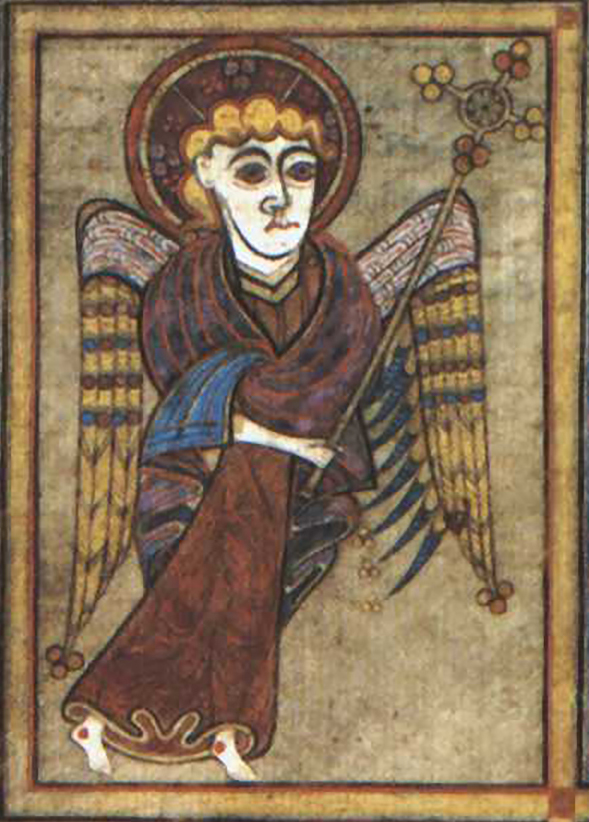
St. Matthew, illumination in colors and gold on parchment, produced in Ireland or England, circa 800 A.D., The Book of Kells, Trinity College, Dublin, Ireland. The image reflects the traditional interpretation of the vision in Ezekiel 1:4-12, with Matthew shown as Man/Angel. The volume is one of the finest examples of Christian art in the Western Church tradition.
Parable of the Great Supper, etching/engraving, Jan Luyken, Bowyer Bible, published 1840, Bolton Library, Bolton, England. This image depicting verses 11-13, with image by Phillip Medhurst and text by Harry Kossuth, is from a 2018 digital edition of their Early Scenes in the Life of Christ.

The Gospel reading, Matthew 22:1-14, records another event in the week before the arrest, trial and crucifixion of Christ, being St. Matthew’s record of the Parable of the Wedding Feast, also known as the Parable of the Great Supper. The event, also recorded in Luke 14:15-24 took place just two days before Maundy Thursday. This is the sixth of eight readings from St. Matthew’s Gospel in the Whitsunday/Trinitytide cycle. There have been many explanations of the meaning of the phrases “highways,” which are searched for those who are worthy. Jesus provided an explanation in the final verse. Perhaps lost in the modern world is the tradition that the host provided the Wedding Garment which the guest in question was not wearing. The guest was confronted by the “king,” who pronounced “Bind him hand and foot, and take him away, and cast him into outer darkness; there shall be weeping, and gnashing of teeth.” Jesus closed the address with a warning, putting these words into the mouth of the offended king: “For many are called, but few are chosen.” (verse 14). The image of St. Matthew from the Book of Kells was used in Episode Eight in the AIC Christian Education Video series, Trinitytide: the Teaching Season. Another image by Jan Luyken from the Bowyer Bible, illustrating the opening verses in the Gospel reading, appeared as Illustration No. 80 in the AIC Bookstore Publication, The Gospel of Luke: Annotated & Illustrated. The book is available in paperback at my Amazon Author Central page.

As noted many times in earlier posts, the AIC web site offers teaching materials in all three categories as part of our WATCH | LISTEN | READ initiative. Curiously, the subject of individual learning preferences, that is, whether one prefers the written or spoken word or a visual version came up during a conversation with a nurse during my doctor’s visit this month. The offering of all three media is made possible by donations and by the book royalties for AIC Bookstore Publications which are contributed to the AIC. To enhance ease of use, all three media are linked from tabs at the top and bottom of all pages on this site. Please note that, depending upon the subject matter, videos are linked from either the Digital Library page (for the seasonal and topical videos) and the Bible Study/New Testament pages (for the Gospel and Revelation series).

One final note. Be of good cheer and do not let the bias of the corporate world and the media affect your confidence in, and reliance upon, traditional Church teachings. Your best defense against their c0mbined assault on Christianity — remembering that the Church has been under attack since the 1st C.– is to attend a local church where you can, receive Holy Communion regularly, and, when neither is possible, read Morning Prayer and Evening Prayer in the 1928 Book of Common Prayer or the daily “Hours” offices (First, Third, Sixth, Ninth hours plus Vespers and Compline), available in our publication, Hear Us, O Lord: Daily Prayers for the Laity.

As always, thank you for your interest and support. Glory be to God for all things! Amen!
Nineteenth Sunday after Trinity

The Collect for Nineteenth Sunday after Trinity is another adaption by Archbishop Cranmer from the Gelasian Sacramentary for use in the 1549 Book of Common Prayer. It is also another which was amended for the 1662 Book of Common Prayer in which the reference to the Holy Spirit was added. The change made the Collect more consistent with the theme of both the Epistle and Gospel and of the season of Trinitytide. The phrase “direct and rule our hearts” was very popular among the early Saints in the Eastern Church tradition. The doctrine of the equality of the Holy Spirit with God the Father and God the Son was made part of the original Nicene Creed at the Council of Constantinople (or Second Ecumenical Council), 381 A.D. The Council was influenced by the writings of Gregory Nazianzen, who was the presiding Bishop, Gregory of Nyssa and his late brother, Basil of Caesarea. The work of that Council is discussed in detail, with illustrations, in the AIC Christian Education Video series, The Nicene Creed, presented in eight episodes (with the changes made in 381 A.D. in Episode Seven). The contributions of the two Gregories and of Basil of Caesarea are also discussed and illustrated in our video series, The Lives of the Saints, Second Series. Gregory of Nyssa (Feast Day: Jan. 10th) is celebrated in Episode Six; Gregory Nazianzen (Feast Day: Jan. 25th, with some jurisdictions including him with two others in May), in Episode Eight; and Basil of Caesarea (Feast Day: Jun. 14th) in Episode Seventeen. Basil’s most famous essay, On the Holy Spirit, is available in paperback from St. Vladimir’s Seminary Press (ISBN: 978913836-74-3), as Volume 5 in its Popular Patristics Series.

O GOD, forasmuch as without thee we are not able to please thee;
Mercifully grant that thy Holy Spirit may in all things direct and rule our hearts;
through Jesus Christ our Lord. Amen.

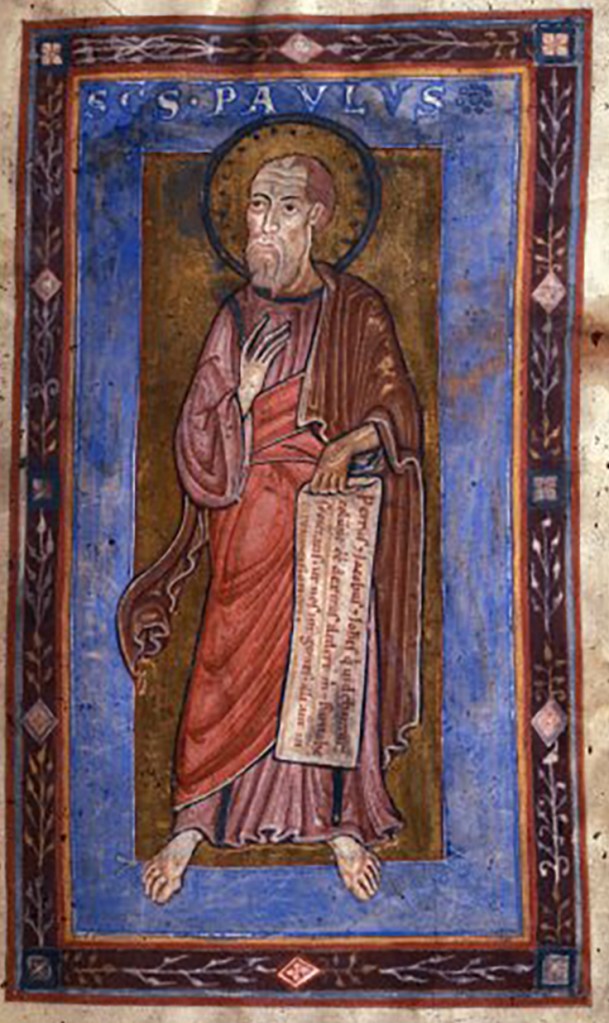
St. Paul, illumination in colors and gold on parchment, Siegberg Lectionary, produced at the Benedictine Abbey of St. Michael, Siegberg, Germany, 2nd Qtr., 12th C. Ms. Harley 2889, Folio 2, British Library, London, England. St. Paul shown holding a scroll rather than the traditional use of a symbol of the manner of death.

The Epistle reading for Nineteenth Sunday after Trinity again follows the pattern of the Gelasian Sacramentary (See the blog posts for Trinity 16 and Trinity 17). The sequence was interrupted by the reading from 1st Corinthians for Trinity 18. The Epistle reading, Ephesians 4:17-32, is another long quotation from St. Paul’s Epistle to the congregation he founded in Asia Minor on his Second Missionary Journey. Ephesus was known as the “first city of Asia” when the Third Ecumenical Council met there in 431 A.D. and granted the Blessed Virgin Mary the title, Theotokos, or Mother of God in modern English. As usual, St. Paul was not shy in expressing his views. He speaks emphatically of the “new” man, who, following Christian teachings from the Gospels, is distinct from the “old” man of the Gentile world.

St. Paul also wrote about the need to master one’s passion, by which he means not just sexual lust but passion for material things, including money. The epistle formed much of the scriptural foundation for the lists of Christian virtue. These virtues were previously confined to oral tradition. They appeared first in written form in the Eastern and Western Church traditions in the 6th, 7th and 8th C. St. Paul ends his counsel to the Ephesians with advice on the subject of forgiveness. Forgiven is also major theme of the Gospel reading. The illustration of St. Paul from the Siegberg Lectionary was also used in several AIC Christian Education Video Series, Advent: The Season of Penitence & Preparation, Episode One; The Great “O” Antiphons, Dec. 22nd, Fifth Antiphon (O Oriens); The Twelve Days of Christmas, Third Day-Peace-Dec. 27); Epiphany: the Manifestation of Christ to the Gentiles, Episode Three; and Trinitytide: the Teaching Season, Episode Seven. For more about the architectual remains left by the Christian population at Ephesus, now Selcuk, Izmir Province, Turkey, including the Tomb of St. John, watch the AIC Bible Study Video series, Revelation: An Idealist Interpretation, Episode Five.

The Gospel reading for Nineteenth Sunday after Trinity, Matthew 9:1-8, is the fifth of nine readings from St. Matthew’s Gospel in Trinitytide. A very short reading, or “pericope” (scholarly terminology meaning Scripture verses read in a liturgy), includes two of St. Matthew’s major themes: the birth and life of Jesus as fulfillment of Old Testament prophecy and events in both His Nativity and life as demonstrations of His divinity. The reading includes some unique details, including the only example of someone who is healed by Jesus being lowered into the scene through the roof, in this case of a house in the region of Capernaum, or “his own city” in verse 1, near the western shore of the Sea of Galilee. The time of the event is early in Jesus’ public ministry, likely in 27 A.D. The audience for the event includes Jesus’ Disciples (not named in the text), the paralytic man and his friends, and “Scribes,” meaning men associated with the Pharisees and with the governance of the Temple. Unlike other accounts of miraculous healings, there are no dramatic examples of the actual healing. Instead, the focus is on the meaning of the event. In this case, Jesus gives credit for the healing to the “faith” of the man’s friends, who have gone to considerable trouble and effort to lower the man into the presence of Jesus.

In St. Matthew’s account, Jesus demonstrates His divinity in knowing the thoughts of both the paralyzed man’s friends, “he saw their faith” (v. 2b) and said to the paralyzed man: “Son, be of good cheer; your sins are forgiven you.” When “some of the scribes” in their minds accuse Jesus of blasphemy, Jesus said, “Why do you think evil in your hearts? For which is easier, to say, ‘Your sins are forgiven you,’ or to say ‘Arise and walk?’ “But that you may know that the Son of Man has power on earth to forgive sins.” (verses 4b, 5 & 6a). When they did not answer, Jesus said: “Arise, take up your bed, and go to your house.” (verse 6b). St. Matthew records in one of his characteristic summaries that the man arose and departed for his home and that the multitudes “marveled and glorified God, who had given such power to men.” (verses 7 & 8). The phrase “Glorifying God” is the key phrase for Eleventh Day – January 4th in the AIC Christian Education Video series, The Twelve Days of Christmas, in which there are key words or phrases for all the days from Dec. 25th to Jan. 5th (Epiphany Eve).

Healing the Paralytic Man at Capernaum, tinted drawing on parchment, one of four Gospel scenes on a single page, Holkam Bible Picture Book, produced at or near London, 1327-1335, Ms. Additional 47682, Folio 24v, British Library, London, England. Commissioned by an unknown Dominican friar, the book was acquired by English collector Thomas Coke in 1816. Formerly known as the Holkam Ms. 66, it was purchased by the British Library, 1952. The image is based on Mark 2:1-12 and St. Luke 5:17-26. The complete book includes 231 miniatures, generally two per page illustrating scenes from Genesis through the Gospel accounts of the Ascension. The captions are in Anglo-Norman French with some English words. Description © British Library Board.

The image from the Holkam Bible Picture Book also appears as Illustration No. 25 in the AIC Bookstore Publication, The Gospel of Mark: Annotated & Illustrated. As with all our books, the volume is available using the link to my Amazon Author Central page.

In my research for this Blog post, I realized that the video and soundtrack for Episode Five and Episode Six in our series, The War on Christianity were never completed. I have started work on finishing the script and slide with the goal of completing the work during January A.D. 2025.

One final note: the blog post for Eighteenth Sunday after Trinity did not include any reference to the Archangel Michael, whose Feast Day, September 29th, coincided with Eighteenth Sunday after Trinity. Images and text regarding St. Michael are the subject of two AIC Christian Education Video series, The Lives of the Saint, Second Series, Episode Twenty-three, and the traditional understanding of the origin, number (or orders or ranks) and nature of angels in The Twelve Days of Christmas, Ninth Day (Jan. 2nd).

As always, thank you for your interest and support. Glory be to God for all things! Amen!

Eighteenth Sunday after Trinity

The Collect for the Eighteenth Sunday after Trinity is another adaptation by Archbishop Cranmer from the 1549 Book of Common Prayer, which the Archbishop adapted from the Gelasian Sacramentary. As noted in earlier posts, the Gelasian Sacramentary is named after Pope Gelasius (ruled at Rome, 492-496), but the document did not appear until the mid-8th C. at Paris, France. The Gelasian document was widely used in the English Church before the separation from Rome during the reign of Henry XVIII. In Western Europe, the Gregorian Sacramentary, which is derived from an an early 9th C. initiative by Holy Roman Emperor Charlemagne, influenced by his spiritual advisor, the Blessed Alcuin of York. A fuller version of the Gregorian Sacramentary was completed around the 10th C. I saved the Gelasian image below from the Wikipedia Commons version of The Yorck Project, commonly called 10,000 Masterworks, which was distributed on a DVD and entered into the public domain in 2002 A.D. The original document measures 10.2″ high and 13.1″ wide. In order to improve the resolution for this usage. I reduced its size and raised the resolution to 300 dpi..

The preamble to the Collect was reworded for the 1662 Book of Common Prayer. It includes the iconic phrase, “the temptations of the world, the flesh and the devil.” The same words also appear as part of the third phrase of the deliverance requests in The Litany, or General Supplication, published in 1544 A.D., the first English language liturgy of the Church 0f England.

LORD, we beseech thee, grant thy people grace to withstand the temptations of the world, the flesh and the devil;
and with pure hearts and minds to follow thee, the only God, through Jesus Christ our Lord. Amen.

The Epistle reading, 1st Corinthians 1:4-9, is one of the shortest readings in the Book of Common Prayer. On this occasion, the canonical order of the Pauline epistles is interrupted, leaping backward from Ephesians 4 on the Seventeenth Sunday after Trinity to a point earlier in the epistle than the first reading from 1st Corinthians 10:1-13 (Ninth Sunday after Trinity) and other readings on the Tenth and Eleventh Sundays after Trinity. The epistle includes closing reference to “the day of our Lord,” an allusion to Jesus coming again.

The Gospel reading, Matthew 22:34-46, includes two important dialogues, the first also recorded in Mark 12:28-37 and the second in Luke 20:41-44. The event is thought to have happened on Tuesday, 30 A.D., three days before Good Friday. The background of the two dialogues is the continuing rivalry between the Sadducees and the Pharisees. In verse 35, one of their number, a lawyer, asks Jesus, “Master, which is the great commandment?” Some context is needed to understand fully the question. Both the Sadducees and the Pharisees had their own answer to the question, with the Pharisees having calculated that there were 613 commandments in Hebrew Scripture and not just the ten in the Decalogue. In this context, the “lawyer” in verse 35 thought that any answer would offend someone. A cardinal rule for all modern-era lawyers is that a lawyer should never ask a question unless he or she already know the answer. In the reading, Jesus replied, as He often did (most famously in His dialogue with Satan in Matthew 4), with verses from Scripture. Here the verses are Deuteronomy 6:5 and Leviticus 19:18. His answer, in verses 37-40, was incorporated into the Anglican Holy Communion liturgy in the 1714 and the 1764 versions. It is commonly known as the Summary of the Law. The Summary of the Law was incorporated into the Holy Communion liturgy in the first American prayer book, published in 1789 A.D.

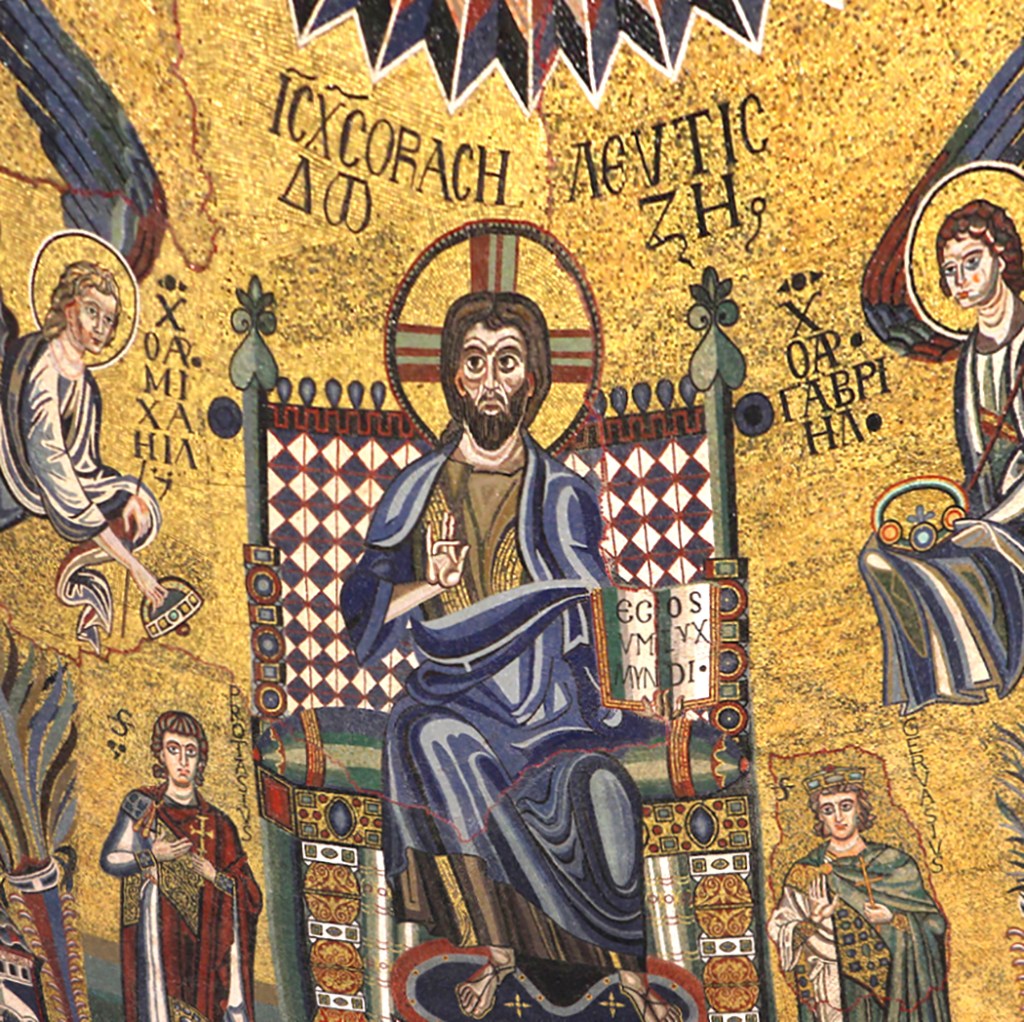
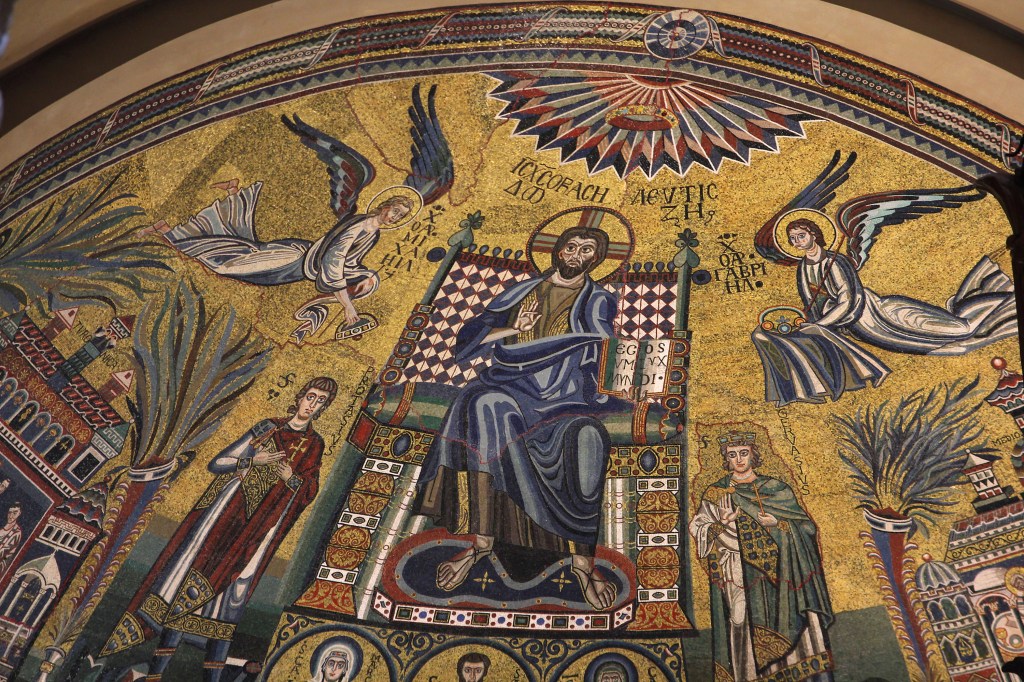
Jesus continued to befuddle His inquisitors with a second citation of Scripture regarding David. He quoted Psalm 110:1, the most-quoted verse in all the Psalms. As Matthew recorded in the closing verse, no one thereafter asked Him any more questions. In Christian art, the Gospel reading is generally depicted by a graphic displaying the words quoted by Jesus. For this blog post, I offer you a graphic which I adapted from a Christ Pantokrator mosaic (literally: Ruler of the Universe) from the Basilica of St. Ambrose, Milan, Italy. Because this Byzantine-style mosaic is very high above the floor level any photographs are distorted by sightlines diminishing toward top center. In the mosaic, Jesus is seated on a throne with the Archangels Michael (left) and Gabriel (right) and several saints. I used this image in the AIC Bookstore Publications, The Gospel of Mark: Annotated & Illustrated (Illus. # 66), Angels: In Scripture, Art & Christian Tradition (Illus. # 13) and Christmas: In Scripture, Art & Christian Tradition (Illus. No. 58). All books are available through my Amazon Author Central page. The image was also used in several AIC Video series, including The Great “O” Antiphons, Episode Two – O Adonai; The Twelve Days of Christmas, 2nd Day – Dec. 26th, 11th Day – Jan. 4th & 12th Day – Jan. 5th; In the Cross of Christ I Glory, 3rd Word, 6th Word, 7th Word; Eastertide, Episode 1; The War on Christianity, Episode 6; Trinitytide: the Teaching Season, Episode 7; and New Testament: Gospels, Episode 2.

Christ Enthroned, mosaic, 13th C. Basilica of St. Ambrose of Milan, Milan, Italy. Image copyright Can Stock Photo, Inc./Tupugato. The original basilica was built in the 6th C., with additions made in the 11th C. Perspective correction, image cropping and image rotation applied. The original image is displayed below. Traditionally, the image is also known in the Western Church as Christ in Majesty and Christ Pantokrator (literally, Ruler of the Universe) in the Eastern Church tradition.

I hope viewers find these resources inspiring and comforting, especially in the current anti-Christian age. We aim to make documents from the 2000 year history of the Church more easily accessible across the spectrum of print, audio or video media.

As always, thank you for your interest and support.

Sixth Sunday after Trinity

First, let me thank all those viewers who have taken advantage of our unique offerings of teaching materials in print, video or audio formats. Learn more about our LISTEN/WATCH/READ initiative at the bottom of the Home/Welcome page. The videos and podcasts were updated in 2022 and 2023. They are keyed to the appointed readings for all the Sundays in the 1928 Book of Common Prayer. Viewers may want to visit the Western Journal web site (https://www.westernjournal.com/bible-discovery-researchers-find-small-relic-previously-unknown-depiction-jesus/) for a story about an archeological project in Austria which includes an early image of the Ascension.

For the Sixth Sunday after Trinity the choice of appropriate historic Christian art is limited. Of the appointed readings from the Psalms (Ps. 16 and 111); Epistles (Romans 6:19-23) and Gospels (Matthew 5:20-26, the first of nine readings in the season for Trinity 6), the Psalm reading includes the important advice: “Fear of the Lord is the beginning of wisdom” does not easily admit of illustration. For more, see the “Fear” and “Wisdom” entries in Layman’s Lexicon (more on the Bookstore page). Neither the Epistle nor the Gospel readings were among the favorites of artists in the Byzantine, Carolingian, or Ottonian eras or, later, in the post-Reformation era. For tge reasons I offer my personal favorite images of St. Paul and St. Matthew.

In the AIC’s archive of images of Paul there are about three dozen images from the 11th to the early 21st C. from both the Eastern and Western Church traditions. The selected image of Paul, an oil on canvas, clearly sugguest a man of firm conviction, one with whom anyone would think carefully about offending. The artist gave him a bald head, full black beard and clad him in a red robe of a vibrant shade. The “Apostle to the Gentiles,” holds in his right hand a spear bearing a round emblem with a cross. The image was originally part of the polyptych in which he is paired with Saint Jerome.

The Apostle Paul, oil on canvas, Bartolomeo Mantagna, 1482 A.D., Museo Poldi Pezzoli, Milan, Italy. Google Art Project.

The Gospel reading, Matthew 5:20-26, is part of the second and third sections following the Beatitudes in the Sermon on the Mount. The verses bridge from the end of the section on Jesus as fulfillment of the law using the “one jot and tittle” phrase (verses 17-20) and the start of Jesus’ lecture on murder and conflict resolution (verses 21-26). Next week, Seventh Sunday after Trinity, the Gospel reading will be the first of three from the Gospel of St. Mark. A reading from the Gospel of St. Matthew will not appear again until the Fifteenth Sunday after Trinity.

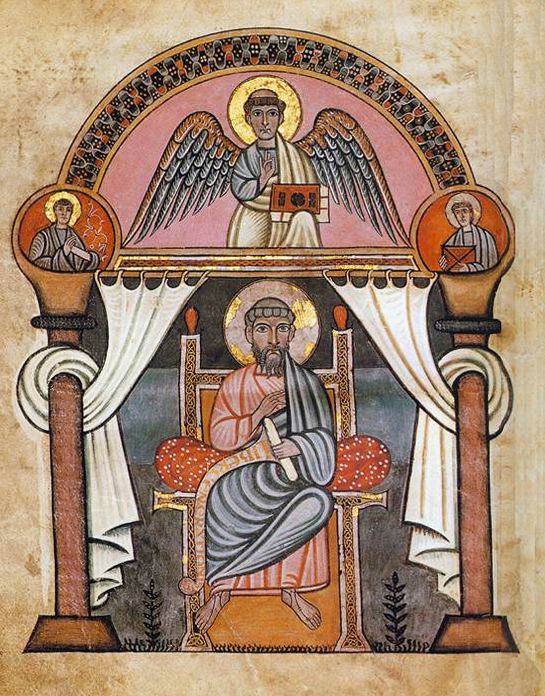
The second image is an illumination of St. Matthew seated, with his traditional symb0l, an man/angel, above, from an illuminated Gospel with a curious history. It was prepared for Christ Church Priory, Canterbury, England, around 750 A.D. The volume was carried away by Viking raiding southeast England in the 9th C. It was returned to Canterbury about a century later following the payment of a ranson to the Vikings. How it came to be owned by a noble Spanish family in the 15th and 16th C. is unknown. What is known is that the family sold it to a representative of the King of Sweden in 1690 A.D. It has been part of the Royal Library of Sweden, Stockholm, Sweden, since 1705. Of the four original images of the four Evangelists only this image of Matthew and the image of St. John have survived. In the AIC Bookstore Publication, The Gospel of Matthew: In Scripture, Art & Christian Tradition, the image appears, with a copy of the opening page of the Gospel of Matthew, as Illustration No. 12.

St. Matthew, illumination in tempera and gold on parchment, Codex Aureus of Canterbury (also called Codex Aureus of Stockholm), circa 750 A.D., Ms. A.135, Konigsliga Biblioteket, Stockholm, Sweden.

As always, thank you for your interest and support. Glory be to God for all things! Amen!