Trinity 23 and AIC Bookstore – Part Six

Ooophs. In A.D. 2025, there is no Trinity 23. On the traditional calendar it is preempted by Sunday Next Before Advent. In 2024 A.D. for reasons I do not remember, I did not provide a Blog post for Trinity 23. In 2025 A.D. it is the final Sunday after Trinity, since Advent begins on Sunday, November 30th. However, you can listen to my Podcast Homily for Trinity 23 or, for a visual version, watch Episode Eight in Trinitytide: the Teaching Season. The Gospel reading for Trinity 23 includes Jesus’ use of the phrase, “Render unto Caesar…” (Matthew 22:15-22). In the video series, the discussion includes another of James Tissot’s remarkable watercolor interpretations of the words of Christ. The Gospel reading for Trinity 23 is the ninth quotation from the Gospel of Matthew in Trinitytide.

For this week’s Blog posting, the focus is on the second of two AIC Bookstore Publications focused on the primary seasons on the Anglican Church Calendar: Easter and Christmas.

The cover image is an 11th C. mosaic, Christ Resurrected (known as the Anastasis in Greek), east wall, Narthex, Hosios Loukas Monastery, Distoma, Greece. Source: Wikipedia Commons. The theological symbolism of the image is discussed in Chapters 2 and 3.

Easter: The Resurrection of Our Lord in Scripture, Art & Christian Tradition is presented in 156 pages. There are 132 illustrations from the 6th C., 9th through 17th C. and 19th through 21st C. The book is divided into six parts, plus a Preface, List of Illustrations and a brief guide to the art of illumination of Scripture. Part One includes discussion and art related to events and prophecies during the three days between Good Friday and Easter Sunday (called the Triduum in Latin), including the “Harrowing of Hades.” This is the period of Jesus’ visit in Hades/Hell that is mentioned in the Apostles’ Creed. A special text box includes the Easter/Paschal sermon of St. John Chrysostom, which is still delivered annually on Holy Saturday in many Eastern Orthodox Churches. Chapter Four in this section is focused on Jesus’ prophetic references to Resurrection in three days.

Part Two is focused on events of the Resurrection recorded for early on Easter Day, according to the accounts in the Gospels of Matthew, Mark, Luke and John. A special text box explains the “Three Marys” tradition regarding the three women at the empty tomb in these Gospel accounts.

Part Three is focused on Post-Resurrection appearances of Jesus Christ, as recorded in the Gospels of Luke and John, including those occurring on Easter evening and the eight days afterward, including accounts of the “doubts” of St. Thomas and his confession; on meeting Apostles on the road to Emmaus and the subsequentmeal at Emmaus; and Jesus with the Apostles at the Sea of Tiberius, uniquely recorded in the Gospel of John.

Part Four is focused on Jesus’ final post-Resurrection appearances, the Great Commission and the Ascension. The text is based on the accounts in the Gospels of Matthew, Mark and Luke, plus The Acts of the Apostles. There are fourteen illustrations of the Ascension depicting the event from both the Western and Eastern Church traditions.

Part Five is focused on music for Easter in both the Western and Eastern Church traditions, including the text of Easter hymns and Psalms; a special text box listing all the seasonal music printed in another AIC Bookstore Publication, The St. Chrysostom Hymnal, which was used at my former parish and which is now available in paperback.

Part Six is focused on Easter traditions both in liturgy and foods and includes images of Easter worship in Kent, Lancashire, St. Agnes Island, and London, England; and in Bucharest, Romania; Kiev, Ukraine; Emmaus-Nicopolis, Israel; and Gomel City, Belarus. For this volume, Corkie Shibley created a recipe for “Empty Tomb Hot Cross Buns.”

Sources for this collection of Christian art include icons, mosaics, frescoes, altarpieces, bas reliefs, tapestries, oil paintings and watercolors; stained glass windows; illustrated Psalters, Pericope Books, Sacramentaries, as well as illustrated Bibles and Gospels produced for the use of both clergy and royalty. The format used in Easter: The Resurrection of Our Lord in Scripture, Art & Christian Tradition is slightly different than in the Christmas volume. For this blog post, there is no image of an inside page, because nearly all the illustrations, for best effect, are printed on full pages placed opposite the actual Scripture text.

This volume, first published in A.D. 2023 and updated at Epiphany A.D. 2024, was written and edited primarily for the education of the laity of the Church; however, clergy from both the Western and Eastern Church traditions may find the Bibliography and the Sources of Illustrations pages useful for further learning and research. I am grateful to the staff at libraries and other archives in England, Europe and the United States and to our donors, who make possible the acquisition of the high-resolution images used in this book. Several individuals who provided exceptional assistance in resolving the many technical issues (resolution, clarity, etc.) are named in the Preface.

Like all the AIC Bookstore Publications, Easter: The Resurrection of Our Lord in Scripture, Art & Christian Tradition is available only through my Amazon Author Central page. Royalties for all the AIC Bookstore Publications are contributed to the AIC. Additional information about pricing and pagination of this and the other AIC Bookstore Publications is found on the AIC Bookstore page.

As always, thank you for your interest and support. Glory be to God for all things! Amen!

Sunday after Ascension

Anglican worship for the Sunday after Ascension marks the close of the prayer cycle focused on historical events, beginning with First Sunday in Advent and including the seasons of Advent, Christmas/Nativity of Our Lod, Epiphany, and Eastertide/Ascension. Next Sunday, Whitsunday/Pentecost, marks the start of what the AIC refers to as the “Teaching Season.” During this second half of the year, the collects and readings are focused on elements of doctrine rather than events.

For Sunday after Ascension, instead of another prayer adapted from one of three primary sources in the Western Church tradition, that is, the Leonine, Gregorian or Gelasian sacramentaries, Archbishop Thomas Cranmer turned to the traditions of the English Church. His Collect for Sunday after Ascension was adapted from a song which was sung for The Venerable Bede during Bede’s final illness in 735 A.D. In the English Church, the words of the song had been incorporated into a prayer in the Vespers office, usually celebrated around 5 P.M. or local sunset. The words of the Collect, very much like the Gospel reading from John 16 for Fourth Sunday after Easter, were intended to prepare worshippers for the transition from the celebration of Christ’s Ascension, celebrated on Ascension Day, the Thursday following Fifth Sunday after Easter, into the recognition of the Descent of the Holy Spirit at Pentecost/Whitsunday. In the King James Version and the Book of Common Prayer, the Holy Ghost, or Holy Spirit, is referred to as “Comforter.” In the New King James Version He is called the “Helper.” Bede is also venerated in the Roman Catholic tradition, although he was not canonized by the Roman Church until the reign of Pope Leo XIII in 1899 A.D. The Venerable Bede was the author of the earliest history of the Church in England, Ecclesiastical History of England, covering the period up to 731 A.D., the year the book was published. An online version is available through CCEL.org.

The Ascension, the left panel of a triptych in tempera on wood, Andrea Mantegna, 1463-1464 A.D., Uffizi Gallery, Florence, Italy. Image from The Yorck Project: 10,000 Masterworks. Public Domain.

O GOD, the King of glory, who hast exalted thine only Son Jesus Christ with great triumph
into thy kingdom in heaven; We beseech thee, leave us not comfortless; but send to us thine Holy Ghost
to comfort us, and exalt us into the same place whither our Saviour Christ is gone before,
who liveth and reigneth with thee and same Holy Ghost, one God, world without end. Amen.

The Epistle reading, 1 Peter 4:7-11, begins with St. Peter’s advice concerning preparation for final judgment (verse 7), goes on to extol the Christian virtue of love (Verse 8, translated as “charity” in the King James Version and the Book of Common Prayer) and acknowledges that virtues come to mankind as a sovereign gift from God. The final verse (verse 11) includes words which have been incorporated into many Christian liturgies and prayers, here printed in the Prayer Book translation:

If any man speak, let him speak as the oracles of God;
If any man minister, let him do it as of the ability which God giveth:
that God in all things may be glorified through Jesus Christ,
to whom be praise and dominion for ever and ever. Amen.

The Gospel reading, John 15:26 to John 16:4a, the fifth of five selections from the Gospel of John in the Sundays after Easter and Sunday after Ascension, includes a warning about the earthly dangers for followers of Jesus Christ, not only for those immediately within His hearing but also for those who would follow Him in the generations to come. Perhaps that is why the reading is presented in the Book of Common Prayer out of chronological order, with reference in verse 26 to an event already celebrated on Ascension Day.

But these things I have told you, that when the time comes,
you may remember that I told you of them.

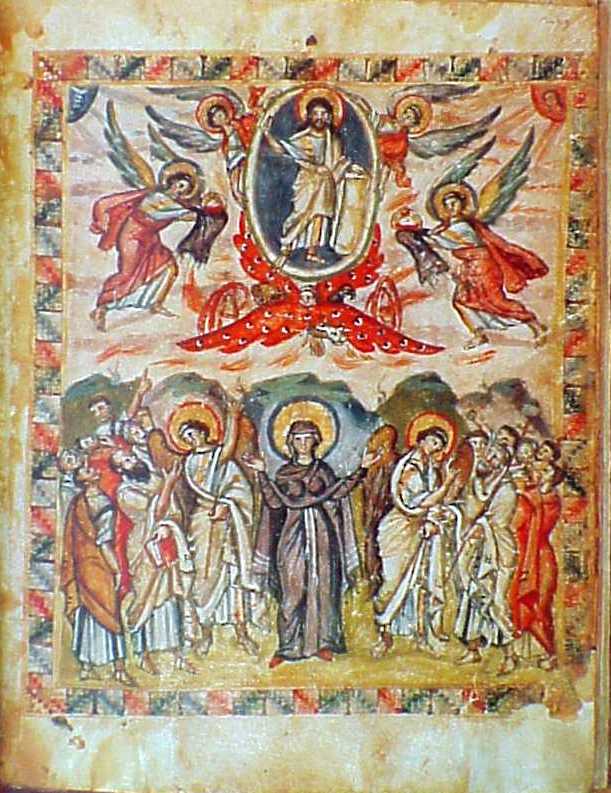
The Ascension, illumination in tempera and gold on parchment, Rabbula Gospels, produced in the region of present-day Syria, then known as Mesopotamia, at the monastery of St. John of Zagba, 586 A.D. Codex Pluteus 1, 56, Folio 13v, Biblioteca Medicea Laurenzina, Florence, Italy. The document has been in Florence since the 16th C. The volume also includes the oldest surviving image of the Crucifixion. This version is from The Yorck Project: 10,000 Masterworks, published on a DVD and released into the Public Domain in 2002 A.D.

The actual descent of the Holy Spirit is celebrated annually on the Church Calendar on Whitsunday/Pentecost. The descent is described vividly by St. Luke in Acts 2:1-11, which is the Epistle reading for Whitsunday. The illustration displayed above the Collect for the Day represents the Western style of literalist interpretation of Christ’s Ascension. The illustration above this paragraph represents a more spiritual style. Both illustrations and twelve others were used in our publication, Easter: The Resurection of Our Lord in Scripture, Art & Christian Tradition, available through my Amazon Author Central page, with details of the volume found on the AIC Bookstore page. The Collect, Epistle and Gospel readings for Sunday after Ascension are discussed and illustrated in Episode Three in the AIC Christian Education Video series, Eastertide: From Resurrection to Ascension, linked from the Digital Library page and, in MP3 audio format, from the Podcast Archive page.

Next week I plan to begin a new series of topical Blog postings. Readers are reminded that Blog entries for the other Sundays on the Church Calendar are linked from the Fr. Ron’s Blog tab for the years from 2023 through 2025. The page includes links to all posts going back to the opening of this site in August 2014. The Blog includes topical links following the actual blog entries.

As always, thank you for your interest and support. Glory be to God for all things! Amen!