First Sunday after Epiphany & AIC Bookstore, Part 10

First Sunday after Epiphany, the first of three Sundays after Epiphany in A.D. 2026, is celebrated this year on January 11th. I discuss the Collect and the Epistle and Gospel readings in Episode Two in our Seasonal Video series, Epiphany: The Manifestation of Christ to the Gentiles. The audio version of Episode Two is linked from the Podcast Archive page. There are two podcast homilies for First Sunday after Epiphany. The first Podcast Homily is based on the Holy Communion readings. The second, my Podcast Homily for Morning Prayer, is based on Psalm 72. The video version includes an image related to Psalm 72 from the Stuttgart Psalter, as it was used in the AIC Bookstore Publication, The Prayer Book Psalter: Picture Book Edition (see more below).

The Collect for First Sunday after Epiphany is a composition by Archbishop Cranmer based upon the Gregorian Sacramentary on the theme of mankind’s dependence upon God for His Grace and how it can and should be applied in the daily life of a Christian. The Epistle reading, Romans 12:1-5, is the first of a sequence of four readings from Romans during Epiphany season in the 1928 Book of Common Prayer. The subject is Paul’s observations on the Church as “one body in Christ.” As noted earlier, only three of these will be read in A.D. 2026.

Finding in the Temple, 19th C. stained glass window, Werchter, Belgium. Copyright Jorisvo | Dreamtime.com.

The Gospel lesson, Luke 2:41-51, is St. Luke’s unique account of the childhood of Christ, when at age 12 he encounters and teaches the leadership of the Temple in Jerusalem. Another stained glass window depicting this event, designed and made by Franz Mayer of Munich, is Window No. 57, St. Joseph’s Villa Chapel, Richmond, VA.

This gives me an opportunity to resume promotion of the AIC Bookstore Publications which was interrupted in mid-December of last year. One of ten books in our unique large page format, Paintings on Light: the Stained Glass Windows of St. Joseph’s Villa Chapel, is available exclusively at our Virtual Bookstore, which is accessible through my Amazon Author Central page. All book royalties are donated to the AIC. The image of Window 57, Teaching the Doctors in the Temple, was used in my Blog Post for First Sunday after Epiphany, 1/9/2015. The post is linked from the Jan. 2015 entry in the Archive column at right.
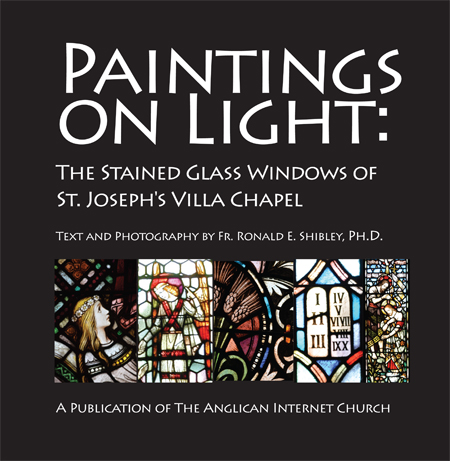
Paintings on Light: the Stained Glass Windows of St. Joseph’s Villa Chapel, printed in our square large page (8.5″ x 8.5″) format, offers high-resolution images of all 46 stained glass windows by Franz Mayer of Munich, the three Sanctuary murals and the 14 Stations of the Cross, as well as the story of the restoration of the Chapel by myself and my former parishioners at St. John Chrysostom Anglican Church (now closed), which worshipped at the Chapel. Summary: Details: 84 pages, including Bibliography, General Index and Scriptural cross-reference.

NOTE: Just for readers/viewers who like knowing small details, here are some statistics not included in the Blog post for Epiphany (Day & Season, linked from the Archive column at right): In Epiphany season, there are five readings from the Gospel of Matthew and one each from the Gospel of Mark and Gospel of John. There are five Collects derived from the Gregorian Sacramentary, one from the Gelasian Sacramentary and one original composition by Bishop John Cosin, added for the 1662 Book of Common Prayer.

As always, thank you for your interest and support, which makes possible the maintenance of our unique collection of videos, podcasts and books and making them available 24/7 on demand, and the continued search for royalty-free images of Christian art across the centuries. Over four dozen additional images were acquired in December 2025 and in this first week of A.D. 2026. Many of these images will be used in Blog posts in the first half of this year.

Glory be to God for all things! Amen!
Epiphany and First Sunday after Epiphany

Epiphany is a difficult season to explain, especially to those not familiar with the Anglican worship tradition. The word itself is often corrupted in popular usage. It most decidedly does not mean a sudden understanding or revelation of reality! In the Church context, Epiphany refers to the many ways in which Christ is revealed, or manifested, to the secular world. The name Epiphany is not Scriptural, so you cannot find it in Strong’s Exhaustive Concordance. It comes from the Greek, Epiphaneia, which means to manifest, or more poetically, to shine forth. Another theological word, Theophany (literally, Revelation), also comes in part from this same Greek word.

In A.D. 2025, Epiphany, which always falls on January 6th, appears in the calendar on a weekday, in this case on a Monday. The length of the season of Epiphany varies, depending upon the moveable date of Easter, the calculation formula for which was established at the Council of Nicea in 325 A.D.. In years when Easter is early, there may be as few as one Sunday after Epiphany. In years when Easter is late, there may be as many as six Sundays after Epiphany. The Western Church tradition, the season of Epiphany as a separate feast from Christmastide (the twelve days from Christmas Day to Jan. 5th), dates to the 4th C. and is traditionally associated with the reign of Pope Leo the Great (440 and 461 A.D.). In the Western Church the first “manifestation” of Christ to the Gentiles is to the Maji, or Wise Men, recounted in Matthew 2:1-12. In the Eastern Church tradition, the Baptism of Christ is celebrated first. In some other Protestant jurisdictions, including the Lutheran, Transfiguration falls within Epiphany season.

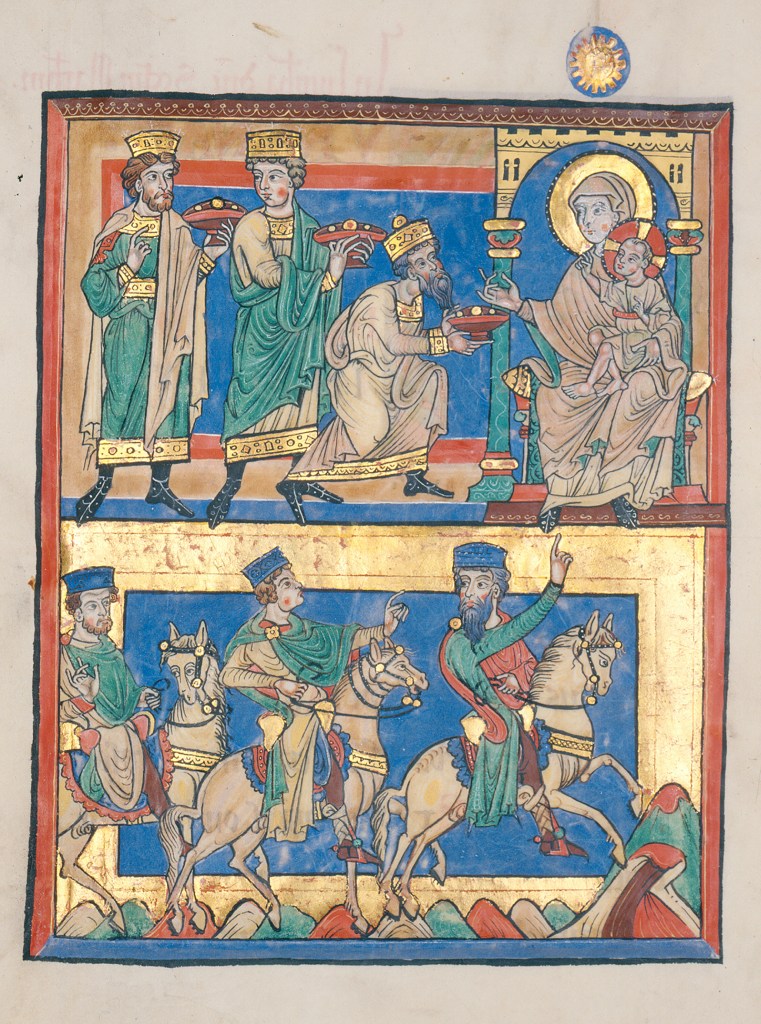
The Magi Follow the Star/Bring Their Gifts to the Holy Family, Evangelistar von Speyer, commonly called Codex Bruchsal1, Folio 13r, Badische Landesbibliothek, Karlsruhe, Germany. Also known as the Speyer Pericopes, the Codex Bruchsal was made circa 1220 A.D. for the Roman Catholic bishop of Bruchsal Cathedral, Karlsruhe, Germany. CC by SA-NC-4.0.

The Collect for Epiphany Day was adapted by Archbishop Thomas Cranmer for the 1549 Book of Common Prayer from the Gregorian Sacramentary in the Roman Catholic tradition. In the Anglican prayer book tradition, when Epiphany Day does not fall on a Sunday, the Collect can be transferred to the First Sunday after Epiphany, since it falls within the Octave (8 days) of Epiphany Day. Many jurisdictions use both collects for First Sunday after Epiphany. Scholar Matthew Shepherd defines Epiphany Day as the end of Christmastide.

O GOD, by the leading of a star didst manifest thy only-begotten Son to the Gentiles;
Mercifully grant that we, who know thee now by faith,
may after this life have the fruition of thy glorious Godhead;
through the same thy Son Jesus Christ our Lord. Amen.

The Epistle reading, Ephesians 3:1-12, is a mini-homily by St. Paul on the “mystery of Christ” (verse 4, 9) that is “now revealed” (verse 5) to mankind so that “the Gentiles should be fellow-heirs, and of the same body, and partakers of his promise by the gospel” (verse 6). St. Paul also refers to the powers of heaven, including “principalities and powers,” (verse 10), which is traditionally understood as two of the nine “ranks” or “orders” of angels (See Ninth Day of Christmas in our Twelve Days of Christmas video series or listen to the companion podcast version).

The Gospel reading, Matthew 2:1-12, is St. Matthew’s account of the visit of “wise men from the east”(verse 1). “Wise men” is derived from a Greek word magi (also spelled maji). They have come to “worship” the newborn “King of the Jews” (verse 2), whose star they had seen in the East. In verses 3-6. St. Matthew records King Herod’s fear concerning the prophecy of the coming of a “Governor” (“Ruler” in the NKJV translation), based on Micah 5:2. In verses 8 & 9, St. Matthew records Herod’s order to find the child. In verse 11, he records that the Wise Men brought three gifts symbolic of Jesus’ royalty: gold, frankincense and myrrh. In the final verse (verse 12), he records a divinely inspired dream in which the Wise Men are warned not to return and their departure back to their own country.

The history of when and how the wise men acquired a number (three) and names (Melchior, Caspar or Gaspard, and Balthazar, and the story of the construction of the Cathedral of the Three Kings at Cologne, Germany, is discussed, with illustrations, in Episode Two in the AIC Christian Education Video series, Epiphany: the Manifestation of Christ to the Gentiles. It is also discussed and illustrated in Chapter Two of the AIC Bookstore Publication, The Gospel of Matthew: Annotated & Illustrated, available using the link to my Amazon Author Central page. Full information about the book is available on the Bookstore page.

The Collect for First Sunday after Epiphany is another adapted by Archbishop Cranmer from the Gelasian Sacramentary. The theme is mankind’s dependence upon God for His Grace. Owing to the frequent appearance of Epiphany Day on a weekday, First Sunday after Epiphany is likely heard/read more often that the Collect, Epistle and Gospel for Epiphany Day. As noted above, local clergy can move these readings to First Sunday after Epiphany when Epiphany Day falls on a weekday.

LORD, we beseech thee mercifully to receive the prayers of thy people who call upon thee;
and grant that they may both perceive and know what things they ought to do,
and also may have grace and power faithfully to fulfil the same; through Jesus Christ our Lord. Amen.

The Epistle reading, Romans 12:1-5, is the first of four consecutive readings from Romans 12 and 13 in Epiphany season. St. Paul’s theme is the unity of the Church as one body under Christ, an understanding made especially clearly in verses 4 and 5.

The Gospel reading, Luke 2:41-51, is St. Luke’s unique account of the only glimpse in Scripture of the childhood of Jesus Christ, commonly called Teaching the Doctors in the Temple. It is the story of how the Blessed Joseph and the Blessed Mary found 12-year old Jesus, missing from their traveling party on the way back to Nazareth, conversing with the Temple scholars in Jerusalem, described by Christ as doing “my Father’s work.” The reading is featured on the Seventh Day of Christmas (Dec. 31) on the theme of “Family” in our Christian Education video series, The Twelve Days of Christmas (or you can listen to the Podcast version).

The image of the Wise Men/Magi following the star also appears as Illustration No. 26 and a spectacular double-page spread on facing pages of Adoration of the Magi, with the Wise Men from the Pericope Book of Henry II, c. 1007-1012 (Clm 4452, Folio 17v and 18R, Bayerische Staatsbibliothek, Munich, Germany), with the Wise Men on the left and the Blessed Virgin and Holy Child on the right. The latter two are Illustrations No. 27 and 28 in The Gospel of Matthew: Annotated & Illustrated, available through my Amazon Author Central page. A Summary of the book is found on the AIC Bookstore page. Christian hymns and carols celebrating events during Epiphany season include We Three Kings of Orient Are (John Henry Hopkins) and Song of Thankfulnesss and Praise (8 verses, Christopher Wordsworth; tune: Monkland). Other traditional hymns are discussed in Episodes One, Two and Three of the Epiphany video series mentioned above.

As always, thank you for your interest and support. Glory be to God for all things! Amen!