Fourth Sunday in Lent & AIC Bookstore 17

For Fourth Sunday in Lent in the 1549 Book of Common Prayer Archbishop Cranmer composed a Collect derived from the Gregorian Sacramentary (10th C., honoring the late 6th-early 7th C. Pope Gregory the Great) on the theme of Christ’s redemptive sacrifice (“by the comfort of thy grace” for the salvation of those who “worthily deserve to be punished.”). The Epistle reading (Galatians 4:21-31) continues St. Paul’s teaching concerning the differences between the old and new covenant using a “slave” vs. “free” allegory. The reading offers a break from the cycle of St. Paul’s teachings on the Christian virtues in the readings for the season of Lent. The Gospel reading (John 4:1-14), St. John’s account of the event traditionally known as the miraculous feeding of the 5,000, is the first of two readings from the Evangelist John during Lent.
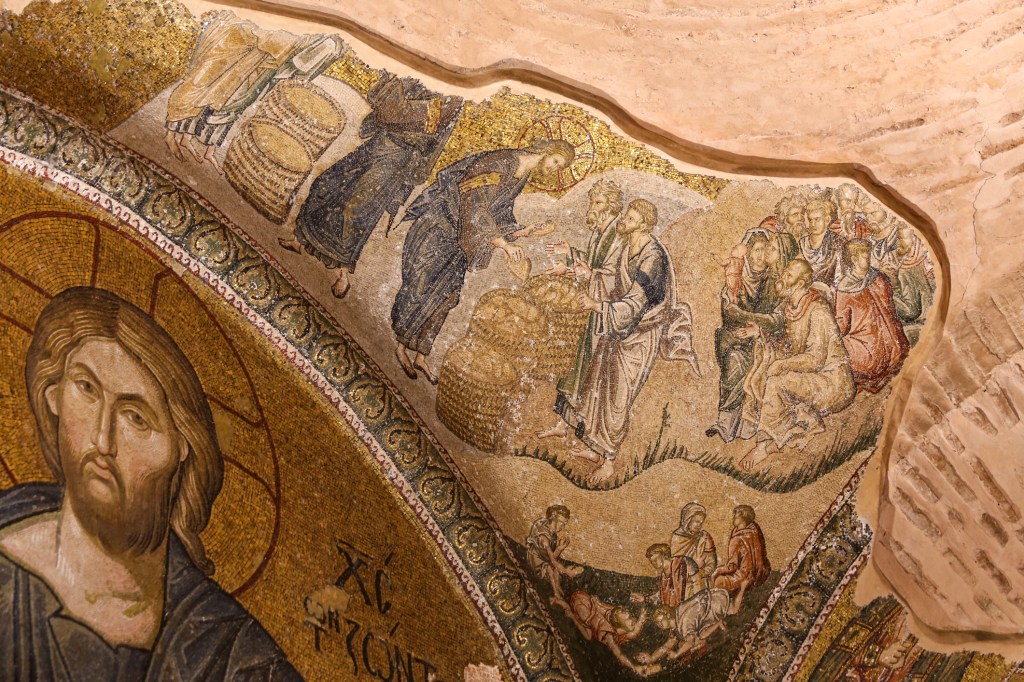
The Multiplication of the Loaves and Fishes, Byzantine mosaic, Outer Narthex, above the Christ Pantokrator image over the door between the Outer and Inner Narthex, Chora Church, Constantinople/Istanbul, Turkey, 14th C. © Evren Kalinbacak|Dreamstime.com.

The Fourth Sunday in Lent is discussed and illustrated in Episode Two in the AIC Christian Education Video series, Lent: the Season of Penitence, which is linked from the Digital Library page. The audio-only version of Episode Two is linked from the Podcast Archive page. My Podcast Homily for Fourth Sunday in Lent is linked from the Podcast Archive page. The Podcast Homily for Fourth Sunday in Lent is linked form the Podcast Homilies Page. A related Podcast Homily based on the Psalm reading for Morning Prayer on Fourth Sunday in Lent, Psalm 147, is linked from the Podcast Homilies-Morning Prayer page.
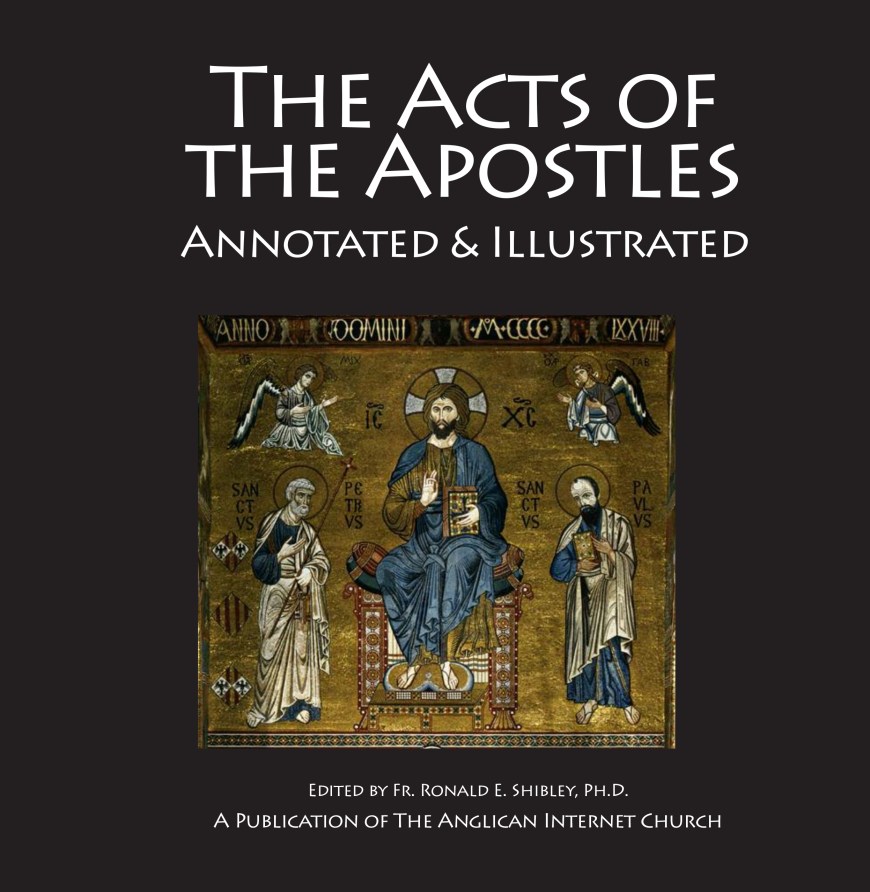
Christ Panatokrator with Saints & Angels, mosaic, 1140-1170 A.D., West Wall, Sanctuary, Capela Palatina, Palermo, Sicily. Photographed by John Schermann. Used with permission.

This week’s focus among the 22 AIC Bookstore Publications is The Acts of the Apostles: Annotated & Illustrated. This work is the first fully illustrated version of St. Luke’s unique account of the growth of the Church Universal during the decades after Christ’s Ascension. The full text of Luke 1 and 2 and Matthew 2 (using the New King James Version text) are followed by commentary and illustrations from the 9th to the 20th C., including maps of St. Paul’s missionary journeys. Three appendices: Angels in the Acts of the Apostles; The Holy Spirit in The Acts of the Apostles; and a complete Glossary of all persons, places and events mentioned in St. Luke’s text, an especially useful resource in understanding the volume of detail provided by St. Luke. 226 pages. $49.00. The book is available exclusively through our Virtual Bookstore, which is my Amazon Author Central page.

As always, thank you for your interest and support. Glory be to God for all things! Amen!

Second Sunday after Epiphany

For the Collect for Second Sunday after Epiphany Archbishop Thomas Cranmer adapted a Collect from the Gregorian tradition on the theme that all that is essential either in heaven or earth comes by the Grace of God the Father. One of those blessings is “peace,” that is, God’s peace. This form of peace is not and cannot be the result of any earthly tribunal or government agency. The Collect provides a basis for the Anglican belief that worship is corporate and not simply the individual prayers of those present.

O ALMIGHTY and everlasting God, who dost govern all things in heaven and earth;
Mercifully hear the supplications of thy people and grant us thy peace all the days of our life. Amen.

The Epistle reading, Romans 12:6-12, is the second of four readings in Epiphany from St. Paul’s epistle to the Romans. Here St. Paul offers one of the earliest lists of what came to be called the Christian Virtures, in this case, Love, Humility, Patience, Compassion and Diligence. The concepts are further developed in the reading for Third Sunday after Epiphany. A list of the Christian virtues, and their opposites, the vices, was developed within the Church and was finalized around the 7th and 8th C. in the Western Church. These are discussed on pages 234-235 in Layman’s Lexicon: A Handbook of Scriptural, Theological and Liturgical Terms, an AIC Bookstore publication. The book is available through my Amazon Author Central page. Details are available on the AIC Bookstore page.

The Baptism of Christ. illumination in colored inks and gilt on parchment, Hilda Codex, circa 1030 A.D. Made for Hilda, Abbess of Meschede, Germany. Hs. 1640, Folio 075r, Universitats-und-Landesbibliothek Darmstadt, Darmstadt, Germany. CC0 license. The figure at lower right is the “spirit of the River Jordan.”

For the Gospel reading, the Archbishop chose Mark 1:1-11, the evangelist’s account of the work of John the Baptist, who is known in the Church not only as John the Forerunner but also as the “last prophet of the Old Testament,” his baptism of Jesus Christ interpreted as another manifestation of Christ to the Gentiles; and the presence at the event of God the Father (the voice from heaven) and the Holy Spirit (as the Dove). The illumination above was used as Illustration No. 18 in The Gospel of John: Annotated & Illustrated, available through my Amazon Author Central page. The image depicts the Holy Spirit in the form of a dove, fishes and plants in the river, the lower half of Christ’s body and the unique clothing of John the Baptist. The Hitda Codex is one of the few which were produced using purple coloration. The halo around Christ’s head features the Eastern Church style with two horizontal and two vertical bars for images of Christ. My Podcast Homily for this reading from the Gospel of Mark is also available.

As always, thank you for your interest and support. Glory be to God for all things! Amen!