First Sunday in Advent & AIC Bookstore Preview – Part 7

Sunday, Nov. 30th, A.D. 2025, marks the start of the penitential season of Advent. My Podcast Homily for First Sunday in Advent is linked from the Digital Library page. The theme is “The Coming of the Light” and in it I discuss Archbishop Cranmer’s new Collect for the occasion, the Epistle reading (Romans 13:8-14) and the Gospel lesson (Matthew 21:10-13). Another Podcast Homily for First Sunday in Advent, this time based on the Morning Prayer readings for the same occasion, is also available. Should you be visual-minded you can watch Episode One (focused on First and Second Sunday in Advent) in our Seasonal Video series, Advent: a Season of Penitence & Preparation. In this video series I also explain other traditions associated with Advent, including the “Greening of the Altar,” the use of Chrismons rather than Christmas ornaments, and the practice of avoiding Christmas carols until Christmas Eve.

For this post for First Sunday in Advent, the highlighted AIC Bookstore Publication is a very special book, Angels: In Scripture, Art & Christian Tradition, which was published in A.D. 2023.
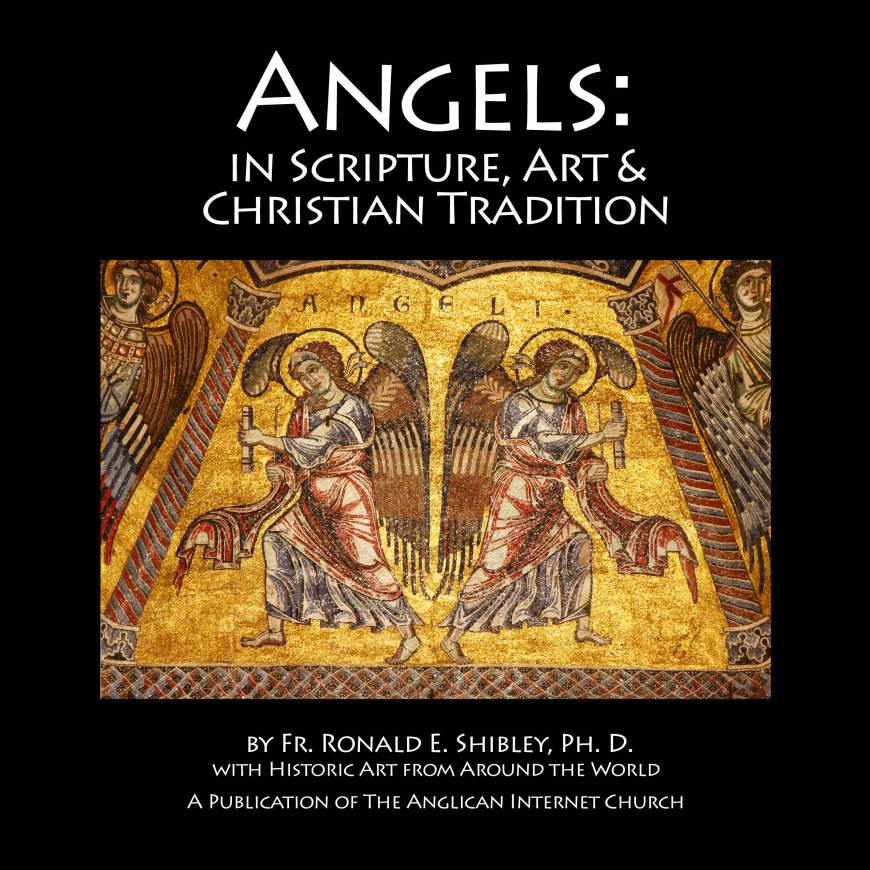
The cover art is an 11th C. Byzantine-influenced mosaic in the upper registry, Baptistery of Saint John, located opposite the Basilica of Santa Maria dei Fiori, Florence, Italy. A full view of the mosaic is printed on page 4.

In the Preface to Angels: In Scripture, Art & Christian Tradition I offered this: “The purpose of this book is to educate Christians in the rich literary, artistic and liturgical traditions concerning angels in both the Western and Eastern Church understanding.” In the book I explore every mention of angels in the Old and New Testament, plus the second canon Old Testament and a non-canonical Old Testament book in the Eastern Church tradition. There are 153 illustrations including frescoes, icons, mosaics, stained glass windows, watercolors, paintings and engravings. I pay special tribute to the Holy Roman Emperor Charlemagne and his spiritual advisor, the Blessed Alcuin of York; and to the Ottonian and other successors to the title Holy Roman Emperor in the Western Church; to St. John of Damascus, author of the Exact Exposition on the Orthodox Faith, the earliest known explanation of the origin, nature and purpose of angels; and, finally, to St. Clement of Alexandria and St. Thomas Aquinas, the former from the Eastern Church tradition and the latter from the Western Church tradition.

The book is divided into five parts: Part One is a primer on angels); Part Two is focused on every reference to angels in the Old Testament; Part Three includes discussion of each mention of angels in the New Testament; Part Four is focused on references to angels in Christian worship; and Part Five includes discussion and illustrations of angels traditions around the world, including foods and festivities.

The publication of Angels: In Scripture, Art & Christian Tradition completes the planned catalogue of AIC Bookstore Publications. Corkie Shibley suggested the concept of a book on angels. As a special bonus for readers, I have included her recipe for the remarkably light biscuits, which she calls “Angel Biscuits.” The recipe is placed at the end of Part Five.

Royalties on this and the other AIC Bookstore Publications are donated to the AIC. The book is available online through my Amazon Author Central page. Additional information about the catalogue is available on the AIC Bookstore page.

I offer a special thanks to our contributors — and also those who assisted in the production of the book, each of whom is named in the Preface. Contributions and book royalties provide the funds necessary to obtain the high-resolution images and licenses for the use of the same. Through reader support, we have been able to collect and catalogue over 3,000 such images, most of them rarely seen by the general public.

As always, I thank you for your interest and support. Glory be to God for all things! Amen!

Trinity 23 and AIC Bookstore – Part Six

Ooophs. In A.D. 2025, there is no Trinity 23. On the traditional calendar it is preempted by Sunday Next Before Advent. In 2024 A.D. for reasons I do not remember, I did not provide a Blog post for Trinity 23. In 2025 A.D. it is the final Sunday after Trinity, since Advent begins on Sunday, November 30th. However, you can listen to my Podcast Homily for Trinity 23 or, for a visual version, watch Episode Eight in Trinitytide: the Teaching Season. The Gospel reading for Trinity 23 includes Jesus’ use of the phrase, “Render unto Caesar…” (Matthew 22:15-22). In the video series, the discussion includes another of James Tissot’s remarkable watercolor interpretations of the words of Christ. The Gospel reading for Trinity 23 is the ninth quotation from the Gospel of Matthew in Trinitytide.

For this week’s Blog posting, the focus is on the second of two AIC Bookstore Publications focused on the primary seasons on the Anglican Church Calendar: Easter and Christmas.

The cover image is an 11th C. mosaic, Christ Resurrected (known as the Anastasis in Greek), east wall, Narthex, Hosios Loukas Monastery, Distoma, Greece. Source: Wikipedia Commons. The theological symbolism of the image is discussed in Chapters 2 and 3.

Easter: The Resurrection of Our Lord in Scripture, Art & Christian Tradition is presented in 156 pages. There are 132 illustrations from the 6th C., 9th through 17th C. and 19th through 21st C. The book is divided into six parts, plus a Preface, List of Illustrations and a brief guide to the art of illumination of Scripture. Part One includes discussion and art related to events and prophecies during the three days between Good Friday and Easter Sunday (called the Triduum in Latin), including the “Harrowing of Hades.” This is the period of Jesus’ visit in Hades/Hell that is mentioned in the Apostles’ Creed. A special text box includes the Easter/Paschal sermon of St. John Chrysostom, which is still delivered annually on Holy Saturday in many Eastern Orthodox Churches. Chapter Four in this section is focused on Jesus’ prophetic references to Resurrection in three days.

Part Two is focused on events of the Resurrection recorded for early on Easter Day, according to the accounts in the Gospels of Matthew, Mark, Luke and John. A special text box explains the “Three Marys” tradition regarding the three women at the empty tomb in these Gospel accounts.

Part Three is focused on Post-Resurrection appearances of Jesus Christ, as recorded in the Gospels of Luke and John, including those occurring on Easter evening and the eight days afterward, including accounts of the “doubts” of St. Thomas and his confession; on meeting Apostles on the road to Emmaus and the subsequentmeal at Emmaus; and Jesus with the Apostles at the Sea of Tiberius, uniquely recorded in the Gospel of John.

Part Four is focused on Jesus’ final post-Resurrection appearances, the Great Commission and the Ascension. The text is based on the accounts in the Gospels of Matthew, Mark and Luke, plus The Acts of the Apostles. There are fourteen illustrations of the Ascension depicting the event from both the Western and Eastern Church traditions.

Part Five is focused on music for Easter in both the Western and Eastern Church traditions, including the text of Easter hymns and Psalms; a special text box listing all the seasonal music printed in another AIC Bookstore Publication, The St. Chrysostom Hymnal, which was used at my former parish and which is now available in paperback.

Part Six is focused on Easter traditions both in liturgy and foods and includes images of Easter worship in Kent, Lancashire, St. Agnes Island, and London, England; and in Bucharest, Romania; Kiev, Ukraine; Emmaus-Nicopolis, Israel; and Gomel City, Belarus. For this volume, Corkie Shibley created a recipe for “Empty Tomb Hot Cross Buns.”

Sources for this collection of Christian art include icons, mosaics, frescoes, altarpieces, bas reliefs, tapestries, oil paintings and watercolors; stained glass windows; illustrated Psalters, Pericope Books, Sacramentaries, as well as illustrated Bibles and Gospels produced for the use of both clergy and royalty. The format used in Easter: The Resurrection of Our Lord in Scripture, Art & Christian Tradition is slightly different than in the Christmas volume. For this blog post, there is no image of an inside page, because nearly all the illustrations, for best effect, are printed on full pages placed opposite the actual Scripture text.

This volume, first published in A.D. 2023 and updated at Epiphany A.D. 2024, was written and edited primarily for the education of the laity of the Church; however, clergy from both the Western and Eastern Church traditions may find the Bibliography and the Sources of Illustrations pages useful for further learning and research. I am grateful to the staff at libraries and other archives in England, Europe and the United States and to our donors, who make possible the acquisition of the high-resolution images used in this book. Several individuals who provided exceptional assistance in resolving the many technical issues (resolution, clarity, etc.) are named in the Preface.

Like all the AIC Bookstore Publications, Easter: The Resurrection of Our Lord in Scripture, Art & Christian Tradition is available only through my Amazon Author Central page. Royalties for all the AIC Bookstore Publications are contributed to the AIC. Additional information about pricing and pagination of this and the other AIC Bookstore Publications is found on the AIC Bookstore page.

As always, thank you for your interest and support. Glory be to God for all things! Amen!
Seventeenth Sunday after Trinity A.D. 2024

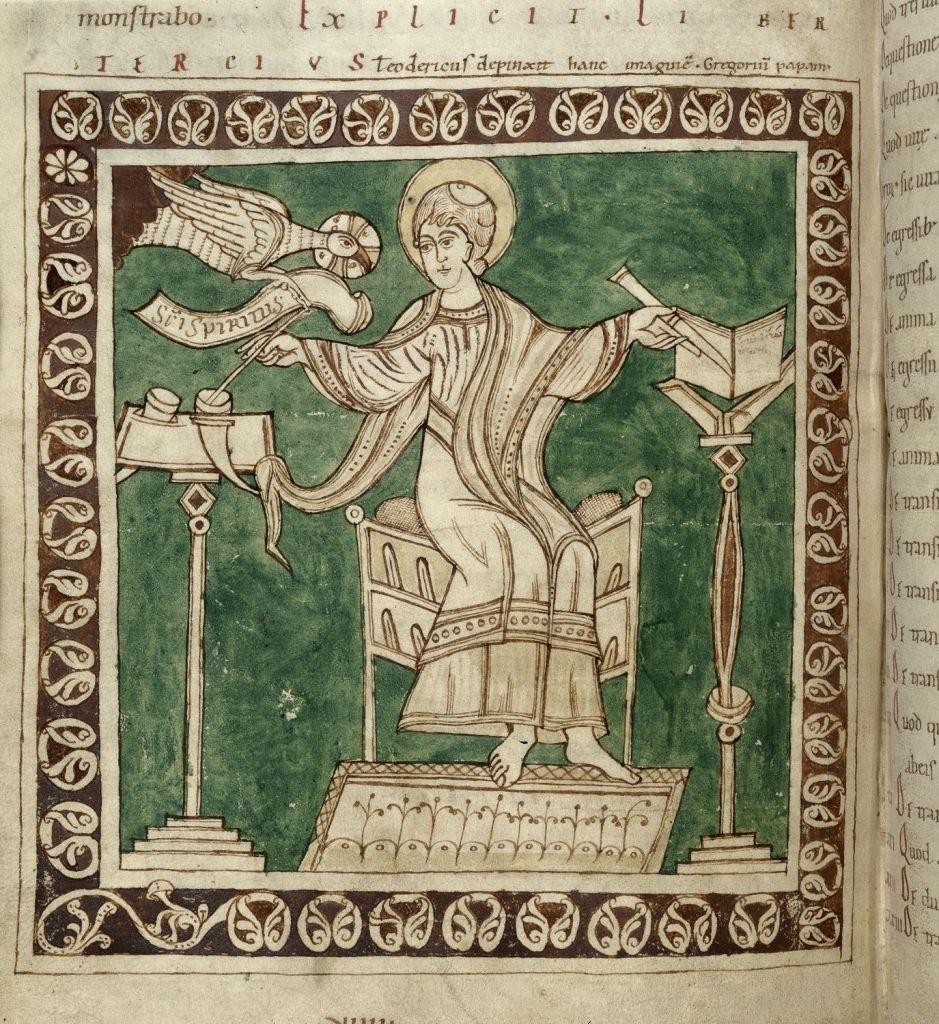
For the Seventeenth Sunday after Trinity the Collect is a composition by Archbishop Thomas Cranmer based upon the Gregorian Sacramentary, named in honor of Pope Gregory the Great, who led the Roman Catholic Church from 590 A.D. until his death in 604 A.D. Illuminations depicting Gregory, acknowledging his profound influence on the liturgy of the Church, often show him with the Holy Spirit whispering into his ear. Note that the word “prevent” has a different meaning than the modern usage. In the 16th-17th C it meant “stand before.”

LORD, we pray thee that thy grace may always prevent and follow us,
and make us continually to be given to all good works; through Jesus Christ our Lord. Amen.

In the Epistle reading, Ephesians 4:1-6, St. Paul also emphases the presence of the Holy Spirit in the faithful in his message concerning the unity of the faith. The reading includes two ic0nic phrases important to St. Paul’s theology: “one faith, one baptism, one God and Father of all” and “the unity of the Spirit in the bond of peace.” The recipient of the letter, the church at Ephesus, was another congregation visited by St. Paul on his second missionary journey (described in Acts 18). According to tradition, St. John served for a time as the functional equivalent of a bishop at Ephesus, where he had taken the Blessed Virgin after the Crucixion. The House of Mary at Ephesus, traditionally said to be the house St. John built for Mary, remains a popular tourist site and is a designated holy place for Roman Catholics. It was visited by three Popes: Paul VI (1967), John Paul II (1979) and Benedict XVI (Nov 2006 during his historic visit to Istanbul (formerly Constantinople) which included celebration of Holy Communion with the Eastern Orthodox Ecumenical Patriarch, Bartholomew II.

The Gospel reading, Luke 14:1-11, is the twelfth and last reading from St. Luke during Trinitytide: the Teaching Season (in which calculation I include the Sunday next before Advent). All the remaining Gospel readings are from the Gospel of Matthew and the Gospel of John. The reading includes two separate but related scenes. The first scene simply sets the stage for the second and illustrates the strained relationship between Jesus and the Pharisees. Both scenes, the Healing of the Man with Dropsy and the Parable of the Chief Seats, are unique to the Gospel of Luke. Dropsy, technically known as edema, is a disease which results in extreme fluid retention, usually in the legs and feet. In the mosaic below, the swelling is shown in young man’s lower torso. The mosaic is in the upper walls of the Apse, Monreale Cathedral (Cattedrale di Santa Maria Nuovo de Monreale in Italian). The cathedral was dedicated to the Nativity of the Blessed Virgin Mary in 1182 A.D., eight years after the structure was begun in the reign of the Norman King of Sicily, William II. The full legend above the image is in Latin (only the final three words are visible in the image): “Jesus in domo cujusdam principis fariseorum sanat hydropicum die sabbati” (literally: “Jesus heals the man with dropsy in the house of the leader of the Pharisees on the Sabbath day”). The mosiac, presented in red, white, silver, blue is set into a gold background, with Jesus’ followers at left with two Pharisees and members of the household at right. Look closely at the fine detail in the background buildings and, especially, at the suggestion of flow of the robes of the figures in the foreground. The silver-haired figure, whose face is only partially visible at the left of the image, is consistent with traditional imagery of St. Peter. The halo around Jesus’ head includes the traditional Eastern Church symbology of Christ, always shown with two vertical and two horizontal lines. The “X” above Jesus’ head is a traditional symbol identifying Christ. Every part of the mosaic is made from varying sizes of glass tile. For more details about this ancient method, typical of Byzantine Christian art, see the Fr. Ron’s Blog post, Deesis Mosaic-Hagia Sophia & Other Images, dated April 6, A.D. 2024 (linked from the Archive column at right). In that post I include enlarged sections which reveal more about the “how” of creating mosaics. My Podcast Homily for Seventeenth Sunday after Trinity is linked from the Podcast Homilies page. The readings are discussed in the AIC Christian Education Video series, Trinitytide: the Teaching Season in Episode Seven.

Christ Healing a Man with Dropsy, Byzantine-style mosaic, north wall, apse, Monreale Cathedral, Palermo, Sicily, late 12th-early 13th C. Photo, June 2010, by Sibeaster. Public Domain.

Finally, I offer you one piece of advice for survival in our anti-Christian world of the 21st C. Instead of allowing such thoughts to negatively influence your daily life follow this mantra “Turn it off and tune it out.” The mantra is easy to apply not only to media but also to enterprises which, directly or indirectly, are hostile to the Christian faith. To fill the void, use web resources to create your own list of trusted resources in video, print and electronic and bookmark them for ease of daily use.

As always, thank you for your interest and support. Glory be to God for all things! Amen.

O Sapientia (Wisdom) – Dec. 18th

O Antiphons-Slide5Today, December 18th, is the first of the final seven days of Advent.  The AIC Seasonal Video series, The Great “O” Antiphons, offers Scripture, commentary, the reading/responses of antiphons and music for the occasion.  The series is based on a 12th C. office in the Roman Catholic tradition.  Here you will find information and links each day until the final episode on Dec. 24th.  The text for the entire series is printed on pages 21-27 in the AIC Bookstore Publication, Occasional Services for Anglican Worship, available using the Virtual Bookstore link at the bottom of the Home page.  The entire series is linked from the Digital Library page with Podcast versions from the Podcast Archive page.

The theme music for the day is On Jordan’s Bank the Baptists’ Cry, performed on his church organ by Jared Haselbarth, from his DVD (available at http://www.NABA.com).   The key phrase is O Sapientia, meaning Wisdom.  In Christian theology, Jesus Christ is the embodiment of the wisdom of the Father.

Watch “O Sapientia – Wisdom for Dec. 18th.

Listen to the Podcast version of O Sapientia.