Epiphany Eve (First Sunday after Christmas)

Welcome to this first issue of Fr. Ron’s Blog in A.D. 2025. This Sunday, January 5th, has multiple distinctions. It is a) the eve of Epiphany, b) the First Sunday after Christmas and c) the Twelfth Day of Christmas. All twelve episodes of our video series, The Twelve Days of Christmas, are linked from the Welcome page and the Digital Library page. Podcast versions are linked from the Podcast Archive page.

In this week’s Blog post I discuss the Collect, Epistle and Gospel readings for this final Sunday in Christmastide, reserving discussion of Epiphany season, which begins on Monday, Jan. 6th, for next week’s post. My podcast homily for First Sunday after Christmas is linked from the Podcast Homilies page.

The Collect for First Sunday after Christmas Day in the 1928 Book of Common Prayer is not one which Archbishop Cranmer adapted from a Roman Catholic sacramentary. An original composition by Archbishop Thomas Cranmer for the 1549 Book of Common Prayer, it is the same Collect printed as the first of two Collects for Christmas Day. Scholars theorize that this unusual duplicate usage was intended to increase the likelihood that it would be read at least once during the busy Christmas season. The Collect expresses many concepts which are central to Anglican theology. My choice of illustrations from Christian art is one of my personal favorites. I use it on my new Mac Book Pro in the “Start” page.

The Nativity of Our Lord, mosaic, south wall, Nave, Capella Palatina, Palermo, Sicily. The cathedral was begun under the patronage of Roger II, the first Norman King of Sicily, in 1132 A.D. and was dedicated on Palm Sunday, 1140 A.D. The mosaics were added between 1140 and 1170 A.D. The legends jn the mosaic are written in Koine Greek, commonly known as New Testament Greek. The York Project: 10,000 Masterworks. Public Domain. Image lightened in Photoshop.

ALMIGHTY GOD, who hast given us thy only-begotten Son to take our nature upon him,
and as at this time to be born of a pure virgin; Grant that we being regenerate,
and made thy children by adoption and grace, may daily be renewed by thy Holy Spirit;
through the same our Lord Jesus Christ, who liveth and reigneth with thee and the same Spirit ever,
one God, world without end. Amen.

This image of the Nativity mosaic was used as Illustration No. 8 focused on “Angels in the Nativity Accounts,” in the AIC Bookstore Publication, Christmastide: The Nativity of Our Lord, available using the links to my Amazon Author Central page. It also appears in the AIC Video series, The Twelve Days of Christmas, in the episode for First Day of Christmas – Dec. 25th (linked from the Welcome and Digital Library pages).

The Epistle reading, Galatians 4:1-7, is an essay by St. Paul’s on the theological concept of sonship and adoption by grace to which Archbishop Cranmer referred in the Collect for the occasion. After alluding to the context of these events being part of God the Father’s plan (“In the fulness of time”), St. Paul wrote in verses 4b and 5: “God sent forth His Son, born of a woman, born under the law, to redeem those who were under the law, that we might receive adoption as sons.”

The Gospel lesson, Matthew 1:18-25, is St. Matthew’s account of the Nativity of Christ, one of the sources for the mosaic shown above. The account follows St. Matthew’s genealogy flowing through the mostly male line of Jewish kings and includes his account of the angelic dream in which St. Joseph was reassured concerning the Blessed Virgin Mary and emphasizes St. Matthew’s theme of the life of Christ as fulfillment of Old Testament prophecy. I discuss and illustrate all three dream sequences of Matthew in Part Three, Christmas: The Nativity of Our Lord, available using the link to my Amazon Author Central page.

As always, thank you for your interest and support. Glory be to God for all things.

Twenty-fifth Sunday after Trinity

The extended celebration of Trinitytide: The Teaching Season nears its end with Twenty-fifth Sunday after Trinity. The fact that there are 25 Sundays after Trinity in A.D. 2024 owes to the variability of the calendar, which is determined by the date of Easter. Here’s a brief primer on how this works. Advent season, which marks the start of a new Church Year, always begins with First Sunday in Advent, which is always on the Sunday closest to Nov. 30, the Feast Day of St. Andrew. This means there will always be four Sundays in Advent coming before Christmas Day on December 25th. The other “signpost” which affects the Calendar is the moveable date of Easter. In the Western Church, Easter always falls on the first Sunday after the first full moon following the Spring Equinox (March 21st). A different system, created at the Council of Nicea in 325 A.D., is used in the Eastern Church, in which the date of Easter cannot be set until the senior Rabbi at Jerusalem establishes the date of Passover. The setting of the date of Easter determines the placement of Septuagesima Sunday, which is always the ninth Sunday before Easter. The earliest possible date for Septuagesima Sunday is January 18th. The establishment of Septuagesima Sunday then determines the number of Sundays after Epiphany, which can be as few as one or as many as six. In the small type footnote on page 224 of the 1928 B.C.P., readers can find the complicated formula for adding Sundays to Trinitytide in years in those years in which Easter comes early. All that said, these rules are the reason that there are Twenty-five Sundays after Trinity in A.D. 2024. There. Doesn’t that make you feel better!

The Collect for Twenty-fifth Sunday after Trinity is the same collect used for Fifth Sunday after Epiphany (again, see p. 244 of the B.C.P.). It is another adaptation by Archbishop Cranmer from the Gregorian Sacramentary, produced much later than his lifetime but named in honor of Pope Gregory the Great. In Archbishop Cranmer’s decidedly poetic text, retains the prayers for both the Church (institutionally) and the members of the Church (broadly) were added and also the Gregorian theme of the Almighty Lord who governs and defends the Church.

O LORD, we beseech thee to keep thy Church and household continually in thy true religion;
that they who do lean up0n the hope of thy heavenly grace
may evermore be defended by thy mighty power; through Jesus Christ our Lord. Amen.

Opening page, Byzantine illumination in tempera and gold on parchment, Epistle to the C0lossians, Greek script, with St. Paul and St. Timothy set into text of Colossians 1:1-5, early 12th C., Acts and Epistles of the Apostles, Ms. W.533, Folio 247v, Walters Art Museum, Baltimore, MD. CC by NC-SA 3.0.

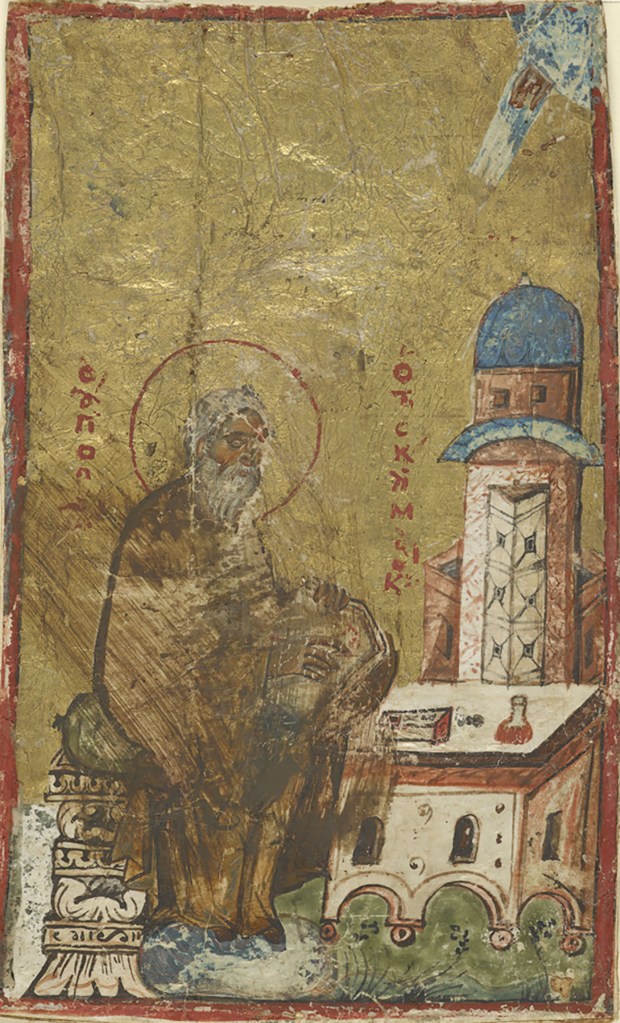
The Epistle reading, Colossians 3:12-17, includes St. Paul’s list of the Christian virtues, including, mercy, kindness, humility, meekness, long-suffering, forgiveness, and love. St. Paul was the first to list them and his understanding was expanded and interpreted by many of the monastic athers of the early Church. The first inclusive list appeared in The Ladder of Divine Ascent, written in the 6th C. by John Climacus, abbott of the new monastery of St. Catherine in Sinai under the patronage of the Byzantine emperor Justinian. In the 7th C., under Gregory the Great the list was expanded to include “contrary virtues,” a list of sins which are the opposite of the virtues. I discuss the concept of the Christian virtues in the VIRTUE(S) and SIN entries in the AIC Bookstore Publication, Layman’s Lexicon: A Handbook of Scriptural, Theological & Liturgical Terms, available through my Amazon Author Central page. Royalties from this and the other AIC Bookstore Publications are contributed as received to the AIC.

John Climacus, illumination in tempera and gold on parchment, 12th C. Note tha hand of God in the upper right corner, implying the Almighty as the source of St. John’s inspired writings. Freer Gallery, Washington, D.C. Public domain.

The Gospel reading, Matthew 13:24-30, is the the Parable of the Wheat and the Tares. The parable was spoken in the “Kingdom Parables” in Chapter 13. I illustrated the parable with a circa 1540 illumination produced for a Lutheran church in France in The Gospel of Matthew: Annotated & Illustrated, available as noted above through my Amazon Author Central page.

As always, thank you for your interest and support. Glory be to God for all things!