Fourth Sunday after Epiphany

For Fourth Sunday after Trinity Archbishop Cranmer created a Collect which he derived from the Gregorian Sacrementory. The theme is again the need for mankind to recognize the all-knowing God as the only way to overcome man’s sinful nature and the threats of the secular world upon the Christian faithful. It is useful to remember that the Greek word Theos (Strong’s Greek word # 2316), from which the Western world derived the term theology, literally means “the one who sees.”


O GOD, who knowest us to be set in the midst of so many and great dangers,
that by reason of the frailty of our nature we cannot always stand upright;
Grant to us such strength and protection, as may support us in all dangers,
and carry us through all temptations; through Jesus Christ our Lord. Amen.

The Apostle Paul, oil on wood panel, circa 1520 A.D., attributed to Lucas van Leyden, Yale University Art Galley, New Haven, CT. Public domain.

The Epistle reading, Romans 13:1-7, is the last of four readings from Romans 12 and 13 in Epiphany season. St. Paul makes absolutely clear in the first verse that “there is no authority except from God.” In England in the early 18th C., the first verse in Basil Woodd’s hymn, Hail, Thou Source of Every Blessing [Hymn No. 49, St. Chrysostom Hymnal] the lyric declares: “Hail, Thou source of every blessing Sovereign Father of mankind; Gentiles now, Thy grave possessing, in Thy courts admission find. Grateful now we fall before Thee, in Thy Church obtain a place, Now by faith behold Thy glory, Praise Thy truth, adore Thy grace.” The St. Chrystom Hymnal is available through my Amazon Author Central page.

The Gospel reading, Matthew 8:1-13 is an account of two healings, the healing of the leper and of the Centurion’s servant. In the former case, the leper, an outcast under Jewish law, was healed immediately by Jesus’ touch. In the latter, the healing occurred some distance away and includes the phrase “wailing and gnashing of teeth.” The Collect, Epistle and Gospel reading are discussed an illustrated in Episode Three of the AIC video series, Epiphany: the Manifestation of Christ to the Gentiles. In the context of the healing the leper, an early 11th C. illumination in tempera and gold on parchment was used as Illustration # 52 and, in the context of the healing of the Centurion’s servant, as Illustration No. 53 in The Gospel of Matthew: Annotated & Illustrated, available through my Amazon Author Central page. My Podcast Homily for Fourth Sunday after Epiphany can be listened to or downloaded from the Podcast Homilies page.

As always, thank you for your interest and support. Glory be to God for all things! Amen!

Third Sunday after Epiphany

For the Collect for Third Sunday after Epiphany, for the 1549 Book of Common Prayer, Archbishop Thomas Cranmer selected a short prayer adapted by fellow Englishman the Blessed Alcuin of York from an original in the Gelasian Sacramentary. Alcuin was the editor of the updated version of the Vulgate Bible during the adminstration of Holy Roman Emperor Charlemagne. The theme is that Almighty God is the source for any protection from the dangers of the world. In the Nicene Creed, Christ sits at the “right hand” of the Father.

ALMIGHTY and everlasting God, mercifully look upon our infirmities, and in all our dangers and necessities,
stretch forth thy right hand to help and defend us; through Jesus Christ our Lord. Amen.

The Epistle reading, Romans 12:16-21, takes up where St. Paul left off in verses 6-15 from the Second Sunday after Epiphany. He continues his version of one of earliest lists of Christian virtues, here adding humility, tolerance, forbearance agains the temptation to seek vengeance, and, finally, overcoming evil with good. As noted last week, the list of Christian virtues was fully developed in the Western Church tradition by the 7th and 8th C.

The Wedding at Cana, stained glass window by Franz Mayer of Munich, 1929, Upper Nave, South Wall, St. Joseph’s Villa Chapel, Richmond, VA , from Painting on Light: the Stained Glass Windows of St. Joseph’s Villa Chapel.

The Gospel reading, John 2:2-11, is the Evangelist’s unique account of the making of water into wine at the Wedding at Cana. St. John made this incident the first of seven “signs”in the Gospel of John of Jesus’ divinity (from the Greek semeion, Strong’s Greek Word # 4592, which is translated as “miracles” in the King James Version). In the miraculous conversion of water into wine, St. John observed that Jesus “manifested His glory; and his disciples believed in Him.”

The Collect, Epistle and Gospel readings for Third Sunday after Epiphany are discussed in Episode Three in the AIC Video series, Epiphany: the Manifestation of Christ to the Gentiles. The stained glass window book mentioned in the image credit is available through my Amazon Author Central page. Additional information about the book is found on the AIC Bookstore page. My Podcast Homily for Third Sunday after Epiphany is linked from the Podcast Homilies page.

I regret to note that I have fallen behind in the plan to complete the newest two episodes in our video series, The War on Christianity, during January. With good luck I will be able to complete the work during February. As always, thank you for your interest and support. Glory be to God for all things! Amen!

Second Sunday after Epiphany

For the Collect for Second Sunday after Epiphany Archbishop Thomas Cranmer adapted a Collect from the Gregorian tradition on the theme that all that is essential either in heaven or earth comes by the Grace of God the Father. One of those blessings is “peace,” that is, God’s peace. This form of peace is not and cannot be the result of any earthly tribunal or government agency. The Collect provides a basis for the Anglican belief that worship is corporate and not simply the individual prayers of those present.

O ALMIGHTY and everlasting God, who dost govern all things in heaven and earth;
Mercifully hear the supplications of thy people and grant us thy peace all the days of our life. Amen.

The Epistle reading, Romans 12:6-12, is the second of four readings in Epiphany from St. Paul’s epistle to the Romans. Here St. Paul offers one of the earliest lists of what came to be called the Christian Virtures, in this case, Love, Humility, Patience, Compassion and Diligence. The concepts are further developed in the reading for Third Sunday after Epiphany. A list of the Christian virtues, and their opposites, the vices, was developed within the Church and was finalized around the 7th and 8th C. in the Western Church. These are discussed on pages 234-235 in Layman’s Lexicon: A Handbook of Scriptural, Theological and Liturgical Terms, an AIC Bookstore publication. The book is available through my Amazon Author Central page. Details are available on the AIC Bookstore page.

The Baptism of Christ. illumination in colored inks and gilt on parchment, Hilda Codex, circa 1030 A.D. Made for Hilda, Abbess of Meschede, Germany. Hs. 1640, Folio 075r, Universitats-und-Landesbibliothek Darmstadt, Darmstadt, Germany. CC0 license. The figure at lower right is the “spirit of the River Jordan.”

For the Gospel reading, the Archbishop chose Mark 1:1-11, the evangelist’s account of the work of John the Baptist, who is known in the Church not only as John the Forerunner but also as the “last prophet of the Old Testament,” his baptism of Jesus Christ interpreted as another manifestation of Christ to the Gentiles; and the presence at the event of God the Father (the voice from heaven) and the Holy Spirit (as the Dove). The illumination above was used as Illustration No. 18 in The Gospel of John: Annotated & Illustrated, available through my Amazon Author Central page. The image depicts the Holy Spirit in the form of a dove, fishes and plants in the river, the lower half of Christ’s body and the unique clothing of John the Baptist. The Hitda Codex is one of the few which were produced using purple coloration. The halo around Christ’s head features the Eastern Church style with two horizontal and two vertical bars for images of Christ. My Podcast Homily for this reading from the Gospel of Mark is also available.

As always, thank you for your interest and support. Glory be to God for all things! Amen!
Epiphany and First Sunday after Epiphany

Epiphany is a difficult season to explain, especially to those not familiar with the Anglican worship tradition. The word itself is often corrupted in popular usage. It most decidedly does not mean a sudden understanding or revelation of reality! In the Church context, Epiphany refers to the many ways in which Christ is revealed, or manifested, to the secular world. The name Epiphany is not Scriptural, so you cannot find it in Strong’s Exhaustive Concordance. It comes from the Greek, Epiphaneia, which means to manifest, or more poetically, to shine forth. Another theological word, Theophany (literally, Revelation), also comes in part from this same Greek word.

In A.D. 2025, Epiphany, which always falls on January 6th, appears in the calendar on a weekday, in this case on a Monday. The length of the season of Epiphany varies, depending upon the moveable date of Easter, the calculation formula for which was established at the Council of Nicea in 325 A.D.. In years when Easter is early, there may be as few as one Sunday after Epiphany. In years when Easter is late, there may be as many as six Sundays after Epiphany. The Western Church tradition, the season of Epiphany as a separate feast from Christmastide (the twelve days from Christmas Day to Jan. 5th), dates to the 4th C. and is traditionally associated with the reign of Pope Leo the Great (440 and 461 A.D.). In the Western Church the first “manifestation” of Christ to the Gentiles is to the Maji, or Wise Men, recounted in Matthew 2:1-12. In the Eastern Church tradition, the Baptism of Christ is celebrated first. In some other Protestant jurisdictions, including the Lutheran, Transfiguration falls within Epiphany season.

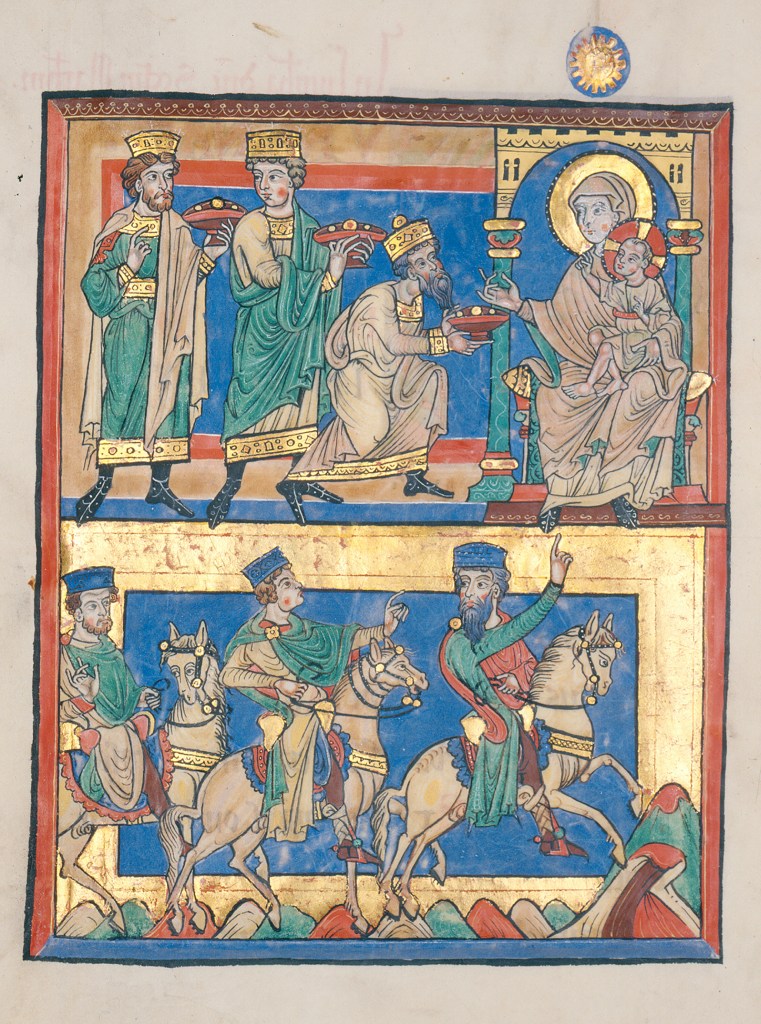
The Magi Follow the Star/Bring Their Gifts to the Holy Family, Evangelistar von Speyer, commonly called Codex Bruchsal1, Folio 13r, Badische Landesbibliothek, Karlsruhe, Germany. Also known as the Speyer Pericopes, the Codex Bruchsal was made circa 1220 A.D. for the Roman Catholic bishop of Bruchsal Cathedral, Karlsruhe, Germany. CC by SA-NC-4.0.

The Collect for Epiphany Day was adapted by Archbishop Thomas Cranmer for the 1549 Book of Common Prayer from the Gregorian Sacramentary in the Roman Catholic tradition. In the Anglican prayer book tradition, when Epiphany Day does not fall on a Sunday, the Collect can be transferred to the First Sunday after Epiphany, since it falls within the Octave (8 days) of Epiphany Day. Many jurisdictions use both collects for First Sunday after Epiphany. Scholar Matthew Shepherd defines Epiphany Day as the end of Christmastide.

O GOD, by the leading of a star didst manifest thy only-begotten Son to the Gentiles;
Mercifully grant that we, who know thee now by faith,
may after this life have the fruition of thy glorious Godhead;
through the same thy Son Jesus Christ our Lord. Amen.

The Epistle reading, Ephesians 3:1-12, is a mini-homily by St. Paul on the “mystery of Christ” (verse 4, 9) that is “now revealed” (verse 5) to mankind so that “the Gentiles should be fellow-heirs, and of the same body, and partakers of his promise by the gospel” (verse 6). St. Paul also refers to the powers of heaven, including “principalities and powers,” (verse 10), which is traditionally understood as two of the nine “ranks” or “orders” of angels (See Ninth Day of Christmas in our Twelve Days of Christmas video series or listen to the companion podcast version).

The Gospel reading, Matthew 2:1-12, is St. Matthew’s account of the visit of “wise men from the east”(verse 1). “Wise men” is derived from a Greek word magi (also spelled maji). They have come to “worship” the newborn “King of the Jews” (verse 2), whose star they had seen in the East. In verses 3-6. St. Matthew records King Herod’s fear concerning the prophecy of the coming of a “Governor” (“Ruler” in the NKJV translation), based on Micah 5:2. In verses 8 & 9, St. Matthew records Herod’s order to find the child. In verse 11, he records that the Wise Men brought three gifts symbolic of Jesus’ royalty: gold, frankincense and myrrh. In the final verse (verse 12), he records a divinely inspired dream in which the Wise Men are warned not to return and their departure back to their own country.

The history of when and how the wise men acquired a number (three) and names (Melchior, Caspar or Gaspard, and Balthazar, and the story of the construction of the Cathedral of the Three Kings at Cologne, Germany, is discussed, with illustrations, in Episode Two in the AIC Christian Education Video series, Epiphany: the Manifestation of Christ to the Gentiles. It is also discussed and illustrated in Chapter Two of the AIC Bookstore Publication, The Gospel of Matthew: Annotated & Illustrated, available using the link to my Amazon Author Central page. Full information about the book is available on the Bookstore page.

The Collect for First Sunday after Epiphany is another adapted by Archbishop Cranmer from the Gelasian Sacramentary. The theme is mankind’s dependence upon God for His Grace. Owing to the frequent appearance of Epiphany Day on a weekday, First Sunday after Epiphany is likely heard/read more often that the Collect, Epistle and Gospel for Epiphany Day. As noted above, local clergy can move these readings to First Sunday after Epiphany when Epiphany Day falls on a weekday.

LORD, we beseech thee mercifully to receive the prayers of thy people who call upon thee;
and grant that they may both perceive and know what things they ought to do,
and also may have grace and power faithfully to fulfil the same; through Jesus Christ our Lord. Amen.

The Epistle reading, Romans 12:1-5, is the first of four consecutive readings from Romans 12 and 13 in Epiphany season. St. Paul’s theme is the unity of the Church as one body under Christ, an understanding made especially clearly in verses 4 and 5.

The Gospel reading, Luke 2:41-51, is St. Luke’s unique account of the only glimpse in Scripture of the childhood of Jesus Christ, commonly called Teaching the Doctors in the Temple. It is the story of how the Blessed Joseph and the Blessed Mary found 12-year old Jesus, missing from their traveling party on the way back to Nazareth, conversing with the Temple scholars in Jerusalem, described by Christ as doing “my Father’s work.” The reading is featured on the Seventh Day of Christmas (Dec. 31) on the theme of “Family” in our Christian Education video series, The Twelve Days of Christmas (or you can listen to the Podcast version).

The image of the Wise Men/Magi following the star also appears as Illustration No. 26 and a spectacular double-page spread on facing pages of Adoration of the Magi, with the Wise Men from the Pericope Book of Henry II, c. 1007-1012 (Clm 4452, Folio 17v and 18R, Bayerische Staatsbibliothek, Munich, Germany), with the Wise Men on the left and the Blessed Virgin and Holy Child on the right. The latter two are Illustrations No. 27 and 28 in The Gospel of Matthew: Annotated & Illustrated, available through my Amazon Author Central page. A Summary of the book is found on the AIC Bookstore page. Christian hymns and carols celebrating events during Epiphany season include We Three Kings of Orient Are (John Henry Hopkins) and Song of Thankfulnesss and Praise (8 verses, Christopher Wordsworth; tune: Monkland). Other traditional hymns are discussed in Episodes One, Two and Three of the Epiphany video series mentioned above.

As always, thank you for your interest and support. Glory be to God for all things! Amen!

A Correction & Plans for A.D. 2025

Sharp-eyed readers will have noticed the error in the entry for the final Sunday in Christmastide. I did not see it myself until I sat down in church on Sunday. I suspending writing on Dec. 26th. Call it a “senior moment” that when writing was resumed for the last Sunday in the season it was the Collect, Epistle and Gospel readings for First Sunday after Christmas Day that were posted instead of the later Second Sunday after Christmas Day. Apologies.

Following review of all the blog posts for 2024 A.D., for the new year 2025 A.D. I’ve decided to continue with the old style of commentary on the Collect, Epistle and Gospel (C/E/G) readings for the seasons of Epiphany, Gesima, Lent & Easter and for Whitsunday. That will take readers/site visitors to the point in which C/E/G commentaries were begun in 2024 A.D. with the start of Trinitytide.

During these cold winter days of late December and early January, I have updated the AIC image database, now totaling over 2800 entries. All the uses in this Blog have now been noted in the Excel file. Later this month I expect to start work on the two remaining videos in the War on Christianity series. These two episodes will be focused on practical solutions for Christians living in an anti-Christian world.

Thanks as always for your interest and support. Glory be to God for all things! Amen!

Epiphany Eve (First Sunday after Christmas)

Welcome to this first issue of Fr. Ron’s Blog in A.D. 2025. This Sunday, January 5th, has multiple distinctions. It is a) the eve of Epiphany, b) the First Sunday after Christmas and c) the Twelfth Day of Christmas. All twelve episodes of our video series, The Twelve Days of Christmas, are linked from the Welcome page and the Digital Library page. Podcast versions are linked from the Podcast Archive page.

In this week’s Blog post I discuss the Collect, Epistle and Gospel readings for this final Sunday in Christmastide, reserving discussion of Epiphany season, which begins on Monday, Jan. 6th, for next week’s post. My podcast homily for First Sunday after Christmas is linked from the Podcast Homilies page.

The Collect for First Sunday after Christmas Day in the 1928 Book of Common Prayer is not one which Archbishop Cranmer adapted from a Roman Catholic sacramentary. An original composition by Archbishop Thomas Cranmer for the 1549 Book of Common Prayer, it is the same Collect printed as the first of two Collects for Christmas Day. Scholars theorize that this unusual duplicate usage was intended to increase the likelihood that it would be read at least once during the busy Christmas season. The Collect expresses many concepts which are central to Anglican theology. My choice of illustrations from Christian art is one of my personal favorites. I use it on my new Mac Book Pro in the “Start” page.

The Nativity of Our Lord, mosaic, south wall, Nave, Capella Palatina, Palermo, Sicily. The cathedral was begun under the patronage of Roger II, the first Norman King of Sicily, in 1132 A.D. and was dedicated on Palm Sunday, 1140 A.D. The mosaics were added between 1140 and 1170 A.D. The legends jn the mosaic are written in Koine Greek, commonly known as New Testament Greek. The York Project: 10,000 Masterworks. Public Domain. Image lightened in Photoshop.

ALMIGHTY GOD, who hast given us thy only-begotten Son to take our nature upon him,
and as at this time to be born of a pure virgin; Grant that we being regenerate,
and made thy children by adoption and grace, may daily be renewed by thy Holy Spirit;
through the same our Lord Jesus Christ, who liveth and reigneth with thee and the same Spirit ever,
one God, world without end. Amen.

This image of the Nativity mosaic was used as Illustration No. 8 focused on “Angels in the Nativity Accounts,” in the AIC Bookstore Publication, Christmastide: The Nativity of Our Lord, available using the links to my Amazon Author Central page. It also appears in the AIC Video series, The Twelve Days of Christmas, in the episode for First Day of Christmas – Dec. 25th (linked from the Welcome and Digital Library pages).

The Epistle reading, Galatians 4:1-7, is an essay by St. Paul’s on the theological concept of sonship and adoption by grace to which Archbishop Cranmer referred in the Collect for the occasion. After alluding to the context of these events being part of God the Father’s plan (“In the fulness of time”), St. Paul wrote in verses 4b and 5: “God sent forth His Son, born of a woman, born under the law, to redeem those who were under the law, that we might receive adoption as sons.”

The Gospel lesson, Matthew 1:18-25, is St. Matthew’s account of the Nativity of Christ, one of the sources for the mosaic shown above. The account follows St. Matthew’s genealogy flowing through the mostly male line of Jewish kings and includes his account of the angelic dream in which St. Joseph was reassured concerning the Blessed Virgin Mary and emphasizes St. Matthew’s theme of the life of Christ as fulfillment of Old Testament prophecy. I discuss and illustrate all three dream sequences of Matthew in Part Three, Christmas: The Nativity of Our Lord, available using the link to my Amazon Author Central page.

As always, thank you for your interest and support. Glory be to God for all things.