Archbishop Thomas Cranmer’s choice for the Collect for Third Sunday in Lent is the second five Collects in Lent which he sourced from the Gregorian Sacramentary, one of the three primary sacramentaries in the Roman Catholic tradition. Its most memorable phrase, “the right hand of Thy majesty,” is based on the Hebrew understanding of the “right hand” of God being the most honored position. The understanding was incorporated into Christian theology at the Council of Nicea in 325 A.D. In the Nicene Creed, written at that First Ecumenical Council and amended at the Council of Constantinople in 381 A.D. (Second Ecumenical Council, Jesus Christ sits at the right hand of the the Father. There is much more information about the Creeds of the Church in our eight-episode video series, The Nicene Creed, linked from the Digital Library page.
WE beseech thee, Almighty God, look upon the hearty desires of thy humble servants,
and stretch forth the right hand of thy Majesty, to be our defense against all our enemies;
through Jesus Christ our Lord.
The Epistle reading, Ephesians 5:1-14, continues past practice in Lent with another Pauline epistle focused on the concept of guidance for leading a Christian life, later known as the Christian Virtues. These virtues were fully developed by in the 6th through 8th C. in the Western Church. In this reading, the subject is the need for the mastery of passions, here meaning both physical and emotional. These include sexual impropriety and covetousness (verses 3 & 5); intemperate language (verse 4); and idolatry (verse 5). Other themes in the reading include “light” vs. “darkness,” with Christ as the symbol of light who countered the “darkness” of the world before His coming as Saviour. In verse 14, based on Isaiah 60:1, the Evangelist to the Gentiles calls out: “Awake, you who sleep, arise from the dead, and Christ will give you light.” The phrase was immortalized into a hymn, Sleepers Awake!, written in 1599 A.D. by German composer, Philipp Nicolai, and later a cantata of the same name by Johann Sebastian Bach. Bach’s cantata was sung for the first time at Leipzig in 1731 for the Twenty-seventh Sunday after Trinity.
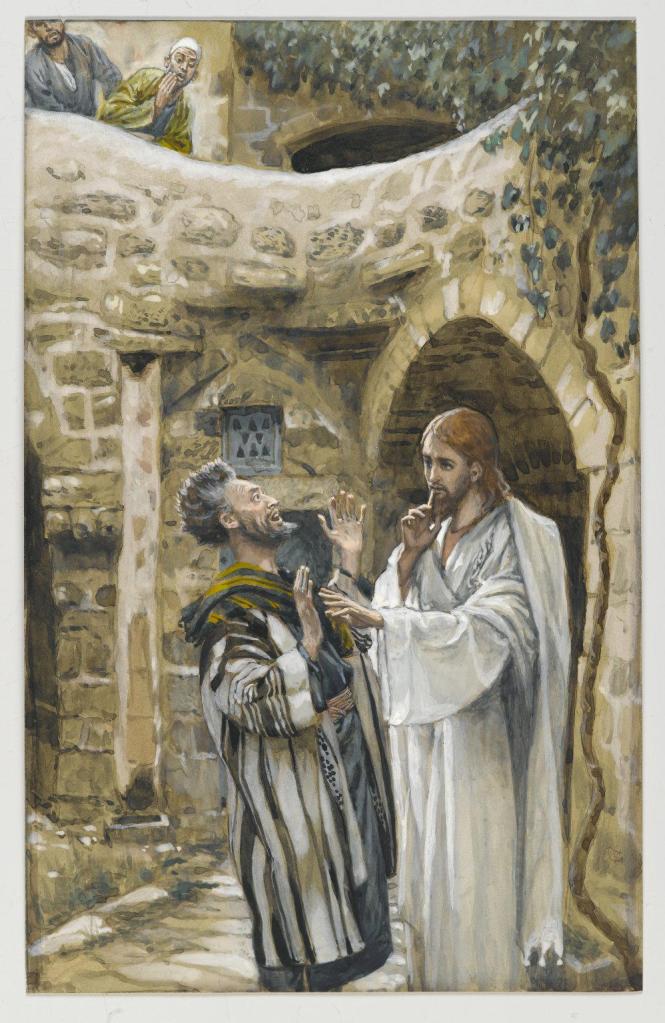
The Gospel reading, Luke 11:14-28, is the first and only reading from St. Luke’s Gospel in Lent. For whatever reason, probably its complexity of its imagery, this encounter was not often illustrated in mosaics, frescoes or icons in the first millennium of Christianity. Numerous commercial examples were produced in the 20th and 21st C. As noted above, the reading is complex. I have divided it into four parts. The first (verse 14) is St. Luke’s brief record of Jesus driving out a demon, or evil spirit, from a mute man and the result: an immediate healing. The event is pictured above as interpreted by French artist James Tissot based on St. Matthew’s account (Matthew 12:22-24). In part two (verse 15) St. Luke records the criticism of Jesus by Temple authorities that He has used “demonic” powers in the manner of Beelzebub. The name roughly means “Lord of the Flies” in Hebrew. In part three (verses 17-26), Jesus offers a demonstration of His divinity: proving that He knew their thoughts (verse 17a) and offers a short sermon on spiritual warfare (verses 17b-26), referring to the possible return of demons that are driven out. Here Jesus uses the Hebrew magical number 7, referring to their return with seven other, even more powerful, spirits. In the final section, part four (verses 27-28), St. Luke offers an account of a woman from the crowd of observers, quoting her beatitude concerning the Blessed Virgin Mary: “Blessed is the womb that bore You, and the breasts which nursed You” (NKJV text). Jesus replied: “Rather, blessed are they that hear the word of God, a keep it” (NKJV text). Eastern Church scholars contend that Jesus is here stating a principle and is not commenting upon the relative worthiness of His mother. For an approximately 15 minute discussion of the important Greek words which appear in this dialogue, listen to my Podcast Homily for Third Sunday in Lent, which is linked from the Podcast Homilies page. One of these important words is “menounge” (Strong’s Greek word # 3304 in verse 28), which the King James Version translates as “rather” and the New King James Version renders as “more than that.” In The Gospel of Luke: Annotated & Illustrated I noted that Jesus made a similar declaration to the Pharisees in John 8:47. Like all our AIC Bookstore Publications, the book is available through my Amazon Author Central page. A summary of the volume is found on the AIC Bookstore page.
F.Y.I: The previously-promised soundtracks for the two new episodes in our video series, The War on Christianity, have not been recorded. Tax-filing preparation, getting my garden ready for Spring, and many other items competing for time have gotten in the way. The new target date is early April. Apologies for the delay.
As always, thank you for your interest and support. Glory be to God for all things! Amen!

 Anglican Internet Church
Published by