The Sixth Sunday in Lent, the final Sunday in the season, is commonly known as Palm Sunday but officially is labelled as “the Sunday next Before Easter” in the 1928 Book of Common Prayer. For the occasion, for the 1549 Book of Common Prayer, Archbishop Cranmer once again relied upon a prayer from the Gregorian Sacramentary. As notes in earlier posts, the Gregorian Sacramentary is one of the three primary sources in the Roman Catholic tradition.
The celebration of Palm Sunday began in the Western Church after the election of Constantine as Holy Roman Emperor, and his conversion to Christianity, in the early 4th C., the subsequent relocation of the center of gravity for the Church to Constantinople, and later still, the many good works of his mother, Helen. Her actions helped revive and expand the knowledge of Christianity’s history, but she also built many churches and basilicas in the Holy Land. It was her leadership that led to the beginning pilgrimage to the Holy Land as a Christian obligation, especially for those with the means to do so. Although known as Palm Sunday, it should be noted that New Testament Scriptural accounts of the Entry into Jerusalem refer to “tree branches” and to garments being thrown in Jesus’ path. The use of palms is of later origin and is based upon an Old Testament practice of palm usage in celebrations, especially those celebrating military victories. In regions where palm branches are not available other local flowers and branches of trees are used, such as willows, olive and yew trees. The final phrase in the Collect for Palm Sunday was written by Archbishop Cranmer.
ALMIGHTY and everlasting God, who, of thy tender love toward mankind,
hast sent thy Son, our Saviour Jesus Christ, to take upon him our flesh,
and to suffer death upon the Cross, that all mankind should follow the example of His great humility;
Mercifully grant, that we may both follow the example of His patience, and also be made partakers of His Resurrection;
through the same Jesus Christ our Lord. Amen.
The epistle reading, Philippians 2:5-11, is another of Pauline authorship and is the Scriptural source for the many Christian doctrines and of the tradition of bowing and making the sign of the Cross when approaching the altar: “Wherefore God also hath highly exalted, and given him a name which is above every name: that at the name of Jesus every knee should bow, of things in heaven and things in earth, and things under the earth; and that every tongue should confess that Jesus Christ is Lord, to the glory of God the Father (verses 9-11).
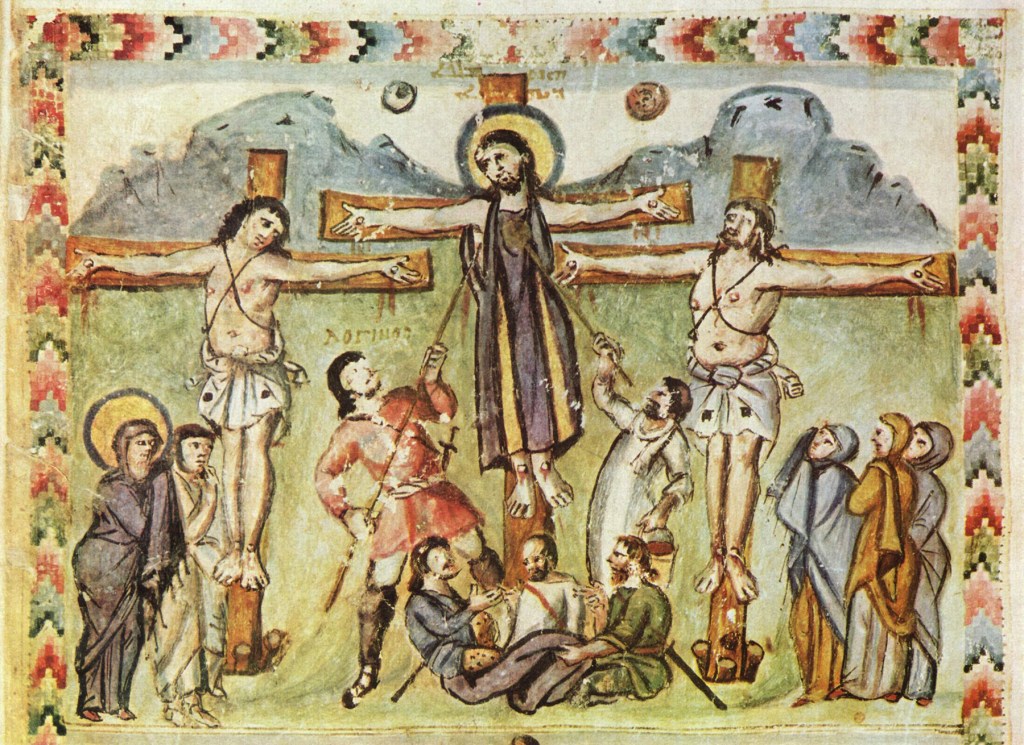
The Gospel reading, Matthew 27:1-54, is the fourth, the last, and by far the longest reading, from the Gospel of Matthew in Lent. In the Anglican tradition, unlike in most other denominations, the reading is not the Scriptural/historical account of the Entry into Jerusalem (Matthew 21:1-13, which is read on the First Sunday in Advent). It is instead the Evangelist’s long form account of the trial, sentencing, Crucifixion and death of Christ upon the Cross. As noted by Massey Sheperd in his Commentary on the Book of Common Prayer, it is the first of the New Testament accounts of the Passion of our Lord which area printed in the BCP for the days between Palm Sunday and Good Friday. The central section of the image above is Illustration No. 82 in The Gospel of John: Annotated & Illustrated, available through my Amazon Author Central page. Many other versions of the Crucifixion, including illuminations, icons, mosaics and frescoes, are included in the publications in the same series covering the Gospels of Matthew, Mark and Luke, likewise available through my Amazon Author Central page. Summary information about all four volume, including pagination, price and content is found on the AIC Bookstore page.
These readings and the Collect are discussed and illustrated in Episode Three in our Christian Education Video series, Lent: the Season of Penitence, which is linked from the Digital Library page. The episode also includes discussion of the important part St. Helen played in the discovery of plaque upon the cross (THIS IS JESUS THE KING OF THE JEWS) and remnants of the Cross in the early 4th C. and the start of pilgrimages from the Western into the Holy Land. My podcast homily for Palm Sunday is linked from the Podcast Homilies page.
As always, thank you for your interest and support. Glory be to God for all things! Amen.

 Anglican Internet Church
Published by