Second Sunday in Lent

The Second Sunday in Lent, which is 2/25 in A.D. 2025, finds the AIC actively engaged in updating our database of digital resources. The review and update involves taking a page-by-page review of all 22 of our printed books, plus the various Seasonal and Bible Study Video series. As of today, 2/24/2024, I have crossed the half-way point, having finished all the printed books, the Seasonal Videos (Advent, Great “O” Antiphons, Christmas, Twelve Days of Christmas, Epiphany, Gesima, Lent, Easter and Trinitytide), the Christian Education Videos (The War on Christianity; The Nicene Creed; The Lord’s Prayer; The Lives of the Saints, both the First and Second Series); and Episode One to Episode 7 in The New Testament: Gospels series. The image count stands at just over 2500, but this does not count duplicate versions (including different sizes; details; perspetive correction; brigthening effect; and other technical adjustments).

This week I am starting research on a new series of topical postings to Fr. Ron’s Blog. I begin this adventure with some material discovered in the examination of images from Constantinople before 1453. The Byzantine world produced some of the finest and most-inspiring examples of Christian art, including illuminated manuscripts, frescoes and mosaics in churches, cathedrals and monasteries in locations ranging from northeast France, where only one Byzantine building remains, to Asia Minor and the Holy Land. In my effort to make sure our citations are correct, I have had to re-visit online sites to verify a wide range of issues, including accuracy of content description, identity of the author/artist, the date or ranges of dates of creation/completion, as well as credit lines for photography, manuscript and folio numbers. Recently, this led me to revisit image of the Hagia Sophia, originally built in the reign of Emperor Justinian during the 6th C. and Chora Church (or Church of Our Saviour), the latter of which is used as the background image on this web site.

In this research I found a site that includes detailed study and imagery of Chora Church. Chora Church fell into serious decline and neglect during the period after the Crusader attack on Constantinople in 1204 A.D. For the following sixty years, until after the Byzantine Empire recaptured the city and surrounding areas Eastern Orthodox worship was effectively banned and replaced with Roman Catholic liturgies. In what is called the Late Byzantine revival in the late 13th and early 14th C. many of Byzantium’s finest buildings were restored or enlarged, including Chora Church. Between 1321 and 1321 Chora Church was repaired and improved. The two images I share today come from the Inner Narthex (which was the second Narthex, between the Outer Narthex entrance and the central Nave) and, on the right hand side, the Parakklesion, a long rectangular space which runs from the right hand end of the Outer Narthex down the long axis of the building and parallel Nave (or Naos) and the Altar (or Bema).

The first image shows a mosaic of the Blessed Virgin with Joseph and the Christ Child at center with Joachim and Anne, Mary’s parents, looking on. It is located in below the smallest of two domes in the Inner Narthex, which includes images related to Mary. At my former parish at St. Joseph’s Villa, Richmond, VA, there is a stained glass window which depicts Mary learning wisdom from her parents. (Image: Byzantologist. CC by NC-SA 2.0).
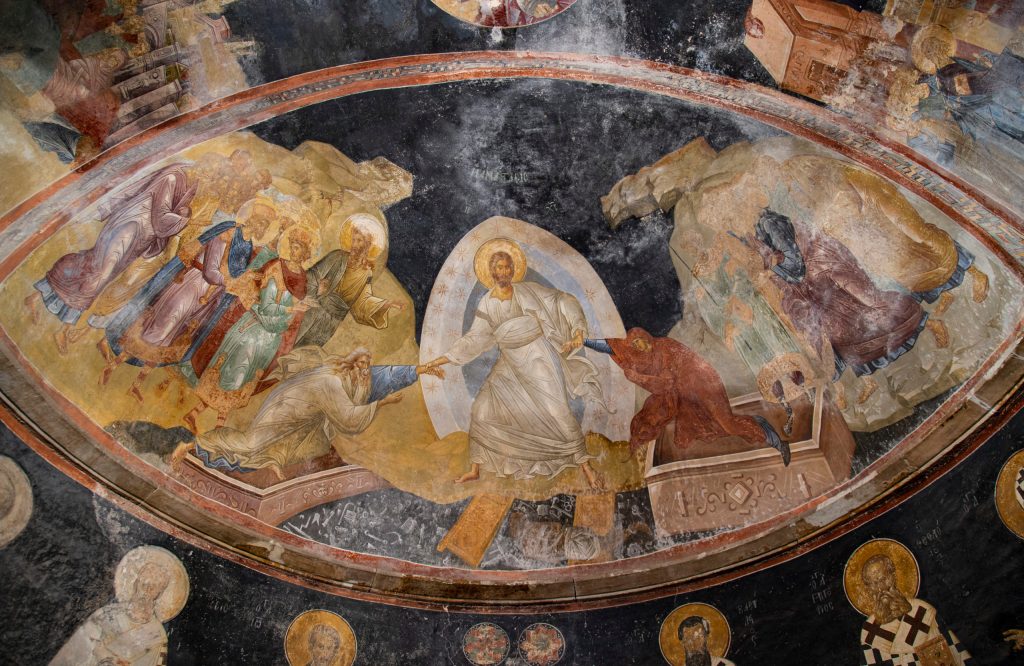
The second image is larger version of one which I used, based on a different source, in Easter: The Resurrection of Our Lord in Scripture, Art & Christian Tradition, available using the Virtual Bookstore link at the bottom of the Welcome page and on the AIC Bookstore page. The work is a Apse fresco placed at the far end of the Parakklesion. The title is Anastasis, which literally means “to stand up” and which is the Greek word for Resurrection. In this remarkable image Christ appears to yank Adam, in blue at left, with His right hand, and, with his left hand, Eve, in white, from Hades. Note that Jesus stands upon the destroyed gates of Hades, or Hell in the Western Church tradition and that there are keys remaining in the Pit (Abyssos in Greek). Surrounding the Christ figure, the saints and apostles look on. The figure at Jesus’ right, wearing a golden halo, is John the Baptist, always described as the Last Prophet of the Old Testament. (Image: Byzantologist. CC by NC-SA-2.0).

I hope you find these two images inspiring and spiritually uplifting in our age of secular decline. You can see a 16-page version or watch a companion video at http://www.SmartHistory.org under the heading Picturing Salvation-Chora’s Brilliant Byzantine Mosaics and Frescoes by Dr. Evan Freeman. This world could use a lot more of this kind of confident expression of the Christian Faith.

Next week, I will focus on The Blessed Alcuin of York, author of the Collect for Peace (“Almighty God, unto whom all hearts are open, all desires, known, and from whom no secrets are hid….’) in the Holy Communion liturgy in the 1928 Book of Common Prayer.

As always, thank you for your interest and support. Glory be to God for all things! Amen!

The Season of Lent & a Confession

The process on updating the database of images in the AIC Library had to be interrupted this past week in order to update the Welcome page for the start of the season of Lent. The seasonal graphic and links to the three episodes in the video series are now active.

I also wanted to remind readers/viewers of St. John Chrysostom’s advice to his parishioners at Constantinople in the late 4th C. that, in considering what sacrifice one might make for the season of Lent. He suggested that rather than abstaining from certain foods one might also consider restraining the tongue during the six weeks of Lent. His further comments described the tongue as a weapon just as powerful as a sword. From 381 to 398, Chrysostom was first a Deacon, then a Priest and, later, Bishop of Antioch. He was consecrated Bishop of Constantinople in 398. He died in exile in 407 after a dispute with the Empress Eudoxia. The image is mosaic at the Hagia Sophia, Constantinople, built under the patronage of the Emperor Justinian in the 6th C. The mosaic dates a later date.

In working on updating the complete index of images in the archives of the AIC, which now total almost 2500 images, I have discovered a few errors in photo credits in The Lives of the Saints video series. Here is the correct information about the images of St. Luke and St. Gabriel.

The 18th C. icon of St. Luke in Slide 297 in The Lives of the Saints, First Series was incorrectly credited to the Greek artist, Emmanuel Tzanes. The icon is actually not from Greece but from Russia. The image shows Luke with the Ox figure, consistent with the tradition of identifying the Evangelists associated with one of the four creatures desribed by Ezekiel. Wikimedia Commons identified the source as a private collection in the Netherlands.

In The Lives of the Saints – Second Series, focused on the non-1928 B.C.P. Saints, there were two icons of the Archangel Gabriel. The image in Slide 344 was incorrectly identified as being from Macedonia in the late 12th C. The image actually has a far more interesting history. It is not an icon but a fresco which was taken from Constantinople during the last years of before the collapse of the Byzantine Empire in 1453 A.D. It was painted in the late Byzantine style, characterized by pastel colors and a fluidity not previously seen, by Cyrus Emanuel Eugenicus. It was installed at the Cathedral Church of the Transfiguration of the Saviour, Tsalenjikha, Georgia. The image was used in this blog on 3/17/2017.

Best wishes and blessings for the Lenten Season. And, as always, thank you for your interest and support of the AIC ministry. Glory be to God for all things! Amen!

Quinguagesima Sunday

Today in Virginia has been strange. Wet. Chilly. Cloudy. And offering home of the Spring soon to some. I am thankful not to have needed to go outside for any reason, having brought in a seat of Duraflame fire logs yesterday! Today’s Gospel reading is Luke’s account of the healing of the Blind Man of Jericho, as a last example of “manifestations” to the Gentiles in the “Gesima” season.

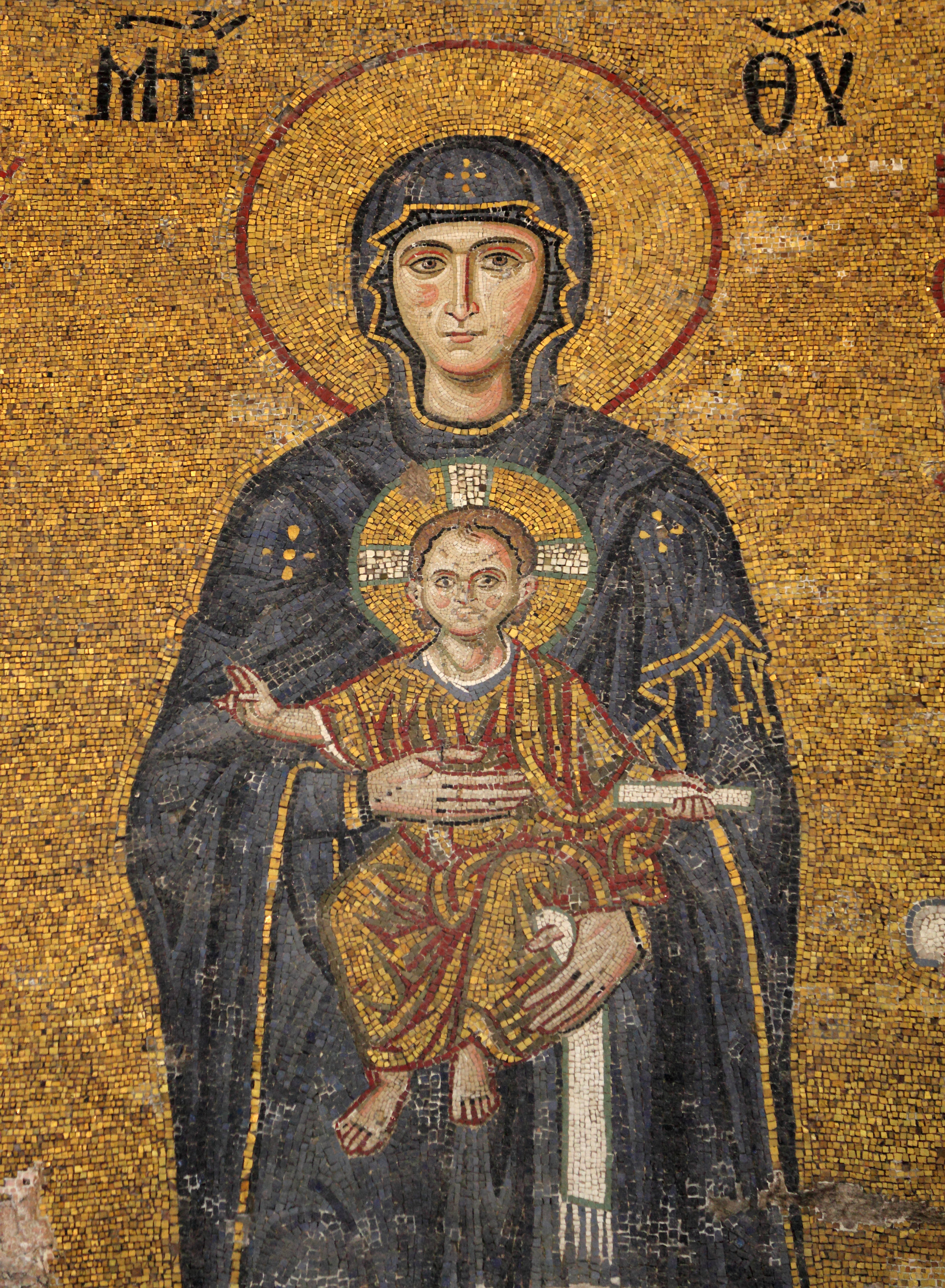
This morning, I was working on further work on the computer database of images and came across a marvellous 11th C. addition to the Hagia Sophia. The image, in its original form, shows the Blessed Virgin Mary and the Christ Child seated between an image of the Byzantine Empress Eirene, which means light, on the left and her husband, Emperor John II Comnenus in the Christ Pantokrator Monastery, part of the Hagia Sophia complex. It was built as a hospital complex for the treatment and healing of both men and women, built between 1118 and 1124. It housed the remains of the both the Comnenus and Palaiologos dynasties of Byzantium. Mary is seated on a bench holding a rather adult-looking Christ Child, who is making the sign of a blessing with His right hand and holding a scroll his His left hand, in her lap. This kind of image was popular in the Byzantine world, implying the blessing the God upon the sitting Emperor.  The Comenus (also spelled Komnenos) dynasty was one of the last four to rule at Constantinople. The Byanzantine empire fell to Ottononian rule in 1453 during the reign of Constantine XI Paleologos. For more about the Hagia Sophia, see https://www.pallasweb.com/deesis/history.html

The count of images now stands at over 2400. I’ve been working of cataloguing two collections, the Dreamstime.com and the Can Stock Photo, Inc. catalogues. The task is complicated by the closure of Can Stock Photo, Inc. in 2023. I can no longer access the master datebase to verify credit sources and dates. I’m getting there by cross-checking all uses in our 22 books as well as in the various video series.

Thanks for your interest and support. Glory be to God for all things! Amen!

Septuagesima Sunday

The three Sundays ending with “gesima” start with Sunday, Jan. 28th. These Sundays are still honored in the Anglican tradition, while they have been relegated to lesser status in other denominations. Lnks to both episodes in our “Gesima” series have been placed on the Welcome page.

Meanwhile, work continues on updating the AIC’s database of images of Christian art across the centuries. The objective to is make certain that every image used in any of our twenty-two books and in the various AIC Video series since 2010 have been entered into the Excel database. As of this writing there are 2165 images, but this might not include some of the earlier video series. For ease of future reference, all items are described, with appropriate dates and file numbers for the source, plus a column showing where each image is found on my Mac and where it has been used in either book, video or blog posting. Boring? Yes, but essential for future use.

As always, thank you for your interest and support. Glory be to God for all things! Amen!
Ending and Old and Preparing for a New Year

Thank you very much for your continued interest in this unique teaching Web Site. As we end the Year of Our Lord 2023 and near the start of A.D. 2024, I have been working on fixing small issues that always arise with a complex site. My hope is to start A.D. 2024 with everything working the way it should. 

Video Links Issue Resolved

The AIC offers links to nearly 200 videos across several series. Recently, links from nearly all episodes hosted at Vimeo.com, became inoperative for unknown reasons. With the assistance of their customer service people, the problem was resolved. A random check across all the different programs suggests that all links are working. This coming year the AIC will take advantage of Vimeo’s new program for creating customized backgrounds whenever a video is called up. I hope to have this working during the month of January.

Bookstore Information Updated

I’ve corrected a few errors in the details in the cross-references to AIC Bookstore Publications within sections of the site. As of today, the number of pages, number of illustrations and prices are correct. Prices are shown for each book on the AIC Bookstore page. As of 12/29/2023 A.D., all twenty-two books are available for order. Twenty-one books are available in 2024 editions. The remaining book could be available in its 2024 edition in January. 

Internal Links Tested

The internal links on this site were tested and found operable as of 12/29/2023 A.D. These internal links are intended to aid in quick navigation so that no manuals or special Apps or other programs are needed to get from one page to another.  If any viewer should discover any non-functioning links, an email would be appreciated (send notices to: frron.aic@earthlink.net).

WATCH | LISTEN | READ

Finally, renewed emphasis throughout this site has been focused on Learn Your Way mantra: WATCH | LISTEN | READ. We have tried to offer teaching materials tailored to a broad range of learning styles. The final section of the 2024 A.D. edition of Christian Spirituality: An Anglican Perspective is focused on where to find our resources and how to navigate the AIC Web Site. In 2024 A.D., I plan to offer additional episodes in The War on Christianity series, with at least two additional episodes planned. It is also possible that additional Saints could be added in the Lives of the Saints (Second Series), which celebrates saints not among the eighteen with Feast Days or joint Feast Days in the 1928 Book of Common Prayer.

Thank You and Happy New Year

Thanks to all of you who have been following the AIC, now well into its second decade on the Web. Your support and interest is appreciated. If you are travelling for the New Year holiday I pray for your safe travel and return home. Glory be to God for all things! Amen!
Christmas & the Twelve Days of Christmas

I invite you to watch or listen to the AIC’s two special and unique videos for the Christmas season. Christmas: The Nativity of Our Lord, presented in two episodes covering Christmas Day and First and Second Sundays after Christmas, and The Twelve Days of Christmas, presented in twelve episodes, one each for the days from Dec. 25th to Jan. 5th.

Episode One
Episode Two

Readings, music, pictures and daily key word(s)
(no, not the same as the song of the same name!)

First Day – December 25th – Love
Second Day – December 26th – Forgiveness
Third Day – December 27th – Peace
Fourth Day – December 28th – Compassion
Fifth Day – December 29th – Obedience
Sixth Day – December 30th – Joy
Seventh Day – December 31st – Family
Eighth Day – January 1st – Church
Ninth Day – January 2nd – Angels
Tenth Day – January 3rd – Commandments
Eleventh Day – January 4th – Glorifying God
Twelfth Day – January 5th – Grace and Faith

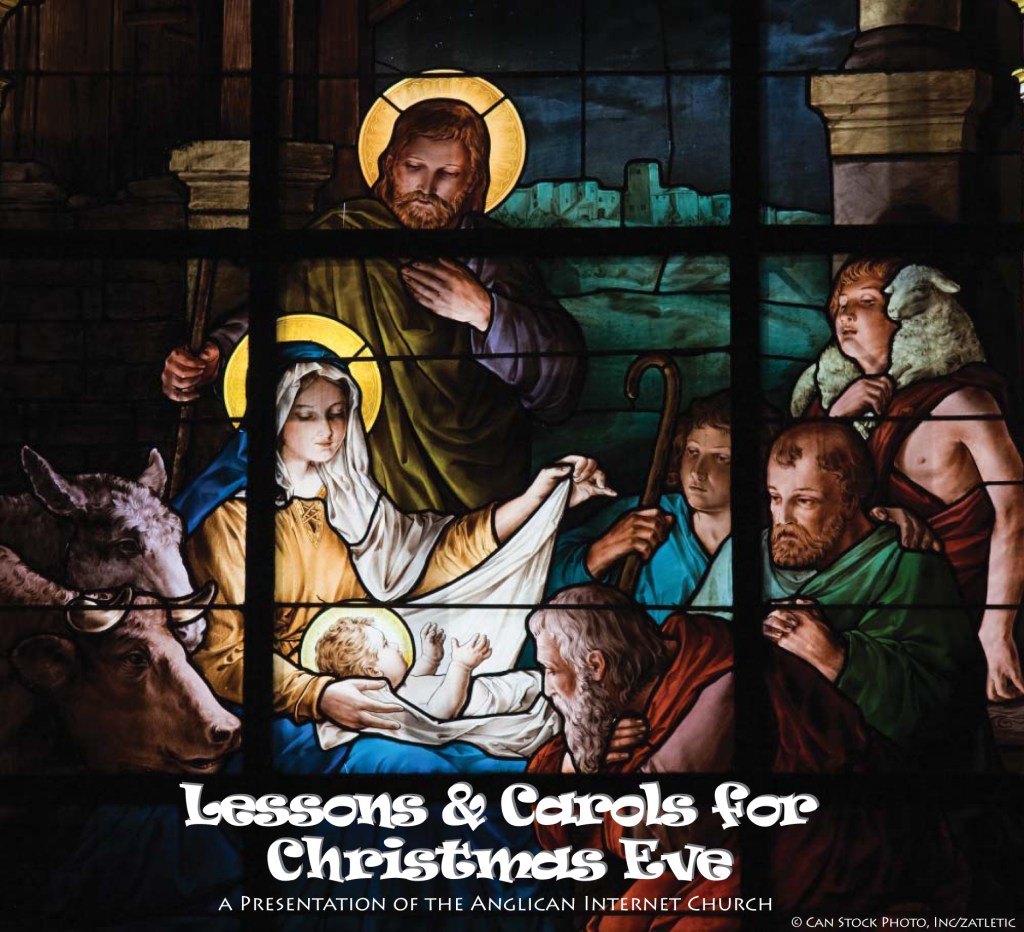
Lessons & Carols for Christmas Eve

One of my favorite aspects about Anglican worship and devotions is the tradition of Christmas Eve singing. My wife and I have always enjoyed viewing the King’s College, Cambridge, programs or the similar presentation at St. Paul’s, London. Several years ago, facing the shortage of local presentations, I created a video version for those similarly without access. Click the image below to watch the program. There is a link to an MP3 Podcast version available on the Podcast Archive page. May the Lord bless and preserve you this holiday season.

For the full version of the Christmas Eve Suite, use the links on the Digital Library page.

Fourth Sunday in Advnet & Bookstore News

Fourth (and Final) Sunday in Advent

Tomorrow is Fourth Sunday in Advent, the last service in the season and which turns into Christmas Eve following the evening service. From the Anglican Internet Church I send greetings to all and wish you a joyful and safe celebration of Christmas.

Angels Book Now Available

Earlier this week Angels: In Scripture, Art & Christian Tradition went live on Amazon KDP Publishing. You can order the book through my Amazon Author Central page (https://www.amazon.com/author/ronald-e-shibley). This leaves only one volume still to be updated into A.D. 2024 editions. I hope to have that one in place early in January.

God bless. And, again, a Merry Christmas to all.

Digital Library Back Online

Technical Troubles Fixed by Vimeo

On Monday, when I tried to link the videos for our Great “O” Antiphons series for the final seven days of Advent, I discovered that almost all our videos were not accessible through the Digital Library page. The technical folks at Vimeo figured out the problem and, as of this morning, all our videos are now available for viewing or download.

As regular site visitor know, the Digital Library is. the heart of our WATCH | LISTEN | READ initiative. We offer nearly 200 video presentations. with the voice track of the each available for listening or download on the Podcast Archive page. In the case of the Great “O” Antiphons, the same material is offered in print form in Part Four of our bookstore publication, Christmas: The Nativity of Our Lord in Scripture, Art & Christian Tradition and as part of the Christmas Eve Suite on pages 23 to 27 in Occasional Services for Anglican Worship.

Later today, I will post links to all the episodes in The Great “O” Antiphons series on the Welcome page.

We apologize for any inconvenience this may have caused. And urge viewers to take advantage of The Great “O” Antiphons offices through either the video, audio or print media. Thanks again for your support.

Glory be to God for all things! Amen!

More Progress on the Bookstore Updates

Prayers in the Christian Tradition Updated

Our oldest publication, Prayers in the Christian Tradition, originally printed on 8.5″ x 11″ paper on an injet printer, then folded twice and cut, then stapled into a 5.5 x 5.5 size, has been updated for 2024 with some small style changes on every page, retention of all the original indexes and a new design for the spine and back cover, is now live with KDP Publishing. The price remains $15.00. There are ancient prayers organized by purpose and content. The 2024 edition includes current information about all 21 other books available through our Virtual Bookstore on Amazon.com.

Angels: In Scripture, Art & Christian Tradition Sent for “Final” Proof

The Angel book project is nearing completion. A final proof-reading sessions were held on 12/12 and 12/13, with all corrections and changes posted on 12/14 and sent to KDP Publishing. The proof copy is supposed to arrive on Monday, 12/18. 

These changes leave only one volume stlll in the review process. With luck, the issues will be resolved in early January.

Third Sunday in Advent

The Gospel reading for Third Sunday in Advent contain’s Jesus’ firm statment that John the Baptist is the one foretold in Old Testament prophecy. I hope you will be able to attend a service in which the sermon/homily is focused on that reading.

As always, thank you for your interest and support. Glory be to God for all things! Amen!