
Episode Sixteen in the revised and expanded versions of our Bible Study Video series, The New Testament: Gospels, is now available in video and podcast versions. The topics are St. Luke’s unique reverse order genealogy of Jesus and his account of the Temptations of Christ. The graphic with this Blog post is a 96 dpi version of the Temptations from the Codex Aureus of Echternach, made at the Abbey of Echternach, Echternach, Luxembourg (then part of Germany) between 1030 and 1050 A.D. The Codex is one of the marvels of the Ottonian era of the rulers of the Holy Roman Empire revived in 800 A.D. by Charlemagne. It is just one of three scenes on a single page, with other scenes of the Calling of the first Apostles and Cleansing the Temple. You can see shine in the gilt in the 300 dpi version in the video. Other illustrations include work by Ducci di Bouninsegna; an miniature of Christ and Satan from a Psalter from England in the 13th C.; an illumination of Luke writing his Gospel made for Charlemagne in 800 A.D.; two watercolors, one of the Temptation on the pinnacle of the Temple and one of St. Joseph, by James Tissot; an oil on canvas of the Temptations by Vassily Surikov, and a scene from an icon in the Russian Orthodox tradition.
Watch the Video Listen to the Podcast
I am currently working on Episode Thirty-six on the first “sign” in the Gospel of John, the Wedding at Cana. I am also working on a plan for advertising on an Anglican site for our Bookstore Publications.
As always, thanks for your interest and support. With my 77th birthday coming up I need encouragement! Please consider becoming a follower by clicking the Follow Anglican Internet Church tab in the righthand column or otherwise sharing the site with others.
May God bless you in all that you do in His Name! Amen! Glory be to God for all things! Amen!
 Episode Fifteen in the revised and expanded version of our Bible Study Video series, New Testament: Gospels, is now online in video and podcast versions. Topics are St. Luke’s unique boyhood narrative and the baptism of Christ. There are 10 illustrations from the 11th, 12th, 16th, 19th and early 20th C. I’ve chosen the oldest, an Ottonian-era illumination of the Baptism of Christ from the Hitda Codex, named for the Abbess of Meschede, Germany and made circa 1020 A.D. in the Cologne region. It includes imaginative coloration and decoration, with a starry sky, a fish-filled river Jordan, and a heaven-sent dove. I hope a viewer can tell me what the recumbent figure at lower right represents. The original is in the Hessische Landesbibliotek, Darmstadt, Germany, but this version came from the Yorck Project’s 10,000 Masterworks DVD.
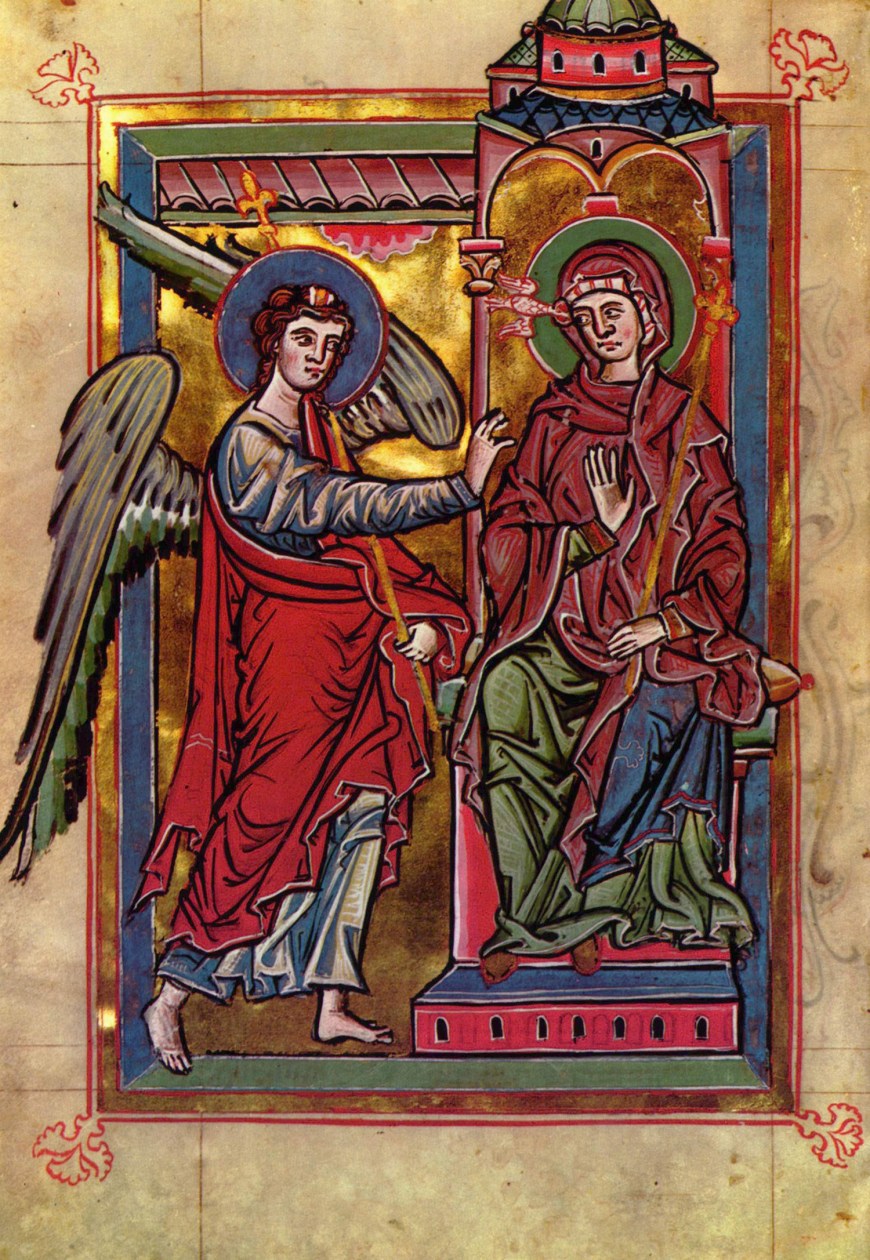
 The episode is loaded with many of the examples of historic art added to our library in the last year. Few in the Western Church are aware that St. Luke is credited in the Eastern Church and among many Roman Catholics as the first icon-painter. The episode includes St. Luke Painting the Virgin Mary, a miniature illumination (less than 1″) in colored inks and gold on parchment with an elaborate floral border from The Gospels of Luke and John, a codex made in England in the 1st Quarter of the 16th C., from Ms. Royal 1 E V, Folio 3, British Library, London, England. The image is so small that I could not use it here. Instead, I offer another you, St. Luke Writing His Gospel, an illumination in tempera and gilt on vellum from the St. Augustine Gospels, begun in Italy (presumably Rome) in the 6th C. and completed in England after being given to Corpus Christi College, Cambridge, by St. Gregory the Great. The original is at Cambridge, CCC Library Mss 286, Folio 129v. This version is in lower resolution for internet use. The version in the video is 300 dpi. Both versions have been modified with perspective correction technology.
 Episode Ten in the revised and expanded Bible Study Video series, New Testament: Gospels, is now available. This latest episode includes the final 3 of 18 miracles and the Jesus-Disciples dialogue that comes immediately before the Turning Point Verse, Mark 10:45. The selected illustration is Feeding the Multitude, an illumination in tempera and gilt on parchment from the Codex Egberti, a Gospel book prepared for Egbert, Bishop of Trier, between 980 and 993 A.D. at the Reichenau Monastery, Reichenau, Germany. Folio 047V, Trier City Library, Trier, Germany.
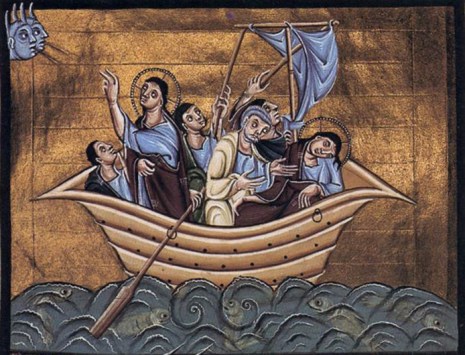 Episode Nine in the revised edition of our Bible Study series, New Testament: Gospels is now online in both video and podcast versions. In Episode Nine I continue discussion of the Gospel of St. Mark with the next six of eighteen miracles he describes. The first three demonstate Divine Power over Nature and the second three demonstrate Divine Power over Speech and Sight. The illustration, Calming the Seas, is the top half of a miniature illumination in colored inks and gilt on vellum from the Gospels of Otto III, produced at Reichenau Monastery, Reichenau, Germany, in the late 10th or early 11th C. The original is at the Bavarian State Library, Munich, Germany. I applied perspective correction to the original image. Otto III was a Saxon/German king who ruled the Holy Roman Empire in Europe, which was revived in 800 A.D. by Charlemagne. The monastery is the same facility where the Bamberg Apocalypse was prepared in the early 11th C. Viewers who have read the AIC Bookstore Publication, Revelation: An Idealist Interpretation, which includes 51 illustrations from the Bamberg Apocalypse, will recognize the style and, possibly, some of the faces.
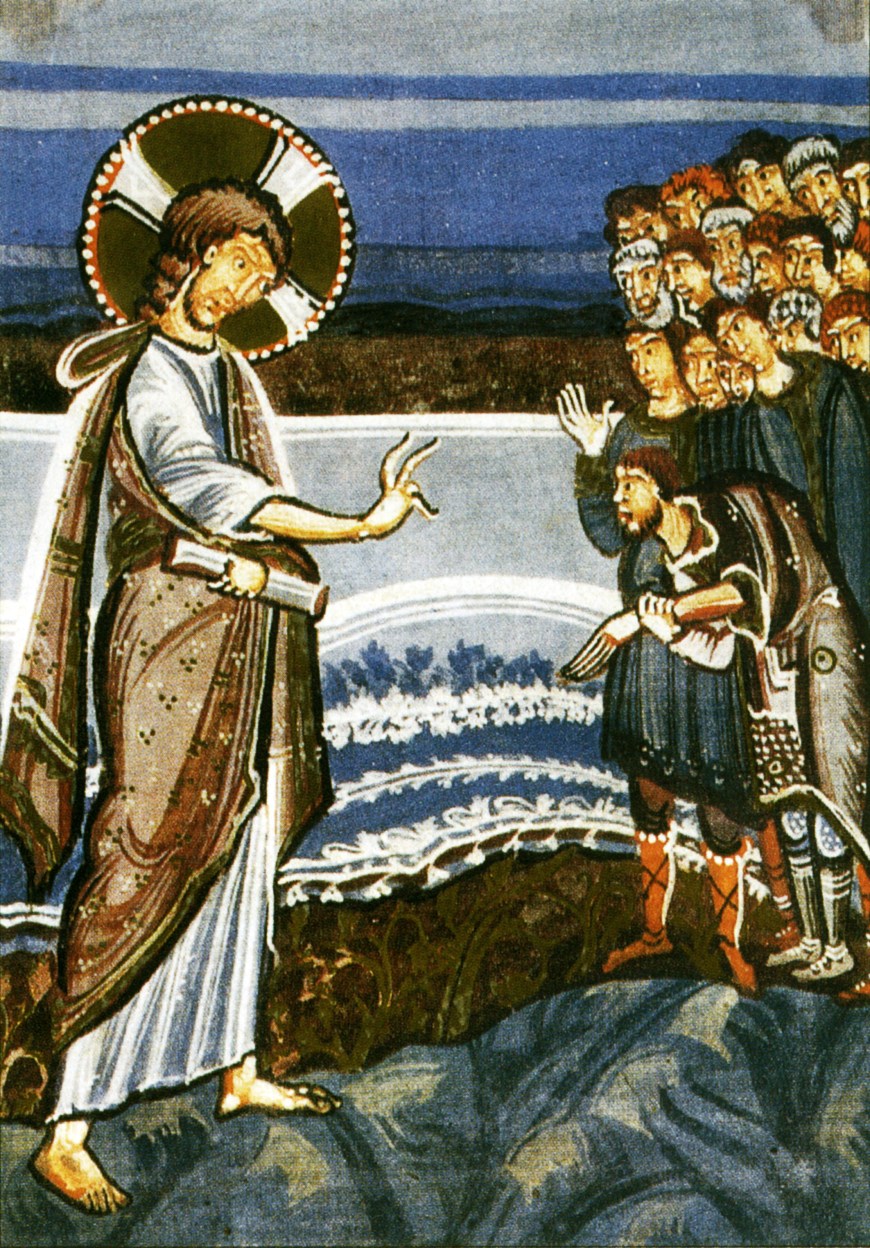 The example is Christ Healing the Man with a Withered Hand from the Hitda Codex, a Gospel book commissioned by and named in honor of the Abbess of the convent at Meschede, Germany, after 1020 A.D., Hessische Landesbibliotek, Darmstadt, Germany. Photoshop effects applied. The document is in the artistic tradition of the Ottonian dynasty of Saxon kings, successors to Charlemagne in the revived Holy Roman Empire in Western Europe. A better image is now available in The Gospel of Luke: In Scripture, Art & Christian Tradition, image number 52 (See the
 Anglican Internet Church