In working on Trinitytide: The Teaching Season I realized that readings from St. Paul’s work occupy 80+% of all the Epistle/For the Epistle readings for Trinity Season. My inventory of historical images had only 4 or 5 representations of St. Paul and I had often fallen back to Andrei Rublev’s tempera and silver on panel unfinished icon, which dates to the 1st decade of the 15th C. The search for more images took me through a lot of terrible art but, in the end, I found about 15 additional images of the prolific Evangelist to the Gentiles and who is often substituted for Matthias in imagery of the Twelve. especially in the Eastern Church tradition.

Not wanting to give away too much, I have included here only one of the new impressions. As Trinity season progresses, and I release more episodes in the Trinitytide series, all 15 of the new images will appear in slides.
In the example at left the 11th C. artist captured three historical understandings about images of St. Paul: receding hair line, full bear, intense facial expression. He hold a book, representing either the Gospels or, more likely, the Pauline Epistles. Since this is a Byzantine image and not one from the Western Church tradition, he does not hold an object which symbolizes the manner of his martyrdom. In nearly all Western Church icon, painting, mosaic or statue St. Paul holds a sword or a broken sword. I applied perspective correction to the original image to make it more closely resemble the frontal view of the same mosaic by another photographer. Apologies to the Dreamstime photographer. As always, I am impressed by the way the Byzantine mosaic-maker managed to give the sense of flowing robes with lapis blue and the suggestion of indirect light. Based on the colors and the pose, I wonder whether this mosaic was the inspiration for Rublev’s unfinished work. Perhaps, but perhaps not, since other sources date the mosaic to a later century, before the Moslem conquest of Constantinople.
Next week I will upload Episode Four in the series, which covers the Seventh, Eighth and Ninth Sundays after Trinity, plus three more of the eleven Trinitarian hymns in the AIC Bookstore publication, The St. Chrysostom Hymnal. To learn more about the Hymnal, visit my Amazon Author Central page.
As always, thank you for your interest and support.
May the Lord bless you in all that you do in His Name! Amen! Glory be to God for all things! Amen!

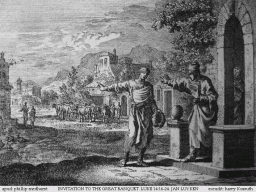 pologies to readers/viewers for the incorrect attribution of a scene in Episode Two of Trinitytide: The Teaching Season. The credit line for Jan Luyken’s etching of the Invitation to the Great Supper should have read:
 Episode Two in the AIC Seasonal Video series, Eastertide: From Resurrection to Ascension, is now available in both video and podcast versions. Subjects are services for Easter Monday and Easter Tuesday, each commemorating a post-Resurrection appearance of Christ, and the First, Second and Third Sundays after Easter. There are 16 illustrations from the 11th, 12th, 14th, 15th, 16th, 17th, 18th and 19th C., including the tempera on panel work, Jesus on the Road to Emmaus, by Duccio di Buoninsegna in the Byzantine style at the Museo dell’Opera del Duomo (Siena), Siena, Italy, painted between 1308 and 1311 A.D. (Public domain: Yorck Project, 10,000 Masterwerke).
 This morning I uploaded Episode One in our newest Seasonal Video series, Eastertide: From Resurrection to Ascension. The episode includes 17 illustrations from the 13th to the 19th C. (with a photograph from the 21st C.), mostly Resurrection imagery. Artists include, in order of use, fresco-makers at Constantinople, James Tissot, William Holman Hunt, Giotto, fresco-makers at Milan, Byzantine icon-painters, and Russian Orthodox icon painters, including the celebrated Andrei Rublev, from the 15th to the 18th C. Regular viewers will have noticed the change in the series graphic from Portrait to Landscape orientation. This became necessary when I switched production of videos from the version of iMovie on my iPad to the enhanced version on my Mac. The “Ken Burns effect” program on the Mac, which has many additional features, especially in the area of multi-source soundtracks, is strongly biased toward Landscape imagery. Viewers will easily see the difference in the way the images scan during the video. For those especially fond of icons: the image in the title graphic is one of the best, most carefully drawn representations of the classic “Harrowing of Hades” depiction of Christ, standing on the destroyed gates of Hades and the pit with the “keys to Hades and Death,” lifting Adam (in white) and Eve (in red) from Hades. The figure with halo at left center (near the tip of Jesus’ right hand) is John the Baptist, observing in his status as the Last Prophet of the Old Testament. The blue oval is a classic representation of the Glory of the Lord, sheckinah in Hebrew.
 In the earlier podcast versions I read both the Verse and the Response lines and said the Amen. In the new video version, I enlisted the help of the congregation at Holy Cross Reformed Episcopal Church in North Chesterfield, VA. I thank them for their enthusiastic participation. They and I speak the opening Confession (left), repeated at the start of each section); the opening Verse and Response that includes the Lord’s Prayer; the internal transition Verse and Response (see below) in each of the seven parts; the closing Verse and Response which includes the Nicene Creed; and, throughout, the Amen for each prayer. To enhance the viewing experience and make it as much as possible like participation in the original 3-hour program, I have inserted an Intermission slide between
 each of the sections, with the instruction to pause the video. Each transition slides notes the starting time of the next section.
 The video version includes 117 slides, each with an illustration. There are about 48 different illustrations, ranging from the oldest known representation of the Crucifixion from around the mid-6th C. in Northern Mesopotamia (part of modern Syria), to mosaics, frescoes, watercolors, engravings, and paintings from the 6th through the 18th C. in the Western and Eastern Church artistic traditions; and, from the 19th C., stained glass windows. One of these windows, a stunningly-beautiful piece at St. Gertrude’s Church, Stockholm, Sweden, is used as the transition slide that marks the start of the Verse and Response for each part of the program. For the Confession slide, I inserted a Christ Pantokrator mosaic (top left) from the Hagia Sophia at Constantinople commissioned by the Byzantine Emperor Justininian in the 6th C. The picture credit lines are not mentioned in the narrative, both to save time and to avoid distraction from the meaning of the text and the solemn mood of the presentation.
 Anglican Internet Church