Two new episodes are now available on our You Tube channel. Episode Twenty-one celebrates the life of Cyprian of Carthage, whose Feast Day is September 13th. I wrote about St. Cyprian in the previous blog post. I’ve fixed the You Tube link so it should be available as of this morning. Watch the video. Listen to the Podcast
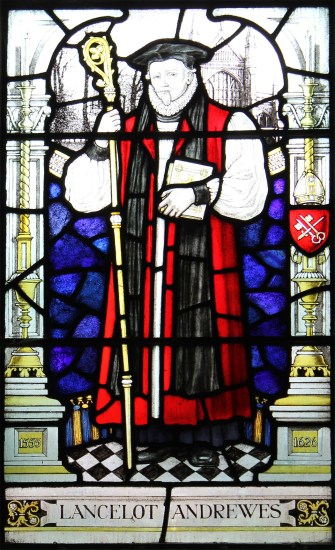 Episode Twenty-two, also published today, celebrates the life and contributions of one of the greatest of the 16th-17th Anglican divines, the Blessed Lancelot Andrewes, whose Feast Day is September 25th. Andrewes is one of my personal favorites. I suspect that he was one of those rumored to have desired placing the Church of England under the jurisdiction of the Patriarch/Archbishop of Constantinople. The illustration is a memorial window in the Cloister at Chester Cathedral, Chester, England. The picture is public domain through Wikipedia Commons. I applied perspective correction using Photoshop to the original file.
Andrewes is little-known outside the world’s small circle of Anglicans interested in the history of the Church. He was a remarkable man in many respects. He could speak and write in the ancient languages of the Holy Land: Aramaic, Latin, Greek, Hebrew, Arabic, and Syriac. He served on the committee which supervised the production of the Histories in the Hebrew Old Testament. He was Chaplain to both Queen Elizabeth I and King James I. During his lifetime he wrote a series of devotions, commonly called catenae, which are prayers based on Scriptural verses. His placed a restriction that this collection could not be published until after his death, I suspect it was out of a desire not to introduce another potential form of worship into an already troubled Church environment that was not too far relieved from the memory of the terror of Bloody Mary and the death of the three Oxford Martyrs, Latimer, Ridley and Cranmer (the subject of Episode Twenty-three in this series. I wrote about him in Christian Spirituality: An Anglican Perspective
I’ve finished both the slides and script for the next several episodes in the Saints2 series, including No. 23-Gabriel, Michael and Raphael; No. 24-Jerome of Jerusalem; No. 25-Francis of Assisi; No. 26-Vincent De Paul and am currently completing No. 27-The English Martyrs (mentioned above).
In book news, the Kindle version of The Writing Prophets of the Old Testament should be available on or before September 22nd. I’m awaiting the final proof of the file around the 18th of the month. Until two weeks ago, I had not been aware that it was not already converted and available.
As always, thanks to viewers for your interest in this internet ministry. Book sales and contributions are our only sources of financial support.
May God bless you in all that you do in His Name! Amen. Glory be to God for all things! Amen!
 UPDATED VERSION – 08/25/2017
 Next week (week of 8/28) I will release Episode Twenty-one in The Lives of the Saints – Second Series. Episode Twenty-one celebrates the life of St. Cyprian of Carthage, whose Feast Day is September 12. The illustration is a detail which I lifted from a 6th C. Byzantine mosaic frieze at the Basilica of St. Apollinare, Ravenna, Italy (image copyright RibieroAntonio/Can Stock Photo, Inc.). In the frieze the martyred saints stand in line to give their crowns to Jesus Christ, who is seated as Christ Pantokrator flanked by angels. In the original, St. Cyprian stands between St. Cornelius, Bishop of Rome when Cyprian was Bishop of Carthage, and St. John Cassian, one of the earliest Western Church chroniclers of the early Church.
 Episode 19 in The Lives of the Saints – Second Series, focused on the life of St. Joseph of Arimathea is now available in both video and podcast versions. Finding a good graphic for St. Joseph was a challenge, since there are so few icons, mosaics or paintings of him. The Byzantine icon, Descent from the Cross (14th C., Agia Marina, Kalapanagiotis, Cyprus shows the scene well. But the most striking is Lamentation Over the Dead Christ, painted in oil on canvas by Pietro Perugino in 1495 A.D. and which is now displayed at the Pitta Palace, Florence, Italy, provides the most famous depiction. From it many have extracted the head of St. Joseph, who kneels at the feet of Jesus.
 Another image of Joseph of Arimathea is from the Life of Christ series of sketches in charcoal and watercolor by French artist James Tissot, now in the collection of the Brooklyn Museum, which has made them available in the public domain. In Tissot’s work the subject is much more clearly of Semetic origins (compared to the Europeanized image painted by Perugino and typical of Western Church art).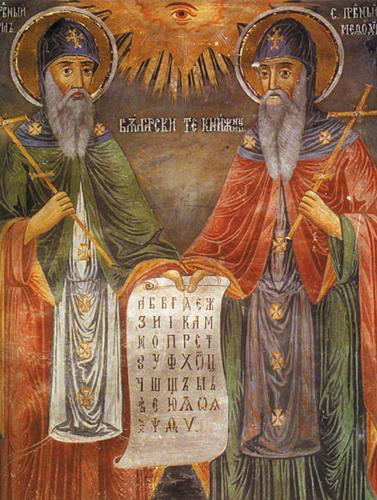
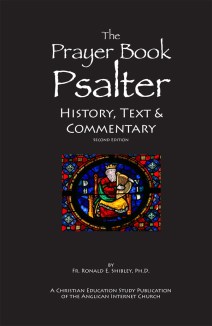 This coming week I expect to finish the first video produced on our new iMac laptop using the more advanced version of iMovie. It is a short preview with page images for the AIC Bookstore – Spring A.D. 2017 Preview. You’ll see the stylistic differences right away, with new page transitions not available in the iPad version used for all earlier videos. There will be information about all publications, including the pending revised edition of The Prayer Book Psalter. The revised version includes some design changes to type faces and content. Some of these include the first line in Latin for each Psalm and additional focus in the commentaries on how the same issues and verses are addressed in other AIC Publications, including books, videos and podcasts. The publication date depends upon completion of the proof-reading, but I hope it can be finished by early summer.
 Episode Sixteen in The Lives of the Saints, Second Series, celebrating the life and remarkable contributions to the Church Universal of St. Athanasius of Alexandria, is now on line at our Web Site and through our You Tube channel. St. Athanasius is celebrated in the Western Church on May 2nd, the date of his death.
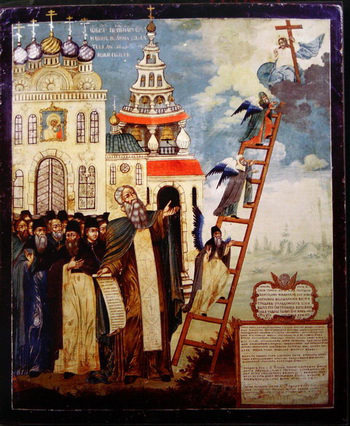 sode Fifteen in The Lives of the Saints – Second Series was uploaded to the Web last week. It celebrates the life of St. John Climacus, 7th C. abbot of St. Catherine’s Monastery in Sinai, and includes many colorful illustrations on the author of The Ladder of Divine Ascent, one of the most important books of the early church in the realm of Christian Spirituality.
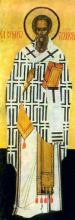 Saturday, February 18th, is the Feast Day of St. Simeon of Jerusalem. Episode Twelve in The Lives of the Saints – Second Series honors his devoted work in leading the church in the 1st Century. The illustration is a Russian Orthodox icon showing him in bishop’s garb against gold background. The location and date was not specified by the public domain source. This is a short episode, owing to the lack of material about St. Simeon.
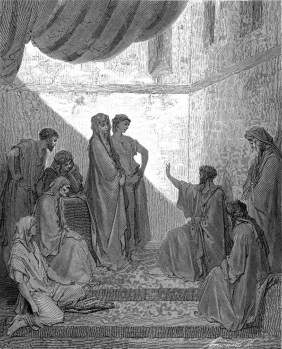 I have uploaded two new videos this week. The first, Episode Ten, is Part Two of the celebration of the remarkable life of St. John Chrysostom, 4th-5th C. Bishop of Antioch, then Constantinople. Episode Ten includes a reading of the Seven Nocturne Prayers which caused so much distress among the Constantinople clergy called to return for evening worship instead of sumptuous dinners! In addition to the Nocturnes are four quotations from his writings.
 Two new episodes in The Lives of the Saints (Second Series) were uploaded this week. Episode Nine celebrates the life and contributions to the Church Universal of St. Gregory Nazianzen, whose Feast Day is Jan. 25th. St. Gregory is also known by two other names: St. Gregory the Theologian and Gregory Nazianzus, which recognizes the name of his jurisdiction as Bishop in Asia Minor (now southeastern Turkey).
 Episode Nine celebrates the life of the AIC’s patron saint, John Chrysostom, which literally means John the Golden Mouth. He was perhaps the most gifted pulpit orator of the Church in the first 1,000 years of Christianity. He left behind an enormous legacy of homilies on Genesis and the Psalms as well as the Gospels of Matthew and Luke, all the epistles of St. Paul, and St. Luke’s Acts of the Apostles. He served the Church first at Antioch, the second See of the early Church, and later as the 12th Bishop of Constantinople, the last of the five early Sees of the Church. St. John was forced from office by Empress Eudoxia in 403 A.D. He returned briefly, owing to the strong public outcry against his expulsion, but was exiled a second and final time around 405 A.D. He died in exile in 407 A.D. HIs last words were: “Glory be to God for all things!” His remains, along with those of Gregory Nazainzen, were stolen in 1204 A.D. during the Fourth Crusade. For centuries, they remained in St. Peter’s Basilica (first the old one and then the current one). They were returned by Pope Benedict XVI in time for the Feast of St. Andrew in November 2006 A.D.
 Anglican Internet Church