 Episode Sixteen in The Lives of the Saints, Second Series, celebrating the life and remarkable contributions to the Church Universal of St. Athanasius of Alexandria, is now on line at our Web Site and through our You Tube channel. St. Athanasius is celebrated in the Western Church on May 2nd, the date of his death.
Regular readers of his blog will notice the familiar black, while and gold on blue in the accompanying 12th C. fresco from Macedonia. There’s nothing like that shade of blue in western religious art.
Athanasius is also called Athanasius the Great to distinguish him from the many Eastern saints of the same name. He’s also known as the Father of the Canon; the Father of Orthodoxy, and was recognized among the first four men named “Doctors of the Church” in the Roman Catholic tradition (with St. John Chrysostom, St. Basil of Caesarea, St. Basil the Great, and St. Gregory Nazianzen). For five decades in the middle of the 4th C. he defended Nicene Christianity against Arians and others, even at the risk of persecution and expulsion from office. Today, his accusers are long gone, most of their names forgotten, but Athanasius the Great remains among the most-revered figures in the Church in both the Eastern and Western traditions.
The episode runs just over 18 minutes and includes many other works of art viewers might not have seen before.
Watch the Video Listen to the Podcast.
As always, thanks for your interest and support of the Anglican Internet Church ministry. Glory be to God of all things! Amen!
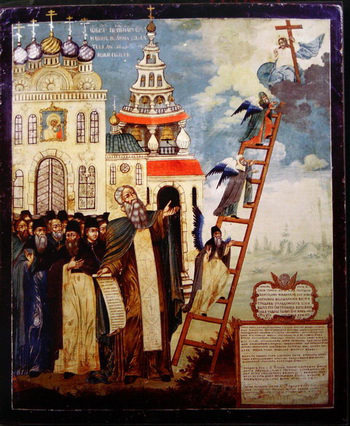 sode Fifteen in The Lives of the Saints – Second Series was uploaded to the Web last week. It celebrates the life of St. John Climacus, 7th C. abbot of St. Catherine’s Monastery in Sinai, and includes many colorful illustrations on the author of The Ladder of Divine Ascent, one of the most important books of the early church in the realm of Christian Spirituality.
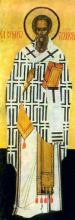 Saturday, February 18th, is the Feast Day of St. Simeon of Jerusalem. Episode Twelve in The Lives of the Saints – Second Series honors his devoted work in leading the church in the 1st Century. The illustration is a Russian Orthodox icon showing him in bishop’s garb against gold background. The location and date was not specified by the public domain source. This is a short episode, owing to the lack of material about St. Simeon.
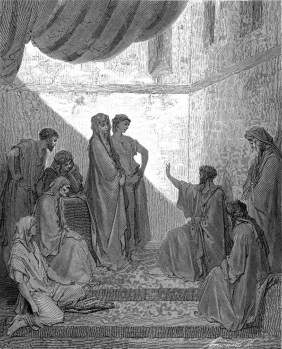 I have uploaded two new videos this week. The first, Episode Ten, is Part Two of the celebration of the remarkable life of St. John Chrysostom, 4th-5th C. Bishop of Antioch, then Constantinople. Episode Ten includes a reading of the Seven Nocturne Prayers which caused so much distress among the Constantinople clergy called to return for evening worship instead of sumptuous dinners! In addition to the Nocturnes are four quotations from his writings.
 Two new episodes in The Lives of the Saints (Second Series) were uploaded this week. Episode Nine celebrates the life and contributions to the Church Universal of St. Gregory Nazianzen, whose Feast Day is Jan. 25th. St. Gregory is also known by two other names: St. Gregory the Theologian and Gregory Nazianzus, which recognizes the name of his jurisdiction as Bishop in Asia Minor (now southeastern Turkey).
 Episode Nine celebrates the life of the AIC’s patron saint, John Chrysostom, which literally means John the Golden Mouth. He was perhaps the most gifted pulpit orator of the Church in the first 1,000 years of Christianity. He left behind an enormous legacy of homilies on Genesis and the Psalms as well as the Gospels of Matthew and Luke, all the epistles of St. Paul, and St. Luke’s Acts of the Apostles. He served the Church first at Antioch, the second See of the early Church, and later as the 12th Bishop of Constantinople, the last of the five early Sees of the Church. St. John was forced from office by Empress Eudoxia in 403 A.D. He returned briefly, owing to the strong public outcry against his expulsion, but was exiled a second and final time around 405 A.D. He died in exile in 407 A.D. HIs last words were: “Glory be to God for all things!” His remains, along with those of Gregory Nazainzen, were stolen in 1204 A.D. during the Fourth Crusade. For centuries, they remained in St. Peter’s Basilica (first the old one and then the current one). They were returned by Pope Benedict XVI in time for the Feast of St. Andrew in November 2006 A.D.




 Anglican Internet Church