
Episode Fourteen is the 3rd in the New Testament: Gospels Bible Study Video series to be focused on the Gospel of St. Luke. Topics include more on the Nativity, with special emphasis on the third angelic “annunciation,” this time to the shepherds; the last 2 of 4 unique songs in the Gospel of St. Luke, the Magnificat and the Nunc dimittis; plus the prophecies of Simeon and Anna. The episode includes 8 illuminations in colors and gold on parchment from the 11th C. and 3 from the 13th C.; 2 frescoes from the 13th C. and one from the 14th C.; a spectacular mosaic of the Holy Family registering according to the decree of Quirinius from the 1st Qtr, 14th C. near Constantinople/Istanbul; 1 enamel from the 15th C.; 1 oil on canvas from the 15th C; and 2 watercolors from the 19th C. Nearly all of these are not widely-seen. They were found in recently-digitized collections in England, Germany, Italy, Spain and Asia Minor. I hope viewers enjoy seeing these inspiring works of faith as much as I have enjoyed searching archives to find appropriate images and help them into public view on the Web.
Watch the Video on our YouTube channel. Listen to the Podcast hosted on our Podbean channel.
It was difficult to decide which illustration to include in this Blog posting, The one which really sums up the concept of “behold” as used by St. Luke is from the Gospels of Otto III, one of the Holy Roman Emperors who followed in the line of Charlemagne, crowned HRE at Rome in 800 A.D. I used it in a blog posting in June A.D. 2018. The work was painted at the Reichenau monastery, Reichenau, Germany, the same facility where the Bamberg Apocalypse was made between 1000 and 1020 A.D. Everything the reader/viewer should “behold” flows fantastically above St. Luke’s head in nearly every color imaginable, but especially red and yellow. The original is at the Bavarian State Library, Munich, Germany. This image came from the Yorck Project: 10,000 Masterworks, made available on a DVD in the early 21st C.
Meanwhile I have been continuing to work on Episode Thirty-two and Episode Thirty-three, on the Gospel of St. John. My wife, Corkie, and I did take time off to celebrate our 47th anniversary with a trip to Roanoke and Lexington, VA. We paid homage to Roanoke’s famed Black Dog Salvage, bringing home two pieces of furniture. We enjoyed our stay at the Robert E. Lee Hotel and dinner at the Southern Inn Restaurant (directly across Main St. from the hotel). Corkie drove the entire length of the Blue Ridge Parkway between Roanoke and Afton Mountain/Rockfish Gap, west of Charlottesville. The views from the many lookouts across the Shenadoah Valley were truly spectacular. I must not leave out our lunch visit to another Roanoke landmark, The New Yorker Delicatessen and Restaurant on Williamson Road where I had a real Reuben and Corkie feasted on a liverwurst (the real thing) on rye.
Thank you for your interest and support. Please consider sharing your knowledge of this site with others. You can subscribe by clicking the Follow Anglican Internet Church tab.
As always, may God bless you in all that you do in His Name! Amen! Glory be to God for all things! Amen!
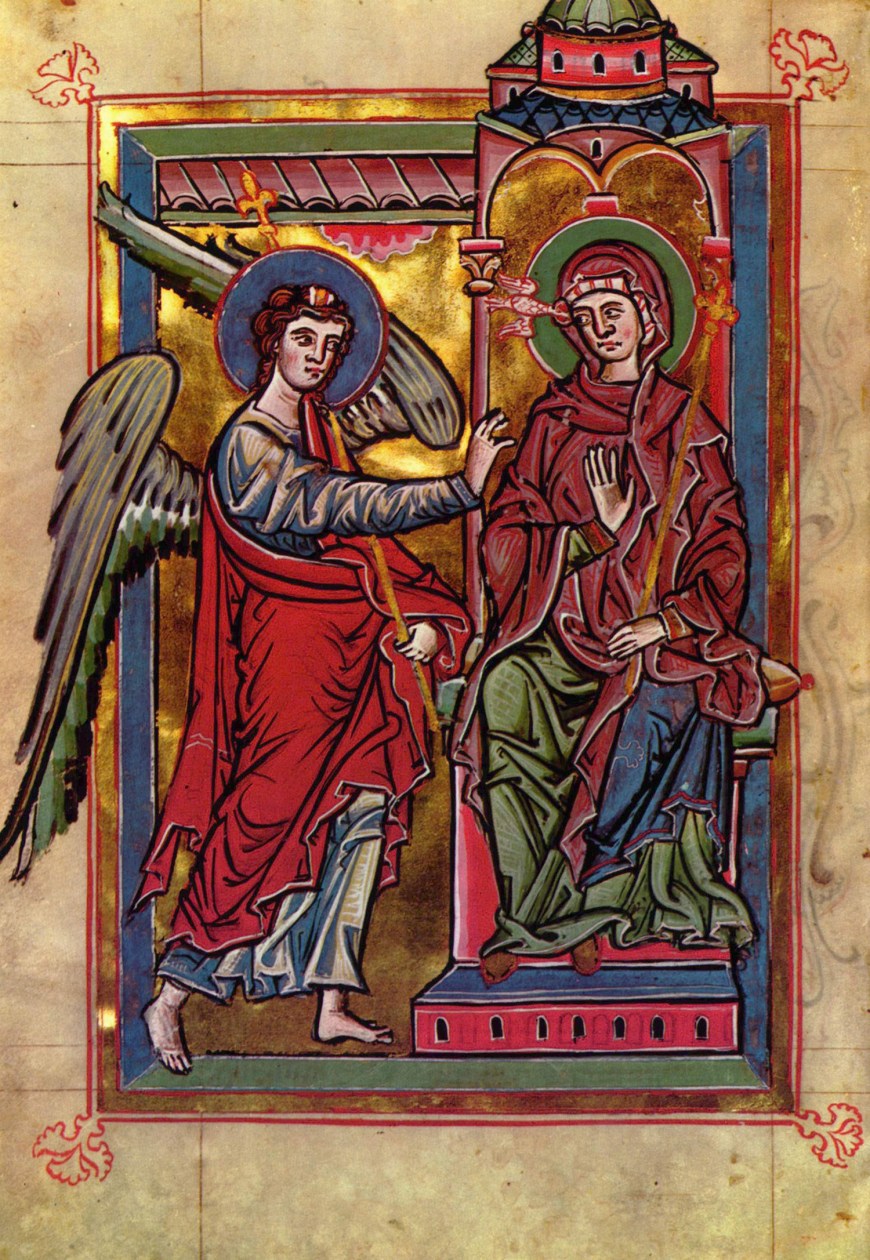
 The episode is loaded with many of the examples of historic art added to our library in the last year. Few in the Western Church are aware that St. Luke is credited in the Eastern Church and among many Roman Catholics as the first icon-painter. The episode includes St. Luke Painting the Virgin Mary, a miniature illumination (less than 1″) in colored inks and gold on parchment with an elaborate floral border from The Gospels of Luke and John, a codex made in England in the 1st Quarter of the 16th C., from Ms. Royal 1 E V, Folio 3, British Library, London, England. The image is so small that I could not use it here. Instead, I offer another you, St. Luke Writing His Gospel, an illumination in tempera and gilt on vellum from the St. Augustine Gospels, begun in Italy (presumably Rome) in the 6th C. and completed in England after being given to Corpus Christi College, Cambridge, by St. Gregory the Great. The original is at Cambridge, CCC Library Mss 286, Folio 129v. This version is in lower resolution for internet use. The version in the video is 300 dpi. Both versions have been modified with perspective correction technology.
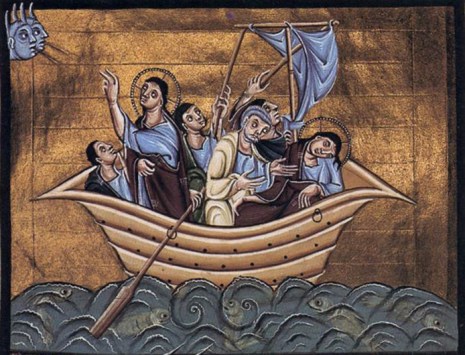 Episode Nine in the revised edition of our Bible Study series, New Testament: Gospels is now online in both video and podcast versions. In Episode Nine I continue discussion of the Gospel of St. Mark with the next six of eighteen miracles he describes. The first three demonstate Divine Power over Nature and the second three demonstrate Divine Power over Speech and Sight. The illustration, Calming the Seas, is the top half of a miniature illumination in colored inks and gilt on vellum from the Gospels of Otto III, produced at Reichenau Monastery, Reichenau, Germany, in the late 10th or early 11th C. The original is at the Bavarian State Library, Munich, Germany. I applied perspective correction to the original image. Otto III was a Saxon/German king who ruled the Holy Roman Empire in Europe, which was revived in 800 A.D. by Charlemagne. The monastery is the same facility where the Bamberg Apocalypse was prepared in the early 11th C. Viewers who have read the AIC Bookstore Publication, Revelation: An Idealist Interpretation, which includes 51 illustrations from the Bamberg Apocalypse, will recognize the style and, possibly, some of the faces.
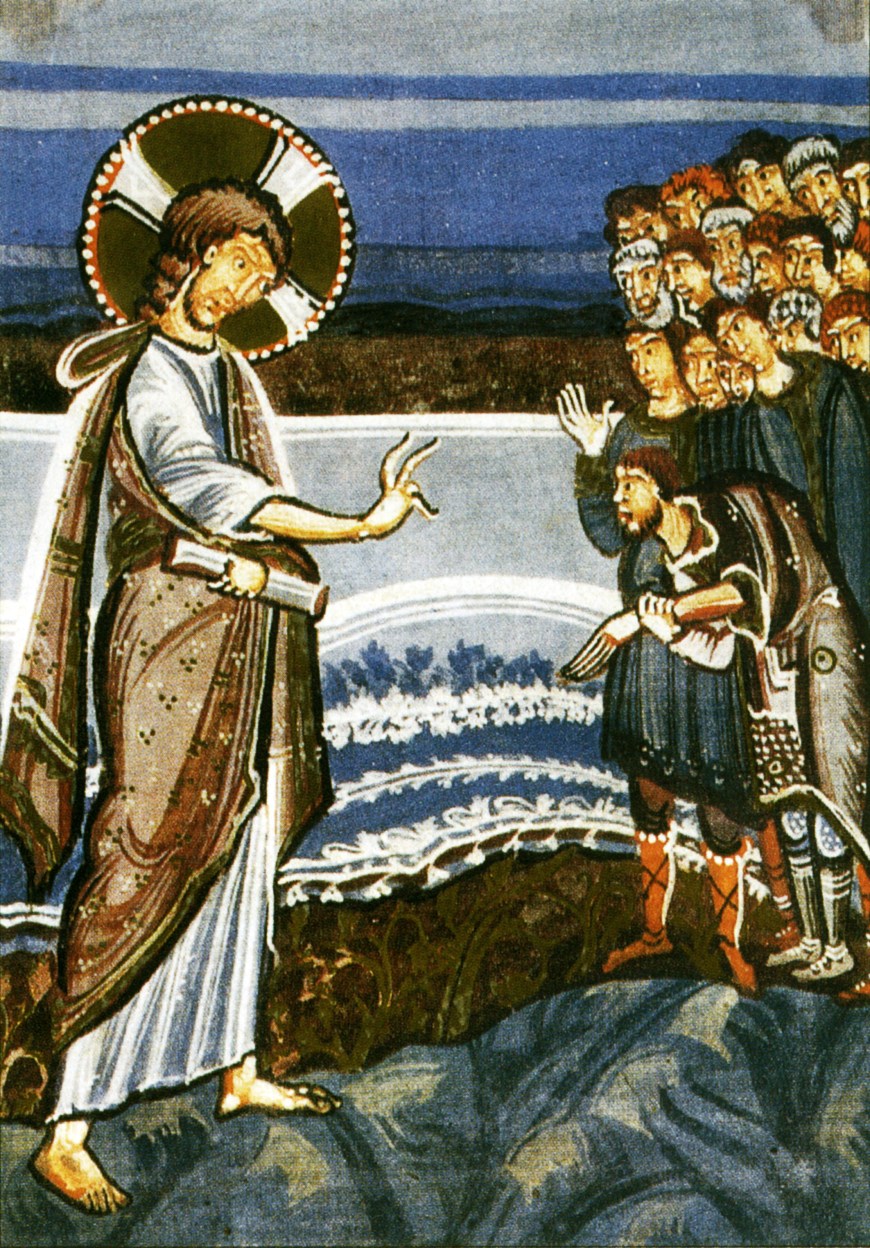 The example is Christ Healing the Man with a Withered Hand from the Hitda Codex, a Gospel book commissioned by and named in honor of the Abbess of the convent at Meschede, Germany, after 1020 A.D., Hessische Landesbibliotek, Darmstadt, Germany. Photoshop effects applied. The document is in the artistic tradition of the Ottonian dynasty of Saxon kings, successors to Charlemagne in the revived Holy Roman Empire in Western Europe. A better image is now available in The Gospel of Luke: In Scripture, Art & Christian Tradition, image number 52 (See the

 Anglican Internet Church