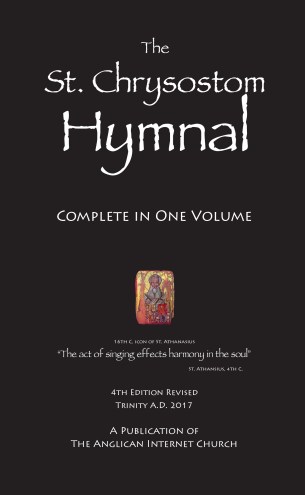
 I’m very pleased to announce that initial problems with producing The St. Chrysostom Hymnal in a single volume are being resolved this month. The first effort resulted in a volume far to large to transmit to our printer unless the book was separated into two volumes. The problem was resolved using file compression technology and by making the file compatible only with the most recent versions of Adobe Acrobat.
The 4th Edition Revised will be available in early December as a single volume offering lovers of traditional Christian music access not only to many of the best hymns from the venerable 1940 Hymnal but also an expanded collection of traditional and easily-sung hymns and carols from many denominations as a supplement for other hymnals. The following is but a small sample of the contents.
The following are selected highlights of the contents. For Advent there is one new song, Charles Coffin’s The Advent of Our King (1789). Other music is set to tunes that are easier to sing. These include Lift Up Your Heads, Ye Mighty Gates (which is Hymn 484 in the 1940 Hymnal, here set to Veni Emmanuel); O Word, That Goest Forth on High (7th C.); and While Shepherds Watched Their Flocks By Night, set in the English style to Winchester Old..
For Christmas the selection is expanded to include two of Martin Luther’s hymns, Good News from Heaven the Angels Bring (in a different translation more easily sung) and All Praise to Thee, Eternal Lord; James Montgomery’s Bright and Joyful Is the Morn (1825); and John Simpson Cook’s Gentle Mary Laid Her Child (1919) (reset to Tempus Adest Floridum); and the German Christmas hymn, Rejoice, Rejoice, Ye Christians (1640).
For Epiphany I have added the renowned English cleric and music scholar John Mason Neale’s O Thou, Who By a Star Didst Guide (1842); Basil Woodds’ evangelical hymn Hail, Thou Source of Every Blessing (1810); plus the celebrated Catherine Winkworth’s 19th C. translation of O Christ, Thou True and Only Light (1630), the latter an inspiring interpretation of the literal meaning of the Greek word from which we get Epiphany: to shine forth. [F.Y.I: I use a modern, Celtic-inspired string arrangement of Hail, Thou Source of Every Blessing as the introductory music in several of our video series and podcasts.]
For Lent the hymnal offers a new tune for St. Gregory the Great’s Kind Maker of the World (6th-7th C.) and several new songs, including Robert Grant’s Savior, When In Dust to Thee (1815) (revived from the 1933 Episcopal Hymnal and set to the lyrical Welsh tune, Aberystwyth) and the German hymn, O Faithful God, Thanks Be to Thee (1572), set to the familiar tune Old Hundredth (using a Lutheran arrangement which varies slightly from the more familiar version).
Many of the hymns for the Hours offices in the 1940 Hymnal are reset to more easily sung tunes, avoiding the more difficult plainsong arrangements. There are entire sections of music directed separately to God the Father, God the Son, God the Holy Spirit, and to the Holy Trinity, including a personal favorite of mine, Bernard of Clairveaux’s stirring and worshipful 12th C. hymn, O Jesus, King Most Wonderful, inspired by the book which started a trend in the Church of England’s worship practices, Hymns Ancient and Modern (1861) and set to Winchester Old. There is also a selection of suitable Opening (Processional) and Closing (Recessional) hymns; hymns of praise, including Henry Baker’s hymn, Praise, O Praise, Our God and King (circa 1870), a paraphrase of Psalm 136 which also inspired John Milton’s Let Us With a Gladsome Mind, arranged to the simple tune Monkton; and a collection of hymns to the Church Universal. Also included is Horatio Nelson’s For All the Saints in Warfare (1864) from the 1892 Episopal Hymnal, which includes a special 2nd verse for each of the eighteen saints with feast days in the Book of Common Prayer. I use that song as the theme music to open and close episodes in the AIC Christian Education video series, The Lives of the Saints.
Sources of the music, which range from the 3rd through the 20th C., include the hymnals of many denominations, including the Church of England and older Episcopal Church hymnals going as far back as the late 18th C. as well as Lutheran, Methodist, Baptist, Presbyterian, Moravian Brethren, Roman Catholic, Byzantine and other traditions.
The 494 traditional hymns, carols and canticles are set to tunes and arrangements intended to encourage full participation in congregational singing. The cover includes a revealing quotation from St. Athanasius: “the act of singing affects harmony in the soul.”
Hymns and carols were selected for their use of traditional words, faithfulness to Scripture, and ease of singing by the average member of any congregation rather than for professional choral singing. The selection of tunes was a compromise: retaining time-tested traditional music; encouraging greater participation by members of a congregation; and also avoiding any which might immediately bring to mind a commercial for a famous brand of hot dog or the opening theme of a television series. All the tunes and songs were tested by the members of my former parish for ease of singing and for general appeal to a broad cross-section of people with backgrounds in several denominations other than Anglican/Episcopal.
An additional bonus is the wide selection of doxologies, which are set to six traditional and familiar tunes. Indexes are include a combined Author-Composer-Translator-Arranger-Sources list, plus indexes by Tune, Metric, Church Season, Liturgical Purpose, First Line or Common Title, and, if known, Scriptural Source.
Readers can use the Virtual Bookstore links on the Home page to access additional information, pricing and ordering your own copies. 100% of all book royalties are contributed to the AIC and help us offset the cost of the royalty-free art which is used in all our video series and for the royalty-free music used for both the videos and podcasts.
Thank you for your interest in and support for The Anglican Internet Church. May God bless you in all that you do in His Name.
Glory be to God for all things! Amen!
 One viewer raised a question concerning the current episode, Episode Five, in AIC’s Christian Education video series, The War on Christianity. The question indicates the need for a clarification for those who my have not seen Episode One through Episode Four. For those who have just joined in watching series, let me repeat some of the points I made in that first episode.
 For Christmas Eve, a modern version of the evocative traditional English style of carols and lessons can be watched using the link below. It picks up where the Great “O” Antiphons ended with a series of prayers and responses for Christmas Eve:
 One of the best programs the AIC has created is the series devoted to key theme words for each of the days from Christmas Day to Epiphany Eve. Below are the links for Dec. 25th through December 31st. Next week I will post the remaining links. The series has nothing whatsoever to do with the silly song of the same name.
 The 4th edition of the St. Chrysostom Hymnal is almost ready for publication. The preliminary design for the cover follows our new white on black color scheme and a quotation from St. Athanasius: “the act of singing effects harmony in the soul.”
 Anglican Internet Church