At last! Glitches overcome (or fixed), on Wednesday morning I completed and uploaded Part 1 and Part 2 of Episode One in the newest AIC Season Video series, Trinitytide: the Teaching Season. As noted in a previous blog posting, the episode ran too long and was split into two parts. There is only a transition slide between the end of Part 1 and the start of Part 2 so viewers will need to watch Part 2 to hear the discussion of seasonal music for Whitsunday and Whitsun Week.
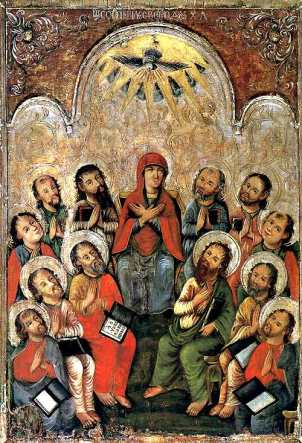
For thematic focus (after all, this is a teaching video series) I included a discussion of Whitsunday and a short history of Trinity season and its relationship to Pentecost in the new Trinitytide series. Viewers will find an outstanding collection of illustrations in Episode One, with 15 of them on the first Pentecost. Many are rarely seen in the Western Church, except among religious scholars and art historians. The oldest Pentecost illustration was made in 586 A.D. The most recent example was prepared near the end of the 19th or early in the 20th C. Viewers will also learn about the 14th person in the Byzantine icons of Pentecost (12 Apostles, the Blessed Virgin, and — watch and find out).
Watch Episode One-Part 1. Listen to the Podcast of Episode One-Part 1
Watch Episode One-Part 2. Listen to the Podcast of Episode One-Part 2
Episode Two in the series will be focused on Trinity Sunday, First Sunday after Trinity and Second Sunday after Trinity, plus more seasonal music from The St. Chrysostom Hymnal. I expect to have the episode ready next week or the following week.
As always, thanks for your interest in and support for this Internet-based ministry which seeks to teach traditional Christian doctrine and practice to the faithful wherever they live — and make it available 24/7.
May God bless you in all that you do in His Name!
Glory be to God for all things! Amen!

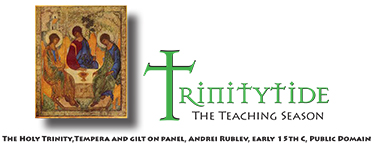 I’ve begun work on the series for Trinitytide A.D. 2018, with a series graphic using Andrei Rublev’s c. 1420 A.D. icon in which the three visitors to Abraham under the Oak of Mamre represent the Holy Trinity. Until the Renaissance, any representation of God the Father was forbidden, which they still are in the Eastern Church, which uses only images of Christ, who was seen by mankind. The Holy Spirit is always the Dove described in the Gospels or a flame of fire described by St. Luke in Acts 2. The type face is a new one I bought from a vendor for use with the series. Each episode will include a small logo in the upper left of each slide without the icon.
 Episode Two in the AIC Seasonal Video series, Eastertide: From Resurrection to Ascension, is now available in both video and podcast versions. Subjects are services for Easter Monday and Easter Tuesday, each commemorating a post-Resurrection appearance of Christ, and the First, Second and Third Sundays after Easter. There are 16 illustrations from the 11th, 12th, 14th, 15th, 16th, 17th, 18th and 19th C., including the tempera on panel work, Jesus on the Road to Emmaus, by Duccio di Buoninsegna in the Byzantine style at the Museo dell’Opera del Duomo (Siena), Siena, Italy, painted between 1308 and 1311 A.D. (Public domain: Yorck Project, 10,000 Masterwerke).
 This morning I uploaded Episode One in our newest Seasonal Video series, Eastertide: From Resurrection to Ascension. The episode includes 17 illustrations from the 13th to the 19th C. (with a photograph from the 21st C.), mostly Resurrection imagery. Artists include, in order of use, fresco-makers at Constantinople, James Tissot, William Holman Hunt, Giotto, fresco-makers at Milan, Byzantine icon-painters, and Russian Orthodox icon painters, including the celebrated Andrei Rublev, from the 15th to the 18th C. Regular viewers will have noticed the change in the series graphic from Portrait to Landscape orientation. This became necessary when I switched production of videos from the version of iMovie on my iPad to the enhanced version on my Mac. The “Ken Burns effect” program on the Mac, which has many additional features, especially in the area of multi-source soundtracks, is strongly biased toward Landscape imagery. Viewers will easily see the difference in the way the images scan during the video. For those especially fond of icons: the image in the title graphic is one of the best, most carefully drawn representations of the classic “Harrowing of Hades” depiction of Christ, standing on the destroyed gates of Hades and the pit with the “keys to Hades and Death,” lifting Adam (in white) and Eve (in red) from Hades. The figure with halo at left center (near the tip of Jesus’ right hand) is John the Baptist, observing in his status as the Last Prophet of the Old Testament. The blue oval is a classic representation of the Glory of the Lord, sheckinah in Hebrew.
 Episode Three in the AIC Seasonal Video series, Lent A.D. 2018, was uploaded this morning to our You Tube and Podbean channels. The focus of the episode is Fifth Sunday in Lent (Passion Sunday), Sixth Sunday in Lent (Palm Sunday), and Holy Week (Monday before Easter through Easter Even). The text includes historical background plus commentary on all the Collects, Epistle, “For the Epistle” and Gospel readings plus a selection of seasonal music from The St. Chrysostom Hymnal.
 An offshoot arising out of the production of Episode Three was an idea that came to mind very, very early in the morning a few weeks ago. I pondered it carefully and when I got up and went to my Mac I tried to assemble my thoughts on how to implement the idea. When I retired from the pulpit ministry a few years ago, I had intended to make the 3-hour presentation for Good Friday, In the Cross of Christ I Glory, into an AIC Seasonal Video presentation. Other projects (podcasts, videos and books) overwhelmed me and I just never got around to it. In the Cross of Christ I Glory has been available only in the Podcast Homily versions recorded in 2014-2015 A.D. and presented in eight parts. The program was built upon the foundation of a 1946 A.D. presentation for Good Friday by Bishop William Moody, which I augmented with comments by the Very Rev. George Hodges from his Good Friday services and lectures from 1904 A.D. To this base I added material for the mini-homilies accompanying the seven words from the Cross from the homilies of St. John Chrysostom and St. Gregory of Nyssa.
 The first episode in the newest AIC Seasonal Video series, Lent A.D. 2018, is now available in both video and podcast version. The series will include three episode. Episode One is focused on the origin and meaning of the Feast of Lent and an examination of the two services for Ash Wednesday in the 1928 Book of Common Prayer. In Episode Two I will discuss the Collect, Episode and Gospel readings, and appropriate music for the first four Sundays in Lent. In Episode Three, the focus will be on the final two Sundays plus a discussion of Maundy Thursday.
 Episode Two in our newest Seasonal Video series, Gesima: the Sundays in Pre-Lent, was uploaded yesterday. The second and last episode in the series, it is focused on the Collect, Epistle and Gospel for both Sexagesima Sunday and Quinquagesima Sunday plus commentary on Shrove Tuesday, the last day before Lent.
 I’ve been working on the slides and script for Episode One in the Lent A.D. 2018 seasonal video. which must be uploaded days before Ash Wednesday, 2/14. There will be three main areas of interest in Episode One: church meaning of the season; origin of the season; and discussion of services (Holy Communion and Penitential Office) for Ash Wednesday. The first draft of the title/masthead is at left. The image of a draped Cross is copyright Can Stock Photo, Inc./Robhainer. There will be pictures of Anglican Churches around the world, especially altars, including St. Paul’s in London. Episode Two will be focused on First, Second, Third, and Fourth Sundays in Lent. I’m still searching for pictures to use in the series. Any suggestions would be welcome. Pass them along to me via email at: front.stjohnanglican@earthlink.net.
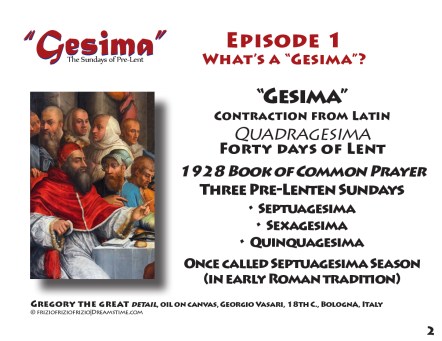 The next teaching series in the AIC Seasonal Video category, Gesima: the Sundays of Pre-Lent, begins today with Episode One. In Episode One I discuss the origin (both the historical and language) of the name, the season’s importance for traditional Anglican worship and a discussion of the first Sunday in the season, Septuagesima Sunday, including appropriate music.
 Anglican Internet Church