Stirring Ourselves Up

Anglicans place great importance on the concept of getting ourselves “stirred up” on the last Sunday before the start of the penitential season of Advent.  This year Sunday Next Before Advent is November 23rd and the First Sunday in Advent is November 30th, the Feast of St. Andrew, the first called of the Apostles.  As I am approaching the one year anniversary of my retirement from active parish ministry on the day before Epiphany, I am faced with the first season in about ten years that I have not conducted a Stir-Up Sunday from the pulpit and the first Advent-Christmas seasons when I have not been personally involved with planning and conducting Advent and Christmas Eve/Christmas Day services.   I’ve come to a decision about how I can “stir myself up” and also stir up followers of my blog posts, MP3 podcast homilies, You Tube videos and book-publishing efforts.

FIRST, beginning on Sunday, November 30th, I will post a revised and extended homily for each of the Sundays on the Anglican Calendar.  The podcast versions will be available through links on a new Homilies page at the AIC web site:  www.AnglicanInternetChurch.net.  Each of the links will show you the name/number of the Sunday and also the primary Scriptural source(s).  In this way, I hope, I can keep adding fresh insight and commentary on traditional Anglican teachings and not have these lost following my retirement.

Advent-Christmas-2014-2015.inddSECOND, beginning December 18th, the seventh day before Christmas Eve, I will post a new video in the Great “O” Antiphons series on our You Tube channel, with a link from the AIC web site.  Each of these seven videos will feature an organ and solo performance of an Advent hymn, plus commentary on the origin and meaning of the each of the seven Antiphons, plus the reading and response for each Antiphon.  I’ve made a new mini-graphic for the series and also a postcard mailer.  If you’d like one, please request to be added to our Weekly Update.  Send a request to me a frron.stjohnanglican@earthlink.net)

THIRD, beginning December 25th, Christmas Day, I will post a revised and expanded version of the Advent-Christmas-2014-2015.inddTwelve Days of Christmas videos.  For each of the twelve days there will be historic art and icons, where available, for the theological themes of the days.   These videos will be converted into MP3 Podcast versions.  There will be links to the Podcasts on the Digital Library page.

FOURTH, sometime after the first of the year, I will resume production of the Bible Study series offered free via our You Tube channel and also via a Podcast version.  These will include completion of the study of the Gospel of St. John and completion of the expanded and revised version of our streaming video series on Revelation.   The series on Revelation will cover every single verse in the book.  There is a new mini-graphic for the series and a postcard mailer.

CS-Cover-Small-72FIFTH, also sometime after the first of the year, the AIC will offer a series of short videos constructed around themes developed in our most recent publication, Christian Spirituality: an Anglican Perspective.  You can order a copy of either the print or Kindle editions from my author page at Amazon.com

I invite you to join me for these new or revised programs.  I hope that each of you finds them instructive, rewarding, and helpful in building your personal defenses in the world’s ongoing War on Christianity.  Judging from events of the last few months, I think you’ll agree that Christians need to learn more about the beliefs of the Church Universal in order to counter the assault from militant Islam and the consequences of misguided efforts to reach some kind of stalemate with Islam, such as Islamic services at the National Cathedral!  One wonders if the Episcopal Church asked for a Christian service on Sundays at Mecca or Medina or the Hagia Sophia in Istanbul.

Advent – Christmas – Epiphany A.D. 2014-2015

The combined Advent-Christmas-Epiphany season will be celebrated by the Anglican Internet Church this season with one new series and an expanded version of another.

O-Antiphons-Title1The new series is The Great “O” Antiphons, which will appear in both You Tube and podcast versions, one each day, between December 18th and December 24th.   Based upon a modified version of the Christmas Eve celebration in our publication, Occasional Services for Anglican Worship, it celebrates the seven verses of the hymn, O Come, O Come, Emmanuel.  The “O” Antiphons service is thought to date from the 12th Century.  The original purpose of the “O” Antiphons service was to provide a transition from the lasts days of the penitential season of Advent into the festive celebration of the Nativity of Our Lord on Christmas Day.  You can learn more about this and other services in the book and order your own copy of Occasional Services for Anglican Worship in either paperback or Kindle editions at Fr. Shibley’s author page at Amazon.com.

Each episode will feature music, art and graphics, plus Old Testament readings and a short mini-homily for each of the seven theme words:  O Sapentia (Wisdom); O Adonai (Lord); O Radix Jessee (Root of Jessee); O Clavis David (Key of David); O Oriens (Dayspring); O Rex Gentium (King of Nations); and, on Christmas Eve, O Emmanuel (God With Us).   The purposes of the series are to revive this ancient celebration that was once nearly universally used in the week before Christmas and to promote the concept of Christian Spirituality as an active defense against the assaults of our aggressively anti-religious, anti-Christian secular world.  The most recent AIC Bookstore publication, Christian Spirituality: an Anglican Perspective, an exploration of the same theme, is also available at Fr. Ron’s author page.

TwelveDays-Title1This year the AIC will offer the third podcast version and second You Tube video version of The Twelve Days of Christmas, posted daily on each of the days from Christmas Day through Epiphany Eve.    The series has nothing to do with the song of the same name, which is focused on material things, but focuses instead on events or spiritual and theological virtues, one for each day on the Anglican Church calendar.

In this expanded and updated version for A.D. 2014-2015, Fr. Ron Shibley will discuss the key word(s) or virtues for each day:  Love (Christmas Day); Forgiveness (December 26th); Peace (December 27th); Compassion (December 28th); Obedience (December 29th); Joy (December 30th); Family (December 31st); Church (January 1st); Angels (January 2nd); Commandments (January 3rd); Glorifying God (January 4th); and, finally, Grace and Peace (January 5th).


The Final Three I AMs

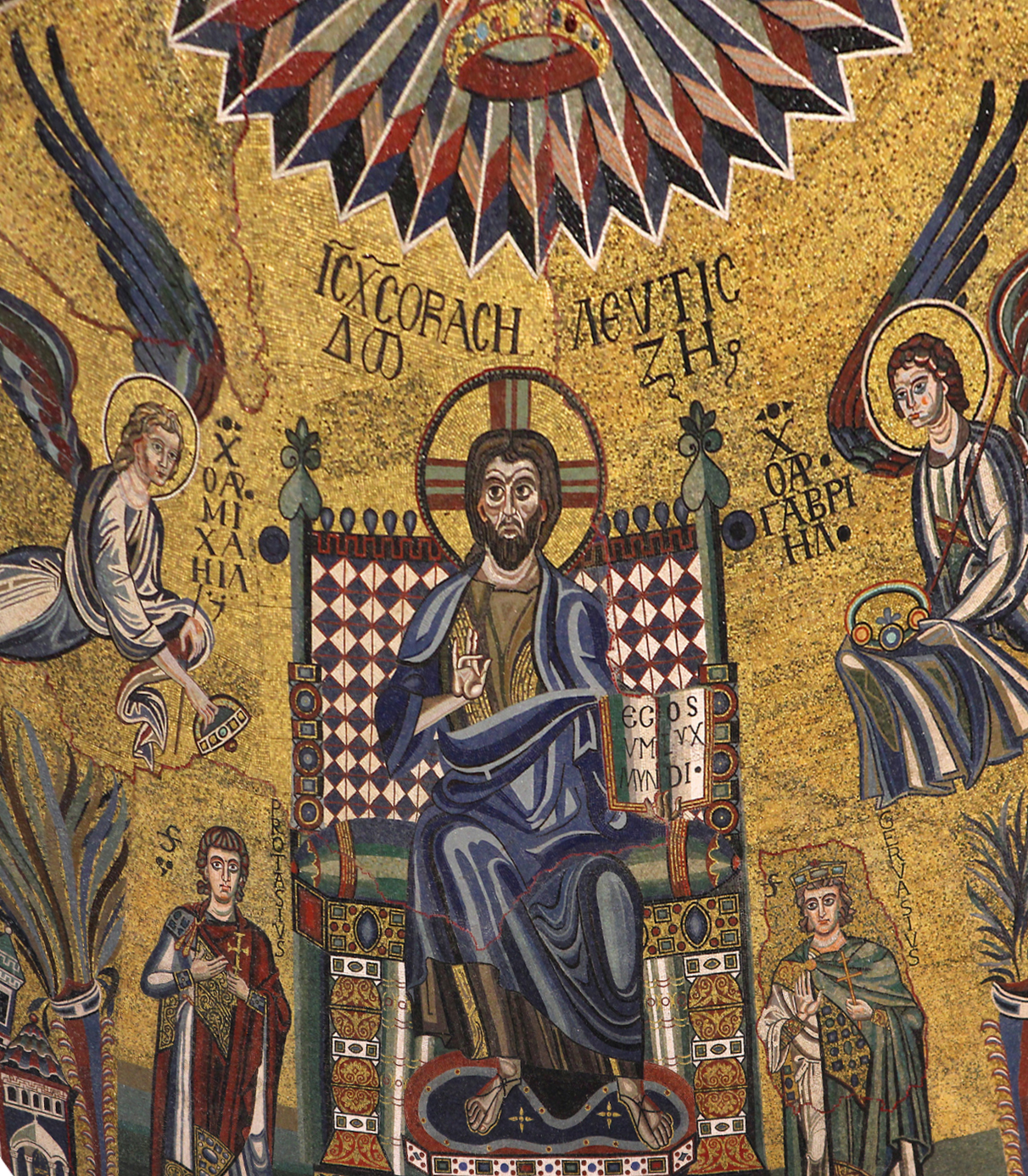
I had some trouble this morning with my Internet connection and could not be sure that the full text of the Weekly Update went out.  The message announced the publication of Episode 35 in The Holy Bible: the New Testament, which is focused on the final three I AM sayings (Greek: ego eimi) in St. John’s Gospel:  I AM the Resurrection and the Life;  I AM the Way, the Truth and the Life; and I AM the True Vine.

I use these three sayings to connect the message of my You Tube video Bible Study to concepts explained in more detail in Blessed is the Man …, which is Part Three of Christian Spirituality: an Anglican Perspective.  Jesus says “I AM the Way…..”   In Psalm 1, the unknown Psalmist divides the world into the “Two Ways,” that of the godly, or righteous, and the ungodly, and offers a clear statement, expressed in two verses in the negative, of what the godly man will not do, followed by three verses, expressed in the positive form, of what the godly will do and act.  In Psalm 119, King David reminds readers of how the righteous will be guided in their daily lives not just by “knowledge” but by “understanding.”   How we, as Christians, can access this “way” is discussed in “Seeing” the Face of God, which is Part Two in Christian Spirituality.  The book is availalbe from my author page at Amazon in both paperback and Kindle editions

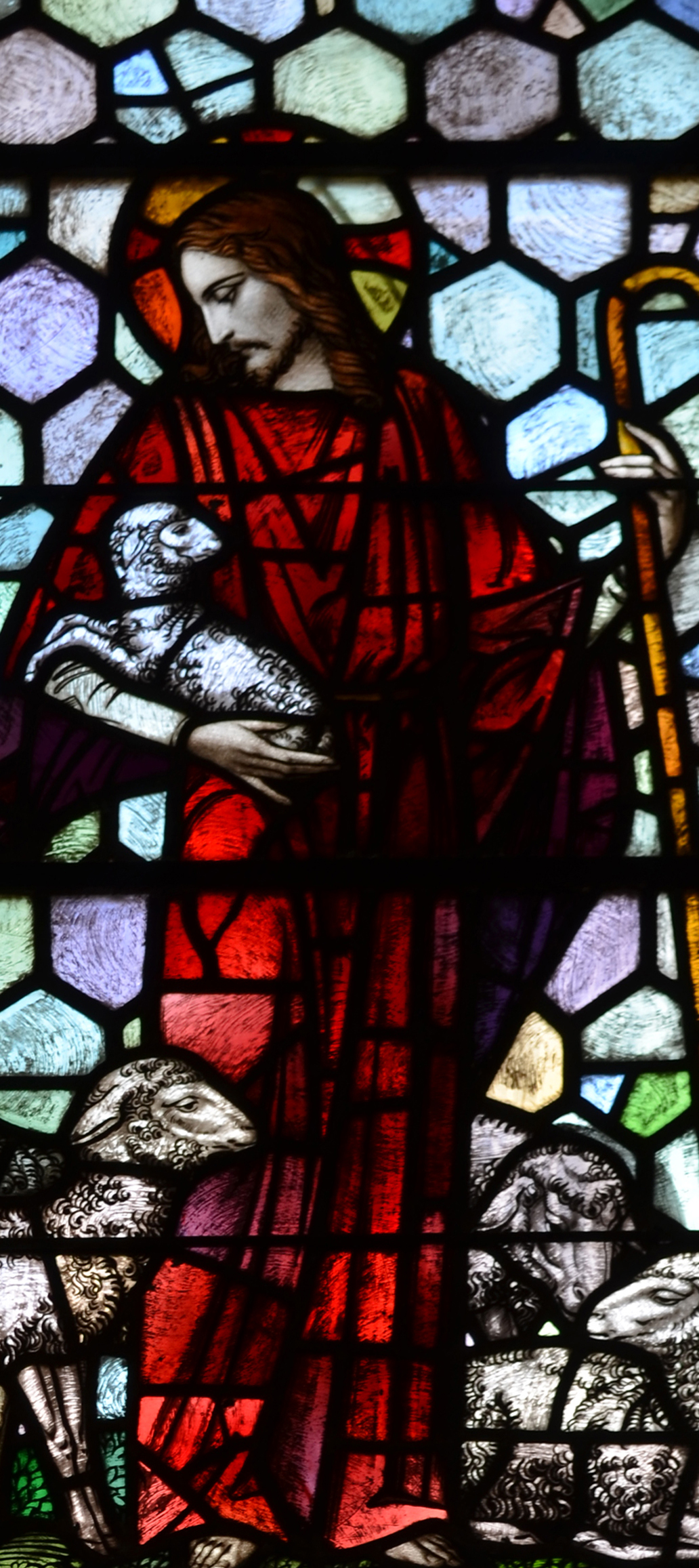
Jesus, the Good Shepherd (O Poimen, O Kalos)

Detail from Window 35, stained glass by Mayer of Munich, St. Joseph's Villa Chapel, Richmond, VA. A.D. 1931
Detail from Window 35, stained glass by Mayer of Munich, St. Joseph’s Villa Chapel, Richmond, VA. A.D. 1931

No other of the I AM sayings (Greek: ego eimi) in the Gospel of St. John enjoys such widespread acceptance as I AM the Good Shepherd (John 10:11, 14).  This week I uploaded Episode 34 in the AIC Bible Study series The Holy Bible: the New Testament in which I complete my discussion of both I AM the Door and I AM the Good Shepherd.  For that video I prepared a detail from the Mayer of Munich stained glass window at St. Joseph’s Villa Chapel, Richmond, VA.   This window is located in the upper wall of the Nave on the North side.  The Mayer artists created six-sided panels using soft pastel colors in shades of blue and green, separated by the black lead cames, making the red-robed image of Jesus appear to float on the light from the sky outside.  The technique is described in the AIC publication, Paintings on Light: the Stained Glass Windows of St. Joseph’s Villa Chapel, available in paperback from my author page at Amazon.com. Paintings on Light includes high-resolution pictures of 43 of the 46 stained glass windows in the Chapel.  Later this year or early in A.D. 2015, I will produce a DVD version to be offered through Amazon.

The Mayer artists depict Jesus with a lamb in His right arm, a shepherd’s crook (or crozier) in His left

Detail, Window 24, Coronation of Mary as Queen of Heaven, by Mayer of Munich, St. Joseph's Villa Chapel, Richmond, VA. A.D. 1931
Detail, Window 24, Coronation of Mary as Queen of Heaven, by Mayer of Munich, St. Joseph’s Villa Chapel, Richmond, VA. A.D. 1931

hand, and a small flock of lambs at His feet.  The lamb in His arm wears a small bell around its neck, signifying that it is the lead lamb which the others will follow.  The same type of bell appears in another window at the Chapel, The Coronation of Mary as Queen of Heaven, in which the Blessed Virgin also holds a lamb in her arms.  It is one of five small windows located on the ground floor in the South Aisle.

Jesus is indeed our true Shepherd, following in the image of the Twenty-third Psalm (“The Lord is my shepherd, I shall not want….”) and other shepherd imagery from the writing prophets of the Old Testament.  As Jesus tells us in John 10, He knows His sheep and they recognize His voice and will follow Him.  He assures us: “I have come that they [the faithful sheep) may have life, and that they may have it more abundantly” (John 10:10 NKJV).  The Old Testament and New Testament models for Jesus as shepherd are discussed in detail in the “Shepherd” entry in Layman’s Lexicon, another AIC publication available at the Amazon author site linked above.

In the Greek language, shepherd is Poimen.  The classic Eastern Orthodox depiction of Jesus as Good Shepherd is available as a printed icon on a wood base at St. Isaac of Syria Skete, Boscobel, WI (stock number I061114a).  The icon is labelled in the background, O Poimen, O Kalos, which means Good Shepherd.  The halo includes the three Greek letters meaning I Am that I Am, the words spoken by God to Moses (Exodus 3:14, 15).

The next Bible Study video, Episode 35, will be focused on the final two I AMs, I AM the Resurrection and the Life and I Am the True Vine, the latter being part of Jesus’ final sermon to the Apostles before His arrest on the evening of Maundy Thursday.

The AIC publication, Christian Spirituality: an Anglican Perspective is now available in both paperback and Kindle version from my author page (use the link above).  The Kindle version was being uploaded this morning.  There is a discount for the Kindle edition for purchasers of the paperback edition through Amazon/Kindle.


Christian Spirituality: an Anglican Perspective

In light of the ongoing War on Christianity, the Anglican Internet Church Bookstore offers a new book which can help any Christian defend himself or herself against the assaults of the aggressively secular and often anti-Christian world.  The paperback edition will be available later this week from my Author page at Amazon.  A Kindle edition will be prepared later this month and also be available on Amazon.com.  In the next few weeks the paperback edition will be available through your local bookseller (ISBN:  978-1502765147).

CS-Cover-Small-72Christian Spirituality: an Anglican Perspective is a handbook to the Eastern Church concept of Christian Spirituality presented in the context of the Anglican teaching and worship experience. In Part One I introduce the topic and present the writings of Archbishop Thomas Cranmer and the Blessed Lancelot Andrewes as examples of Christian Spirituality applied to Anglican worship and prayer.  In  Part Two (“Seeing” the Invisible God) I explore the two Old Testament understandings of “face of the Lord” and present the Christ Pantokrator icon from the monastery of St. Catherine in Sinai as the New Testament way of “seeing” God; then explore a new spiritual way of “seeing.”  In Part Three (Blessed Is the Man…) I explore the meaning and uses of Blessed is, blessed are, blessed be in the Psalms and New Testament, and the meaning of key terms:  godly, ungodly, righteous, righteousness, heart, fear of the Lord and way(s).  In Part Four (Put Not Your Trust in Princes…) I offer practical applications of the theory of Christian Spirituality in a 21st Century context of obsession with excess and offer guidelines for personal prayer development, the writing of personal catenae, and explore examples of Apostolic Wisdom, demonstrated in the work of two pairs of saints:  Paul & Peter and James & Jude.

Later this year I will develop a series of short videos adapted from the book, focused on specific topics mentioned in the book.  These will be available free of charge on the AIC’s You Tube channel.  Also later this year, the AIC will offer a new series of videos intended to make it easier for anyone, anywhere, to pray the daily hours (offices) of 1st, 3rd, 6th and 9th Hours, plus Vespers and Compline from Hear Us, O Lord: Daily Prayers for the Laity (also available from my Amazon author page).

The Blessed Lancelot Andrewes – September 25th

Among the great teachers of Christian Spirituality within the Anglican tradition is the Blessed Lancelot Andrewes. Bishop Andrewes was by any standard, an exceptional man. Born in London in 1555 A.D., the eldest of 13 children of a merchant/sailor, as a child he exhibited the habits of a serious scholar, disciplining himself to study daily, uninterrupted, from 7 AM to Noon. At Cambridge, he studied Greek, Latin and Hebrew, receiving his first degree in 1571 A.D., followed by a masters at Oxford in 1581 A.D.  He spoke and wrote in Aramaic (the language Jesus spoke), Syriac, Arabic, Latin, Greek and Hebrew, and 15 modern languages.  He taught courses in the Catechism and the Ten Commandments at Cambridge University, was chaplain to Queen Elizabeth I and her successor, James I, and chairman of the committee responsible for the first twelve books of the Old Testament (Genesis to 2 Kings) for the King James Version (1611 A.D.)He held nearly all the honors possible in the Church of England, short of being Archbishop of Canterbury: Dean at Westminster (1601 A.D.), Bishop of Chichester (1605 A.D.), Bishop of Eley (1609 A.D.) and still later Bishop of Winchester, a post he held until his death in 1626 A.D. The Church of England celebrates his Feast Day on September 25th.  The illustration is an oil on canvas in the English style, c. 1660, artist unknown.

Launcelot_Andrews_(1555-1626),_English_School_circa_1660Andrewes was among the first in the Western Church tradition to understand that Spirituality and Theology (from two Greek words, Theos (God, or the One who sees), and logos, meaning word, are not mutually exclusive. He saw theology as a way to gain a vision of God (or, as St. Peter wrote, a way of partaking of the divine nature (2 Peter 1:4)). He believed that liturgical worship was not an end in itself but a means toward combining the concept of time, an exclusively human understanding, with the concept of eternity, a state occupied only by God.

Advocates of Christian Spirituality, who believe that through this combination one can come the closest to a union with the Creator that is possible in this earthly life.  The AIC celebrates his blessed memory with this catena of his own creation:

Blessed, praised, celebrated, magnified, exalted, glorified, and hallowed by Thy name, O Lord; Great and marvellous are Thy works, Lord God Almighty; just and true are Thy ways, Thou king of saints; Praise our God, all ye His servants, and ye that fear Him, both small and great. Alleluia.

This material is excerpted from the forthcoming AIC publication, edited by Fr. Ron Shibley, Christian Spirituality: An Anglican Perspective, to be published in paperback and Kindle versions in time for Advent A.D. 2014.

Before Abraham was, I Am – John 8:58

Before Abraham was, I Am.   These are among the most powerful words Jesus spoke, as reported in the Gospel of St. John.  They were said to a group of Pharisees and scribes in the Treasury inside the Temple at Jerusalem.  The location is the Temple as rebuilt during the time of Zerubbabel and Nehemiah after the return from exile in Babylon and as modified and expanded under Herod.

NotMadeByHands-Icon-GreekAs I’ve noted in the on-going Bible Study videos on the Gospel of St. John, this phrase marks the climax of a series of conversations at different locations but with essentially the same audience that begin in Chapter 6 with the start of the “I Am the Bread of Life” conversation (John 6:30-49).  All the several uses of the Greek ego eimi (I Am) were like a galvanic shock to the audience, because, whether they were willing to admit it or not, they knew quite well that in this choice of words Jesus meant to remind them of God’s answer to Moses’ question regarding the identity of God.  Ego eimi is the Greek equivalent of eyheh asher eyheh, or I Am that I Am, or I Am the Existing One from the Greek Septuagint text of Exodus 3:14, 15.

The illustration is a 15th C Russian Orthodox icon, Not Made With Hands, based upon a 4th C. linen burial mask from the region of Edessa.

Through the prolonged series of conversations the topics were the contention of the Jews that they were children of their father Abraham and their confusion and rejection of Jesus’ use of “Father” to mean God, His Father.  Through the exchange they ask at two different points:  Who Are You? and “Who Do You Make Yourself Out to Be?”  The answer in the first case was I Am who I told you from the beginning (meaning in the multiple uses of ego eimi (I Am).  This, of course, they were not prepared to admit and finally Jesus accuses them of being spiritual children of the devil whose work they do and not of obedient Abraham.

Then we get to verse 56:  “Your father Abraham rejoiced to see My day, and he saw it and was glad.” (8:56).  And they willfully continue to deny His divinity.  “You are not yet fifty years old, and have you seen Abraham” (8:57).

And then the galvanic shock, to which they reacted exactly the same as frogs on a lab table.  What He said to them was not the wandering, lengthy expository explanation preferred by many modern translations.  BEFORE ABRAHAM WAS, I AM!

John relates in verse 59 another miracle that goes mostly unnoticed in the modern world:  “Then they took up stones to throw at Him; but Jesus HID HIMSELF and WENT OUT OF THE TEMPLE, GOING THROUGH THE MIDST OF THEM.” (8:59).  This does not mean He slipped out via a window or the back door.  By His Divine power he vanished from their midst.

In Episode 33 of the You Tube video I continue after verse 8:59 with Part 1 of 2 in “I Am the Door…” and ‘I AM the Good Shepherd” with explanations of the meaning of “door” and “shepherd.”

New Testament – Episode 32

This week I uploaded to You Tube a new episode in the New Testament course.  Episode 32 picks up where Episode 31 left off, in the middle of the dialogue which followed the “I Am the Light of the World” saying in John 8:12.  The encounter described by St. John takes place in the Treasury in the Second Temple (built after the return from Babylon; greatly expanded, or built over or built upon, by Herod; destroyed by the Romans in 70 A.D.   Famous phrases in this encounter are “I Am from above” (8:23) and  “Who are You?” (8:25) and “You are of your father the devil, and the desires of your father you want to do” (8:44). To keep each Episode under 22 minutes, I stop with Jesus’ accusation of their disbelief in 8:44.

As in earlier episodes I have stressed the strange avoidance of the true meaning of ego eimi (I Am) in the Western Church.  In this episode I demonstrate that in the 1st Millenium, in both the Eastern and Western Church, there was agreement that ego eimi was the Greek equivalent of God’s words to Moses in Exodus 3:14, 15:  in Hebrew ehyeh asher ehyeh, or I Am the Existing One (SAAS Septuagint

Ambrose - Mosaic2-late 4th C

I cite three early Bishops or scholars.  The first is St. Ambrose of Milan (4th Century) (Exposition on the Christian Faith), shown in a mosaic thought have been made during his lifetime.

chrysostom28--small

The second is our patron saint, John Chrysostom, Bishop of Antioch and Constantinople (late 4th, early 5th Century) (55th Homily on the Gospel of St. John), shown in a modern Eastern Orthodox icon.

????????????????

The third is The Venerable Bede, author of the first history of the Church in England and composer of the Ascension Day hymn, A Hymn of Glory Let Us Sing, in the 8th Century.  Bede is shown in a 1902 painting by J. D. Penrose now in the British Museum collection.

All three argued that the Pharisees and scribes who were the audience in the Treasury could not possibly have misunderstood the connection between “I Am the Light of the world” and “I Am from above” and the Old Testament identification of the God of Abraham, Isaac & Jacob.

In Episode Thirty-three I will repeat 8:44, 45 and carry the dialogue, according to St. John’s first hand witness, to its natural conclusion: Before Abraham was, I Am” (8:58) and on to ” I Am the Door” and I Am the Good Shepherd.

New Testament – Episode 31 Now Available

The War on Christianity continues worldwide, but the church still lives in the hearts of believers.  Our online Bible Study courses offered on our You Tube channel (and via MP3 podcasts hosted by Podbean.com) are intended to provide reliable teaching incorporating the valuable ideas of the Eastern Church expressed in Western Church language written for the average lay person.  The most recent offering is Episode 31, which I posted to You Tube on 9/10 A.D. 2014.

Light_of_the_World-Hunt-Painting  There is not much in Scripture to equal St. John’s unique use of the Greek ego eimi (I AM), used as a title or name of God in his Gospel.  In Episode 31 I focus on three of the I AM declarations:  The Bread of Life (6:35, 48), the Living Bread (6:48) and The Light of the World (8:12).  Not every use of “I am” in St. John’s account is based on ego eimi, but there are dozens of examples in which the meaning is the same as in Exodus 3:16, in which God spoke to Moses.  The phrase was deliberately used in John’s eyewitness account to leave no doubt that the person speaking is the same God who spoke to Moses.

Since so many Western Church translations overlook the importance of ego eimi/I AM and many do not translate them that way, I’ve focused several episodes of my New Testament course on the I AM sayings.  In Episode 31 I have connected “I AM the Light of the World” to what I label as the theological “declarations” which John offered in his opening chapter in his Gospel on the linkage of Christ to Light and the issue of Light vs Darkness.  I quote John 1:4, 5, 7, 8, 9; John 9:5; Revelation 21:23, 24 and also from Luke 1:72, 73 (Benedictus) which touches on the same topic.

Icons used in this episode are from the 6th and 15th centuries, plus maps from the early 20th Century.  The picture included with this posting is The Light of the World by William Holman Hunt, which is based on Revelation 3:21 (letter to the Church at Laodicea).  I used it in Episode 8 in the Revelation course, but did not use it in Episode 31 in the New Testament series.

The next episode (Episode 32) in the New Testament series will continue the discussion of “Light of Life” (John 8:12) and take the conversation through John 8:58, when Jesus boldly declares to the doubting Pharisees and scribes: “Before Abraham was, I AM.”  I will move through all the remaining major I AM statements and several of the lesser I AM usages and show viewers cases in which the Divine I Am is not what was intended by St. John.

The MP3 podcast versions of the AIC digital archives can be heard via iTunes or at our Podbean site