Second Sunday in Lent

The observation of the penitential season of Lent continues with Second Sunday in Lent. For this occasion Archbishop Cranmer adapted the Collect from a prayer in the Gregorian Sacramentary, one of the three primary sources in the Roman Catholic tradition. It is the first of five Gregorian Collects used in the season of Lent. This is not surprising, given the important part Pope Gregory the Great played in the Western Church’s celebration of Lent. One of the themes (“evil thoughts”) in the Collect is repeated in, or perhaps sourced from, the Epistle reading from the pen of St. Paul.

ALMIGHTY God, who sees that we have no power of ourselves to help ourselves;
Keep us both outwardly in our bodies, and inwardly in our souls;
that we may be defended from all adversities which may happen to the body,
and from all evil thoughts which may assault and hurt the soul;
through Jesus Christ our Lord. Amen.

The Epistle reading, 1 Thessalonians 4:1-8, another teaching from St. Paul on the Christian virtues. St. Paul focuses on self-control, especially in matters of “passions,” particularly “concupiscence,” or “passion of lust” in the New King James Version. In the early Church, especially in the Eastern Church, these desires are commonly referred to as “ill dreams and dark pleasures.” That specific term is used in the Third Prayer for the Vespers office in Hear Us, O Lord: Daily Prayers for the Laity and a related phrase, “ill dreams and nightly fears, wrought by dark and evil spirits,” in the Sixth Prayer in the Compline office. A similar topic is discussed in the VIRTUE(S) entry in Layman’s Lexicon: a Handbook of Scriptural, Liturgical & Theological Terms, and a text box, “The Christian Virtues and Their Opposites,” is found on page 165, in The Gospel of Matthew: Annotated & Illustrated, all three books are available through my Amazon Author Central page, with complete details of each book on the AIC Bookstore page.


Christ and the Canaanite Woman, illumination in tempera and gold on parchment, Codex Egberti, circa 980-983, Codex 24, Folio 25v, Wissenschaftliche Bibliothek der Stadt Trier, Trier, Germany. Public Domain.
Jesus with the Woman of Canaan, oil on canvas, Michael Angelo Immenraet, Unionskirche, 1673, Wikimedia Commons.

The Gospel reading, Matthew 15:21-28, is the third in a row in Lent and one for four readings in Lent from the Gospel of Matthew. The evangelist records an encounter between Jesus Christ and the “Woman of Canaan,” who had a demon-possessed daughter. The woman is called a “Syro-Phoenician” in Mark 7:26. The image from the Codex Egberti appears as Illustration No. 78 in The Gospel of Matthew: Annotated & Illustrated, and, in a larger, high-resolution version, as Illustration No. 41 in The Gospel of Mark: Annotated & Illustrated, both available through my Amazon Author Central page. Full information about both books is found on the AIC Bookstore page. The difference between the two names is the result of the different target audience for each Gospel. St. Matthew’s Gospel was intended for unconverted Jews, who would know the region by its Hebrew name, Canaan. Mark’s target audience was broader and more likely included people who would know the region by its geographical name. Although the unnamed woman was not a Hebrew, in verse 22, she calls Jesus by the titles of “Lord” and “Son of David.” The conversation is wide-ranging and includes reference to Jesus’ mission and “little dogs” and “crumbs under the table.” Jesus speaks to her with the admonition, “I was not sent except to the lost sheep of Israel” (verse 24 in the New King James Version). The woman’s daughter is healed owing to what Jesus describes as the woman’s “faith”: “O Woman, great is your faith! Let it be as you desire it.” (verse 28, NKJV).

The Collect and the two readings are discussed in Episode Two in our video series, Lent: a Penitential Season. My Podcast Homily for Second Sunday in Lent is linked from the Podcast Homilies page. One of the great hymns associated with Second Sunday in Lent, Kind Maker of the World,” is attributed to Gregory the Great. In our Bookstore Publication, The St. Chrysostom Hymnal, it remains Hymn 56 but the words are set to the more easily-sung French tune from the Grenoble tradition in the mid-18th C., Deus tuorum militum. Some hymnals label the tune “Grenoble,” and others credit it to the Ambrosian tradition in northern Italy. The tune’s name literally means “God of your soldiers.” The volume, as noted above, like all the AIC Bookstore Publications, is available through my Amazon Author Central page.

As always, thank you for your interest and support for this site. Glory be to God for all things! Amen!
Quinquagesima Sunday

Last week I let readers know of the on-going work on new episodes in The War on Christianity, a video series that began in A.D. 2020 as part of what became a continuing celebration of the AIC’s tenth year on the Web. In Episode One of the series I offered a glimpse of news coverage of attacks upon Christianity in the United States and Europe. In Episode Two and Episode Three I offered “A Summary History of the Church from the Day of Pentecost until Now.” The subject of Episodes Four and Five included three case studies of the decline of Christianity in three parts of the world where it had once been dominant: the Holy Land, North Africa and Asia Minor. Which brings us to the episodes-in-progress: Episode Six and Episode Seven. I have now completed and uploaded to iMovie all the slides for both episodes under the heading “The First Line of Defense: the Te Deum Laudamus.” My plan is to record the voice track in the next two weeks, with the objective of uploading completed episodes in mid-to-late March. Episodes Eight and Nine will continue the focus on the “First Line of Defense” theme with discussion and illustration of the Creeds of the Church. Links to Episode One through Episode Five are found on the Digital Library page.

The name of the last of the three Sundays in the season, Quinquasesima Sunday, always celebrated on the seventh Sunday before Easter, is derived from a Latin word meaning “fifty.” It is actually forty-nine days before Easter and not fifty; I discuss the reasons for the disparity in Episode One of our video series, Gesima: the Pre-Lenten Season. In England, Quinquagesima Sunday is also known as Shrove Sunday, presumably because it is the last Sunday before Shrove Tuesday, the day before Ash Wednesday. For the Collect, composed by Archbishop Cranmer for the 1549 Book of Common Prayer, Archbishop Thomas Cranmer did not adapt something from the historic prayers in the Roman Catholic tradition, as printed in the Leonine, Gregorian, and Gelasian models, but turned, as he did for other Sundays in the Church Year, to the Epistles of St. Paul. The source is 1 Corinthians 13:11, part of the Epistle reading for the day. The themes are grace, faith and love. In the King James Version a key word is “charity,” which is translated in the New King James Version and other modern translations as “love,” from the Greek agape (Strong’s Greek word # 26), which was translated in Jerome’s Vulgate Bible using the Latin, caritas.

O LORD, who hast taught us our doings without charity are nothing worth;
Send thy Holy Ghost and pour into our hearts that most excellent gift of charity,
the very bond of peace and of all virtues, without which whomsoever liveth it counted dead before thee.
Grant this to thine only Son Jesus Christ’s sake. Amen.

The Epistle reading, 1 Corinthians 13:1-13, is one of the most-quoted lines among all the writings of the Apostle to the Gentiles. St. Paul’s lessons clearly states that agape/love/charity is superior to either the gift of prophecy or the hypothetical ability to move mountains. For more on all the Greek words which can be translated as “love,” See the Love/Loving entry in Layman’s Lexicon: a Handbook of Scriptural, Theological & Liturgical Terms, available through my Amazon Author Central page. Full information about the book can be found on the AIC Bookstore page.

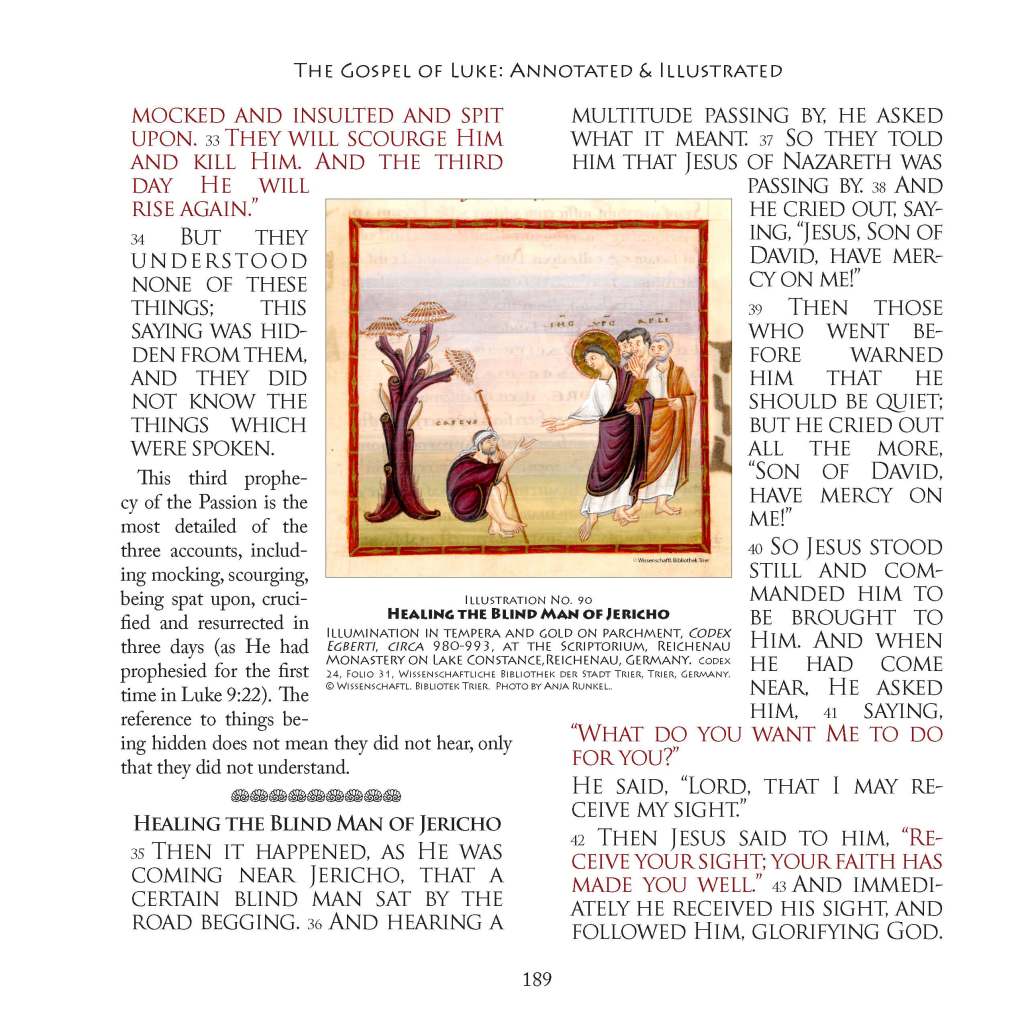
The Gospel reading, Luke 18:31-43, has two parts. The first, verses 31b-33, includes Jesus’ prophecy of His own death and resurrection in three days. The second part is a record of the Healing of the Blind Man of Jericho. My Podcast Homily for Quinquagesima Sunday is linked from the Podcast Homilies page. The illustration is a page from our Bookstore Publication, The Gospel of Luke: Annotated & Illustrated, available through my Amazon Author Central page. A summary of the content of the book and pricing is found on the AIC Bookstore page.

As always, thank you for your interest and support. Glory be to God for all things! Amen!

Sexagesima Sunday

Sexagesima Sunday is the second of three pre-Lent Sundays, which are now unique to the Anglican worship tradition. For more historical and other detail on the season watch Episode One in our video series. Gesima: the Pre-Lenten Season or listen to the audio Podcast version, which its linked from the Podcast Archive page. This week I offer site visitors two remarkable examples from our nearly 3000-item library of historic art.

The Collect for Sexagesima Sunday was adapted by Archbishop Cranmer from the Gregorian Sacramentary, which was also the source for the Collect for Septuagesima Sunday. It was used for the first time in the 1549 Book of Common Prayer and was read by Archbishop Cranmer himself on Whitsunday/Pentecost, June 9, A.D. 1549. The prayer book also may have been used earlier in the same year at St. Paul’s Cathedral, London. Like the Epistle and Gospel reading for the day, the themes are the “mercies” of God and the Christian virtues. Sexagesima Sunday is actually 57 days before Easter and not the sixty which its name suggests. Readers should remember that the Greek word for God, Theos, (Strong’s Greek Word #2316) is often translated as The One Who Sees.

O LORD God, who sees that we put not our trust in any thing that we do;
Mercifully grant that by thy power we may be defended against all adversity;
through Jesus Christ our Lord. Amen.

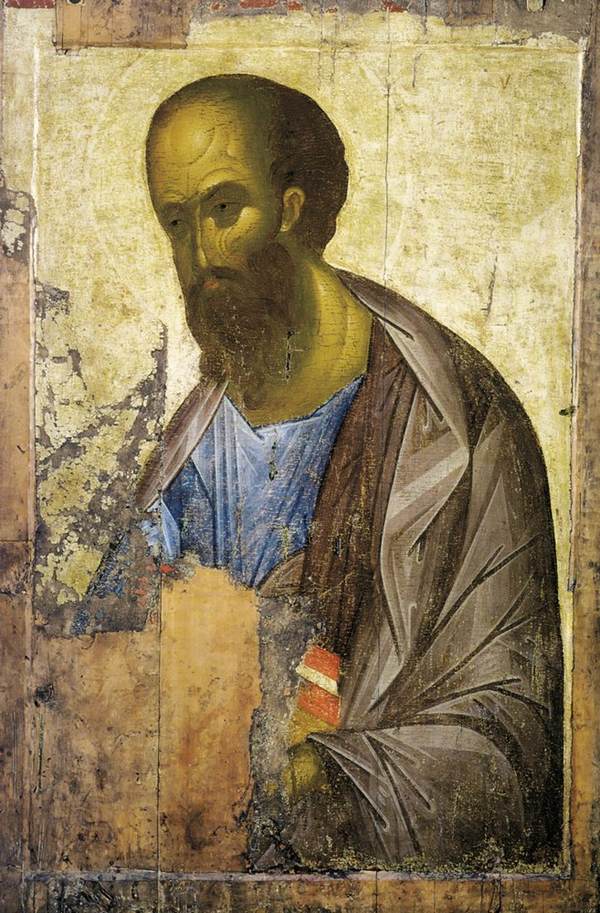
St. Paul, unfinished icon in tempera and gold on wood panel, Andre Rublev, circa 1410-1420, made for the Deesis tier in a Russian church at Zvenigorod, 33 miles west of Moscow, Tretyakov Gallery, Moscow, Russia. Wikipedia Commons/Public Domain.

The Epistle reading, 2nd Corinthians 11:13-21, St. Paul’s letter to the formerly pagan congregation he established at Corinth on his Second Missionary Journey accompanied by Silas. The verses are discussed and illustrated in Episode Two of our video series, Gesima: the Pre-Lenten Season, linked from the Digital Library page and in audio form from the Podcast Homilies page. In this epistle to congregation most resistant to his teachings, he mentions the Christian virtue of diligence and names forms of suffering he endured on his journey, including stoning, beatings, shipwreck, followed by a list of more general adversities, including hunger, thirst and robbery. The image of St. Paul was painted by one of the world’s most gifted icon painters. As the credit line suggests, the image is no longer mounted in the church for which it was being made, having become an “historic” object rather than a religious one. Even in its unfinished form it is an exceptional example of art put to use for Christian purposes. Frequent visitors to this site may have noticed that another image of this icon has a blue background, which was the result of studio lighting. This one is the real thing and will be used in all future AIC Publications and updates to existing books and videos.

The Sower, opaque watercolor over graphite on gray wove paper, James Tissot, 1886-1894, Brooklyn Museum, Brooklyn, NY. Public Domain.

The Gospel reading, Luke 8:4-15, is the evangelist’s account of the Parable of the Sower. The watercolor above appears as Illustration No. 71 in our publication, The Gospel of Matthew: Annotated and Illustrated and Illustration 71 in The Gospel of Mark: Annotated and Illustrated. In the comparable volume on the Gospel of Luke I used an oil on canvas by Vincent Van Gogh. These books are available through my Amazon Author Central page. A summary of the book, including price and pagination, is found on the AIC Bookstore page. The image is from a collection of around 300 images in James Tissot’s Life of Christ series, the largest collection of which is now held at the Brooklyn Museum.

As noted in previous posts late last year, I am working on Episode Six and Episode Seven in our video series, The War on Christianity. I expect to finish the text and slides before the end of this weekend. Each of the 24 slides in Episode Six and 33 in Episode Seven is produced by clipping from a sheet with six slides each and some single image pages in Adobe Photoshop. Afterward, each slide must be inset into a video and the sound track recorded using Apple’s iMovie software. The completed episodes probably will not be ready for publication before the middle to the end of March. It will be linked from the Digital Library page and the voice track, converted into an MP3 file, linked from the Podcast Archive page. In other news, I’ve had.a request from an Anglican clergyman in northern Italy to use some material from this site. I have given permission with the condition that the material contains a link to this site.

As always, thank you for your interest and support. Glory be to God for all things! Amen!

Fourth Sunday after Epiphany

For Fourth Sunday after Trinity Archbishop Cranmer created a Collect which he derived from the Gregorian Sacrementory. The theme is again the need for mankind to recognize the all-knowing God as the only way to overcome man’s sinful nature and the threats of the secular world upon the Christian faithful. It is useful to remember that the Greek word Theos (Strong’s Greek word # 2316), from which the Western world derived the term theology, literally means “the one who sees.”


O GOD, who knowest us to be set in the midst of so many and great dangers,
that by reason of the frailty of our nature we cannot always stand upright;
Grant to us such strength and protection, as may support us in all dangers,
and carry us through all temptations; through Jesus Christ our Lord. Amen.

The Apostle Paul, oil on wood panel, circa 1520 A.D., attributed to Lucas van Leyden, Yale University Art Galley, New Haven, CT. Public domain.

The Epistle reading, Romans 13:1-7, is the last of four readings from Romans 12 and 13 in Epiphany season. St. Paul makes absolutely clear in the first verse that “there is no authority except from God.” In England in the early 18th C., the first verse in Basil Woodd’s hymn, Hail, Thou Source of Every Blessing [Hymn No. 49, St. Chrysostom Hymnal] the lyric declares: “Hail, Thou source of every blessing Sovereign Father of mankind; Gentiles now, Thy grave possessing, in Thy courts admission find. Grateful now we fall before Thee, in Thy Church obtain a place, Now by faith behold Thy glory, Praise Thy truth, adore Thy grace.” The St. Chrystom Hymnal is available through my Amazon Author Central page.

The Gospel reading, Matthew 8:1-13 is an account of two healings, the healing of the leper and of the Centurion’s servant. In the former case, the leper, an outcast under Jewish law, was healed immediately by Jesus’ touch. In the latter, the healing occurred some distance away and includes the phrase “wailing and gnashing of teeth.” The Collect, Epistle and Gospel reading are discussed an illustrated in Episode Three of the AIC video series, Epiphany: the Manifestation of Christ to the Gentiles. In the context of the healing the leper, an early 11th C. illumination in tempera and gold on parchment was used as Illustration # 52 and, in the context of the healing of the Centurion’s servant, as Illustration No. 53 in The Gospel of Matthew: Annotated & Illustrated, available through my Amazon Author Central page. My Podcast Homily for Fourth Sunday after Epiphany can be listened to or downloaded from the Podcast Homilies page.

As always, thank you for your interest and support. Glory be to God for all things! Amen!
A Correction & Plans for A.D. 2025

Sharp-eyed readers will have noticed the error in the entry for the final Sunday in Christmastide. I did not see it myself until I sat down in church on Sunday. I suspending writing on Dec. 26th. Call it a “senior moment” that when writing was resumed for the last Sunday in the season it was the Collect, Epistle and Gospel readings for First Sunday after Christmas Day that were posted instead of the later Second Sunday after Christmas Day. Apologies.

Following review of all the blog posts for 2024 A.D., for the new year 2025 A.D. I’ve decided to continue with the old style of commentary on the Collect, Epistle and Gospel (C/E/G) readings for the seasons of Epiphany, Gesima, Lent & Easter and for Whitsunday. That will take readers/site visitors to the point in which C/E/G commentaries were begun in 2024 A.D. with the start of Trinitytide.

During these cold winter days of late December and early January, I have updated the AIC image database, now totaling over 2800 entries. All the uses in this Blog have now been noted in the Excel file. Later this month I expect to start work on the two remaining videos in the War on Christianity series. These two episodes will be focused on practical solutions for Christians living in an anti-Christian world.

Thanks as always for your interest and support. Glory be to God for all things! Amen!

Third Sunday in Advent

Unlike the Collects for the first two Sundays in Advent, the Collect for Third Sunday in Advent is not an original composition by Archbishop Thomas Cranmer for the 1549 Book of Common Prayer. Just in case readers might not have seen it, here is the Archbishop’s unusually short original composition.peosu

LORD, we beseech thee, give ear to our prayers,
and by thy gracious visitation lighten the darkness
of our heart, by our Lord Jesus Christ.

For the 1662 Book of Common Prayer, published after the restoration of the monarchy, a new Collect was produced with a clearer focus on the primary themes of Advent. It places greatly emphasis on words derived from the appointed Epistle reading and the second major theme of Cranmer’s first two Collects for Advent, that is, the promised Second Coming in Christ in judgment. In a nod toward the innovations of Archbishop Cranmer, the revisers introduced a theme from his responses to the first nine Commandments in the Decalogue in the 1549 B.C.P. Holy Communion liturgy: “incline our hearts…” and the response to the Tenth Commandment: “write all these thy laws in our hearts…” Prayer Book scholar Massey Shepherd notes that the preamble includes a rare for the B.C.P. example of direct address to the Lord Jesus Christ and that the “ministers and stewards of thy mysteries” refers to the clergy and bishops of the Church in the role of custodians of the heritage handed down from the Apostles.

O LORD Jesus Christ, who at thy first coming didst send thy messenger to prepare thy way before thee;
Grant that the ministers and stewards of thy mysteries may likewise so prepare and make ready thy way,
by turning the hearts of the disobedient to the wisdom of the just, that at thy second coming to judge the
world we may be found an acceptable people in thy sight, who livest and reignest with the Father and the
Holy Spirit ever,* one God, world without end. Amen.

The Epistle reading, 1 Corinthians 4:1-5, repeats the phrase “mysteries” from the Collect. It includes St. Paul defense of himself against accusations from some members of the congregation at Corinth. St. Paul also mentions “mysteries” in Romans 16:25.

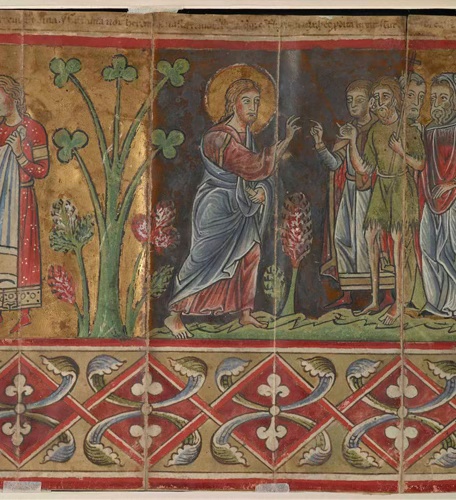
Christ Meets John the Baptist and His Followers, illumination in colors and gold on parchment, the fourth of five scenes on the front (Recto) side of a parchment frieze, with four additional scenes on the reverse (Vers0) side, 4th Qtr., 12th C.; Ms. Additional 42497, Recto, British Library, London, England. The images at the left are part of the second scene, illustrating the naming of Elizabeth. John the Baptist is depicted in a humble, crude green garment quite different from the costume of his followers. The document was acquired by the British Library in 1931 from a private collection in Paris, France.

The Gospel reading, Matthew 11:2-10, goes backward in time to about 28 A.D., being St. Matthew’s account of Jesus’ earliest references to John the Baptist. Followers of John want to know “Are you the Coming One or do we look for another?” (Matthew 1:3). Jesus refers to John in the context of the prophecy of Malachi 3:1. One of the major themes of St. Matthew’s Gospel is that Christ is the fulfillment of Old Testament prophecy.

Other AIC Resources on the topics in the Blog post are: The Collect, Epistle and Gospel readings for Third Sunday in Advent, commonly known as Gaudete Sunday, from the Latin gaudere (rejoice), are discussed and illustrated in Episode Two of our Christian Education Video series, Advent: A Season of Penitence and Preparation. My Podcast Homily on the theme, Rejoice in the Love of God, is linked here and from the Podcast Homilies page. Archbishop Cranmer’s understanding of the concept of taking the Commandents and the teachings of the Church Universal into the heart is explored further in our Bookstore Publication, Christian Spirituality: an Anglican Perspective, pp. 8-13, and the Gospel reading for Third Sunday in Advent is discussed and illustrated in The Gospel of Matthew: Annotated & Illustrated, both available through my Amazon Author Central page.

Additional AIC Resources for days during the week following Third Sunday in Advent include the first four of seven episodes in our Seasonal Video series, The Great “O” Antiphons, based on a 12th C. hymn, with one episode for each of the days from Dec. 18th through Dec. 24th.

December 18th – O Sapientia
December 19th – O Adonai
December 20th – O Radix Jesse
December 21st – O Clavis David

As ever, thank you for your interest and support. The AIC web site remains a reliable resource for teaching and study materials based on traditional understanding of Christian doctrine. Glory be to God for all things! Amen!

Second Sunday in Advent

For Second Sunday in Advent Archbishop Thomas Cranmer created a new Collect in which he stressed themes of the new English Church, which had endorsed the effort to create a complete English language Bible. The “Great Bible of 1539,” commonly called the Coverdale Bible, printed in Europe under the authority of the Church of England, made the Old and New Testaments available in the common language of the English people. Whether the pr0ject ever achieved the stated and lofty objective of putting a copy in every Church in England is debatable. Cranmer’s new Collect begins with the only reference in the Book of Common Prayer to God the Father by the title Blessed Lord. In it the Archbishop imposes upon every Christian a duty, against all the forces allied against them, to read and study and contemplate internally the meaning of the words of the Bible and the true message of the new season of Advent. His phrase, “patience and comfort” is an adaptation of Romans 15:4, which is part of the Epistle reading for the day.

BLESSED Lord, who hast caused all holy Scriptures to be written for our learning;
Grant that we may in such wise hear them, read, mark, learn and inwardly digest them,
that by patience and comfort of thy holy Word, we may embrace, and ever hold fast,
the blessed hope of everlasting life, which thou hast given us in our Saviour Jesus Christ. Amen.

God the Father and God the Son, miniature illumination in tempera and gold on parchment, Oxford Psalter, 1st Qtr., 13th C. before 1200 A.D., Ms. Royal 1 D X, f. 98, British Library, London, England. This represents an interesting way of avoiding the early Church prohibition against images of God the Father by showing them together as duplicate images of Jesus Christ (“He who has seen me has seen the Father”). John 14:9 NKJV.


The Archbishop’s selection for the Epistle, Romans 15:4-13, especially verses 5, 6 and 7 (“Now the God of patience and consolation” through “even the Father of our Lord Jesus Christ,” was part of St. Paul’s plea to both Jewish and Gentile Christians for unity in the common faith. Bible scholars have noted that in verses 9-12 St. Paul quotes from the four “pillars” of Judaism: the Law (the Pentateuch, the first five books of the Old Testament), the Histories, the Psalms and the Prophets. This system of organizing the Old Testament into four parts is discussed and illustrated in Part One, The Writing Prophets of the Old Testament, available at my Amazon Author Central page.

Christ in Majesty, illumination in colors and gold on parchment, Codex Amiatinus, folio 796v, made at the Benedictine monastery, Wearmouth-Barrow, Northumbria, England, circa 700 A.D. for an edition of the Vulgate Bible. The Codex has been held at the Laurentian Library, Florence, Italy, since 1786. The four evangelists are depicted in the corners of the image. The central image shows Christ seated between two archangels, likely Gabriel and Michael. Christ in Majesty is rendered in Latin as Maiestas Domini 

The Gospel reading, Luke 21:25-33, includes reference to details of the promised Second Coming and the Parable of the Fig Tree. The concept of Christ coming in clouds of power and glory is the basis for the images known in the Western Church as “Christ in Majesty.” In the Byzantine/Eastern Church tradition, a related concept, expressed in art depicting Christ enthroned, is known as “Christ Pantokrator,” literally, Ruler of the Universe. Both versions often depict visual understandings of “signs” (verses 25-26) and “in a cloud” (verses 27-28). I discuss the reading in the context on my Second Sunday in Advent homily theme of “Fire of Judgment” in my Podcast Homily for Second Sunday in Advent. In the AIC Christian Education Video on Advent season, the readings are discussed in the episode for First and Second Sundays in Advent. The “fire of judgment” is a common theme in both the Old and New Testaments. The word “fire” is referred to 53 times in the New King James text. Two excellent examples are Psalm 97:3 in which “fire” goes before the Lord and Ps. 104:4 in which His ministers are called a “holy fire.”

In addition to these seasonal Blog posts I have been working on improvements to several parts of this site. My objective is to improve site navigation by providing internal links. The changes start at the bottom of the Home/Welcome page in the LEARN YOUR WAY section. In addition to these adjustments I call your attention to additional upcoming seasonal videos. For the final seven days of Advent (Dec. 18th to Dec. 24th) we will provide Home page links to The Great “O” Antiphons series and Lessons and Carols for Christmas Eve. Just before Christmas Day I will provide active links to our Christmas season series (3 episodes) and the Twelve Days of Christmas series for Dec. 25th through Jan. 5th.

As always, thank you for your interest and support. We do appreciate those of you who have become followers/subscribers to Fr. Ron’s Blog. Glory be to God for all things! Amen!

Twenty-fifth Sunday after Trinity

The extended celebration of Trinitytide: The Teaching Season nears its end with Twenty-fifth Sunday after Trinity. The fact that there are 25 Sundays after Trinity in A.D. 2024 owes to the variability of the calendar, which is determined by the date of Easter. Here’s a brief primer on how this works. Advent season, which marks the start of a new Church Year, always begins with First Sunday in Advent, which is always on the Sunday closest to Nov. 30, the Feast Day of St. Andrew. This means there will always be four Sundays in Advent coming before Christmas Day on December 25th. The other “signpost” which affects the Calendar is the moveable date of Easter. In the Western Church, Easter always falls on the first Sunday after the first full moon following the Spring Equinox (March 21st). A different system, created at the Council of Nicea in 325 A.D., is used in the Eastern Church, in which the date of Easter cannot be set until the senior Rabbi at Jerusalem establishes the date of Passover. The setting of the date of Easter determines the placement of Septuagesima Sunday, which is always the ninth Sunday before Easter. The earliest possible date for Septuagesima Sunday is January 18th. The establishment of Septuagesima Sunday then determines the number of Sundays after Epiphany, which can be as few as one or as many as six. In the small type footnote on page 224 of the 1928 B.C.P., readers can find the complicated formula for adding Sundays to Trinitytide in years in those years in which Easter comes early. All that said, these rules are the reason that there are Twenty-five Sundays after Trinity in A.D. 2024. There. Doesn’t that make you feel better!

The Collect for Twenty-fifth Sunday after Trinity is the same collect used for Fifth Sunday after Epiphany (again, see p. 244 of the B.C.P.). It is another adaptation by Archbishop Cranmer from the Gregorian Sacramentary, produced much later than his lifetime but named in honor of Pope Gregory the Great. In Archbishop Cranmer’s decidedly poetic text, retains the prayers for both the Church (institutionally) and the members of the Church (broadly) were added and also the Gregorian theme of the Almighty Lord who governs and defends the Church.

O LORD, we beseech thee to keep thy Church and household continually in thy true religion;
that they who do lean up0n the hope of thy heavenly grace
may evermore be defended by thy mighty power; through Jesus Christ our Lord. Amen.

Opening page, Byzantine illumination in tempera and gold on parchment, Epistle to the C0lossians, Greek script, with St. Paul and St. Timothy set into text of Colossians 1:1-5, early 12th C., Acts and Epistles of the Apostles, Ms. W.533, Folio 247v, Walters Art Museum, Baltimore, MD. CC by NC-SA 3.0.

The Epistle reading, Colossians 3:12-17, includes St. Paul’s list of the Christian virtues, including, mercy, kindness, humility, meekness, long-suffering, forgiveness, and love. St. Paul was the first to list them and his understanding was expanded and interpreted by many of the monastic athers of the early Church. The first inclusive list appeared in The Ladder of Divine Ascent, written in the 6th C. by John Climacus, abbott of the new monastery of St. Catherine in Sinai under the patronage of the Byzantine emperor Justinian. In the 7th C., under Gregory the Great the list was expanded to include “contrary virtues,” a list of sins which are the opposite of the virtues. I discuss the concept of the Christian virtues in the VIRTUE(S) and SIN entries in the AIC Bookstore Publication, Layman’s Lexicon: A Handbook of Scriptural, Theological & Liturgical Terms, available through my Amazon Author Central page. Royalties from this and the other AIC Bookstore Publications are contributed as received to the AIC.

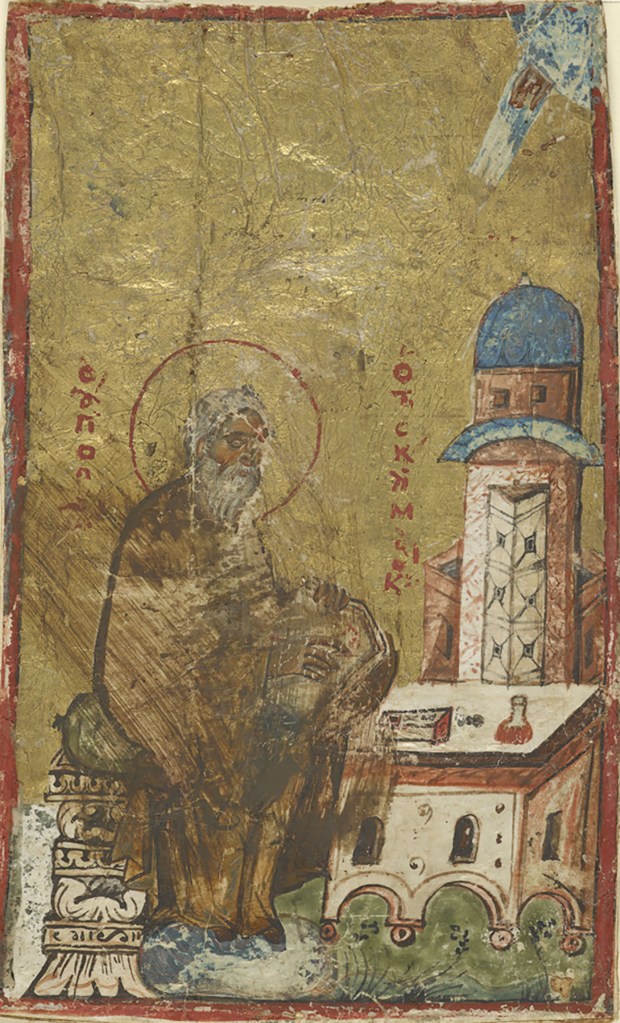
John Climacus, illumination in tempera and gold on parchment, 12th C. Note tha hand of God in the upper right corner, implying the Almighty as the source of St. John’s inspired writings. Freer Gallery, Washington, D.C. Public domain.

The Gospel reading, Matthew 13:24-30, is the the Parable of the Wheat and the Tares. The parable was spoken in the “Kingdom Parables” in Chapter 13. I illustrated the parable with a circa 1540 illumination produced for a Lutheran church in France in The Gospel of Matthew: Annotated & Illustrated, available as noted above through my Amazon Author Central page.

As always, thank you for your interest and support. Glory be to God for all things!

Twenty-fourth Sunday after Trinity

Apologies to followers of this site for absence from Fr. Ron’s Blog last week. My wife and I were travelling to visit our son and his family, an 8+ hours trip down and 8+ more on the way back. Twenty-fourth Sunday after Trinity is the final Sunday with a unique appointed Collect, Epistle and Gospel reading. Since this year there are more than twenty-four Sundays after Trinity it is not the last set of readings. The 1928 B.C.P. has provisions for transferring readings from the final Sundays after Epiphany in years when the calendar has fewer Sundays leading up to Easter. I discuss the complicated rules in Episode Nine in the AIC video series, Trinitytide: The Teaching Season. These will be discussed next week.

The Collect for Twenty-fourth Sunday after Trinity was adapted Archbishop Thomas Cranmer for the first Anglican Book of Common Prayer, published in 1549 A.D. in time for Whitsunday and Trinitytide. The collect was assembled from the collection of prayers for Morning and Evening prayers in the Leonine and Gregorian Sacramentaries, two of the three primary Sacramentaries of the Roman Catholic Church. The common theme continues to be the merciful nature of God the Father and the need for his continual presence in the lives of sinful mankind. A similar prayer was used as the Sixth Prayer in the office of Sixth Hour in our publication. Hear Us, O Lord: Daily Prayers for the Laity, available through my Amazon Author Central page.

LORD, we beseech thee, absolve thy people from their offences;
that through thy bountiful goodness we may all be delivered from the bands of those sins,
which by our frailty we have committed. Grant this O heavenly Father,
for the sake of Jesus Christ, our blessed Lord and Saviour. Amen.

The Epistle reading, Colossians 1:3-12, an advance to the next in the canonical epistles of St. Paul, is a letter to the congregation at Colossae in Asia Minor. The church at Colossae was founded not by St. Paul himself but by his associate, Epaphras. There is no record of St. Paul having visited Colossae. The Apostle to the Gentiles uses spiritual-minded language to both congratulate the Christians at Colossae for their confession of faith and reminds them always of “giving thanks to the Father who has qualifed us to be partakers of the inheritance of the saints in the light.”

Raising the Daughter of Jairus, opaque watercolor over graphite on gray wove paper, part of a series of Scenes in the Life of Christ, James Tissot, 1886-1894, Brooklyn Museum, Brooklyn, NY. Tissot’s historical-style visualizations of Scriptural scenes followed several years of research into clothing styles of the 1st C. and his many visits to the Holy Land.

The Gospel reading, Matthew 9:18-26, the final reading from the Gospel of Matthew, is a record of the Raising of the Daughter of Jairus and the healing of a woman with a blood disorder, also recounted, with different detail, in Mark 5:21-43 and Luke 8:40-50. The scene was one of the favorite Gospel accounts for use in illuminated Gospels and pericope books (which contain only verses used in a liturgy) in the 8th to 12th C. and later in stained glass windows and, even later, in a famous late 19th C. watercolor by James Tissot. The Tissot watercolor was used as Illustration No. 60 in our publication, The Gospel of Matthew: Annotated & Illustrated. A 12th C. illumination and a 20th C. stained glass window by Franz Mayer of Munich, both based on St. Luke’s account are, respestively, Illustration N0. 33 and Illustration No. 34 in The Gospel of Luke: Annotated & Illustrated. The stained glass window is also used in Paintings on Light: the Stained Glass Windows of St. Joseph’s Villa Chapel. As noted above, all AIC Bookstore Publications are available through my Amazon Author Central page.

As always, thanks you for your interest and support. Glory be to God for all things! Amen!

Twenty-second Sunday after Trinity

For the Twenty-second Sunday after Trinity the Collect was adapted by Archbishop Thomas Cranmer for the 1549 Book of Common Prayer from a late edition of the Gregorian Sacramentary. The Gregorian Sacramentary was named in honor of Roman Catholic Pope Gregory the Great, who presided at Rome from 590 to 6o4 A.D. Based on 10th C. document at the Vatican Library, it is one of the three great sacramentaries of the Roman Catholic tradition (Gregorian, Gelasian & Leonine). Scholars argue that the content of the work reflects the influence of Charlemagne, implying a contribution by Alcuin of York, who was the Emperor’s spiritual advisor and teacher. For more on the relationship between Charlemagne and Alcuin, see the blog posting for March 16, A.D. 2024. The design of the volume reflects the style of the sacramentaries produced in Germany during the period of the Ottonian successors to the throne of Charlesmagne. The collect is one of three used in Trinity season in which there are prayers for the Church Universal. The other two are the Collects for the Fifth and the Sixteenth Sundays after Trinity. A similar Collect, also based on the Gregorian Sacramentary, is read on the Fifth Sunday after Epiphany, a Sunday which can be transferred to Trinitytide in years with more than twenty-four Sundays after Trinity. The Fifth Sunday after Epiphany and the complex rules through which select Sundays in Epiphany can be transferred to Trinitytide is discussed in Episode Three of our video series, Epiphany: the Manifestation of Christ to the Gentiles.

LORD, we beseech thee to keep thy household the Church in continual godliness;
that through thy protection it may be free from all adversities,
and devoutly given to serve thee in good works,
to the glory of thy Name through Jesus Christ our Lord. Amen.

The Epistle reading for Twenty-second Sunday after Trinity, Philippians 1:3-11, advances to the next epistle in the canonical list of the epistles of St. Paul. In the older Latin plan of readings, the selection began with verse 5. Verses 3 and 4 were added in the 1662 Book of Common Prayer. St. Luke described Philippi as the “foremost city” in the Greek region of Macedonia (Acts 16:12). . A modern Greek Orthodox baptistery at Philippi, traditionally described as being on the remains of the site visited at the time of St. Paul’s baptism of Lydia (Acts 16:11-15), appears in Illustration No. 57 in the AIC Bookstore Publication, The Acts of the Apostles: Annotated & Illustrated, available through my Amazon Author Central page. Additional details and pricing are found on the AIC Bookstore page. When St. Paul writes about “fellowship” in the Gospel, he relies upon the Greek koinonia [Strong’s Greek word # 2842, related to # 2844), which has the same meaning as “thy household the Church” in the Collect. St. Paul refers twice (verses 6 and 10) to a “day of Jesus Christ/day of Christ), when means the promised Second Coming, from the Greek parousia [Strong’s Greek word # 3952]. The Apostle to the Gentiles assures the Philippians of “the fruits of righteousness” that come only from Jesus Christ. I discuss the meaning of “fellowship” (verse 5), “discernment” (verse 9) and “righteous/righteousness” (verse 119) and nearly 350 other commonly used words and terms, in Layman’s Lexicon: A Handbook of Scriptural, Theological & Liturgical Terms, also available using through my Amazon Author Central page. The entire reading is part of St. Paul’s prayer for the congregation at Philippi.

The Parable of the Unforgiving Servant, oil on canvas, 1649 A.D., Claude Vignon, Musee des Beaux Arts, Tours, France.
Wikimedia Commons

The Gospel reading, Matthew 18:21-35, is the seventh of nine readings in Trinitytide from the Gospel of Matthew. The reading includes two parts. Prayer Book scholar Massey Shepherd noted that verses 21 and 22, including Peter’s question and Jesus’ answer, were added to the traditional Latin pericope (meaning a collection of quotes from Scripture used in a liturgy) for the 1662 Book of Common Prayer. The addition placed the reading in the broader context of the forgiveness which Jesus announced in the Second Petition of the Lord’s Prayer. Following the two-verse dialogue on forgiveness is the Parable of the Unforgiving Servant (also commonly known as the Parable of the Ten Thousand Talents), revealing a king who practiced forgiveness of one of his servants, which servant then failed to heed the lesson and failed to forgive one of his own servants. In the final verse (verse 35), St. Matthew returned to the theme of St. Peter’s question in verse 1 with Jesus’ final pronouncement: “So my heavenly father also will do to you if each of you, from his heart, does not forgive his brother his trespasses.” The historical style image above was used as Illustration No. 105 in The Gospel of Matthew: Annotated & Illustrated, available through my Amazon Author Central page. F.Y.I.: the AIC sells these publications solely through Amazon so that we do not have to stock any inventory or report retail sales since the seller is Amazon and not the AIC. All author royalties from the sale of these publications are contributed to the AIC.

My Podcast Homily for the Communion service on the Twenty-second Sunday after Trinity is available in MP3 format. Another Podcast Homily, this one paired to the readings for Morning Prayer, is linked from the Podcast Homilies-Morning Prayer page. The Collect, Epistle and Gospel readings for Twenty-second Sunday after Trinity are one of the subjects in Episode Eight in our Christian Education Video series, Trinitytide: the Teaching Season. Interesting images of the remains of basilicas, mosaics and a map of Philippi are available in the Philippi entry at Wikipedia.

Next week I will begin adjusting the Home/Welcome page of this site by modifying links to entries for Trinity season, which this year has 25 days after Trinity. The changes will include links to materials related to Advent season. Advent, a season of penitence and preparation (for Christmas), which heralds the start of a new Church Year on the Anglican Calendar. Advent always begins on the Sunday closest to the Feast of St. Andrew (Nov. 30). In A.D. 2024, the First Sunday in Advent is December 1st.

As always, thank you for your interest and support.