For the Fifth Sunday after Epiphany, Archbishop Thomas Cranmer adapted a Collect from the Gregorian Sacramentary. The Gregorian Sacramentary dates from about the 10th C. and is named in honor of Pope Gregory the Great (590-604 A.D.), one of the most influential Popes of the early Church in the Roman Catholic tradition. It is also known as the Sacramentary of Adrian I. To the many earlier petitions in the Collects for Epiphany season, Archbishop Cranmer’s Collect adds the Church Universal to the list of those for whom prayers are sought (which is the meaning of “beseech” in the opening line). The Collect also refers to certain divine attributes of God the Father incorporated into Christian doctrine, including “grace” and “power” (in other places called “might”).
O LORD, we beseech thee to keep thy Church and household continually in thy true religion;
that they who do lean only upon the hope of thy heavenly grace may evermore be defended by thy mighty power;
through Jesus Christ our Lord. Amen.
The Epistle reading, Colossians 3:12-17, is another from the epistles of St. Paul in which the Christian virtues are listed, in this reading adding compassion, kindness, humility, “long suffering,” forebearance, forgiveness and love (charity in the KJV text) and thankfulness for the Lord’s blessings upon mankind. In this reading, St. Paul uniquely refers to the spiritual and other benefits of “psalms and hymns and spiritual songs.” Another prominent leader in the early Church, Athanasius of Alexandria, echoed the sentiment slightly differently in the 4th C.: “The act of singing affects harmony in the soul.” The Christian virtues, which were summarized in more or less final form by the 7th and 8th C. in both the Eastern and Western Church traditions, are discussed in the “Virtue(s)” entry in our Bookstore publication, Layman’s Lexicon: a Handbook of Scriptural, Theological and Liturgical Terms, available through my Amazon Author Central Page.
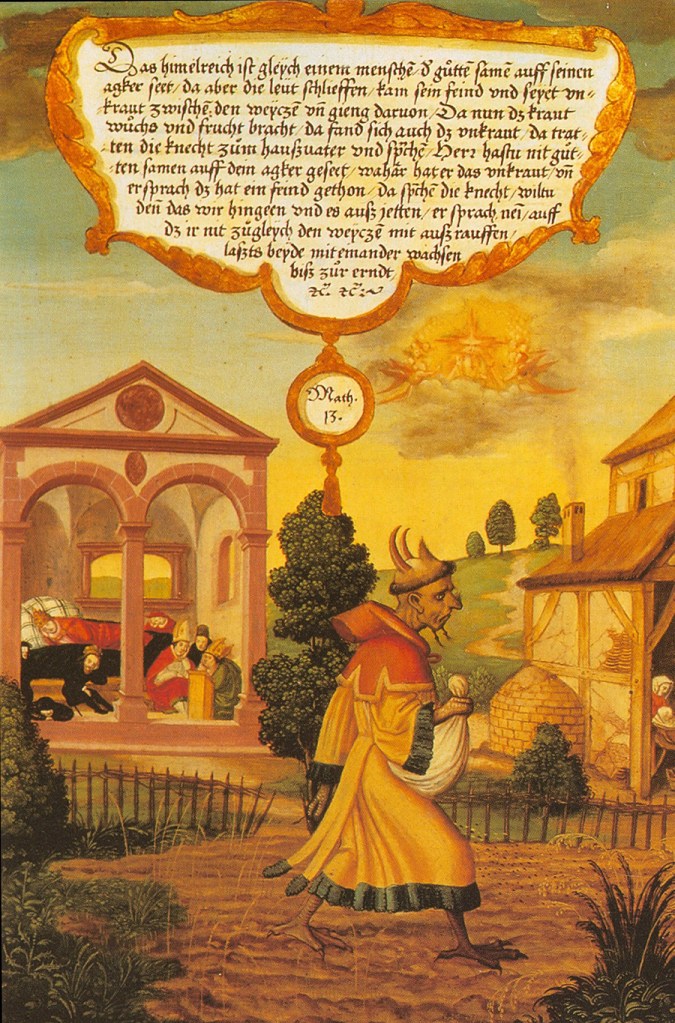
The Gospel reading, Matthew 13:24-30, includes the Parable of the Wheat and the Tares, which is also known as the Parable of the Evil Enemy in the German/Lutheran tradition. The illustration was used as Illustrati0n No. 72 in our Bookstore Publication, The Gospel of Matthew: Annotated & Illustrated, also available through my Amazon Author Central page. For full information about this volume and previously mentioned Bookstore Publications, visit the AIC Bookstore page. For more on Fifth Sunday after Epiphany, watch Episode Three in our video series, Epiphany: the Manifestation of Christ to the Gentiles. The Podcast Homily for Fifth Sunday after Epiphany is linked from the Podcast Archive page. My Podcast Homily based on the Psalm reading for Fifth Sunday after Epiphany, Psalms 112 and 113 is linked from the Podcast Homilies-Morning Prayer page.
Since Fifth Sunday after Epiphany is the final Sunday in the season in 2025 A.D., there will be no post for the Sixth Sunday after Epiphany. The next Blog post will be focused on Septuagesima Sunday, the first of the three “Gesima” Sundays.
As always, thank you for your interest and support. Glory be to God for all things! Amen!






 Anglican Internet Church