Fifth Sunday after Easter

For Fifth Sunday after Easter, commonly known as Rogation Sunday, the Collect is another which was adapted from the Gelasian Sacramentary used in the Roman Catholic tradition. This short prayer acknowledges the LORD as the source of “all things that are good,” which we may think are our own, come through His “merciful guiding.” The Epistle is another reading from the Epistle of St. James offering more practical New Testament wisdom: become “doers” of the Word and “not hearers only.” James describes the benefits of restraint, or “bridling” of the tongue. Almost four centuries later one of the greatest saints of the Eastern Church, John Chrysostom, Bishop of Antioch and then Constantinople, suggested that practicing control of one’s tongue could be considered a worthy sacrifice during the season of Lent. The Gospel reading is again from John 16, this time verses 16-33, in which Jesus grants mankind permission to pray directly to the Father and promises that He will likewise pray for the same to His Father. The reading includes another concept of time of which Jesus spoke in His final days, in this case, “hour,” which are discussed in Episode 43 and Episode 44 in the AIC Video series, New Testament: Gospels, linked from the Digital Library page. In just a few days, the Disciples would discover exactly what Jesus meant in saying “that in me ye might have peace. In the world ye shall have tribulation.” This dialogue appears only in the Gospel of John. There are no examples that I know of in Christian art which depict this event. The timeline in The Orthodox Study Bible: New Testament implies, by association with other events on the last days of Christ, that the location was somewhere in Jerusalem on Maundy Thursday. The dialogue is discussed, without illustration, in the AIC Bookstore Publication, The Gospel of John: Annotated & Illustrated. The volume is available through my Amazon Author Central page. Full details about the book are found on the AIC Bookstore page.

The Collect, Epistle and Gospel readings for Fifth Sunday after Easter are discussed in Episode Three in our video series, Eastertide: From Resurrection to Ascension, linked from the Digital Library page. The audio-only version, in MP3 format, is linked from the Podcast Archive page. My Podcast Homily for Fifth Sunday after Easter is linked from the Podcast Homilies page. A related Podcast Homily for Fifth Sunday after Easter, based on Psalm 118, the appointed Psalm for Morning Prayer, is linked from the Podcast Homilies-Morning Prayer page.

Next week, my Blog post will be made on Ascension Day, May 14th, and will include commentary on readings for Ascension Day and Sunday after Ascension.

As always, thank you for your interest and support for keeping this site available, on-demand, 24/7. Glory be to God for all things! Amen!
Fifth Sunday after Easter

For Fifth Sunday after Easter, also known as Rogation Sunday, Archbishop Cranmer again turned to the Gelasian Sacramentary as the source for the Collect for the Day. The first line in the Collect is a paraphrase of James 1:17, which was part of the Epistle reading for Fourth Sunday after Easter. The Christian tradition of praying for bountiful harvests is traced to practices endorsed by Pope Leo the Great in the late 5th C. Rogation comes from the Latin verb rogare, meaning to ask. In the English Church the first Rogation liturgy was used in the late 12th-early 13th C. in the Sarum Rite. Sarum is modern Salisbury in Wiltshire in southwest England.

O LORD, from whom all good things do come;
Grant to us thy humble servants, that by thy holy inspiration
we may think those things that are good, and by thy
merciful guidance, may perform the same, through
Jesus Christ our Lord. Amen.

The Epistle reading, James 1:22-27, another example of Christian “wisdom” writings during the Sundays after Easter, opens with the famous advice to Christians to “be doers of the word, and not hearers only and ends with other sage advice, to “keep oneself unspotted from the world.”

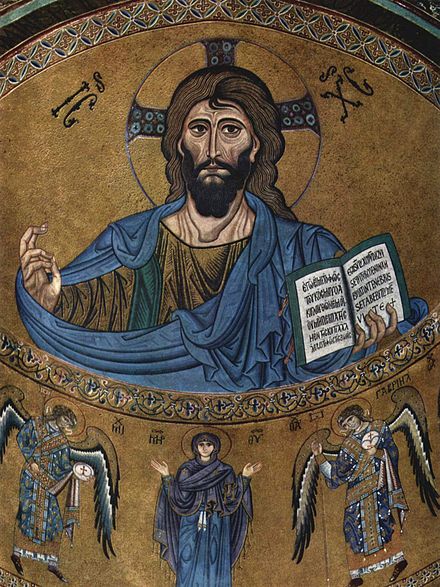
Christ Pantokrator, apse mosaic, Cathedral of Cefalu, Sicily, 11th C. with inscriptions in Greek and Latin. Christ offers a blessing with his right hand and hold the Gospel of John, open to the “I Am the Light of the world” (John 8:12) in his left hand. © Can Stock Photo, Inc./VLADJ55

The Gospel reading, John 16:23-33, is the third and last reading from the unique Gospel of John in Eastertide. Like the earlier readings for the Sundays after Easter, the words were spoken by Jesus after the Last Supper on the evening of Maundy Thursday. In verse 26, Jesus grants to the faithful the right to pray to the Father in HIs name and acknowledges that He came forth from the Father. Jesus closes with words that are both a forewarning and a comfort: “In Me you may have peace. In the world you will have tribulation; but be of good cheer, I have overcome the world” (NKJV text). These readings along with the readings for Fourth Sunday after Easter, Ascension Day and Sunday after Ascension are discussed and illustrated in Episode Three in our video series, Eastertide: From Resurrection to Ascension, linked from the Bible Study: New Testament page. The audio version in MP3 format is linked from the Podcast Archive page. The readings from John 16, although unique to the Gospel of John, are not easily illustrated and therefore were not commonly represented in Christian art across the centuries. Instead, for this fifth and final of the numbered Sundays after Easter, I have used another Christ Pantokrator image, an Apse mosaic at the Cathedral at Cefalu on the northern coast of Sicily east of Palermo, created under commission from Roger II, the Norman king of Sicily. These Byzantine-style mosaics in the Cathedral were commissioned in the 11th C. but were not completed until the 13th C., with the Christ Pantokrator image completed around 1150 A.D. Under the Christ Pantokrator image is the Blessed Virgin Mary flanked by the Archangels Gabriel (left) and Michael (right). In a wider view of the area under the Apse mosaic, the Archangels Raphael and Uriel are shown.

During the Sundays after Easter there have been a number of new subscribers to these blog postings. I thank each of you, as well as earlier subscribers, and invite other viewers to “follow” this blog by clicking the “Follow Fr. Ron’s Blog” and the WordPress logo. You will receive an email from WordPress for each future posting. Next Sunday, Sunday after Ascension, will be the last in this series of postings based upon the Collect and appointed readings. All the other Sundays on the Church Calendar already have appropriate postings during the last two years. My focus in Fr. Ron’s Blog will shift to theme-based commentaries, some based on appointed readings, others based on interesting topics currently under-represented in earlier posts, and anything else that I believer would help site visitors better understand the Anglican worship tradition and Christian art over the centuries.

As always, thank you for your interest and support.