Fourth Sunday in Lent

For the Fourth Sunday in Lent Archbishop Thomas Cranmer again relied upon the Gregorian Sacramentary as the source for the Collect. It is the third of five Collects in Lent to come from that source. This adaptation even more strongly than other collects in the season points toward the redemptive sacrifice of Jesus Christ for the many sins of God’s creation, mankind. In the Western Church, the word or title “Almighty,’ affirms that God is the Supreme authority over all things. In the Eastern Church tradition, especially as understood in the Russian language, His Name in this capacity is Bozhe, which literally translates as the One who can do anything He wishes. It is one of several different Russian words referring to God the Father. Strong’s Exhaustive Concordance defines the title as meaning “sufficient or all-powerful. It is used 48 times, the first in Genesis 17:1 and the last in Joel 1:15, in the King James Version of the Old Testament. The title is derived from the Hebrew Shaddah (Strong’s Hebrew word # 7706). In the New Testament, there are only nine uses, eight of which are from Revelation, based on the Greek word Pantokrator (Strong’s Greek word # 3841). In the Eastern Church tradition, the image of Christ as “Pantokrator” is commonly used in icons, mosaics and frescoes. A common colloquial translation of the title into English is “Ruler of the Universe.” An image of Christ as Pantokrator as used in the Deesis mosaic in the Hagia Sophia at Constantinople/Istanbul, appears in the blog post for First Sunday after Easter, posted on 4/6/2024.

In the English language, one of the clearest example of the meaning of Pantokrator, in the late 17th C., Bible scholar, Bishop, and spiritual advisor to Queen Elizabeth I and King James I, the Blessed Lancelot Andrewes compiled a set of prayers based on Scripture. Since there was no single English word to convey the meaning, he used this all-encompassing phrase, “Blessed, praised,. celebrated, magnified, exalted, glorified and hallowed be thy Name, O Lord; Great and marvelous are Thy works, Lord God Almighty,” which is part of the Second Antiphon in the Sixth Hour office in our publication, Hear Us, O Lord: Daily Prayers for the Laity. More of Andrewes’ writings are printed in the Introduction to Christian Spirituality: An Anglican Perspective. Both books are available through my Amazon Author Central page. A summary of each is found on the AIC Bookstore page.

GRANT, we beseech thee, Almighty God, that we, who for our evil deeds do worthily deserve to be punished,
by the comfort of thy grace may mercifully be relieved; through Jesus Christ our Lord. Amen.

The Epistle reading, Galatians 4:21-31, is part of St. Paul’s explanation of the difference between the Old Covenant and the New Covenant. This epistle was addressed in verse 2 to the several churches in the region of Galatia in Asia Minor, but St. Paul does not name any particular city. In the reading, in symbolic language St. Paul explains the important difference between the descendants of the two sons of Abraham, one born of a “bondmaid” (Hagar, or Agar in the KJV, symbolizing bondage under the law, in verses 22, 24, 25; called a “bondwoman in the NKJV text) and one born of a “freewoman” (Sarah, referred to but not named in verses 22 and 23). He uses the phrase “children of promise” (verse 28), which refers to Christians guided by the Holy Spirit under the New Covenant.

The Miracle of the Loaves and the Fishes, opaque watercolor over graphite on gray wove paper, James Tissot, 1886-1894, Brooklyn Museum, Brooklyn, NY. Public Domain.

The Gospel reading, John 6:1-14, is the first of two readings from St. John’s Gospel in Lent. The subject, with great detail including the talk of Philip and Andrew, is the miracle of the Feeding of the 5,000, which is the fourth of the seven “signs” in the Gospel of John. Discussed in detail in Episode Thirty-nine in our video series, The New Testament: The Gospel of John. The image, also commonly known as The Feeding of the 5,000, is Illustration No. 37 in The Gospel of John: Annotated & Illustrated, like the other AIC Bookstore Publications cited above, linked from my Amazon Author Central page. Full information about the book is found on the AIC Bookstore page. Tissot’s image, like his other Bible illustrations, includes great detail and a visual expression of the scale and the setting, including an extensive variety of clothing commonly worn in the 1st C.

As always, thank you for your interest and support. Glory be to God for all things! Amen!
Third Sunday in Lent

Archbishop Thomas Cranmer’s choice for the Collect for Third Sunday in Lent is the second five Collects in Lent which he sourced from the Gregorian Sacramentary, one of the three primary sacramentaries in the Roman Catholic tradition. Its most memorable phrase, “the right hand of Thy majesty,” is based on the Hebrew understanding of the “right hand” of God being the most honored position. The understanding was incorporated into Christian theology at the Council of Nicea in 325 A.D. In the Nicene Creed, written at that First Ecumenical Council and amended at the Council of Constantinople in 381 A.D. (Second Ecumenical Council, Jesus Christ sits at the right hand of the the Father. There is much more information about the Creeds of the Church in our eight-episode video series, The Nicene Creed, linked from the Digital Library page.

WE beseech thee, Almighty God, look upon the hearty desires of thy humble servants,
and stretch forth the right hand of thy Majesty, to be our defense against all our enemies;
through Jesus Christ our Lord.

The Epistle reading, Ephesians 5:1-14, continues past practice in Lent with another Pauline epistle focused on the concept of guidance for leading a Christian life, later known as the Christian Virtues. These virtues were fully developed by in the 6th through 8th C. in the Western Church. In this reading, the subject is the need for the mastery of passions, here meaning both physical and emotional. These include sexual impropriety and covetousness (verses 3 & 5); intemperate language (verse 4); and idolatry (verse 5). Other themes in the reading include “light” vs. “darkness,” with Christ as the symbol of light who countered the “darkness” of the world before His coming as Saviour. In verse 14, based on Isaiah 60:1, the Evangelist to the Gentiles calls out: “Awake, you who sleep, arise from the dead, and Christ will give you light.” The phrase was immortalized into a hymn, Sleepers Awake!, written in 1599 A.D. by German composer, Philipp Nicolai, and later a cantata of the same name by Johann Sebastian Bach. Bach’s cantata was sung for the first time at Leipzig in 1731 for the Twenty-seventh Sunday after Trinity.

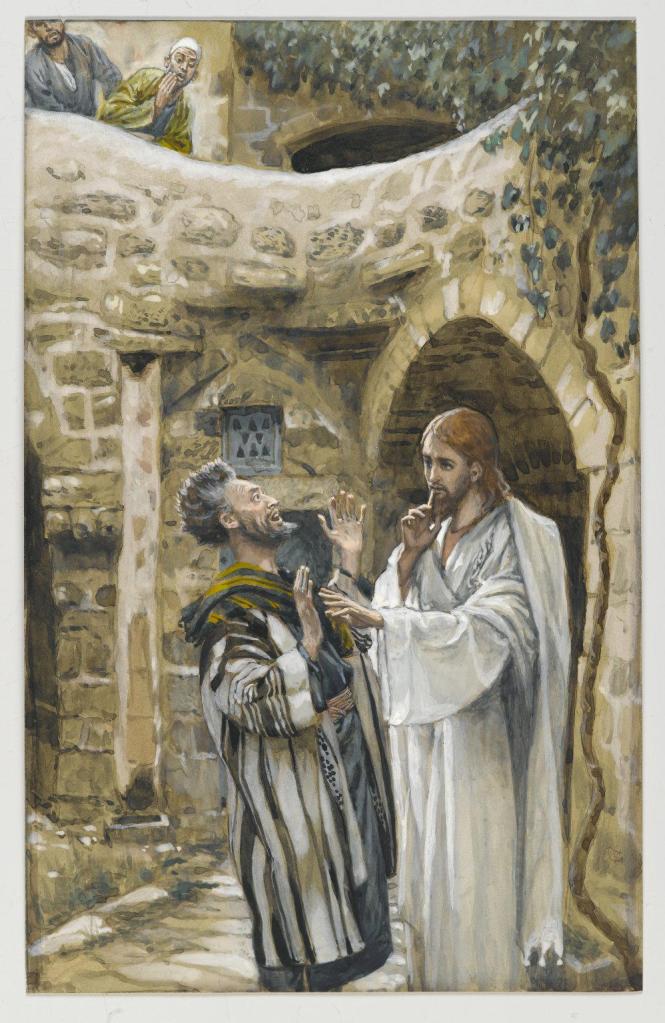
Christ Healing the Mute Man, opaque watercolor over graphite on gray wove paper, James Tissot, 1886-1894, Brooklyn Museum, Brooklyn, NY. Image based upon the less-detailed account in Matthew 12:22-24. Public Domain.

The Gospel reading, Luke 11:14-28, is the first and only reading from St. Luke’s Gospel in Lent. For whatever reason, probably its complexity of its imagery, this encounter was not often illustrated in mosaics, frescoes or icons in the first millennium of Christianity. Numerous commercial examples were produced in the 20th and 21st C. As noted above, the reading is complex. I have divided it into four parts. The first (verse 14) is St. Luke’s brief record of Jesus driving out a demon, or evil spirit, from a mute man and the result: an immediate healing. The event is pictured above as interpreted by French artist James Tissot based on St. Matthew’s account (Matthew 12:22-24). In part two (verse 15) St. Luke records the criticism of Jesus by Temple authorities that He has used “demonic” powers in the manner of Beelzebub. The name roughly means “Lord of the Flies” in Hebrew. In part three (verses 17-26), Jesus offers a demonstration of His divinity: proving that He knew their thoughts (verse 17a) and offers a short sermon on spiritual warfare (verses 17b-26), referring to the possible return of demons that are driven out. Here Jesus uses the Hebrew magical number 7, referring to their return with seven other, even more powerful, spirits. In the final section, part four (verses 27-28), St. Luke offers an account of a woman from the crowd of observers, quoting her beatitude concerning the Blessed Virgin Mary: “Blessed is the womb that bore You, and the breasts which nursed You” (NKJV text). Jesus replied: “Rather, blessed are they that hear the word of God, a keep it” (NKJV text). Eastern Church scholars contend that Jesus is here stating a principle and is not commenting upon the relative worthiness of His mother. For an approximately 15 minute discussion of the important Greek words which appear in this dialogue, listen to my Podcast Homily for Third Sunday in Lent, which is linked from the Podcast Homilies page. One of these important words is “menounge” (Strong’s Greek word # 3304 in verse 28), which the King James Version translates as “rather” and the New King James Version renders as “more than that.” In The Gospel of Luke: Annotated & Illustrated I noted that Jesus made a similar declaration to the Pharisees in John 8:47. Like all our AIC Bookstore Publications, the book is available through my Amazon Author Central page. A summary of the volume is found on the AIC Bookstore page.

F.Y.I: The previously-promised soundtracks for the two new episodes in our video series, The War on Christianity, have not been recorded. Tax-filing preparation, getting my garden ready for Spring, and many other items competing for time have gotten in the way. The new target date is early April. Apologies for the delay.

As always, thank you for your interest and support. Glory be to God for all things! Amen!
Sexagesima Sunday

Sexagesima Sunday is the second of three pre-Lent Sundays, which are now unique to the Anglican worship tradition. For more historical and other detail on the season watch Episode One in our video series. Gesima: the Pre-Lenten Season or listen to the audio Podcast version, which its linked from the Podcast Archive page. This week I offer site visitors two remarkable examples from our nearly 3000-item library of historic art.

The Collect for Sexagesima Sunday was adapted by Archbishop Cranmer from the Gregorian Sacramentary, which was also the source for the Collect for Septuagesima Sunday. It was used for the first time in the 1549 Book of Common Prayer and was read by Archbishop Cranmer himself on Whitsunday/Pentecost, June 9, A.D. 1549. The prayer book also may have been used earlier in the same year at St. Paul’s Cathedral, London. Like the Epistle and Gospel reading for the day, the themes are the “mercies” of God and the Christian virtues. Sexagesima Sunday is actually 57 days before Easter and not the sixty which its name suggests. Readers should remember that the Greek word for God, Theos, (Strong’s Greek Word #2316) is often translated as The One Who Sees.

O LORD God, who sees that we put not our trust in any thing that we do;
Mercifully grant that by thy power we may be defended against all adversity;
through Jesus Christ our Lord. Amen.

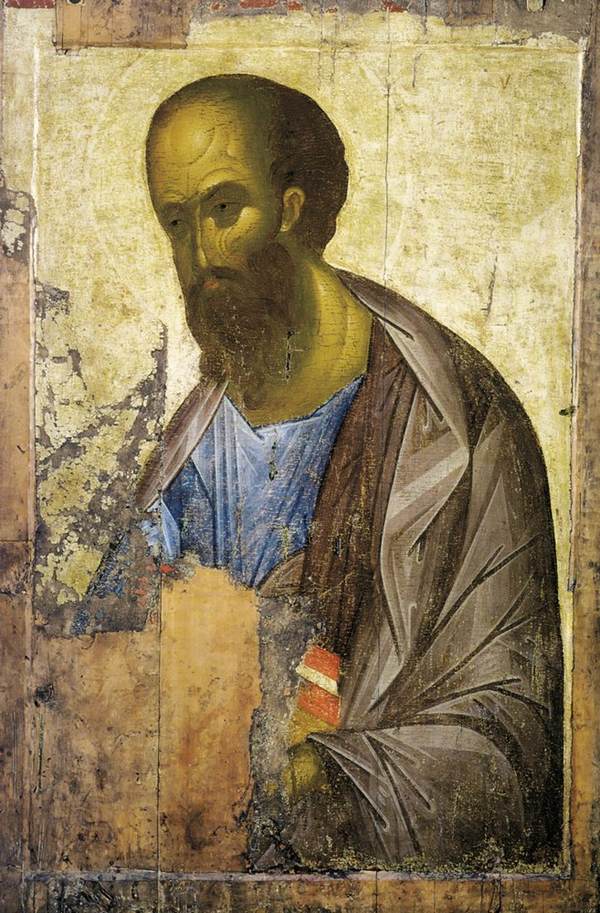
St. Paul, unfinished icon in tempera and gold on wood panel, Andre Rublev, circa 1410-1420, made for the Deesis tier in a Russian church at Zvenigorod, 33 miles west of Moscow, Tretyakov Gallery, Moscow, Russia. Wikipedia Commons/Public Domain.

The Epistle reading, 2nd Corinthians 11:13-21, St. Paul’s letter to the formerly pagan congregation he established at Corinth on his Second Missionary Journey accompanied by Silas. The verses are discussed and illustrated in Episode Two of our video series, Gesima: the Pre-Lenten Season, linked from the Digital Library page and in audio form from the Podcast Homilies page. In this epistle to congregation most resistant to his teachings, he mentions the Christian virtue of diligence and names forms of suffering he endured on his journey, including stoning, beatings, shipwreck, followed by a list of more general adversities, including hunger, thirst and robbery. The image of St. Paul was painted by one of the world’s most gifted icon painters. As the credit line suggests, the image is no longer mounted in the church for which it was being made, having become an “historic” object rather than a religious one. Even in its unfinished form it is an exceptional example of art put to use for Christian purposes. Frequent visitors to this site may have noticed that another image of this icon has a blue background, which was the result of studio lighting. This one is the real thing and will be used in all future AIC Publications and updates to existing books and videos.

The Sower, opaque watercolor over graphite on gray wove paper, James Tissot, 1886-1894, Brooklyn Museum, Brooklyn, NY. Public Domain.

The Gospel reading, Luke 8:4-15, is the evangelist’s account of the Parable of the Sower. The watercolor above appears as Illustration No. 71 in our publication, The Gospel of Matthew: Annotated and Illustrated and Illustration 71 in The Gospel of Mark: Annotated and Illustrated. In the comparable volume on the Gospel of Luke I used an oil on canvas by Vincent Van Gogh. These books are available through my Amazon Author Central page. A summary of the book, including price and pagination, is found on the AIC Bookstore page. The image is from a collection of around 300 images in James Tissot’s Life of Christ series, the largest collection of which is now held at the Brooklyn Museum.

As noted in previous posts late last year, I am working on Episode Six and Episode Seven in our video series, The War on Christianity. I expect to finish the text and slides before the end of this weekend. Each of the 24 slides in Episode Six and 33 in Episode Seven is produced by clipping from a sheet with six slides each and some single image pages in Adobe Photoshop. Afterward, each slide must be inset into a video and the sound track recorded using Apple’s iMovie software. The completed episodes probably will not be ready for publication before the middle to the end of March. It will be linked from the Digital Library page and the voice track, converted into an MP3 file, linked from the Podcast Archive page. In other news, I’ve had.a request from an Anglican clergyman in northern Italy to use some material from this site. I have given permission with the condition that the material contains a link to this site.

As always, thank you for your interest and support. Glory be to God for all things! Amen!

Twenty-fourth Sunday after Trinity

Apologies to followers of this site for absence from Fr. Ron’s Blog last week. My wife and I were travelling to visit our son and his family, an 8+ hours trip down and 8+ more on the way back. Twenty-fourth Sunday after Trinity is the final Sunday with a unique appointed Collect, Epistle and Gospel reading. Since this year there are more than twenty-four Sundays after Trinity it is not the last set of readings. The 1928 B.C.P. has provisions for transferring readings from the final Sundays after Epiphany in years when the calendar has fewer Sundays leading up to Easter. I discuss the complicated rules in Episode Nine in the AIC video series, Trinitytide: The Teaching Season. These will be discussed next week.

The Collect for Twenty-fourth Sunday after Trinity was adapted Archbishop Thomas Cranmer for the first Anglican Book of Common Prayer, published in 1549 A.D. in time for Whitsunday and Trinitytide. The collect was assembled from the collection of prayers for Morning and Evening prayers in the Leonine and Gregorian Sacramentaries, two of the three primary Sacramentaries of the Roman Catholic Church. The common theme continues to be the merciful nature of God the Father and the need for his continual presence in the lives of sinful mankind. A similar prayer was used as the Sixth Prayer in the office of Sixth Hour in our publication. Hear Us, O Lord: Daily Prayers for the Laity, available through my Amazon Author Central page.

LORD, we beseech thee, absolve thy people from their offences;
that through thy bountiful goodness we may all be delivered from the bands of those sins,
which by our frailty we have committed. Grant this O heavenly Father,
for the sake of Jesus Christ, our blessed Lord and Saviour. Amen.

The Epistle reading, Colossians 1:3-12, an advance to the next in the canonical epistles of St. Paul, is a letter to the congregation at Colossae in Asia Minor. The church at Colossae was founded not by St. Paul himself but by his associate, Epaphras. There is no record of St. Paul having visited Colossae. The Apostle to the Gentiles uses spiritual-minded language to both congratulate the Christians at Colossae for their confession of faith and reminds them always of “giving thanks to the Father who has qualifed us to be partakers of the inheritance of the saints in the light.”

Raising the Daughter of Jairus, opaque watercolor over graphite on gray wove paper, part of a series of Scenes in the Life of Christ, James Tissot, 1886-1894, Brooklyn Museum, Brooklyn, NY. Tissot’s historical-style visualizations of Scriptural scenes followed several years of research into clothing styles of the 1st C. and his many visits to the Holy Land.

The Gospel reading, Matthew 9:18-26, the final reading from the Gospel of Matthew, is a record of the Raising of the Daughter of Jairus and the healing of a woman with a blood disorder, also recounted, with different detail, in Mark 5:21-43 and Luke 8:40-50. The scene was one of the favorite Gospel accounts for use in illuminated Gospels and pericope books (which contain only verses used in a liturgy) in the 8th to 12th C. and later in stained glass windows and, even later, in a famous late 19th C. watercolor by James Tissot. The Tissot watercolor was used as Illustration No. 60 in our publication, The Gospel of Matthew: Annotated & Illustrated. A 12th C. illumination and a 20th C. stained glass window by Franz Mayer of Munich, both based on St. Luke’s account are, respestively, Illustration N0. 33 and Illustration No. 34 in The Gospel of Luke: Annotated & Illustrated. The stained glass window is also used in Paintings on Light: the Stained Glass Windows of St. Joseph’s Villa Chapel. As noted above, all AIC Bookstore Publications are available through my Amazon Author Central page.

As always, thanks you for your interest and support. Glory be to God for all things! Amen!


Sixteenth Sunday after Trinity

The Sixteenth Sunday after Trinity, celebrated on September 15th in A.D. 2024, marks the first reading from Ephesians during Trinitytide: the Teaching Season. The Collect for the day is another composition by Archbishop Thomas Cranmer made for the 1549 Book of C0mmon Prayer. It is another which was drawn from the “Gelasian” Sacramentary, named after the 5th C. pope although the volume was not published until circa 750. As you have undoubtedly noticed, the Gelasian liturgy, the second oldest in the Roman Catholic tradition, was highly-favored in the English Church both before and after the Church of England separated from the Church of Rome. The word “Church” was substituted for the original “congregation” in the 1662 Book of Common Prayer.

O LORD, we beseech thee, let thy continual pity cleanse and defend thy Church;
and, because it cannot continue in safety without thy succour,
preserve it evermore by thy help and goodness; through Jesus Christ our Lord. Amen.

The Epistle reading, Ephesians 3:13-21, as noted above, is the first in Trinitytide from St. Paul’s Epistle to the Ephesians, a congregation he established in Asia Minor on his Second Missionary journey. This selection includes St. Paul’s colorful and vivid language which later became popular parts of Christian prayer. These verses are the source of the Christian understanding of the Church as the earthly body of the faithful (as reflected in the previously mentioned insertion of “Church” in place of “congregation”) and the necessity of the Holy Spirit “in” the “inner man” and Christ “dwelling” in the heart (v. 16b-19a). He also uses another term which became part of Christian belief: fulness. I discuss the meaning of “heart” (used 826 times in the King James Version) in the AIC Bookstore Publication, Layman’s Lexicon: a Handbook of Scriptural, Liturgical & Theological Terms, available through my Amazon Author Central page.

The Gospel reading, Luke 7:11-17, the eleventh reading from Luke’s Gospel in Trinitytide: the Teaching Season, is Luke’s account of Jesus “raising” the son of the Widow of Nain, an event which took place around 28 A.D. in western Judea in the second year of Jesus’ public ministry. Fortunately for Christians, the event was featured often in illuminated Gospels, pericope books and other media. For this post I offer three examples from the AIC’s image archive. The first two, in the spiritual style, are Byzantine/Ottonian illuminations from the late 10th and early 11th C. and the third is an example in the historical style in the form of a last quarter 19th. C. watercolor. All three examples were used in one or more episodes Episode Twenty and Episode Twenty-five in the AIC Bible Study Video series, The New Testament, and in Episode Seven in our Christian Education Video series, Trinitytide: the Teaching Season. The spectacularly detailed image from the Gospels of Otto III was used as Illustration No. 56 in the AIC Bookstore Publication, The Gospel of Luke: Annotated & Illustrated, available through my Amazon Author Central page.

Raising the Son of the Widow of Nain, illumination in tempera and gold on parchment, Gospels of Otto III, circa 998 A.D., Clm 4453, Image 60, Bayerische Staatsbibliothek, Munich, Germany. CC by-NC-SA-4.0

This first example was produced at Reichenau Monastery, Lake Constance, Reichenau, Germany, for Holy Roman Emperor Otto III, whose mother was a Byzantine princess. Using that family connection, artists from Constantinople were brought to Reichenau to aid the already-experienced local artists in producing illustrated Bibles and other liturgical books in the Byzantine style of illumination. During the Ottonian era of Holy Roman Emperors, successors to Charlemagne, coronated at Rome, Christmas Day, 800 A.D., developed their own distinctive style, often labelled after the monk Liuthar, the chief of the artists who began in the Scriptorium at Reichenau around 1000 A.D. The art they produced there remains unequalled in the range of detail, including facial expressions, the use of gold as a background, elaborate foliage and flora patterns as borners (see the example above), and scenes often framed between classical architectural features, such as the columns shown above.

The second example is from the Hitda Codex, an illuminated liturgical book produced for Hitda, the Abbess of Meschede, Germany, circa 1020 A.D. The Codex is the only surviving example of Christian art produced at or near Cologne, the center of the empire created by Charlemagne, a Frankish monarch whose kingdom stretched from the southern half of presentday Denmark into most of Spain, a large part of northern Italy and eastward into the edge of the Balkans. Charlemagne was crowned Holy Roman Emperor at Rome on Christmas Day, 800 A.D., becoming the first Christian emperor in the West since the Vandals sacked Rome in 455 A.D. In earlier posts, I have explained the important part which Charlemagne and his spiritual advisor, the Blessed Alcuin of York, played in the spread of Christianity into western Europe.

Raising the Son of the Widow of Nain, illumination in colors and gold on parchment, Hitda Codex, produced for Hitda, Abbess of Meschede, Germany, circa 1020 A.D., Hs. 1640, Universitats- und Landesbibliothek Darmstadt, Darmstadt, Germany. CC0 license.

The third and final example is another watercolor created in the historical style by James Tissot, part of his Life of Christ series produced between 1886 and 1896 and now part of the collection of the Brooklyn Museum. In the watercolor, Tissot’s mastery of architectural detail, costume and a wide range of facial expressions is evident, as is his capture of the details of the central scene in St. Luke’s account.

Raising the Son of the Widow of Nain, opaque watercolor over graphite on gray wove paper, James Tissot, 1886-1896, Brooklyn Museum, Brooklyn, NY.

As always, I thank you for your interest and support. Especial thanks is owed to those who have signed on as followers of this Blog. The AIC’s online presence is intended to make these and other amazing examples of Christian more widely available in a variety of media. Most of our material is available free of charge. Author royalties from all the AIC Bookstore Publications are donated to the AIC. I encourage readers/viewers to visit the host sites for all these images, where these and many more are available in the public domain. They are owed a great debt of gratitude for preserving, archiving and, especially, digitizing the original art and making it available for research and education.

Glory be to God for all things! Amen!

The Lord’s Prayer: Phrase-by-phrase – Episode Tw0

LP-Title1-smallEpisode Two (of two) in The Lord’s Prayer: Phrase-by-phrase is now available in both video and podcast forms.   The focus in Episode Two is on the fourth, fifth and sixth petitions; the Doxology (in St. Matthew’s version); and a general summary of the series.  The discussion of the Doxology includes a presentation on the two most likely ways the Doxology found its way into St. Matthew’s Gospel.  The illustrations include art from the 9th through the early 21st Centuries.  The episode runs just over 21 minutes.       Watch the video      Listen to the Podcast Continue reading “The Lord’s Prayer: Phrase-by-phrase – Episode Tw0”

Sixteenth Sunday After Trinity

Quite a busy week, starting with a heart catheterization on Tuesday.  I am thankful and glad to report that the test found no new blockages in my heart and no obstruction in the stent which was installed in 2013.  The most convincing theory of the moment is that my symptoms were the result of stress, lack of exercise and lack of sleep, etc.  Consequently, lifestyle changes have already been made, including regular exercise, including at least 30 minutes of walking, and regular massages at my chiropractor’s office.

There will be no new episodes in our Bible Study series on Revelation this week.  I hope to complete work on Episode 23, focused on Revelation 18, before the end of next week.  All the slides are done, as is the sound recording.  I have to coordinate the pictures and sound, tedious, time-consuming work for which had neither time nor energy for this week!  Thanks for your patience.

I am presently at work on the final Chapter of Revelation and hope to have all the episodes completed before the middle of October.

Raising the Son of the Widow of Nain, opaque watercolor over graphite on gray wove paper, James Tissot, late 19th C. Public domain by the Brooklyn Museum

I did complete and upload to the AIC Web Site and Facebook my Podcast Homily for Sixteenth Sunday After Trinity.  The Gospel reading covers the Raising of the Son of the Widow of Nain (Luke 7:11-17).  The only illustration I know of is the lovely watercolor from the Life of Christ series by James Tissot at the Brooklyn Museum.

Listen to the Podcast Homily