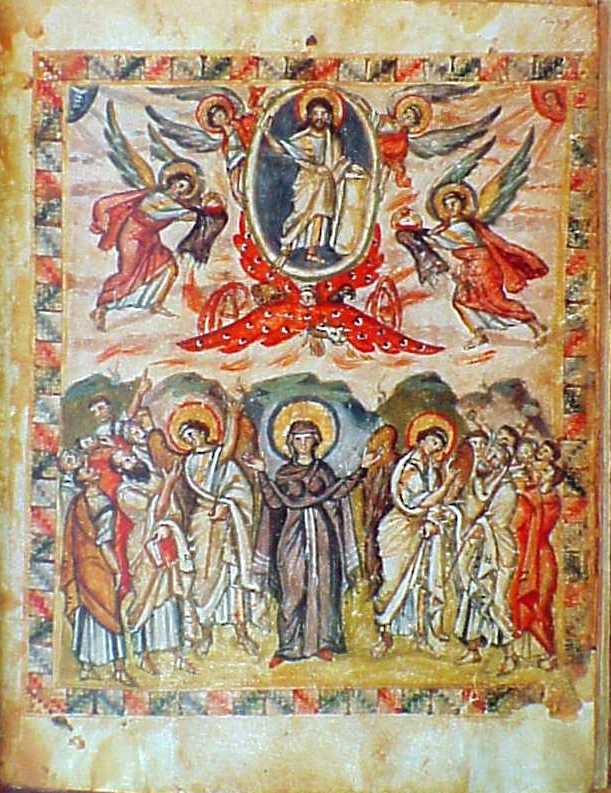
In the Anglican worship tradition, Ascension is officially celebrated on the Thursday following Fifth Sunday after Easter and, because so many cannot attend a mid-week service, themes related to the Ascension are repeated on Sunday after Ascension (the Sixth Sunday after Easter). The Collect for Ascension Day is based on the Gregorian Sacramentary and the Missal texts at Sarum (Salisbury). Theological concepts observed on Ascension Day were incorporated into the Nicene Creed in 325 A.D. The original text and the changes made in 381 A.D. are discussed and illustrated in the AIC Video Series, The Nicene Creed, linked from the Digital Library page. The Epistle reading, Acts 1:1-11, includes St. Paul’s record of post-Resurrection appearances by Christ and His being taken up into heaven. The Gospel reading, Luke 24:49-53, is the evangelist’s own record of the actual event of the Ascension to the Father.
For Sunday after Ascension, the Collect was derived from a Vespers office of the new Church of England that is itself derived from the deathbed song of the Venerable Bede. The Epistle reading, 1 Peter 4:7-11, another example of New Testament wisdom features throughout Eastertide, includes St. Peter’s teachings on the proper use of one’s gifts from God. In the Gospel lesson, the sixth and last in Eastertide from the pen of St. John, John 15:26-16:4a, St. John quotes more from Jesus on preparation for the coming of the Holy Spirit, or The Comforter. The Collect and readings are discussed and illustrated in Episode Three in the AIC Seasonal Video series, Eastertide: From Resurrection to Ascension, linked from the Digital Library page. The audio-only Podcast version of Episode Three is linked from the Podcast Archive page. My Podcast Homily for Sunday after Ascension is linked from the Podcast Homilies page. A related Podcast Homily, focused on the Psalm reading for Morning Prayer on Sunday after Ascension, Psalm 8 & Psalm 108:1-5, is linked from the Podcast Homilies-Morning Prayer page.
Sunday after Ascension brings the season of Eastertide to a close. The remainder of the Anglican Church Year is focused on readings and other material focused on Trinity Sunday and Trinitytide, the longest season on the Anglican Church calendar. The AIC Seasonal Video series, Trinitytide: the Teaching Season, is presented in nine episodes, also linked from the Digital Library page with Podcast/audio only versions linked from the Podcast Archive page.
I have not decided on a plan for Fr. Ron’s Blog during Trinitytide. Since the weekly postings for Trinity were completely rebuilt in A.D. 2021, the weekly Blog will probably revert to more topical postings without any specific plan in mind. As always, thank you for your interest and support. Viewers might be interested to know that the greatest number of visits to our site is coming from Asia. To our Asian friends, another thank you. Glory be to God for all things! Amen!