Trinity 23 and AIC Bookstore – Part Six

Ooophs. In A.D. 2025, there is no Trinity 23. On the traditional calendar it is preempted by Sunday Next Before Advent. In 2024 A.D. for reasons I do not remember, I did not provide a Blog post for Trinity 23. In 2025 A.D. it is the final Sunday after Trinity, since Advent begins on Sunday, November 30th. However, you can listen to my Podcast Homily for Trinity 23 or, for a visual version, watch Episode Eight in Trinitytide: the Teaching Season. The Gospel reading for Trinity 23 includes Jesus’ use of the phrase, “Render unto Caesar…” (Matthew 22:15-22). In the video series, the discussion includes another of James Tissot’s remarkable watercolor interpretations of the words of Christ. The Gospel reading for Trinity 23 is the ninth quotation from the Gospel of Matthew in Trinitytide.

For this week’s Blog posting, the focus is on the second of two AIC Bookstore Publications focused on the primary seasons on the Anglican Church Calendar: Easter and Christmas.

The cover image is an 11th C. mosaic, Christ Resurrected (known as the Anastasis in Greek), east wall, Narthex, Hosios Loukas Monastery, Distoma, Greece. Source: Wikipedia Commons. The theological symbolism of the image is discussed in Chapters 2 and 3.

Easter: The Resurrection of Our Lord in Scripture, Art & Christian Tradition is presented in 156 pages. There are 132 illustrations from the 6th C., 9th through 17th C. and 19th through 21st C. The book is divided into six parts, plus a Preface, List of Illustrations and a brief guide to the art of illumination of Scripture. Part One includes discussion and art related to events and prophecies during the three days between Good Friday and Easter Sunday (called the Triduum in Latin), including the “Harrowing of Hades.” This is the period of Jesus’ visit in Hades/Hell that is mentioned in the Apostles’ Creed. A special text box includes the Easter/Paschal sermon of St. John Chrysostom, which is still delivered annually on Holy Saturday in many Eastern Orthodox Churches. Chapter Four in this section is focused on Jesus’ prophetic references to Resurrection in three days.

Part Two is focused on events of the Resurrection recorded for early on Easter Day, according to the accounts in the Gospels of Matthew, Mark, Luke and John. A special text box explains the “Three Marys” tradition regarding the three women at the empty tomb in these Gospel accounts.

Part Three is focused on Post-Resurrection appearances of Jesus Christ, as recorded in the Gospels of Luke and John, including those occurring on Easter evening and the eight days afterward, including accounts of the “doubts” of St. Thomas and his confession; on meeting Apostles on the road to Emmaus and the subsequentmeal at Emmaus; and Jesus with the Apostles at the Sea of Tiberius, uniquely recorded in the Gospel of John.

Part Four is focused on Jesus’ final post-Resurrection appearances, the Great Commission and the Ascension. The text is based on the accounts in the Gospels of Matthew, Mark and Luke, plus The Acts of the Apostles. There are fourteen illustrations of the Ascension depicting the event from both the Western and Eastern Church traditions.

Part Five is focused on music for Easter in both the Western and Eastern Church traditions, including the text of Easter hymns and Psalms; a special text box listing all the seasonal music printed in another AIC Bookstore Publication, The St. Chrysostom Hymnal, which was used at my former parish and which is now available in paperback.

Part Six is focused on Easter traditions both in liturgy and foods and includes images of Easter worship in Kent, Lancashire, St. Agnes Island, and London, England; and in Bucharest, Romania; Kiev, Ukraine; Emmaus-Nicopolis, Israel; and Gomel City, Belarus. For this volume, Corkie Shibley created a recipe for “Empty Tomb Hot Cross Buns.”

Sources for this collection of Christian art include icons, mosaics, frescoes, altarpieces, bas reliefs, tapestries, oil paintings and watercolors; stained glass windows; illustrated Psalters, Pericope Books, Sacramentaries, as well as illustrated Bibles and Gospels produced for the use of both clergy and royalty. The format used in Easter: The Resurrection of Our Lord in Scripture, Art & Christian Tradition is slightly different than in the Christmas volume. For this blog post, there is no image of an inside page, because nearly all the illustrations, for best effect, are printed on full pages placed opposite the actual Scripture text.

This volume, first published in A.D. 2023 and updated at Epiphany A.D. 2024, was written and edited primarily for the education of the laity of the Church; however, clergy from both the Western and Eastern Church traditions may find the Bibliography and the Sources of Illustrations pages useful for further learning and research. I am grateful to the staff at libraries and other archives in England, Europe and the United States and to our donors, who make possible the acquisition of the high-resolution images used in this book. Several individuals who provided exceptional assistance in resolving the many technical issues (resolution, clarity, etc.) are named in the Preface.

Like all the AIC Bookstore Publications, Easter: The Resurrection of Our Lord in Scripture, Art & Christian Tradition is available only through my Amazon Author Central page. Royalties for all the AIC Bookstore Publications are contributed to the AIC. Additional information about pricing and pagination of this and the other AIC Bookstore Publications is found on the AIC Bookstore page.

As always, thank you for your interest and support. Glory be to God for all things! Amen!

First Sunday after Easter

This week I return to the usual formula of discussion of the Collect, Epistle & Gospel readings. All the readings for Easter Sunday and a short history of the Feast of Easter are discussed in Episode One in our video series, Eastertide: From Resurrection to Ascension, linked from the Digital Library page with Podcast Homilies for each linked from the Podcast Homilies page. Readings for Easter Monday and Easter Tuesday and First Sunday after Easter are discussed and illustrated in Episode Two of the same series. During Eastertide, the possible collects include two original compositions by Archbishop Cranmer, one based on the Church of England’s Vespers office that was derived from the writings of The Venerable Bede, one from the Gelasian Sacramentary, four from the Gregorian Sacramentary, and one from the Leonine, these latter three being the primary sources in the Roman Catholic tradition.

The Collect for First Sunday after Easter was composed for the 1549 Book of Common Prayer by Archbishop Cranmer based upon John 3:16, Romans 4:25 and 1 Corinthians 5:7-8. The verse from 1 Corinthians is one of the three verses which replace the Venite in Morning Prayer on Easter Sunday.

ALMIGHTY Father, who hast given thine only Son to die for our sins,
and to rise again for our justification;
Grant us so to put away the leaven of malice and wickedness,
that we may always serve thee in pureness of living and truth;
through the merits of the same thy Son Jesus Christ our Lord. Amen.

The Epistle reading, 1 John 4:4-12, includes a preview of the coming of the Holy Spirit at Pentecost, St. John’s bold statement in verse 4 that faith has overcome the world and ends with his sage advice in verse 10 concerning the Christian obligation to accept the certainty of the word, or “testimony,” of God over the opinions of men.

The Confession of Saint Thomas, also known as The Incredulity of Thomas, egg tempera, silver and gold icon on panel, Dionysius, circa 1500 A.D. Dionysius was the last of the great Russian icon painters of the 14th and 15th C. Wikimedia Commons.

The Gospel reading, John 20:19-23, as with the Epistle reading from the pen of John the Evangelist, or his dictation to his scribe, Prochorus. The subject is the post-Resurrection appearance of Jesus to ten disciples assembled in a closed room. It includes several blessings upon the Apostles and, in verse 23, the Scriptural basis for the Sacrament of Confession, or Penance: “If you forgive the sins of any, they are forgiven them; if you retain the sins of any, they are retained.” The illustration of Saint Thomas, commonly known as Doubting Thomas, appears as Illustration No. 59 in our Bookstore Publication: Easter: The Resurrection of Our Lord in Scripture, Art & Christian Tradition. It is one of five illustrations in Chapter Six, which covers a series of events late on Easter Day and the following eight days as described in the four Gospel accounts. The volume, with 117 illustrations, is available through my Amazon Author Central page, with the cover and a summary of the book on the AIC Bookstore page.

As always, thank you for your interest and support. Glory be to God for all things! Amen!

Second Sunday in Lent

The Second Sunday in Lent, which is 2/25 in A.D. 2025, finds the AIC actively engaged in updating our database of digital resources. The review and update involves taking a page-by-page review of all 22 of our printed books, plus the various Seasonal and Bible Study Video series. As of today, 2/24/2024, I have crossed the half-way point, having finished all the printed books, the Seasonal Videos (Advent, Great “O” Antiphons, Christmas, Twelve Days of Christmas, Epiphany, Gesima, Lent, Easter and Trinitytide), the Christian Education Videos (The War on Christianity; The Nicene Creed; The Lord’s Prayer; The Lives of the Saints, both the First and Second Series); and Episode One to Episode 7 in The New Testament: Gospels series. The image count stands at just over 2500, but this does not count duplicate versions (including different sizes; details; perspetive correction; brigthening effect; and other technical adjustments).

This week I am starting research on a new series of topical postings to Fr. Ron’s Blog. I begin this adventure with some material discovered in the examination of images from Constantinople before 1453. The Byzantine world produced some of the finest and most-inspiring examples of Christian art, including illuminated manuscripts, frescoes and mosaics in churches, cathedrals and monasteries in locations ranging from northeast France, where only one Byzantine building remains, to Asia Minor and the Holy Land. In my effort to make sure our citations are correct, I have had to re-visit online sites to verify a wide range of issues, including accuracy of content description, identity of the author/artist, the date or ranges of dates of creation/completion, as well as credit lines for photography, manuscript and folio numbers. Recently, this led me to revisit image of the Hagia Sophia, originally built in the reign of Emperor Justinian during the 6th C. and Chora Church (or Church of Our Saviour), the latter of which is used as the background image on this web site.

In this research I found a site that includes detailed study and imagery of Chora Church. Chora Church fell into serious decline and neglect during the period after the Crusader attack on Constantinople in 1204 A.D. For the following sixty years, until after the Byzantine Empire recaptured the city and surrounding areas Eastern Orthodox worship was effectively banned and replaced with Roman Catholic liturgies. In what is called the Late Byzantine revival in the late 13th and early 14th C. many of Byzantium’s finest buildings were restored or enlarged, including Chora Church. Between 1321 and 1321 Chora Church was repaired and improved. The two images I share today come from the Inner Narthex (which was the second Narthex, between the Outer Narthex entrance and the central Nave) and, on the right hand side, the Parakklesion, a long rectangular space which runs from the right hand end of the Outer Narthex down the long axis of the building and parallel Nave (or Naos) and the Altar (or Bema).

The first image shows a mosaic of the Blessed Virgin with Joseph and the Christ Child at center with Joachim and Anne, Mary’s parents, looking on. It is located in below the smallest of two domes in the Inner Narthex, which includes images related to Mary. At my former parish at St. Joseph’s Villa, Richmond, VA, there is a stained glass window which depicts Mary learning wisdom from her parents. (Image: Byzantologist. CC by NC-SA 2.0).

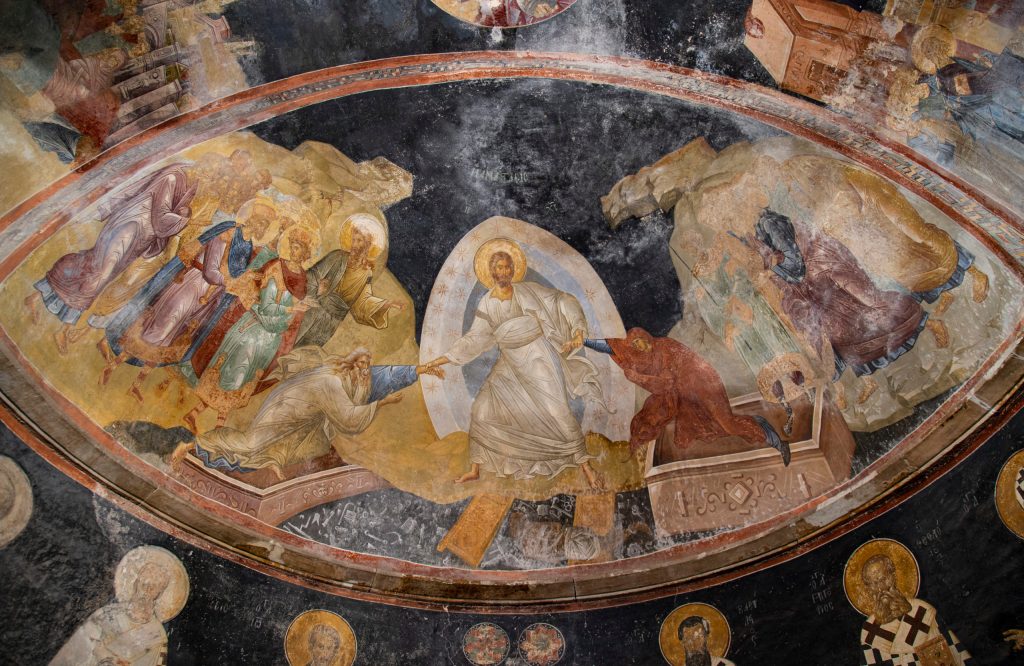
The second image is larger version of one which I used, based on a different source, in Easter: The Resurrection of Our Lord in Scripture, Art & Christian Tradition, available using the Virtual Bookstore link at the bottom of the Welcome page and on the AIC Bookstore page. The work is a Apse fresco placed at the far end of the Parakklesion. The title is Anastasis, which literally means “to stand up” and which is the Greek word for Resurrection. In this remarkable image Christ appears to yank Adam, in blue at left, with His right hand, and, with his left hand, Eve, in white, from Hades. Note that Jesus stands upon the destroyed gates of Hades, or Hell in the Western Church tradition and that there are keys remaining in the Pit (Abyssos in Greek). Surrounding the Christ figure, the saints and apostles look on. The figure at Jesus’ right, wearing a golden halo, is John the Baptist, always described as the Last Prophet of the Old Testament. (Image: Byzantologist. CC by NC-SA-2.0).

I hope you find these two images inspiring and spiritually uplifting in our age of secular decline. You can see a 16-page version or watch a companion video at http://www.SmartHistory.org under the heading Picturing Salvation-Chora’s Brilliant Byzantine Mosaics and Frescoes by Dr. Evan Freeman. This world could use a lot more of this kind of confident expression of the Christian Faith.

Next week, I will focus on The Blessed Alcuin of York, author of the Collect for Peace (“Almighty God, unto whom all hearts are open, all desires, known, and from whom no secrets are hid….’) in the Holy Communion liturgy in the 1928 Book of Common Prayer.

As always, thank you for your interest and support. Glory be to God for all things! Amen!