Whitsunday 2026 A.D.

Sunday, May 24th, 2026 A.D., on the Anglican Church Calendar is Whitsunday, which in other denominations is more commonly known as Pentecost, a celebration of the Descent of the Holy Spirit (Holy Ghost in the King James Version). As noted in previous posts in A.D.2026, the Descent is commonly depicted with the Holy Spirit depicted in the form of a dove, as in the Gospel accounts of the Baptism of Christ (Matthew 3:13-17; Mark 1:9-11; Luke 3:21-22; John 1:29-34) and Acts of the Apostles (2:1-11).
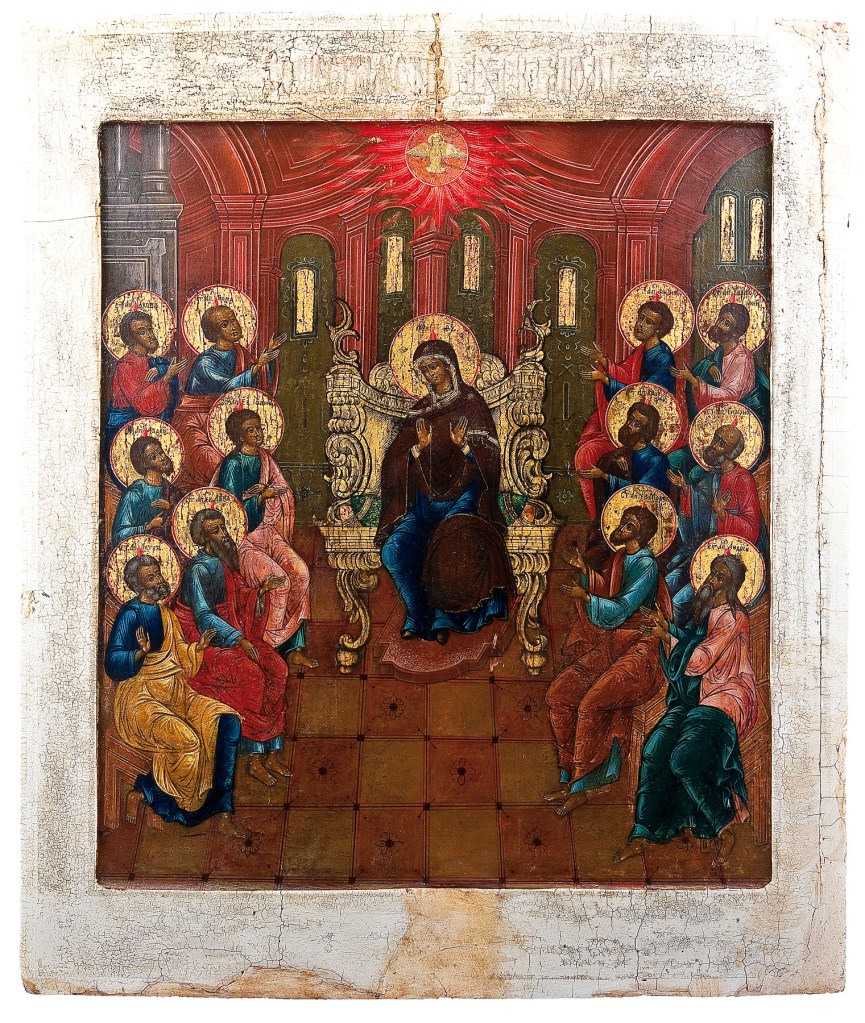
The Descent of the Holy Spirit on the Apostles, gilt and silver on wood icon, probably 18th C., Russia. Holy Spirit depicted as a Dove and flames of fire. From a private collection. Wikimedia Commons.

In the 1928 Book of Common Prayer, there are two Collects for Whitsunday. The first is an adaptation by Archbishop Cranmer from the Gregorian Sacramentary (10th C.), based on the reading used for the Sunday morning Communion service for Whitsunday at St. Peter’s Basilica. In the Collect reference is made to the Spirit offering comfort to “thy faithful people.” The Collect makes clear that it is the presence of the Holy Spirit in the faithful which makes it possible for mankind to achieve “a right judgment in all things.” The second Collect is unique to the 1928 Book of Common Prayer. The identity of the author is unknown. Prayer book scholar Massey Shepherd speculated that it may have been added in order that more of the faithful would hear such doctrine on the Sunday morning celebration of Holy Communion on one of the three most important Sundays on the Church calendar, the other two being Christmas morning and Easter. It contains a plea that by the indwelling of the Spirit the faithful “may be enlightened and strengthened for thy service.” The second Collect is intended for use in the first service when there is more than one service offered on Whitsunday.

The Collects and the two sets of epistle and “for the epistle” reading from St. Luke’s account of the Descent of the Spirit (Acts 2:1-11) plus the Gospel readings for both services are discussed and illustrated in Episode One in our Seasonal Video series, Trinitytide: the Teaching Season, linked from the Digital Library page. The reading from 1 Corinthians 12:4-14 includes important instruction from St. Paul on the nature of the Church and the importance of spiritual gifts. The video series begins with readings for Whitsunday and for weekdays Whitsun Week and closes with the Sunday next before Advent, as well as the complicated rules for moving readings from Epiphany season when there are more than twenty-four Sundays after Trinity. The audio only (MP3) version is linked from the Podcast Archive page. My Podcast Homily for Whitsunday is linked from the Podcast Homilies page. A related Podcast Homily for Whitsunday, based on Psalm 68, the Psalm reading for Morning Prayer on Whitsunday, is linked from the Podcast Homilies-Morning Prayer page.

As always, thank you for your interest and support. Glory be to God for all things! Amen!

Sunday after Ascension

Anglican worship for the Sunday after Ascension marks the close of the prayer cycle focused on historical events, beginning with First Sunday in Advent and including the seasons of Advent, Christmas/Nativity of Our Lod, Epiphany, and Eastertide/Ascension. Next Sunday, Whitsunday/Pentecost, marks the start of what the AIC refers to as the “Teaching Season.” During this second half of the year, the collects and readings are focused on elements of doctrine rather than events.

For Sunday after Ascension, instead of another prayer adapted from one of three primary sources in the Western Church tradition, that is, the Leonine, Gregorian or Gelasian sacramentaries, Archbishop Thomas Cranmer turned to the traditions of the English Church. His Collect for Sunday after Ascension was adapted from a song which was sung for The Venerable Bede during Bede’s final illness in 735 A.D. In the English Church, the words of the song had been incorporated into a prayer in the Vespers office, usually celebrated around 5 P.M. or local sunset. The words of the Collect, very much like the Gospel reading from John 16 for Fourth Sunday after Easter, were intended to prepare worshippers for the transition from the celebration of Christ’s Ascension, celebrated on Ascension Day, the Thursday following Fifth Sunday after Easter, into the recognition of the Descent of the Holy Spirit at Pentecost/Whitsunday. In the King James Version and the Book of Common Prayer, the Holy Ghost, or Holy Spirit, is referred to as “Comforter.” In the New King James Version He is called the “Helper.” Bede is also venerated in the Roman Catholic tradition, although he was not canonized by the Roman Church until the reign of Pope Leo XIII in 1899 A.D. The Venerable Bede was the author of the earliest history of the Church in England, Ecclesiastical History of England, covering the period up to 731 A.D., the year the book was published. An online version is available through CCEL.org.

The Ascension, the left panel of a triptych in tempera on wood, Andrea Mantegna, 1463-1464 A.D., Uffizi Gallery, Florence, Italy. Image from The Yorck Project: 10,000 Masterworks. Public Domain.

O GOD, the King of glory, who hast exalted thine only Son Jesus Christ with great triumph
into thy kingdom in heaven; We beseech thee, leave us not comfortless; but send to us thine Holy Ghost
to comfort us, and exalt us into the same place whither our Saviour Christ is gone before,
who liveth and reigneth with thee and same Holy Ghost, one God, world without end. Amen.

The Epistle reading, 1 Peter 4:7-11, begins with St. Peter’s advice concerning preparation for final judgment (verse 7), goes on to extol the Christian virtue of love (Verse 8, translated as “charity” in the King James Version and the Book of Common Prayer) and acknowledges that virtues come to mankind as a sovereign gift from God. The final verse (verse 11) includes words which have been incorporated into many Christian liturgies and prayers, here printed in the Prayer Book translation:

If any man speak, let him speak as the oracles of God;
If any man minister, let him do it as of the ability which God giveth:
that God in all things may be glorified through Jesus Christ,
to whom be praise and dominion for ever and ever. Amen.

The Gospel reading, John 15:26 to John 16:4a, the fifth of five selections from the Gospel of John in the Sundays after Easter and Sunday after Ascension, includes a warning about the earthly dangers for followers of Jesus Christ, not only for those immediately within His hearing but also for those who would follow Him in the generations to come. Perhaps that is why the reading is presented in the Book of Common Prayer out of chronological order, with reference in verse 26 to an event already celebrated on Ascension Day.

But these things I have told you, that when the time comes,
you may remember that I told you of them.

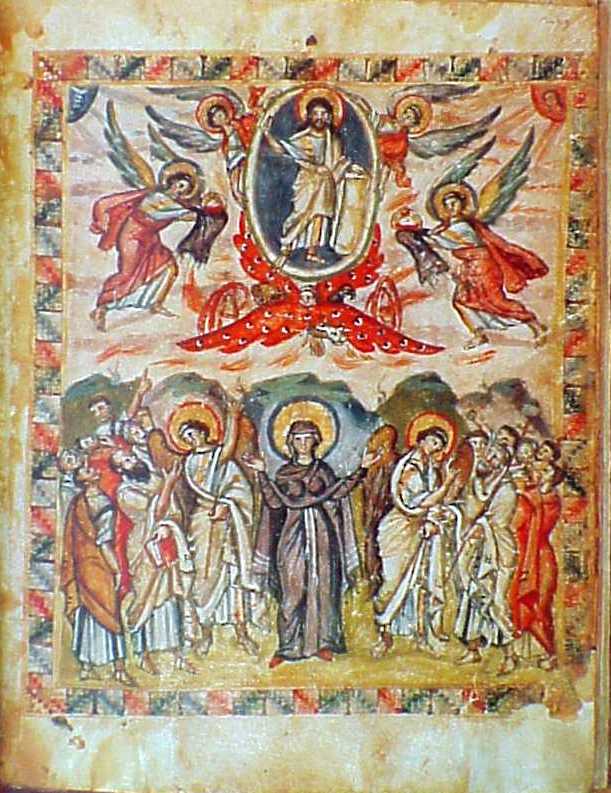
The Ascension, illumination in tempera and gold on parchment, Rabbula Gospels, produced in the region of present-day Syria, then known as Mesopotamia, at the monastery of St. John of Zagba, 586 A.D. Codex Pluteus 1, 56, Folio 13v, Biblioteca Medicea Laurenzina, Florence, Italy. The document has been in Florence since the 16th C. The volume also includes the oldest surviving image of the Crucifixion. This version is from The Yorck Project: 10,000 Masterworks, published on a DVD and released into the Public Domain in 2002 A.D.

The actual descent of the Holy Spirit is celebrated annually on the Church Calendar on Whitsunday/Pentecost. The descent is described vividly by St. Luke in Acts 2:1-11, which is the Epistle reading for Whitsunday. The illustration displayed above the Collect for the Day represents the Western style of literalist interpretation of Christ’s Ascension. The illustration above this paragraph represents a more spiritual style. Both illustrations and twelve others were used in our publication, Easter: The Resurection of Our Lord in Scripture, Art & Christian Tradition, available through my Amazon Author Central page, with details of the volume found on the AIC Bookstore page. The Collect, Epistle and Gospel readings for Sunday after Ascension are discussed and illustrated in Episode Three in the AIC Christian Education Video series, Eastertide: From Resurrection to Ascension, linked from the Digital Library page and, in MP3 audio format, from the Podcast Archive page.

Next week I plan to begin a new series of topical Blog postings. Readers are reminded that Blog entries for the other Sundays on the Church Calendar are linked from the Fr. Ron’s Blog tab for the years from 2023 through 2025. The page includes links to all posts going back to the opening of this site in August 2014. The Blog includes topical links following the actual blog entries.

As always, thank you for your interest and support. Glory be to God for all things! Amen!