The Collect for Nineteenth Sunday after Trinity is another adaption by Archbishop Cranmer from the Gelasian Sacramentary for use in the 1549 Book of Common Prayer. It is also another which was amended for the 1662 Book of Common Prayer in which the reference to the Holy Spirit was added. The change made the Collect more consistent with the theme of both the Epistle and Gospel and of the season of Trinitytide. The phrase “direct and rule our hearts” was very popular among the early Saints in the Eastern Church tradition. The doctrine of the equality of the Holy Spirit with God the Father and God the Son was made part of the original Nicene Creed at the Council of Constantinople (or Second Ecumenical Council), 381 A.D. The Council was influenced by the writings of Gregory Nazianzen, who was the presiding Bishop, Gregory of Nyssa and his late brother, Basil of Caesarea. The work of that Council is discussed in detail, with illustrations, in the AIC Christian Education Video series, The Nicene Creed, presented in eight episodes (with the changes made in 381 A.D. in Episode Seven). The contributions of the two Gregories and of Basil of Caesarea are also discussed and illustrated in our video series, The Lives of the Saints, Second Series. Gregory of Nyssa (Feast Day: Jan. 10th) is celebrated in Episode Six; Gregory Nazianzen (Feast Day: Jan. 25th, with some jurisdictions including him with two others in May), in Episode Eight; and Basil of Caesarea (Feast Day: Jun. 14th) in Episode Seventeen. Basil’s most famous essay, On the Holy Spirit, is available in paperback from St. Vladimir’s Seminary Press (ISBN: 978913836-74-3), as Volume 5 in its Popular Patristics Series.
O GOD, forasmuch as without thee we are not able to please thee;
Mercifully grant that thy Holy Spirit may in all things direct and rule our hearts;
through Jesus Christ our Lord. Amen.
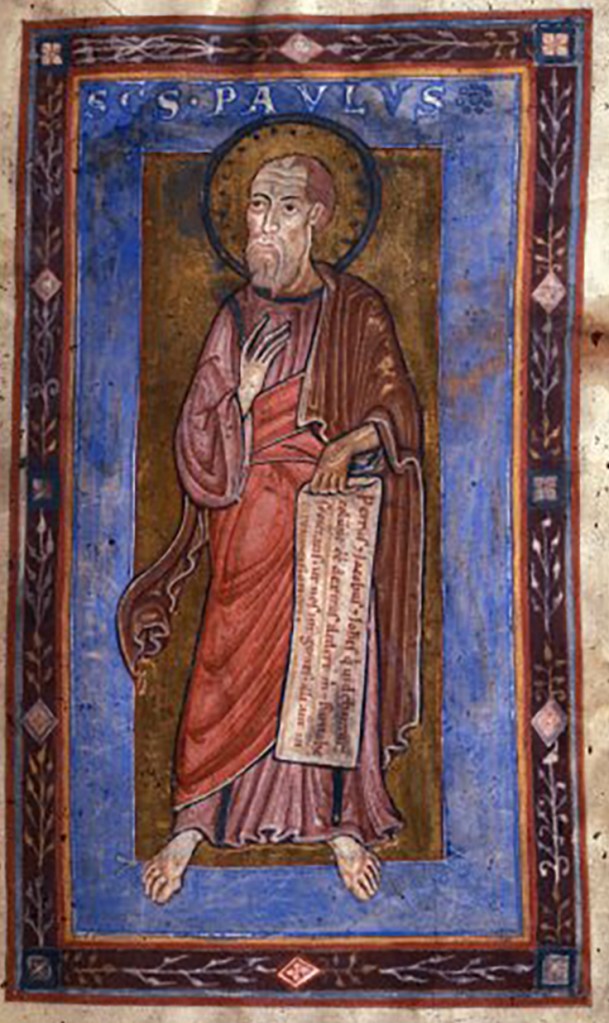
The Epistle reading for Nineteenth Sunday after Trinity again follows the pattern of the Gelasian Sacramentary (See the blog posts for Trinity 16 and Trinity 17). The sequence was interrupted by the reading from 1st Corinthians for Trinity 18. The Epistle reading, Ephesians 4:17-32, is another long quotation from St. Paul’s Epistle to the congregation he founded in Asia Minor on his Second Missionary Journey. Ephesus was known as the “first city of Asia” when the Third Ecumenical Council met there in 431 A.D. and granted the Blessed Virgin Mary the title, Theotokos, or Mother of God in modern English. As usual, St. Paul was not shy in expressing his views. He speaks emphatically of the “new” man, who, following Christian teachings from the Gospels, is distinct from the “old” man of the Gentile world.
St. Paul also wrote about the need to master one’s passion, by which he means not just sexual lust but passion for material things, including money. The epistle formed much of the scriptural foundation for the lists of Christian virtue. These virtues were previously confined to oral tradition. They appeared first in written form in the Eastern and Western Church traditions in the 6th, 7th and 8th C. St. Paul ends his counsel to the Ephesians with advice on the subject of forgiveness. Forgiven is also major theme of the Gospel reading. The illustration of St. Paul from the Siegberg Lectionary was also used in several AIC Christian Education Video Series, Advent: The Season of Penitence & Preparation, Episode One; The Great “O” Antiphons, Dec. 22nd, Fifth Antiphon (O Oriens); The Twelve Days of Christmas, Third Day-Peace-Dec. 27); Epiphany: the Manifestation of Christ to the Gentiles, Episode Three; and Trinitytide: the Teaching Season, Episode Seven. For more about the architectual remains left by the Christian population at Ephesus, now Selcuk, Izmir Province, Turkey, including the Tomb of St. John, watch the AIC Bible Study Video series, Revelation: An Idealist Interpretation, Episode Five.
The Gospel reading for Nineteenth Sunday after Trinity, Matthew 9:1-8, is the fifth of nine readings from St. Matthew’s Gospel in Trinitytide. A very short reading, or “pericope” (scholarly terminology meaning Scripture verses read in a liturgy), includes two of St. Matthew’s major themes: the birth and life of Jesus as fulfillment of Old Testament prophecy and events in both His Nativity and life as demonstrations of His divinity. The reading includes some unique details, including the only example of someone who is healed by Jesus being lowered into the scene through the roof, in this case of a house in the region of Capernaum, or “his own city” in verse 1, near the western shore of the Sea of Galilee. The time of the event is early in Jesus’ public ministry, likely in 27 A.D. The audience for the event includes Jesus’ Disciples (not named in the text), the paralytic man and his friends, and “Scribes,” meaning men associated with the Pharisees and with the governance of the Temple. Unlike other accounts of miraculous healings, there are no dramatic examples of the actual healing. Instead, the focus is on the meaning of the event. In this case, Jesus gives credit for the healing to the “faith” of the man’s friends, who have gone to considerable trouble and effort to lower the man into the presence of Jesus.
In St. Matthew’s account, Jesus demonstrates His divinity in knowing the thoughts of both the paralyzed man’s friends, “he saw their faith” (v. 2b) and said to the paralyzed man: “Son, be of good cheer; your sins are forgiven you.” When “some of the scribes” in their minds accuse Jesus of blasphemy, Jesus said, “Why do you think evil in your hearts? For which is easier, to say, ‘Your sins are forgiven you,’ or to say ‘Arise and walk?’ “But that you may know that the Son of Man has power on earth to forgive sins.” (verses 4b, 5 & 6a). When they did not answer, Jesus said: “Arise, take up your bed, and go to your house.” (verse 6b). St. Matthew records in one of his characteristic summaries that the man arose and departed for his home and that the multitudes “marveled and glorified God, who had given such power to men.” (verses 7 & 8). The phrase “Glorifying God” is the key phrase for Eleventh Day – January 4th in the AIC Christian Education Video series, The Twelve Days of Christmas, in which there are key words or phrases for all the days from Dec. 25th to Jan. 5th (Epiphany Eve).

The image from the Holkam Bible Picture Book also appears as Illustration No. 25 in the AIC Bookstore Publication, The Gospel of Mark: Annotated & Illustrated. As with all our books, the volume is available using the link to my Amazon Author Central page.
In my research for this Blog post, I realized that the video and soundtrack for Episode Five and Episode Six in our series, The War on Christianity were never completed. I have started work on finishing the script and slide with the goal of completing the work during January A.D. 2025.
One final note: the blog post for Eighteenth Sunday after Trinity did not include any reference to the Archangel Michael, whose Feast Day, September 29th, coincided with Eighteenth Sunday after Trinity. Images and text regarding St. Michael are the subject of two AIC Christian Education Video series, The Lives of the Saint, Second Series, Episode Twenty-three, and the traditional understanding of the origin, number (or orders or ranks) and nature of angels in The Twelve Days of Christmas, Ninth Day (Jan. 2nd).
As always, thank you for your interest and support. Glory be to God for all things! Amen!

 Anglican Internet Church
Published by