Whitsunday 2026 A.D.

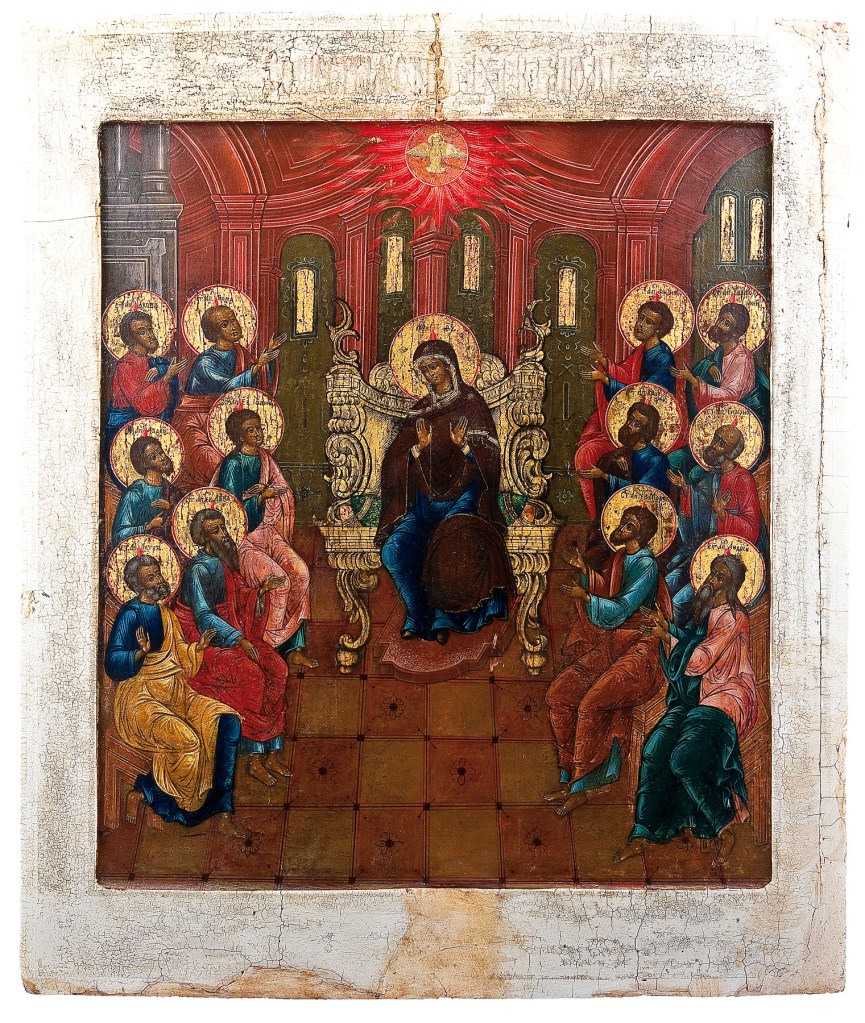
Sunday, May 24th, 2026 A.D., on the Anglican Church Calendar is Whitsunday, which in other denominations is more commonly known as Pentecost, a celebration of the Descent of the Holy Spirit (Holy Ghost in the King James Version). As noted in previous posts in A.D.2026, the Descent is commonly depicted with the Holy Spirit depicted in the form of a dove, as in the Gospel accounts of the Baptism of Christ (Matthew 3:13-17; Mark 1:9-11; Luke 3:21-22; John 1:29-34) and Acts of the Apostles (2:1-11).

The Descent of the Holy Spirit on the Apostles, gilt and silver on wood icon, probably 18th C., Russia. Holy Spirit depicted as a Dove and flames of fire. From a private collection. Wikimedia Commons.

In the 1928 Book of Common Prayer, there are two Collects for Whitsunday. The first is an adaptation by Archbishop Cranmer from the Gregorian Sacramentary (10th C.), based on the reading used for the Sunday morning Communion service for Whitsunday at St. Peter’s Basilica. In the Collect reference is made to the Spirit offering comfort to “thy faithful people.” The Collect makes clear that it is the presence of the Holy Spirit in the faithful which makes it possible for mankind to achieve “a right judgment in all things.” The second Collect is unique to the 1928 Book of Common Prayer. The identity of the author is unknown. Prayer book scholar Massey Shepherd speculated that it may have been added in order that more of the faithful would hear such doctrine on the Sunday morning celebration of Holy Communion on one of the three most important Sundays on the Church calendar, the other two being Christmas morning and Easter. It contains a plea that by the indwelling of the Spirit the faithful “may be enlightened and strengthened for thy service.” The second Collect is intended for use in the first service when there is more than one service offered on Whitsunday.

The Collects and the two sets of epistle and “for the epistle” reading from St. Luke’s account of the Descent of the Spirit (Acts 2:1-11) plus the Gospel readings for both services are discussed and illustrated in Episode One in our Seasonal Video series, Trinitytide: the Teaching Season, linked from the Digital Library page. The reading from 1 Corinthians 12:4-14 includes important instruction from St. Paul on the nature of the Church and the importance of spiritual gifts. The video series begins with readings for Whitsunday and for weekdays Whitsun Week and closes with the Sunday next before Advent, as well as the complicated rules for moving readings from Epiphany season when there are more than twenty-four Sundays after Trinity. The audio only (MP3) version is linked from the Podcast Archive page. My Podcast Homily for Whitsunday is linked from the Podcast Homilies page. A related Podcast Homily for Whitsunday, based on Psalm 68, the Psalm reading for Morning Prayer on Whitsunday, is linked from the Podcast Homilies-Morning Prayer page.

As always, thank you for your interest and support. Glory be to God for all things! Amen!
Ascension Day & Sunday after Ascension

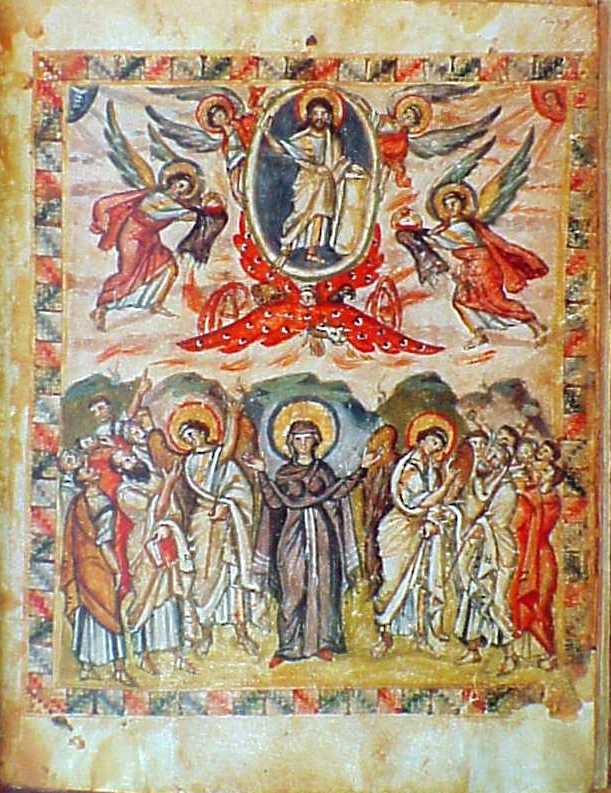
In the Anglican worship tradition, Ascension is officially celebrated on the Thursday following Fifth Sunday after Easter and, because so many cannot attend a mid-week service, themes related to the Ascension are repeated on Sunday after Ascension (the Sixth Sunday after Easter). The Collect for Ascension Day is based on the Gregorian Sacramentary and the Missal texts at Sarum (Salisbury). Theological concepts observed on Ascension Day were incorporated into the Nicene Creed in 325 A.D. The original text and the changes made in 381 A.D. are discussed and illustrated in the AIC Video Series, The Nicene Creed, linked from the Digital Library page. The Epistle reading, Acts 1:1-11, includes St. Paul’s record of post-Resurrection appearances by Christ and His being taken up into heaven. The Gospel reading, Luke 24:49-53, is the evangelist’s own record of the actual event of the Ascension to the Father.

The Ascension, illumination in tempera and gold on parchment, Rabbula Gospels, 586 A.D., region of present-day Syria. Laurentian Museum, Florence, Italy. Public Domain.

For Sunday after Ascension, the Collect was derived from a Vespers office of the new Church of England that is itself derived from the deathbed song of the Venerable Bede. The Epistle reading, 1 Peter 4:7-11, another example of New Testament wisdom features throughout Eastertide, includes St. Peter’s teachings on the proper use of one’s gifts from God. In the Gospel lesson, the sixth and last in Eastertide from the pen of St. John, John 15:26-16:4a, St. John quotes more from Jesus on preparation for the coming of the Holy Spirit, or The Comforter. The Collect and readings are discussed and illustrated in Episode Three in the AIC Seasonal Video series, Eastertide: From Resurrection to Ascension, linked from the Digital Library page. The audio-only Podcast version of Episode Three is linked from the Podcast Archive page. My Podcast Homily for Sunday after Ascension is linked from the Podcast Homilies page. A related Podcast Homily, focused on the Psalm reading for Morning Prayer on Sunday after Ascension, Psalm 8 & Psalm 108:1-5, is linked from the Podcast Homilies-Morning Prayer page.

Sunday after Ascension brings the season of Eastertide to a close. The remainder of the Anglican Church Year is focused on readings and other material focused on Trinity Sunday and Trinitytide, the longest season on the Anglican Church calendar. The AIC Seasonal Video series, Trinitytide: the Teaching Season, is presented in nine episodes, also linked from the Digital Library page with Podcast/audio only versions linked from the Podcast Archive page.

I have not decided on a plan for Fr. Ron’s Blog during Trinitytide. Since the weekly postings for Trinity were completely rebuilt in A.D. 2021, the weekly Blog will probably revert to more topical postings without any specific plan in mind. As always, thank you for your interest and support. Viewers might be interested to know that the greatest number of visits to our site is coming from Asia. To our Asian friends, another thank you. Glory be to God for all things! Amen!
Second Sunday in Lent & AIC Bookstore 16

Apologies to viewers for the late posting of the logo and links for the start of Lent. I was traveling without my computer and could not complete the changes until my return. The Welcome/Home page now includes both the seasonal image and the three episode links.

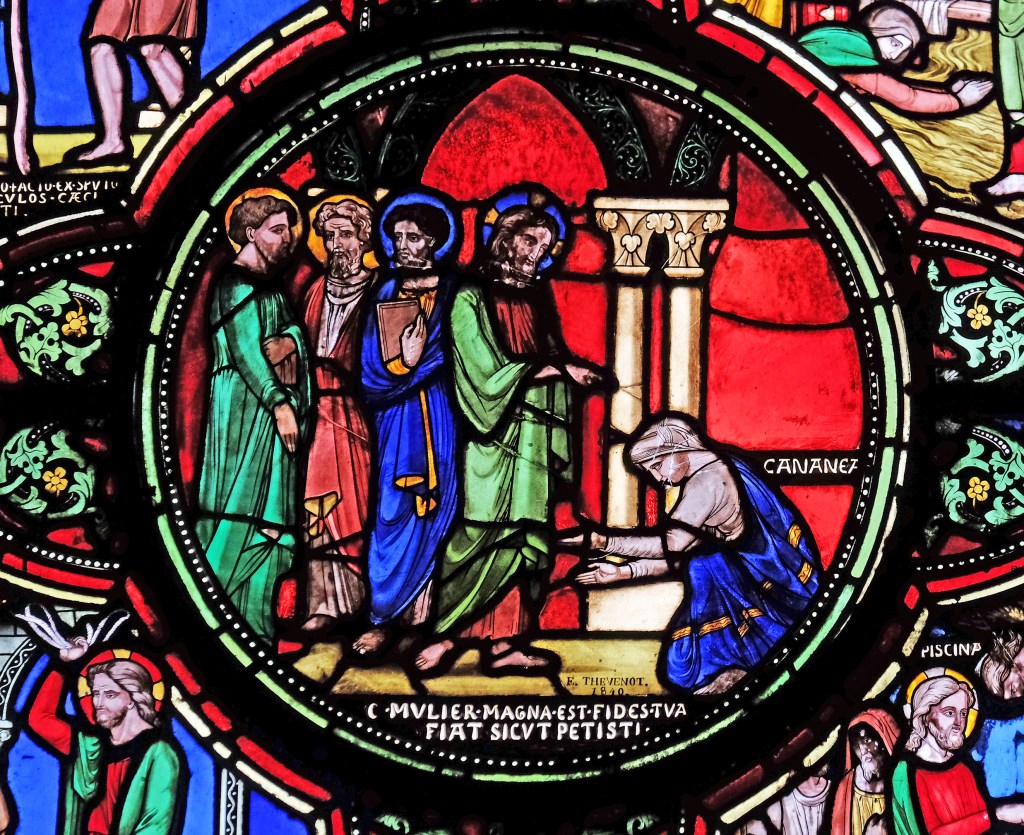
Jesus & the Canaanite Woman, stained glass window in the Munich style, mid-19th C., St. Germain-l ‘Auxerrois Church, a Roman Catholic Church near the Louvre, Paris, France. The window was designed by renowned French stained glass artist, Etienne Thevenot (1797-1862). © Zatletic|Dreamstime.com.

For Second Sunday in Lent Archbishop Cranmer adapted a Collect from the Gregorian Sacramentary (10th C.) on the theme of mankind’s inherent lack of power to do save itself combined with a plea for protection from adversity and from evil thoughts. The Epistle reading, 1 Thessalonians 4:1-8, contains more of St. Paul’s teachings on the Christian virtues, especially on mastering passions. The Gospel reading, Matthew 15:21-28, the Evangelist’s account of Jesus’ encounter with the “Woman of Canaan.” In Episode Two of the AIC Christian Education Video series, Lent: the Season of Penitence, I discuss the differences between this account by St. Mark in which she is called the “Syro-Phoenician Woman.” In both versions, the woman calls Jesus by the titles “Lord” and “Son of David.” The audio-only version of Episode Two is linked from the Podcast Archive page. My Podcast Homily for Second Sunday in Lent based on the Holy Communion readings, is linked from the Podcast Homilies page. A second Podcast Homily for Second Sunday in Lent, based on the Psalm reading in Morning Prayer (Psalms 30 and 32), is linked from the Podcast Homilies-Morning Prayer page.

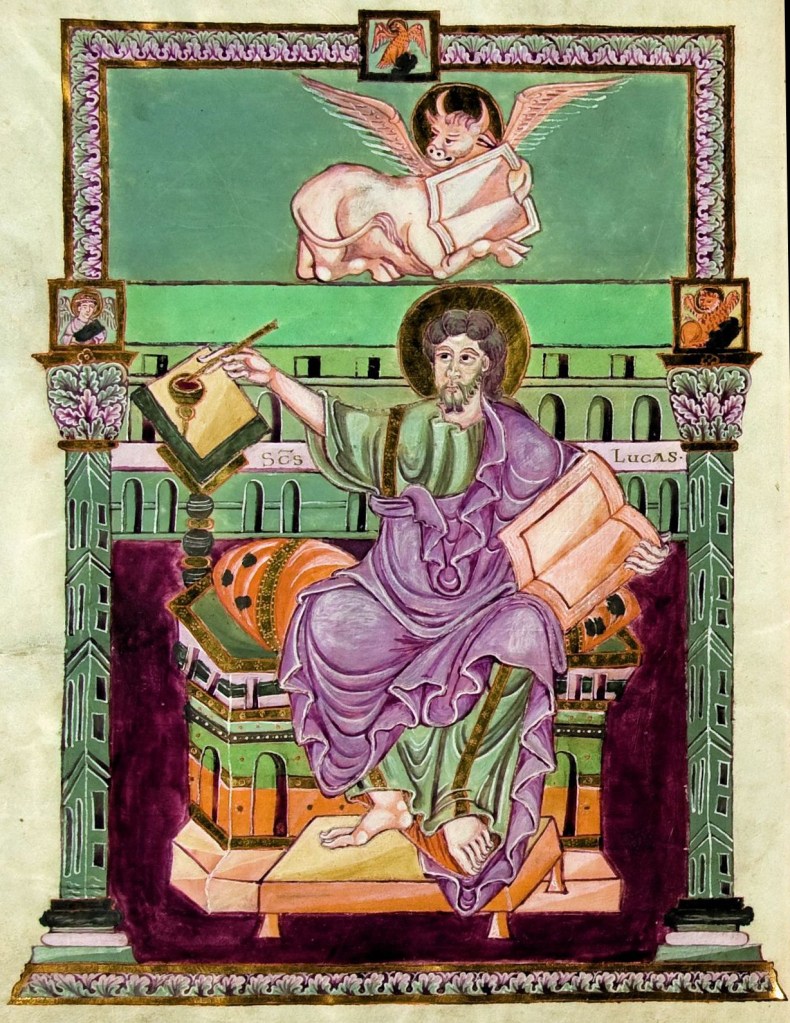
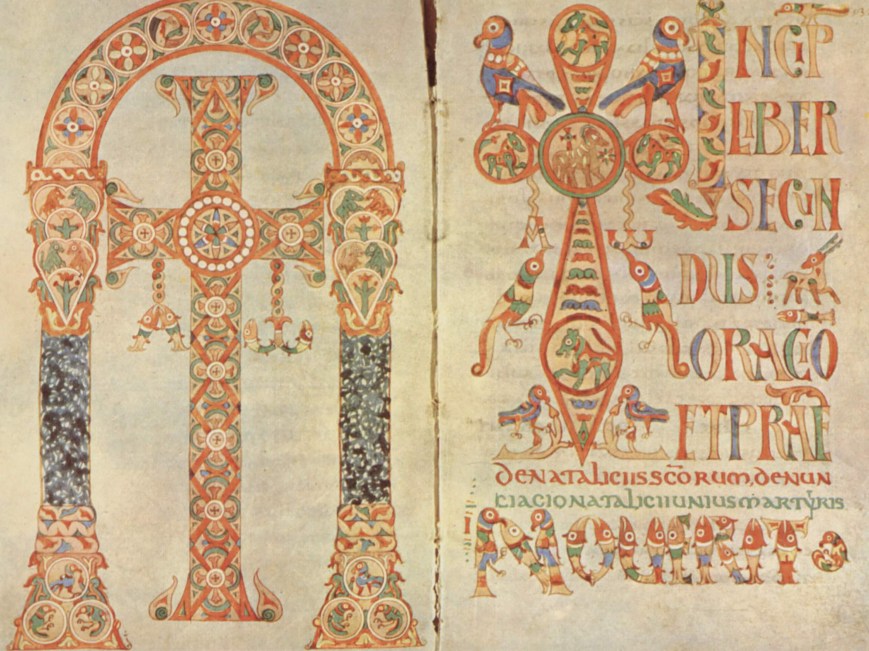
John Writing His Gospel, illumination in tempera and gold on parchment, produced at Reichenau Monastery, Reichenau, Germany, circa 1007-1012, Pericope Book of Henry II, Ms. Clm 4452, Folio 3v, Bayerische Landesbibliothek, Munich, Germany. CC-by-SA 4.0. Henry II was the last of the Ottonian Holy Emperors who were successors to the first Emperor, Charlemagne, crowned at Rome on Christmas Day, 800 A.D., as the first Holy Roman Emperor since the sacking of Rome in the second half of the 5th C.

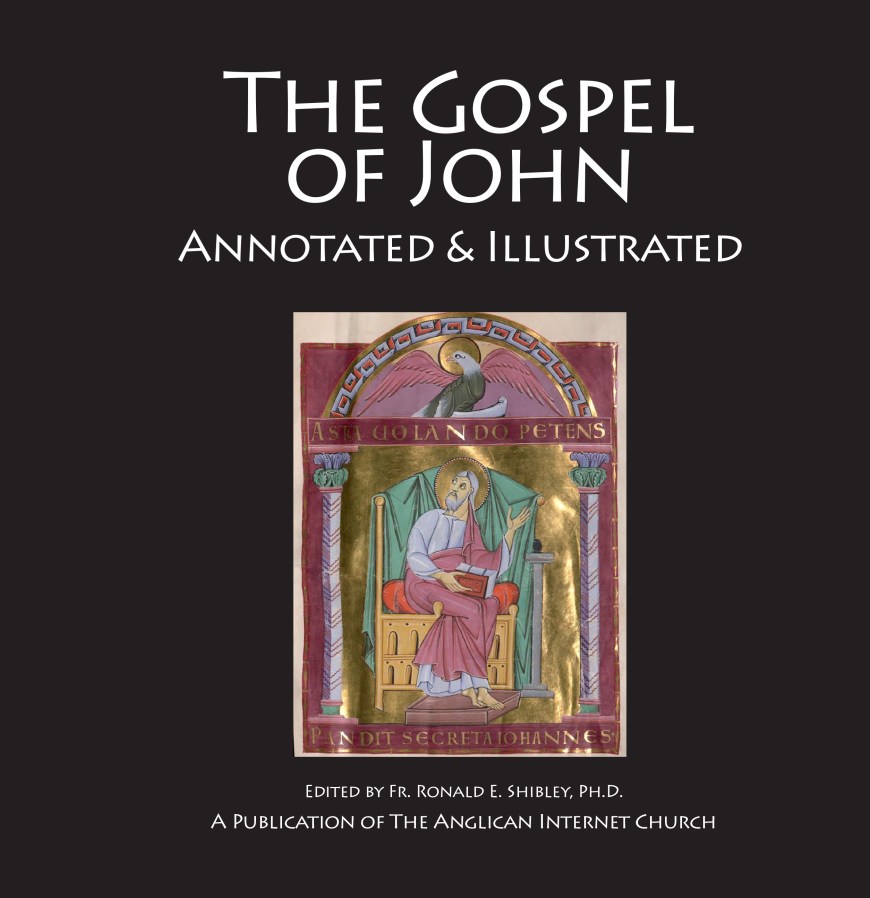
This week’s sampling from the 22 books among the AIC Bookstore Publications is The Gospel of John: Annotated & Illustrated. This volume was actually the first book of the Gospels which was published in the 8.5″ x 8.5″ format. It includes 86 images from a 5th mosaic to a 20th C. stained glass window. Images include many “illuminations” in gold or silver and egg tempera on parchment originally intended for the exclusive use of bishops and emperors. The entire text of St. John’s unique gospel is printed, with section-by-section commentary, using the New King James Version text. The text includes sixteen “special text boxes”: The Art of Illumination of Scripture; A Guide to Reading the Gospel of John; Angels in the Gospel of John; The Seven “Signs” in the Gospel of John; Numerology in the Gospel of John; Concepts of Time in the Gospel of John; “Jews” in the Gospel of John; “Abide” in the Gospel of John; “I AM” in the Gospel of John; Emotions of Jesus in the Gospel of John; “The Son of Man” in the Gospel of John; The New Commandment: “Love” in the Gospel of John; “Peace” in the Gospel of John; Names of the Holy Spirit in the Gospel of John; The Sacrament of Confession/Penance in the Gospel of John; and John Writing His Gospel (Constantinople, 1285 A.D.). 186 pages. $55.00. The book is available exclusively through Fr. Ron’s Amazon Author Central page, which we call the Virtual Bookstore. Additional information about all the AIC Bookstore Publications can be found on the AIC Bookstore page.

As always, thank you for your interest and support. We remain committed to keeping the valuable examples of Christian art across the centuries available on demand, 24/7 through this site’s postings, videos, podcasts and books. You are invited to subscribe to these periodic posts on topics of seasonal or special interest by clicking the “Follow Anglican Internet Church” logo in the right hand column. Glory be to God for all things! Amen!
First Sunday in Lent

This week marks the start of the season of Lent, the penitential season leading up to Easter. The Collect, Epistle & Gospel readings for Ash Wednesday and First Sunday in Lent, respectively, are discussed and illustrated in Episode One and Episode Two of the AIC Seasonal Video Series, Lent: The Season of Penitence. The audio-only versions of Episode One and Episode Two are linked from the Podcast Archive page. The Podcast Homily for Ash Wednesday and the Podcast Homily for First Sunday in Lent are linked from the Podcast Homilies page. A separate Podcast Homily, based upon the Psalm reading for Morning Prayer on First Sunday in Lent, Psalm 3 and Psalm 62, is linked from the Podcast Homilies-Morning Prayer page. Ash Wednesday, the day for the Imposition of Ashes, has marked the start of Lent in the Western Church since the end of the 6th/start of 7th C. Pope Gregory the Great created Ash Wednesday as his answer to the strong Eastern Christian criticism from the Byzantine Patriarch and others that Lent did not actually last forty days in Western Church worship.

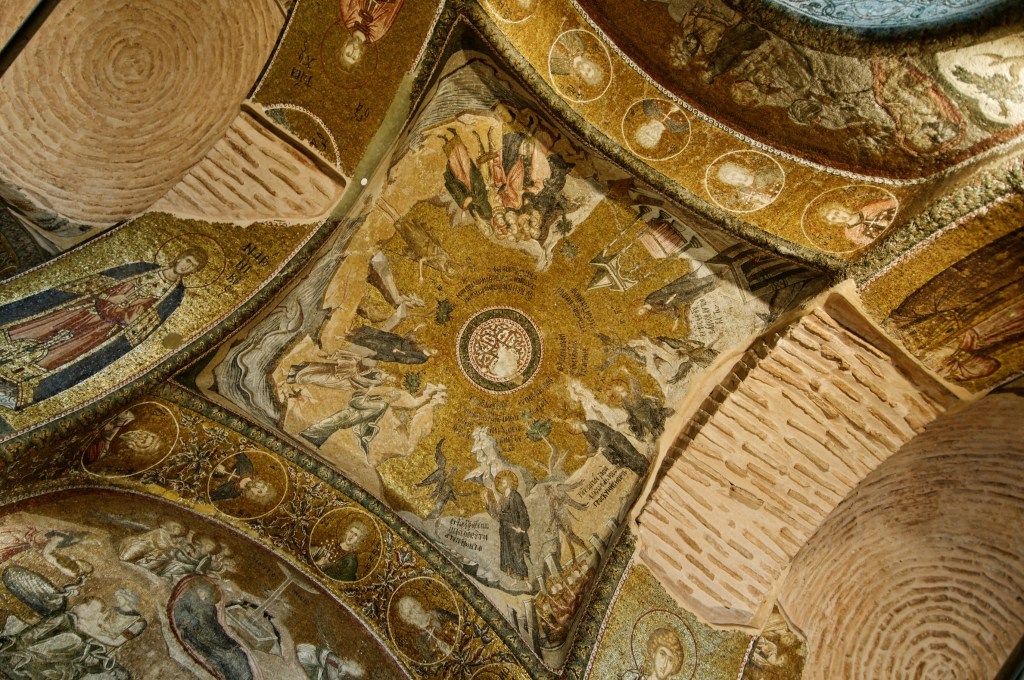
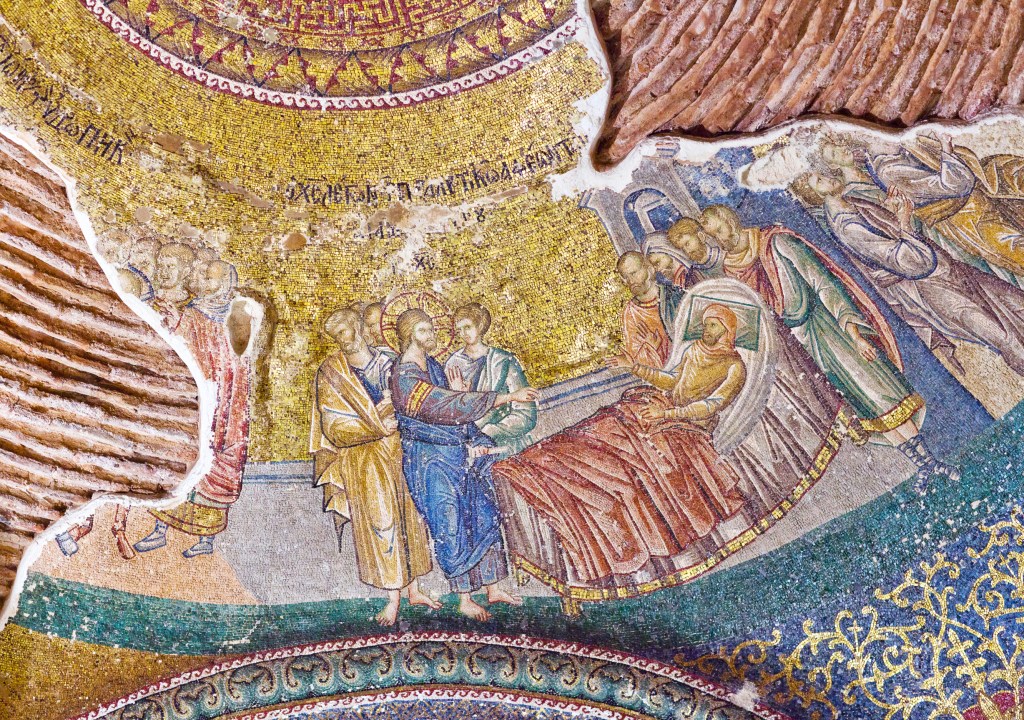
The Collect for First Sunday in Lent is an original composition by Archbishop Thomas Cranmer for the 1549 Book of Common Prayer, based upon Ephesians 4:22-24, focused on three topics: fasting, righteousness & holiness. These adaptations of the writings of St. Paul reflect the strong influence of the Pauline canon upon the worship, study and prayer practices of the Anglican Church. The choice of 2 Corinthians 6 as the Epistle reading also reflects Archbishop Cranmer’s emphasis on the Christian virtues as understood and aggressively taught by St. Paul. The Gospel reading for First Sunday in Lent, Matthew 4:1-11, is the first of four readings from the Gospel of Matthew in Lent, being an account of the Temptations of Christ. The image I have chosen is a mosaic from the ceiling in the north end of the Outer Narthex (or Exonarthex) at Chora Church, formerly Constantinople, now Istanbul, Turkey, depicting John the Baptist as witness to the Temptations. The partially-viewed segment at left is the supper edge of the mosaic of the Nativity of Christ on the east wall of the Exonarthex. The partial image at upper right depicts the Dream of Joseph and the Return of the Holy Family. The mosaics were created between 1315 and 1321 during the reign of Byzantine Emperor Isaac Comnenus using funds contributed by Theodore Metocrites, who is depicted adjacent to a Christ Pantokrator image near the door into the Inner Narthex (or Esonarthex). The image is one of about four dozen images from Chora Church downloaded earlier this year, bringing our archive of images to almost 3,000. The Church is located on the European side of the Straits of the Bosporus. It is now a museum/mosaic in which Christian worship is no longer conducted.

The Temptations of Christ, 1st Qtr., 14th C., Chora Church. © Serban Enache|Dreamstime.com.

Next week I will pick up with another Bookstore Preview, in this case featuring The Gospel of John: Annotated & Illustrated. As always, thank you for your interest and support. Glory be to God for all things! Amen!
Third Sunday after Epiphany, the Conversion of St. Paul and AIC Bookstore-Part 12

Welcome to my Blog post for Third Sunday after Epiphany, the last of three Sundays following Epiphany Day in A.D. 2026. Sunday, Feb. 1, will mark the beginning of the three “Gesima” Sundays (or Pre-Lent season). The “Gesima” Sundays offer a transition in tone and content before the start of Lent on Sunday, February 22nd.

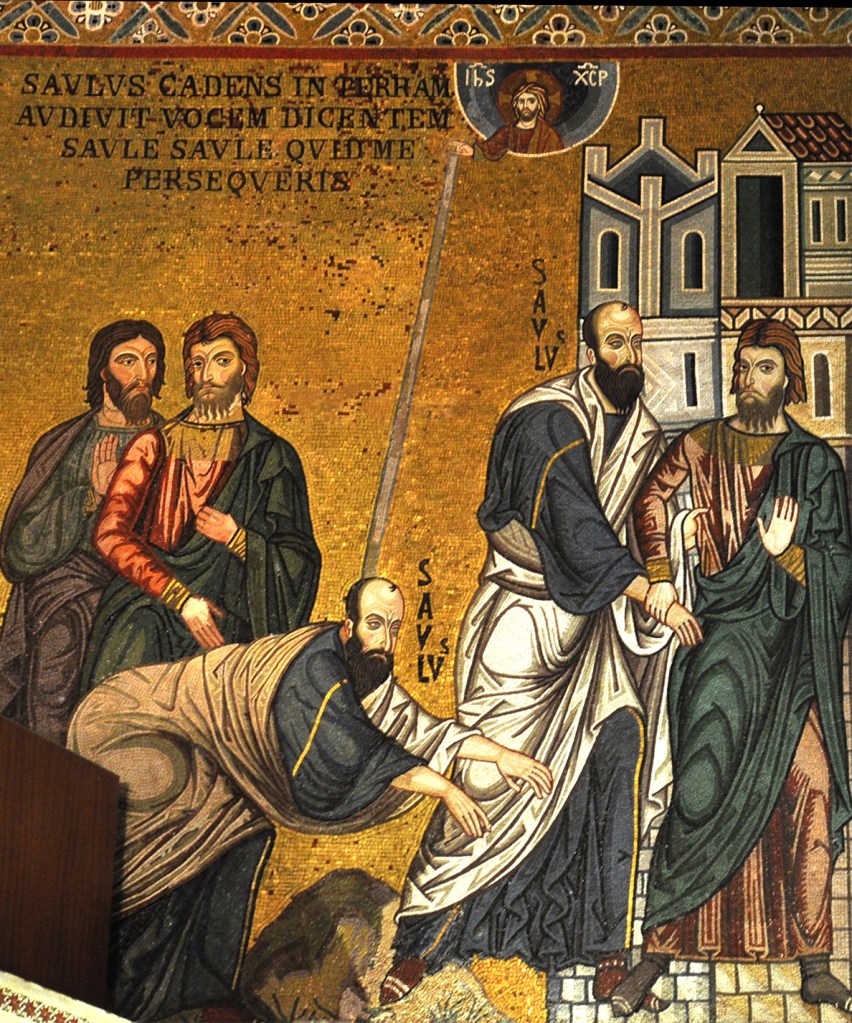
In A.D. 2026, Sunday, January 25th, is also the appointed fixed day honoring the Conversion of St. Paul, a pivotal event in the history of the Church Universal. Below is a remarkable mosaic depicting the event (left) and its immediate consequences (right), of the blinded St. Paul led away, with Christ in a semi-circle at top right. The Collect for the Conversion of St. Paul refers to Saul/Paul as one who “caused the light of the Gospel to shine throughout the world.” The event and the unique legacy of one of Christianity’s most fervent defenders, is discussed and illustrated in more detail in Episode Five in our Christian Education Video series, The Lives of the Saints, Volume 1 – the 1928 B.C.P. Saints. All sixteen episodes in the series are linked from the Digital Library page. The audio track of Episode Five is linked from the Podcast Archive page.

The Conversion of St. Paul, mosaic, Capella Palatina, Palermo, Sicily, commissioned by the first Norman king of Sicily, Roger II, in 1132 A.D. The mosaics were completed between 1140 and 1170 A.D. Public Domain, World Gallery of Art.

I discuss and illustrate the readings for Third Sunday after Epiphany in Episode Three on our video series, Epiphany: The Manifestation of Christ to the Gentiles. The audio version of the Episode Three is linked from the Podcast Archive page. My Podcast Homily for Epiphany 3 is linked from the Podcast Homilies page. Another Podcast Homily, this one derived from the Psalm readings in Morning Prayer for the day, Psalms 42 and 43, attributed to the Sons of Torah, is linked from the Podcast Homilies-Morning Prayer page. In the Hebrew worship tradition, Psalm 43 was spoken aloud by the priest upon approach to the altar.

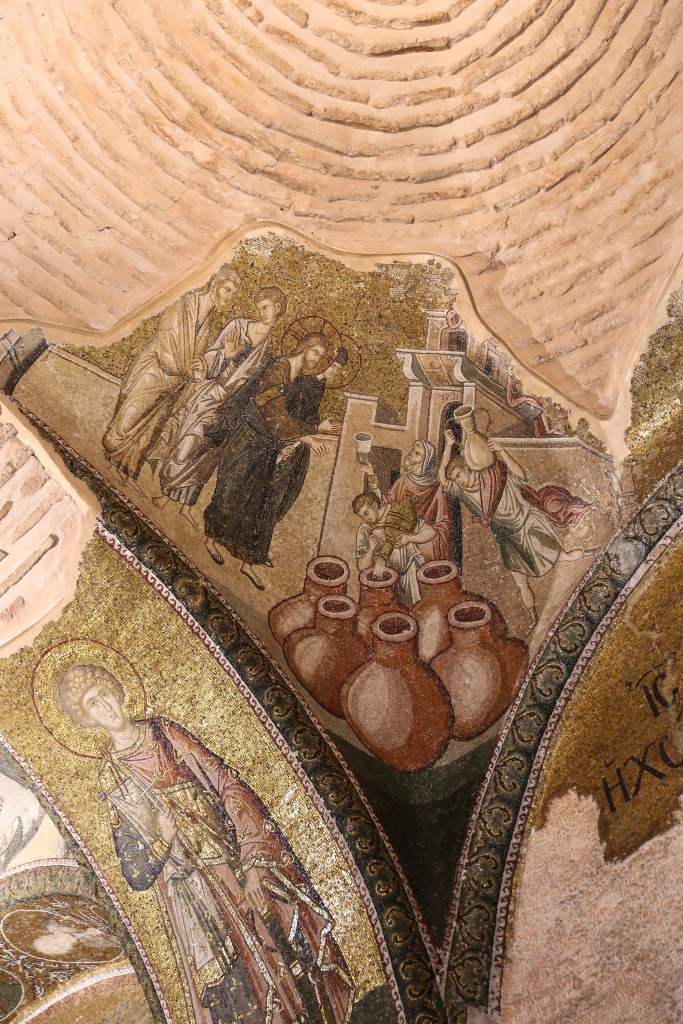
The Miracle at Cana, Byzantine mosaic, Outer Narthex, Chora Church, Constantinople/Istanbul, early 14th C. The image is positioned in a pendentive above the Christ Pantokrator image (visible at lower right) over the door to the passage between the Outer and Inner Narthex. © Evren Kalinbacak|Dreamstime.com

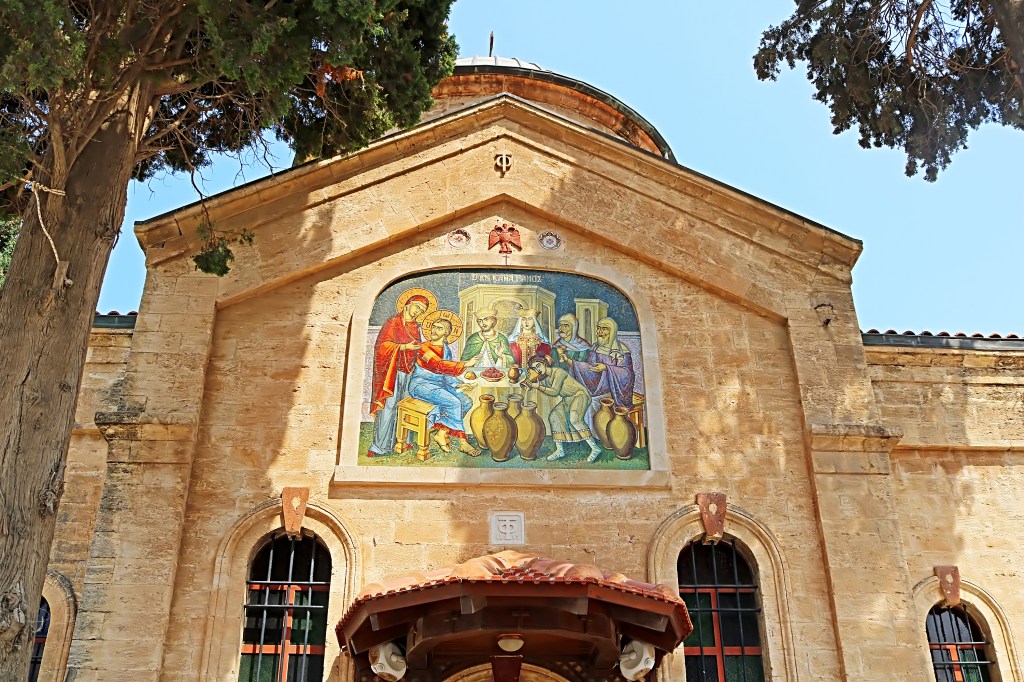
For the occasion, Archbishop Cranmer prepared a Collect based upon the Gelasian Sacramentary in a version strongly influenced by the late 8th-early 9th C. translation of the Vulgate Bible by the Blessed Alcuin of York. Alcuin was the author of the Collect for Purity in the 1928 Book of Common Prayer, spiritual advisor to Holy Roman Emperor Charlemagne and teacher of Christianity to the Emperor’s family, and Abbot of the Abbey of St. Martin of Tours in France. The Epistle reading, Romans 12:16-21 is the third of four teachings of St. Paul on the Christian Virtues. The reading ends with the advice to “overcome evil with good.” The Gospel reading, John 2:1-11, is St. John’s account of the Wedding at Cana, or, in St. John’s words, “the beginning of the miracles did Jesus in Cana of Galilee.”

This important symbolic event is honored in the Galilee by several churches claiming to be on the site of, or near the historic location of, the Wedding, including a Greek Orthodox “Wedding” Church in Kfar Kana, which claims to possess two of the jars used in the wedding. The Greek church features an image of the event over its front door. It is near a similar “Wedding Church” owned by the Franciscans. © Gelia|Dreamstime.com.

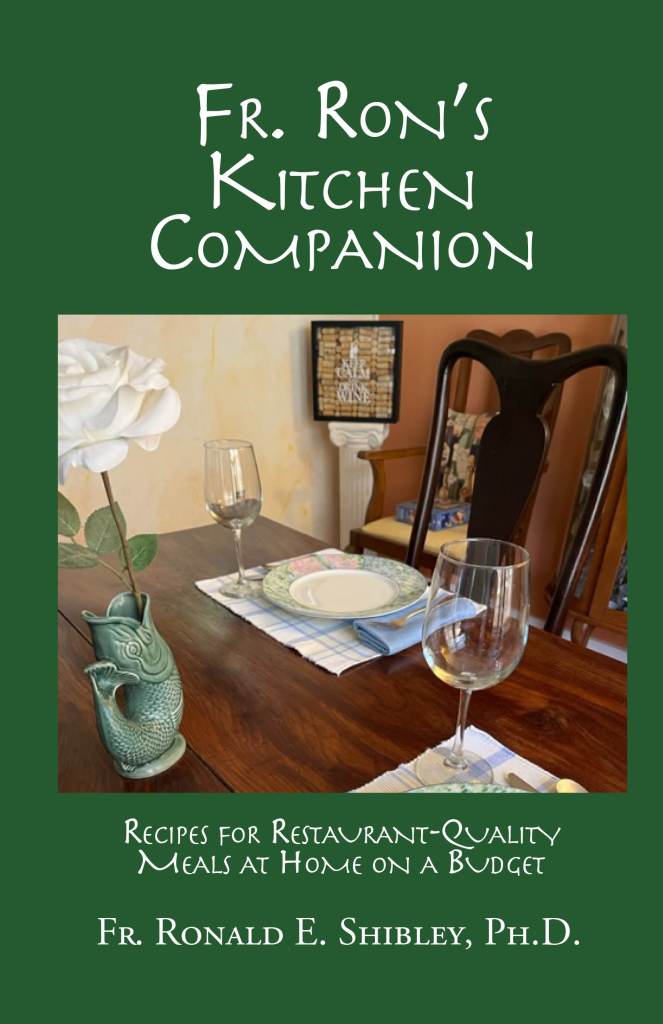
This week’s focus among the AIC Bookstore Publications is Fr. Ron’s Kitchen Companion. The book evolved out of several sources over several decades, beginning with the first version (produced in the early 1980s for a former employee off to college and, later, for my daughter in her first apartment at college). It emerged in a greatly-expanded form for use by my former parishioners, most of whom were living on limited incomes. The current edition, the 9th, dates to 2024, when all the Bookstore publications were updated. The books was given a new cover and expanded content as part of the celebration of the start of the AIC’s second decade on the web.

The book’s sub-title, is self-explanatory. Inside the volume is a list of essential seasonings, some easily available, some which must be ordered from Amazon or other vendors. It is what I label as a backwards cookbook, with the recipes, grouped by protein source, organized to help decide what to do with a particular ingredient; examples: Beef: steak? stewed? ground? skewered? The book is worth the purchase price based on just a few key recipes, including my time-tested recipes for Classic Southern Pot Roast, Hawaiian “Mochi” Chicken and Byzantine Eggplant Moussaka. I hope to produce an updated version of the ingredients list and some new recipes later in A.D. 2026. The revised version also would add sources for some of the Hawaiian-sourced seasonings discovered during or after the trip my wife and I took to Maui at mid-year A.D. 2025. The cover image was arranged and photographed by Corinne (Corkie) Shibley.

As always, thank you for your interest and support. Glory be to God for all things.

First Sunday after Epiphany & AIC Bookstore, Part 10

First Sunday after Epiphany, the first of three Sundays after Epiphany in A.D. 2026, is celebrated this year on January 11th. I discuss the Collect and the Epistle and Gospel readings in Episode Two in our Seasonal Video series, Epiphany: The Manifestation of Christ to the Gentiles. The audio version of Episode Two is linked from the Podcast Archive page. There are two podcast homilies for First Sunday after Epiphany. The first Podcast Homily is based on the Holy Communion readings. The second, my Podcast Homily for Morning Prayer, is based on Psalm 72. The video version includes an image related to Psalm 72 from the Stuttgart Psalter, as it was used in the AIC Bookstore Publication, The Prayer Book Psalter: Picture Book Edition (see more below).

The Collect for First Sunday after Epiphany is a composition by Archbishop Cranmer based upon the Gregorian Sacramentary on the theme of mankind’s dependence upon God for His Grace and how it can and should be applied in the daily life of a Christian. The Epistle reading, Romans 12:1-5, is the first of a sequence of four readings from Romans during Epiphany season in the 1928 Book of Common Prayer. The subject is Paul’s observations on the Church as “one body in Christ.” As noted earlier, only three of these will be read in A.D. 2026.

Finding in the Temple, 19th C. stained glass window, Werchter, Belgium. Copyright Jorisvo | Dreamtime.com.

The Gospel lesson, Luke 2:41-51, is St. Luke’s unique account of the childhood of Christ, when at age 12 he encounters and teaches the leadership of the Temple in Jerusalem. Another stained glass window depicting this event, designed and made by Franz Mayer of Munich, is Window No. 57, St. Joseph’s Villa Chapel, Richmond, VA.

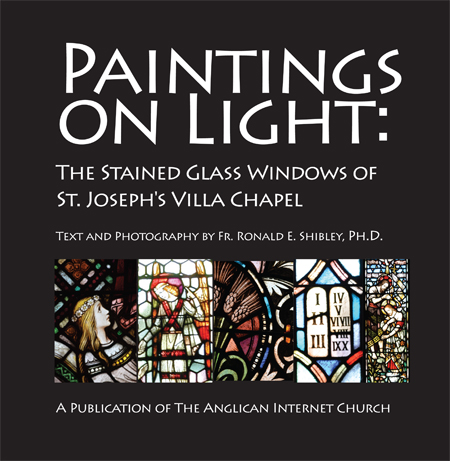
This gives me an opportunity to resume promotion of the AIC Bookstore Publications which was interrupted in mid-December of last year. One of ten books in our unique large page format, Paintings on Light: the Stained Glass Windows of St. Joseph’s Villa Chapel, is available exclusively at our Virtual Bookstore, which is accessible through my Amazon Author Central page. All book royalties are donated to the AIC. The image of Window 57, Teaching the Doctors in the Temple, was used in my Blog Post for First Sunday after Epiphany, 1/9/2015. The post is linked from the Jan. 2015 entry in the Archive column at right.

Paintings on Light: the Stained Glass Windows of St. Joseph’s Villa Chapel, printed in our square large page (8.5″ x 8.5″) format, offers high-resolution images of all 46 stained glass windows by Franz Mayer of Munich, the three Sanctuary murals and the 14 Stations of the Cross, as well as the story of the restoration of the Chapel by myself and my former parishioners at St. John Chrysostom Anglican Church (now closed), which worshipped at the Chapel. Summary: Details: 84 pages, including Bibliography, General Index and Scriptural cross-reference.

NOTE: Just for readers/viewers who like knowing small details, here are some statistics not included in the Blog post for Epiphany (Day & Season, linked from the Archive column at right): In Epiphany season, there are five readings from the Gospel of Matthew and one each from the Gospel of Mark and Gospel of John. There are five Collects derived from the Gregorian Sacramentary, one from the Gelasian Sacramentary and one original composition by Bishop John Cosin, added for the 1662 Book of Common Prayer.

As always, thank you for your interest and support, which makes possible the maintenance of our unique collection of videos, podcasts and books and making them available 24/7 on demand, and the continued search for royalty-free images of Christian art across the centuries. Over four dozen additional images were acquired in December 2025 and in this first week of A.D. 2026. Many of these images will be used in Blog posts in the first half of this year.

Glory be to God for all things! Amen!
Second Sunday after Christmas & Epiphany

Second Sunday after Christmas is only celebrated when Jan. 2, 3, 4 or 5 happen on a Sunday. A.D. 2026 is one of those years. aThe Collect for the day was written by Archbishop Cranmer based on the 2nd Collect for Christmas Day in the Gregorian Sacramentary, a 10th C. tribute to one of the great Roman Catholic popes. The “for the Epistle” reading is Isaiah 61:1-3, which Jesus quotes in Luke 4:18, 19 in reference to the “Spirit of the Lord.” The Gospel lesson. Matthew 2:19-23, St. Matthew’s record of the Holy Family’s Flight to Egypt and Return, both of which were the result to a dream of Joseph. Jan. 4th is also the Eleventh Day of Christmas in the AIC video series, The Twelve Days of Christmas.

Joseph Dreaming/Holy Family Returns, Byzantine mosaic, Outer Narthex, Chora Church, Constantinople, now Istanbul, 14th C. Copyright Bapaume | Dreamtime.com

Epiphany season, one of the fixed feasts on the Anglican Church Calendar, officially begins on Jan. 6th. In A.D. 2026, Epiphany falls on a Tuesday. The name for the season is derived from the Greek word Epiphaneia, which means to manifest, or, more poetically, to “shine forth.” For the first Anglican Book of Common Prayer, published in 1549 A.D., Archbishop Thomas Cranmer wrote a new Collect for Epiphany (day). It was derived from the 10th C. version of the Gregorian Sacramentary. Epiphany was once known as “Little Christmas,” probably because Epiphany Eve (Jan. 5th) marks the end of the Christmas season. In the AIC’s video presentation for Christmas, The Twelve Days of Christmas, I use a graphic to present Christmas Day and Epiphany (Day) as “bookends.”

Epiphany and all the Sundays after Epiphany are each concerned with an example of the “manifestation” of Christ to the Gentile world. I discuss and illustrate the complex history of the season and also the readings for Epiphany Day in Episode One in our video series, Epiphany: The Manifestation of Christ to the Gentiles. The Sundays after Epiphany, which can be as many as six and as few as one, are discussed in Episode Two and Episode Three in the same series. In A.D. 2026, there are only three Sundays after Epiphany. The podcast audio version of Episode One is available on the Podcast Archive page. My Podcast Homily for Epiphany (the Day) is linked from the Podcast Homilies page. You can also listen to the Podcast Homily for Morning Prayer, based on the Psalm readings for Epiphany (day), Psalm 46 and Psalm 100, hosted on the Podcast Homilies-Morning Prayer page. The three Sundays after Epiphany will be the subject of the next three blog posts.

Massacre of the Innocents, Byzantine mosaic, south wall, Outer Narthex, Chora Church, Constantinople, now Istanbul, Turkey, early 14th C. The scene above the arch is a portion of Christ Healing a Paralytic Man at Capernaum (Matthew 9:1-8) Copyright Evren Kalinbacak | Dreamstime.com.

The Epistle reading for Epiphany (day) is Ephesians 3:1-12, St. Paul’s essay on the “mystery” of the Christ who is revealed to the world. The Gospel reading, Matthew 2:1-12, is Matthew’s account of the Visit of the Wise Men. In our video series, The Twelve Days of Christmas, the episode for Fourth Day of Christmas, Dec. 28th, with the theme word “Compassion,” highlights the Murder of the Holy Innocents, Herod’s violent reaction to the news of the possible birth of a Saviour.

The actual visit of the Wise Men, or Magi, is depicted in another late-Byzantine mosaic, also in the Outer Narthex (or exonarthex), in this case at the rear of the Outer Narthex above the opening into the Church’s Parakklesion, effectively a funeral chapel. For more views of these and other Byzantine mosaics and frescoes illustrating hundreds of Scriptural scenes at Chora, visit the Chora Church web site. Another site with nearly a hundred images is available at https://thebyzantinelegacy.com. Yet another is https://www.360tr.com, which offers “virtual” tours you can manipulate. For the 3-D tour, it may take a little practice manipulating the view (forward, sideways, upward), but you will find the effort worthwhile as you move, in the virtual sense, through the Outer Narthex, the Inner Narthex (or Esonarthex), the Naos (the equivalent of the modern Nave and Altar) and the Parakklesion (with its spectacular representation of The Harrowing of Hades (or Anastasis). While at the site be sure to direct the pointer to look upward into the large Christ Pantokrator dome (#8) and the smaller Blessed Virgin dome (#9) in the Inner Narthex and the Church’s third dome in the righthand portion of the Outer Narthex.

The Return of the Magi, with the three Wise Men before the Blessed Virgin Mary (in blue robe, center), Outer Narthex, Chora Church, 14th C. Copyright Evren Kalinbacak | Dreamstime.com

In future posts in A.D. 2026, I will insert additional images from Chora Church in which the Gospel reading is illustrated.

As always, thank you for your interest and support. Glory be to God for all things! Amen!
Trinity 22 & AIC Bookstore – Pt. 5

My Fr. Ron’s Blog post for Trinity 22 was posted on October 25th, A.D. 2024. The episode is linked from the Archives column at the right side of the page. I discussed the Collect, based on the late Gregorian Sacramentary (10th C.), St. Paul’s epistle to the congregation at Phillipi (Philippians 1:3-11) and St. Matthew’s account of Jesus’ lesson on the Unforgiving Servant (Matthew 18:21-35) with first half, 17th C. art work by Claude Vignon. These readings were also discussed in Episode Eight in our Christian Education video series, Trinitytide: the Teaching Season. The podcast version of Episode Eight is linked from the Podcast Archive page. Additionally, the Podcast Homily for Morning Prayer on the Twenty-second Sunday after Trinity is also available.

This week’s post continues my focus on the unique books available in the AIC Bookstore, on this occasion focusing on the first of two books on the Church’s two major seasons, Easter and Christmas. Here, near the start of Advent in A.D. 2025, I present more about Christmas: The Nativity of Our Lord in Scripture, Art & Christian Tradition. This resource would be a great gift to any Christian this year. The volume is available only through my Amazon Author Central page.

Cover image, a stained glass interpretation at an unspecified location, copyright Waamel|Dreamstime.com.

The book was first published at Christmas, A.D. 2023. Art work includes 113 illustrations from the 5th to the early 20th C., including mosaics, icons, frescoes, stained glass, paintings, watercolors and two maps: Palestine in the Time of Christ and an 1835 Plan of Jerusalem. This 173-page high-quality paperback is divided into five parts. Part One includes text and commentary on St. Luke’s unique pre-Nativity account (Luke 1). Part Two continues with text and commentary on St. Luke’s version of the actual Nativity and his transition to post-Nativity events (Luke 2). Part Three includes text and commentary on St. Matthew’s version of the Nativity through the flight to and return from Egypt (Matthew 1 & 2). Part Four is focused on two pre-and post-Nativity traditions with art related to The Great “O” Antiphons (for Dec. 18th to 24th) and The Twelve Days of Christmas (with a theme words or phrases for Dec. 25th to Jan 5th). Part Four includes examples from the AIC’s two video and podcast series of the same name. Part Five, Christmas Traditions from around the World, includes discussion and illustrations of gift-giving, Dickens’ A Christmas Carol, Christmas cards, the Three Kings tradition, Christmas music and foods, including Corkie Shibley’s recipe for my grandmother’s Sugar Cookies.

With its unique format and content, this volume will enhance anyone’s personal library of Christian resources. Next time, my focus will be on Easter: The Resurrection of Our Lord in Scripture, Prayer & Christian Tradition.

As always, thank you for your interest and support. Sales of these volumes help keep the Anglican Internet Church’s unique resources available online, mostly free of charge. All book royalties are donated, as received, to the AIC. Glory be to God for all things! Amen!
Trinity 20 & AIC Bookstore – Part 3

My Fr. Ron’s Blog post for Twentieth Sunday after Trinity was posted on 10/11/2024. In the post I discussed the two changes to the original Gelasian Sacramentary version that were made in 1662 & 1789; St. Paul’s emphasis on his understanding of “joy” in the singing “Psalms, hymns and spiritual songs”; and St.. Matthew’s account of the Parable of the Wedding Feast (Matthew 22:1-14). The post is available using the link for October 2024 in the Archives column.

The same set of readings was discussed and illustrated in Episode Eight in our Christian Education video series, Trinitytide: The Teaching Season. All these episodes include illustrations from our archive of over 3,000 examples of Christian art over the centuries. Another illustration of the Parable of the Wedding Feast is featured in Chapter 22 of The Gospel of Matthew: Annotated & Illustrated, available through my Amazon Author Central page.

Cover art: King David on his harp, stained glass window, Collegiate Church of Notre Dame, Dinant, Belgium. Copyright Jorisvo/Dreamstime.com

This week’s example of works in the AIC Bookstore is The Prayer Book Psalter: History, Text & Commentary (370 pages, six illustrations, including two on the front or back cover). The book brings together both Western Church and Eastern Church interpretations and was intended to answer commonly-asked questions about the Psalter. It can be used as a quick-reference for either clergy or laity.

The text of each Psalm, using the 1928 Book of Common Prayer (1943 U.S. Edition), is followed by commentary from a Christological perspective, where possible using quotations from the ancient fathers of Christianity, including saints Athanasius of Alexandria, Augustine of Hippo, Gregory of Nyssa, James, John Cassian, John Chrysostom, Martin Luther, the Apostles Paul and Peter, and Theodoric of Cyprus. For each Psalm there is a listing of where, if applicable, each Psalm has been used in Christian hymns and songs. The music cross-reference is focused on traditional songs and hymns used not only in the Anglican worship tradition, but also the Baptist, Methodist and Presbyterian traditions.

Each Psalm (see the sample page of Psalm 149, one of the shortest Psalms) is categorized by its type, either Penitential, Passion, Cursing, Messianic, Royal, Hallel and Songs of Ascent; by the traditional understanding of its authorship (David, Sons of Korah; Sons of Asaph (Zaccur, Joseph, Nethaniah and Azariah); Solomon; Moses; Ethan the Ezrahite; and Unknown; and by how and where it is used in the 1928 BCP (Morning Prayer, Evening Prayer, Other); and by its classification in one of the traditional five “Books” of the Psalms in the full text section of the BCP. At the back of the book is a Glossary listing every person or place named in the Psalter, with entries cross-referenced to other Psalms, other Scripture and to other books in the AIC Bookstore. The volume is available exclusively through my Amazon Author Central page.

Next week’s topic will be our other book focused on the Psalms, The Prayer Book Psalter: Picture Book Edition, which features illustrations from the historic Stuttgart Psalter (circa 820 A.D. during the reign of Holy Roman Emperor Charlemagne) and 20 other illustrated editions of the Psalter from the 10th to the 17th C., including the Psalter of Henry the Eighth. The page size is 8.5″ x 8.5″ with the Psalm text set in large type in the Apple Luminari typeface, with illuminated capitals created by Corkie Shibley, and with the Psalm’s title in both English and Latin. The book was produced with the assistance of the Wurttembergische Landesbibliothek, Stuttgart, Germany, the holder of the only known copy of the Stuttgart Psalter. The Stuttgart Psalter is associated with the Blessed Alcuin of York, author of the Collect for Purity in the Anglican Holy Communion liturgy and spiritual advisor and teacher to the Emperor Charlemagne, his family and his royal court, and Abbot of the Abbey of St. Martin, Tours, France.

As always, thank you for your interest and support. Glory be to God for all things! Amen!
Liturgical Worship: Scripture-based – Part 2

This week I continue my discussion about Liturgical Worship in the Anglican tradition using the 1928 Book of Common Prayer. The illustration below shows clergy officiating at Holy Communion using the Sarum Rite. Sarum is modern day Salisbury, England. The Sarum Rite in England is a predecessor of the 1549 Book of Common Prayer, the first England language liturgical prayer book produced under the supervision of Archbishop Thomas Cranmer.

Priests Celebrating at Altar, using the Sarum Rite, illumination, Book of Hours, circa 1400, Ms. Richardson 5-92, Folio 44v, Houghton Library, Harvard University, Cambridge, MA. Public Domain.

One of the best commentaries on the 1928 Book of Common Prayer was written by Massey Shepherd. It includes an introductory commentary plus section-by-section commentary on the entire BCP. On the Holy Communion liturgy, pages 67-89, he observes that the words to be spoken by clergy and people before an after the Gospel reading (“Glory be to thee, O Lord” and “Praise be to thee, O Christ”) are “a reminder that liturgical worship is a corporate action of both minister and congregation, conducted under the inspirational judgment of the Lord.”

Shepherd also notes that the Sanctus prayer, spoken during the Preface, is a paraphrase which is derived from the prophet Isaiah’s vision of the heavenly throne, in which the seraphim sing (Isaiah 6:1-3). Holy, holy, holy, Lord God of hosts, Heaven and earth are full of thy glory: Glory be to thee, O Lord most high.”

Another interesting observation by Massey Shepherd concerns the opening words of the Prayer for the Whole State of Christ’s Church (BCP p. 74) is evidence of the Church’s acceptance of the understanding that God listens of the prayers/petitions of His faithful people and, further, that the text affirms that the people/congregation, in hearing the remainder of the prayer, acknowledge the obligation to be obedient unto His divine will: “all those who do confess thy holy Name may agree in the truth of thy holy Word, and live in unity and godly love.” This understanding is more directly addressed in the preface to the General Confession (p. 75).

As always, thank you for your interest and support. Glory be to God in all things! Amen!