Tuesday before Easter

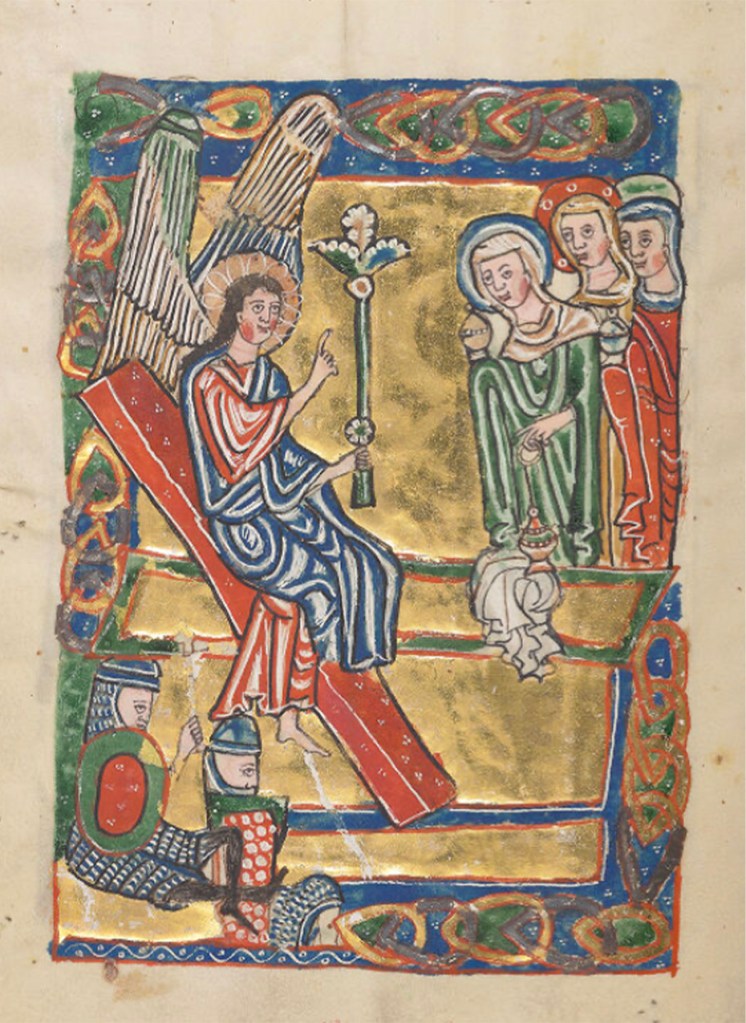
For Tuesday in Holy Week, the Gospel reading, Mark 15:1-39, is another long citation from the 1928 Book of Common Prayer (American edition, 1943 version) which begins with the trial of Jesus before Pilate and ends with His death upon the cross. The illustration for today is another outstanding example of Christian art that was produced at Reichenau Monastery, Reichenau, Germany. The source is the Pericope Book of Henry II. Henry II was the last of the Ottonian Holy Roman Emperors in Europe. The Christ before Pilate scene appears as Illustration No. 76 in our bookstore publication, The Gospel of Mark: Annotated & Illustrated. The volume is available exclusively through my Amazon Author Central page. Additional information about the book is found on the AIC Bookstore page. The Gospel of Mark volume was featured in my Blog post for February 5, A.D. 2026, which is linked from the Archives column at right.

Christ Before Pilate and Crucifixion of Christ, illumination in tempera and gold on parchment, Pericope Book of Henry II, circa 1007-1012, Clm 4452, Folio 107v, Bayerische Staatsbibliothek, Munich, Germany. CC-by NC-SA 4.0.

For tomorrow, Wednesday before Easter, the Gospel reading is Luke 22.

Thank you for your interest and support. Glory be to God for all things! Amen!
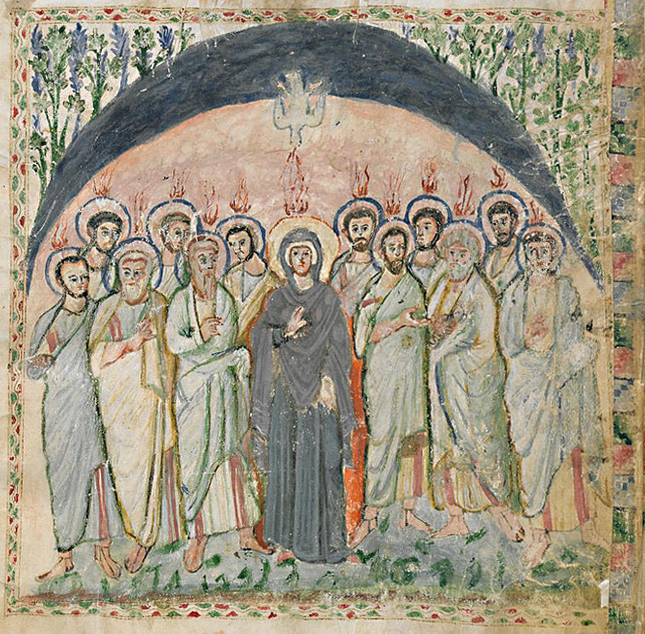
The lower portion

Monday before Easter

This year I have chosen interesting and sometime unique visual interpretations of the Gospel readings for Holy Week. For Monday before Easter the Gospel reading, Mark 14:1-72, is the longest during the cycle from Palm Sunday to Easter Day, covers four line on the opening page, plus four full pages, ending with two lines on the final page (1928 Book of Common Prayer, US Edition, 1943).

Upper panel: Jesus & His Disciples on the Mount of Olives; Lower panel: Arrest of Jesus, Peter Cutting Off the Ear of Malchus, illumination in egg tempera and gold on parchment, Gospels of Otto III, circa 998, Clm 4452, Image 96, Bayerische Staatsbibliothek, Munich, Germany. CC-by-NC-SA 4.0.

The bottom panel in the illustration appears as Illustration No. 73 in the AIC Bookstore Publication, The Gospel of Mark: Annotated & Illustrated. The volume was discussed in the Blog post for February 5, A.D. 2026, linked from the Archives column at right. The book is one the twenty-two volumes available exclusively through my Amazon Author Central page. Additional information is found on the AIC Bookstore page. St. Peter’s action against Malchus, a servant of the High Priest, is mentioned only in Mark 14:47 and John 18:10. The Golden Gospels of Otto III was produced at the Reichenau Monastery, Reichenau, Germany, for the third of four Ottonian successors to Charlemagne as Holy Roman emperors. The team of artists at Reichenau were locally trained by other artists brought from Constantinople under the supervision of the monk Liuthar. Just a few years later they began a two decade-long effort to produce a fully illuminated edition of Revelation (details about the AIC Bookstore version are found on the AIC Bookstore page.

A scene from the Gospel reading for Tuesday before Easter, Mark 15:1-39, will be the subject of the next Blog post. Thank you for your interest and support. Glory be to God for all things! Amen!
Sixth Sunday in Lent (Palm Sunday) and AIC Bookstore 19

For the Sixth Sunday in Lent, officially called Sunday next before Easter but commonly called Palm Sunday, Archbishop Cranmer modified a collect from the Gregorian Sacramentary (10th C.) by adding the phrase “partakers of his resurrection” to the last line. The 1928 Book of Common Prayer instructs that the Collect is to be said daily following collect appointed for each day during the week (Monday before Easter, Tuesday before Easter, Wednesday before Easter, Thursday before Easter (Maundy Thursday), Good Friday, and Easter Even). The Epistle reading, Philippians 2:5-11, includes the instruction that “at the name of Jesus every knee should bow.” The Gospel reading, Matthew 27:1-54, is the evangelist’s long account of the trial of Jesus and His crucifixion and death upon the Cross and the earthquake which followed it, according to the oral tradition known by the Greek word, kerygma. The image is a watercolor by James Tissot depicting events in the reading from St. Matthew’s Gospel. In the 1928 Book of Common Prayer, the actual entry into Jerusalem on Palm Sunday is read on First Sunday in Lent, also based upon St. Matthew’s Gospel, Matthew 21:1-11.

The events described in the Gospel reading are discussed and illustrated in Episode Three in AIC Christian Education Video series, Lent: the Season of Penitence, is linked from the Digital Library page. The audio-only version for Palm Sunday is linked from the Podcast Archive page. The Podcast Homily for Palm Sunday is linked from the Podcast Homilies page. A related podcast homily, based upon the Morning Prayer Psalm reading for the day, Psalm 22, is linked from the Podcast Homilies-Morning Prayer page. The word kerygma is discussed in the AIC Bookstore Publication, Layman’s Lexicon on page. ????. The book. which was featured in my blog post for October 18, A.D. 2025 in conjunction with the entry for Seventeenth Sunday after Trinity (linked from the Archive column), is available through my Amazon Author Central page. Additional information about the book is found on the AIC Bookstore page.

This week’s focus from the AIC Bookstore is The Writing Prophets of the Old Testament, another volume published in the 8.5″ x 8.5″ format.

Cover illustrations, from left to right, are a 10th C. mosaic of Isaiah’s virgin birth prophecy, Neo-Moni Monastery, Chios, Greece; 18th C. Russian Orthodox icons of Ezekiel & Jeremiah, Kishi Monastery, Karelia, Russia; and exterior mosaic of Daniel, Basilica of St. Paul Outside the Walls, Rome, Italy. Images of Isaiah, Ezekiel & Jeremiah are public domain; mosaic of Daniel © Can Stock Photo, Inc./Alessandro0070.

The volume, written for a lay audience of readers, is focused on the Major and Minor Prophets of the Old Testament, supported by documents from both the Eastern and Western Church understandings. It includes five parts of the Septuagint Old Testament not included in the King James Version (Prayer of Azariah; Song of the Three Children; Susanna; Bel & the Dragon; and Daniel and Habakkuk in the Lion’s Den. Sixty-three illustrations from the Third through the Twentieth Century. Includes special text boxes (What is a Prophet?; Isaiah in Christian Liturgies; Jeremiah in Christian Liturgies; Ezekiel in Christian Worship, Scripture & Teaching; Daniel in Christian Worship; Theophanies: Images of Christ and God the Father; Joel in Scripture & Christian Literature; Amos in the Anglican Prayer Book; Micah on Right Worship; Zechariah in Scripture and Christian Literature; Malachi in Christian Liturgy; Old Testament/New Testament Parallels. 144 pages. $35.00. The book is available exclusively through my Amazon Author Central page. More information about the book is included on the AIC Bookstore page.

As always, thank you for your interest and support. Glory be to God for all things! Amen!
Thank You!

To all our viewers and followers of Fr. Ron’s Blog, please accept our thanks for your continued interest and support. I constantly receive offers from potential vendors proposing changes to our site. The AIC exists solely to provide access, on demand, to traditional teaching and study materials, most augmented by examples of Christian art across the centuries. We strive to keep the site available 24/7 with content available consistent with our WATCH/LISTEN/READ initiative. If you have not already done so, we invite you to “follow” the Blog by clicking the box in the right hand column. You will then receive notification of each new posting.

Again, thank you.

Fifth Sunday in Lent & AIC Bookstore 18

For Fifth Sunday in Lent, commonly known as Passion Sunday, Archbishop Thomas Cranmer composed a Collect based upon the Gregorian Sacramentary (10th C.), affirming that by His “great goodness” mankind may be “governed and preserved.” The Epistle reading, Hebrews 9:11-15, includes a rare reference to the “high priest of good things to come” who is “not made with hands.” The allusion is to the mysterious Melchizedek (Genesis 14:18-20; Ps. 110:4; Hebrews 5:6-11 & 6:20-7:28), who is considered as a type of Christ. The Gospel reading, the second of two in Lent from the Gospel of John, John 8:46-58, includes Jesus’ bold “I AM” declaration.

Byzantine Mosaic, illustrating Genesis 16:18-20, 6th C, Basilica di San Vitale, Ravenna, Italy. Ravenna, on the northeast coast of Italy, was under the control of Byzantine Empire. The Basilica is contemporary to the rule of Byzantine Emperor Justinian I, who sponsored the construction of the Hagia Sophia in Constantinople. © Dmitry Chulov|Dreamstime.com.

The Collect, Epistle and Gospel readings are discussed and illustrated in Episode Three in the AIC Christian Education Video series, Lent: the Season of Penitence, which is linked from the Digital Library page. The audio-only version of Episode Three is linked from the Podcast Archive page. My Podcast Homily for Fifth Sunday in Lent is linked from the Podcast Homilies page. A separate Podcast Homily for Fifth Sunday in Lent, based on Psalm 51, the Morning Prayer reading for Fifth Sunday in Lent is linked from the Podcast Homilies-Morning Prayer page.

Three scenes from Revelation, Bamberg Apocalypse, 1000-1020 A.D., Bamberg State Library, Bamberg, Germany. © Staatsbibliothek, Bamberg, Germany. Used with permission.

The focus of this week’s AIC Bookstore Preview is Revelation: An Idealist Interpretation, another volume produced in the large page, 8.5″ x 8.5″ paperback format designed to enhance the illustrations and allow their placement fully in the context of book text. The book, patterned after the AIC Bible Study Video series of the same name, was made possible by the generous support of the Bamberg State Library, which provided high-resolution images from the original volume, The Bamberg Apocalypse, produced between 1000 and 1020 A.D., during the reigns of the Ottonian Holy Roman Emperors Otto III and Henry II. One of the Ottonian royal family was linked by marriage to a Byzantine princess. Artists working at the Reichenau monastery on Reichenau Island on Lake Constantine produced some of the finest expressions of traditional Christian teachings ever produced in the Western Church tradition. Their art drew upon earlier works produced in and around Constantinople. The volume includes A Brief History of Revelation and A Primer on Numerology in Revelation, the latter important in understanding St. John’s many uses of numbers. The companion video series of the same name is linked from the Bible Study-New Testament page. The volume is available exclusively through our Virtual Bookstore, which is my Amazon Author Central page. Additional information about the book is found on the AIC Bookstore page. 220 pages. 52 illustrations. $49.95.

A tip for understanding the Revelation and the four Gospels: when reading the Gospels, start with the Gospel of John and read it slowly, as if listening yourself to the Evangelist dictate the words to his scribe, Prochorus. Likewise with Revelation, especially noting the many allusions to 1st C. understandings about the Old Testament, from which St. John derived many of his allusions to important numbers (explained in A Primer on Numerology in Revelation, pages 7 to 11.

As always, thank you for your interest and support. Glory be to God for all things! Amen!
Fourth Sunday in Lent & AIC Bookstore 17

For Fourth Sunday in Lent in the 1549 Book of Common Prayer Archbishop Cranmer composed a Collect derived from the Gregorian Sacramentary (10th C., honoring the late 6th-early 7th C. Pope Gregory the Great) on the theme of Christ’s redemptive sacrifice (“by the comfort of thy grace” for the salvation of those who “worthily deserve to be punished.”). The Epistle reading (Galatians 4:21-31) continues St. Paul’s teaching concerning the differences between the old and new covenant using a “slave” vs. “free” allegory. The reading offers a break from the cycle of St. Paul’s teachings on the Christian virtues in the readings for the season of Lent. The Gospel reading (John 4:1-14), St. John’s account of the event traditionally known as the miraculous feeding of the 5,000, is the first of two readings from the Evangelist John during Lent.

The Multiplication of the Loaves and Fishes, Byzantine mosaic, Outer Narthex, above the Christ Pantokrator image over the door between the Outer and Inner Narthex, Chora Church, Constantinople/Istanbul, Turkey, 14th C. © Evren Kalinbacak|Dreamstime.com.

The Fourth Sunday in Lent is discussed and illustrated in Episode Two in the AIC Christian Education Video series, Lent: the Season of Penitence, which is linked from the Digital Library page. The audio-only version of Episode Two is linked from the Podcast Archive page. My Podcast Homily for Fourth Sunday in Lent is linked from the Podcast Archive page. The Podcast Homily for Fourth Sunday in Lent is linked form the Podcast Homilies Page. A related Podcast Homily based on the Psalm reading for Morning Prayer on Fourth Sunday in Lent, Psalm 147, is linked from the Podcast Homilies-Morning Prayer page.

Christ Panatokrator with Saints & Angels, mosaic, 1140-1170 A.D., West Wall, Sanctuary, Capela Palatina, Palermo, Sicily. Photographed by John Schermann. Used with permission.

This week’s focus among the 22 AIC Bookstore Publications is The Acts of the Apostles: Annotated & Illustrated. This work is the first fully illustrated version of St. Luke’s unique account of the growth of the Church Universal during the decades after Christ’s Ascension. The full text of Luke 1 and 2 and Matthew 2 (using the New King James Version text) are followed by commentary and illustrations from the 9th to the 20th C., including maps of St. Paul’s missionary journeys. Three appendices: Angels in the Acts of the Apostles; The Holy Spirit in The Acts of the Apostles; and a complete Glossary of all persons, places and events mentioned in St. Luke’s text, an especially useful resource in understanding the volume of detail provided by St. Luke. 226 pages. $49.00. The book is available exclusively through our Virtual Bookstore, which is my Amazon Author Central page.

As always, thank you for your interest and support. Glory be to God for all things! Amen!
Third Sunday in Lent

For Third Sunday in Lent, Archbishop Cranmer adapted a Collect from the Gregorian Sacramentary (10th C.) which refers to the “right hand of thy majesty.” The Epistle reading, Ephesians 5:1-14, is another lesson from St. Paul on the Christian Virtues, specifically, another lesson on the necessity of mastering “passions.” The Gospel lesson, Luke 11:24-28, the evangelist’s account of Jesus driving a demon from a mute man, is the only reading from St. Luke’s Gospel during Lent. It includes a reference to the “Lord of the Flies.”

Driving a Demon from the Mute Man, engraving, The Bible in Pictures, Julius Schnorr von Carolsfeld, Russian edition, 1873. © Pavel Kusmartsev|Dreamstime.com.

The Collect and readings for Third Sunday in Lent are discussed and illustrated in Episode Two of the AIC Christian Education Video series, Lent: the Season of Penitence. The audio-only version in MP3 format is linked from the Podcast Archive page. My Podcast Homily for Third Sunday in Lent is linked from the Podcast Homilies page. A related Podcast Homily for Third Sunday in Lent is based on the Psalm reading for the day, Psalm 34, is linked from the Podcast Homilies-Morning Prayer page.

As always, thank you for your interest and support. Glory be to God for all things! Amen!

Easter Book Promotion 2026

As Easter nears, viewers are invited to this preview of Easter: The Resurrection of Our Lord in Scripture, Art & Christian Tradition.

This six-part book includes the oldest surviving image of the Resurrection (586 A.D.) and 116 other images from the world’s digital archives. 170 pages. $40.00. Order your copy through our Virtual Bookstore, which is Fr. Ron’s Amazon Author Central page. Additional information on the AIC Bookstore page.

Second Sunday in Lent & AIC Bookstore 16

Apologies to viewers for the late posting of the logo and links for the start of Lent. I was traveling without my computer and could not complete the changes until my return. The Welcome/Home page now includes both the seasonal image and the three episode links.

Jesus & the Canaanite Woman, stained glass window in the Munich style, mid-19th C., St. Germain-l ‘Auxerrois Church, a Roman Catholic Church near the Louvre, Paris, France. The window was designed by renowned French stained glass artist, Etienne Thevenot (1797-1862). © Zatletic|Dreamstime.com.

For Second Sunday in Lent Archbishop Cranmer adapted a Collect from the Gregorian Sacramentary (10th C.) on the theme of mankind’s inherent lack of power to do save itself combined with a plea for protection from adversity and from evil thoughts. The Epistle reading, 1 Thessalonians 4:1-8, contains more of St. Paul’s teachings on the Christian virtues, especially on mastering passions. The Gospel reading, Matthew 15:21-28, the Evangelist’s account of Jesus’ encounter with the “Woman of Canaan.” In Episode Two of the AIC Christian Education Video series, Lent: the Season of Penitence, I discuss the differences between this account by St. Mark in which she is called the “Syro-Phoenician Woman.” In both versions, the woman calls Jesus by the titles “Lord” and “Son of David.” The audio-only version of Episode Two is linked from the Podcast Archive page. My Podcast Homily for Second Sunday in Lent based on the Holy Communion readings, is linked from the Podcast Homilies page. A second Podcast Homily for Second Sunday in Lent, based on the Psalm reading in Morning Prayer (Psalms 30 and 32), is linked from the Podcast Homilies-Morning Prayer page.

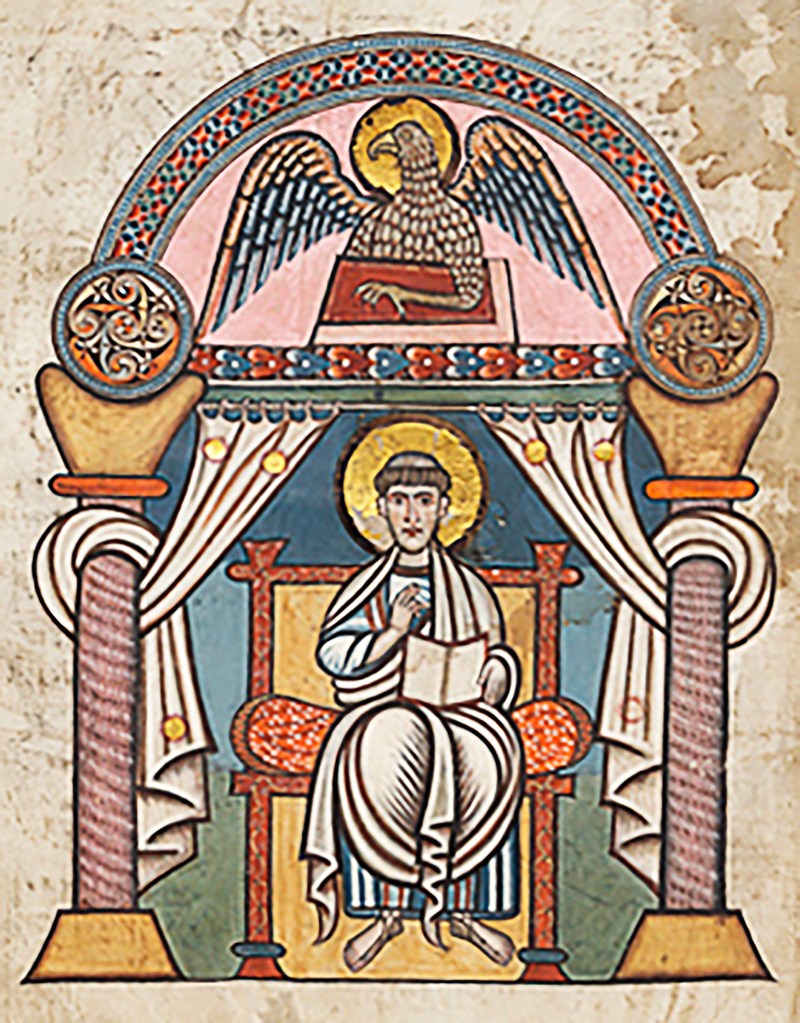
John Writing His Gospel, illumination in tempera and gold on parchment, produced at Reichenau Monastery, Reichenau, Germany, circa 1007-1012, Pericope Book of Henry II, Ms. Clm 4452, Folio 3v, Bayerische Landesbibliothek, Munich, Germany. CC-by-SA 4.0. Henry II was the last of the Ottonian Holy Emperors who were successors to the first Emperor, Charlemagne, crowned at Rome on Christmas Day, 800 A.D., as the first Holy Roman Emperor since the sacking of Rome in the second half of the 5th C.

This week’s sampling from the 22 books among the AIC Bookstore Publications is The Gospel of John: Annotated & Illustrated. This volume was actually the first book of the Gospels which was published in the 8.5″ x 8.5″ format. It includes 86 images from a 5th mosaic to a 20th C. stained glass window. Images include many “illuminations” in gold or silver and egg tempera on parchment originally intended for the exclusive use of bishops and emperors. The entire text of St. John’s unique gospel is printed, with section-by-section commentary, using the New King James Version text. The text includes sixteen “special text boxes”: The Art of Illumination of Scripture; A Guide to Reading the Gospel of John; Angels in the Gospel of John; The Seven “Signs” in the Gospel of John; Numerology in the Gospel of John; Concepts of Time in the Gospel of John; “Jews” in the Gospel of John; “Abide” in the Gospel of John; “I AM” in the Gospel of John; Emotions of Jesus in the Gospel of John; “The Son of Man” in the Gospel of John; The New Commandment: “Love” in the Gospel of John; “Peace” in the Gospel of John; Names of the Holy Spirit in the Gospel of John; The Sacrament of Confession/Penance in the Gospel of John; and John Writing His Gospel (Constantinople, 1285 A.D.). 186 pages. $55.00. The book is available exclusively through Fr. Ron’s Amazon Author Central page, which we call the Virtual Bookstore. Additional information about all the AIC Bookstore Publications can be found on the AIC Bookstore page.

As always, thank you for your interest and support. We remain committed to keeping the valuable examples of Christian art across the centuries available on demand, 24/7 through this site’s postings, videos, podcasts and books. You are invited to subscribe to these periodic posts on topics of seasonal or special interest by clicking the “Follow Anglican Internet Church” logo in the right hand column. Glory be to God for all things! Amen!
First Sunday in Lent

This week marks the start of the season of Lent, the penitential season leading up to Easter. The Collect, Epistle & Gospel readings for Ash Wednesday and First Sunday in Lent, respectively, are discussed and illustrated in Episode One and Episode Two of the AIC Seasonal Video Series, Lent: The Season of Penitence. The audio-only versions of Episode One and Episode Two are linked from the Podcast Archive page. The Podcast Homily for Ash Wednesday and the Podcast Homily for First Sunday in Lent are linked from the Podcast Homilies page. A separate Podcast Homily, based upon the Psalm reading for Morning Prayer on First Sunday in Lent, Psalm 3 and Psalm 62, is linked from the Podcast Homilies-Morning Prayer page. Ash Wednesday, the day for the Imposition of Ashes, has marked the start of Lent in the Western Church since the end of the 6th/start of 7th C. Pope Gregory the Great created Ash Wednesday as his answer to the strong Eastern Christian criticism from the Byzantine Patriarch and others that Lent did not actually last forty days in Western Church worship.

The Collect for First Sunday in Lent is an original composition by Archbishop Thomas Cranmer for the 1549 Book of Common Prayer, based upon Ephesians 4:22-24, focused on three topics: fasting, righteousness & holiness. These adaptations of the writings of St. Paul reflect the strong influence of the Pauline canon upon the worship, study and prayer practices of the Anglican Church. The choice of 2 Corinthians 6 as the Epistle reading also reflects Archbishop Cranmer’s emphasis on the Christian virtues as understood and aggressively taught by St. Paul. The Gospel reading for First Sunday in Lent, Matthew 4:1-11, is the first of four readings from the Gospel of Matthew in Lent, being an account of the Temptations of Christ. The image I have chosen is a mosaic from the ceiling in the north end of the Outer Narthex (or Exonarthex) at Chora Church, formerly Constantinople, now Istanbul, Turkey, depicting John the Baptist as witness to the Temptations. The partially-viewed segment at left is the supper edge of the mosaic of the Nativity of Christ on the east wall of the Exonarthex. The partial image at upper right depicts the Dream of Joseph and the Return of the Holy Family. The mosaics were created between 1315 and 1321 during the reign of Byzantine Emperor Isaac Comnenus using funds contributed by Theodore Metocrites, who is depicted adjacent to a Christ Pantokrator image near the door into the Inner Narthex (or Esonarthex). The image is one of about four dozen images from Chora Church downloaded earlier this year, bringing our archive of images to almost 3,000. The Church is located on the European side of the Straits of the Bosporus. It is now a museum/mosaic in which Christian worship is no longer conducted.

The Temptations of Christ, 1st Qtr., 14th C., Chora Church. © Serban Enache|Dreamstime.com.

Next week I will pick up with another Bookstore Preview, in this case featuring The Gospel of John: Annotated & Illustrated. As always, thank you for your interest and support. Glory be to God for all things! Amen!