Trinitytide: The Teaching Season – Episode Four

Paul-Lucas_van_Leyden-circa 1520
The Apostle Paul by Lucas van Leyden, circa 1520 A.D., Yale University Art Gallery,  Public Domain.

As promised last week, Episode Four in the Trinitytide series is now available in both video and podcast versions.   I’ve used several of the images of St, Paul which have been added to our library either from the public domain or from various picture vendors.   The most unusual one is today’s featured image, an oil on panel by Dutch painter and sculptor Lucas van Leyden, painted circa 1520 A.D. and now in the collection at Yale University Gallery of Art, New Haven, CT.   It is distinctly Western and presents St. Paul as if he were one of van Leyden’s clients sitting in his studio for a portrait, as opposed to the more fierce facial expression and bodily pose favored in Eastern Church art.  As is customary in Western Church art, St. Paul holds a book and a sword, the latter a symbol of the manner of his death.  Traditional accounts say that St. Paul was beheaded outside Rome around 68 A.D. during the reign of Emperor Nero.  Many claims have been made about the whereabouts of his remains, but not, as far as I am aware, are widely accepted.

Episode Four provides the full texts and origin of the Collects for Sixth, Seventh and Eighth Sundays after Trinity.  Commentary, summaries and key quotations are provided for the Epistle and Gospel readings.   I’ve also mentioned the next three of the eleven hymns to the Holy Trinity from The St. Chrysostom Hymnal.  The final two hymns will be mentioned in Episode Five, which is focused on the Ninth, Tenth and Eleventh Sundays after Trinity.

Watch the Video.              Listen to the Podcast

This coming week I will be acquiring three more impressions of St. Paul, all three in stained glass from the 19th C, including his Conversion, the warning of Agabus concerning his arrest, and a full size, frontal view of St. Paul with book and sword.

As always, I thank viewers for their interest and support.  May God bless you in all that you do in His Name.  Amen!  Glory be to God for all things! Amen!

Images of St. Paul

In working on Trinitytide: The Teaching Season I realized that readings from St. Paul’s work occupy 80+% of all the Epistle/For the Epistle readings for Trinity Season.  My inventory of historical images had only 4 or 5 representations of St. Paul and I had often fallen back to Andrei Rublev’s tempera and silver on panel unfinished icon, which dates to the 1st decade of the 15th C.   The search for more images took me through a lot of terrible art but, in the end, I found about 15 additional images of the prolific Evangelist to the Gentiles and who is often substituted for Matthias in imagery of the Twelve. especially in the Eastern Church tradition.

dreamstime_l_43347360-Paul-PCA
St.Paul, 11th C. mosaic at Chora Church (Church of the Holy Savior), Istanbul, Turkey, now a museum.  Image copyright Andrey Andronov|Dreamstime.com).  Perspective correction applied.

Not wanting to give away too much, I have included here only one of the new impressions.  As Trinity season progresses, and I release more episodes in the Trinitytide series, all 15 of the new images will appear in slides.

In the example at left the 11th C. artist captured three historical understandings about images of St. Paul:  receding hair line, full bear, intense facial expression.   He hold a book, representing either the Gospels or, more likely, the Pauline Epistles.  Since this is a Byzantine image and not one from the Western Church tradition, he does not hold an object which symbolizes the manner of his martyrdom.  In nearly all Western Church icon, painting, mosaic or statue  St. Paul holds a sword or a broken sword.  I applied perspective correction to the original image to make it more closely resemble the frontal view of the same mosaic by another photographer.  Apologies to the Dreamstime photographer.  As always, I am impressed by the way the Byzantine mosaic-maker managed to give the sense of flowing robes with lapis blue and the suggestion of indirect light.  Based on the colors and the pose, I wonder whether this mosaic was the inspiration for Rublev’s unfinished work.  Perhaps, but perhaps not, since other sources date the mosaic to a later century, before the Moslem conquest of Constantinople.

Next week I will upload Episode Four in the series, which covers the Seventh, Eighth and Ninth Sundays after Trinity, plus three more of the eleven Trinitarian hymns in the AIC Bookstore publication, The St. Chrysostom Hymnal.  To learn more about the Hymnal, visit my Amazon Author Central page.

As always, thank you for your interest and support.

May the Lord bless you in all that you do in His Name!  Amen!  Glory be to God for all things!  Amen!

Trinitytide: The Teaching Season – Episode Three

Luke-with Symbol-2nd Version- Gospel of Otto III
Luke the Evangelist with his traditional symbol, the Ox,an illumination strongly influenced by the Byzantine-style, from The Gospels of Otto III,, painted in tempera and gilt on parchment at the Benedictine Monastery on Reichenau Island, Lake Constance, Southern Germany, in the mid-11th C. The original is at the Bavarian State Library, Munich, Germany. Public Domain.

Episode Three in our newest Seasonal Video series, Trinitytide: The Teaching Season is now available in both video and podcast version.  There are thirteen illustrations which, I hope, help increase understanding of the Collect, Epistle and Gospel reading for Third Fourth and Fifth Sundays after Trinity.   The one chosen for this Blog entry is from the late Ottonian Empire, successor to the revived Holy Roman Empire started by Charlesmagne.  AIC regulars will remember that Otto III was responsible for the production of the Bamberg Apocalypse, now at the Bamberg State Library, Bamberg, Germany and used in the AIC Bookstore publication, Revelation: An Idealist Interpretation.

Watch the video version.

Listen to the Podcast version

The episode includes the only two readings from the writings of St. Peter during Trinity Season.  The Gospel readings jump back and forth on the historical timeline and include the Parables of the Lost Sheep and Lost Coin (Luke 15:1-10); the Parable of the Blind Leading the Blind (Luke 6:36-42); and the calling of the first four Disciples (Luke 5:1-11).   In my related Podcast Homily (linked from the Podcast Homilies page) for Fifth Sunday after Trinity I explain the early Church understanding of why Jesus was seated while the people stood and the spiritual meaning of “Launch out into the deep” (Luke 5:4).  For those who like a dose of Church history, I offer an interesting observation on a change in wording of the Collect for the same Sunday made in the 1662 B.C.P.

I also include mention the next three of 11 Trinitarian hymns not in the venerable 1940 Hymnal from the AIC Bookstore publication, The St. Chrysostom Hymnal.  The theme music for the video is again Holy, Holy, Holy, Lord God Almighty, played by Richard M. S. Irwin from his dedicated web page: https://play.hymnswithoutwords.com.  I thank Richard for granting permission of its use.  The hymn is always inspirational, but played by Richard on his church organ, it truly represents the majesty of Reginald Huber’s original scoring.

I have started work on Episode Four in the series, which will be available in late June, will feature the Collect, Epistle and Gospel readings for the Sixth, Seventh and Eighth Sundays after Trinity and the next three of 11 hymns to the Trinity.   The readings will require more research in suitable illustrations readers/viewers might not have seen.

As always, thank you for your interest in and support of this online ministry dedicated to traditional teaching of the ancient Christian Faith.  Please consider clicking the “Follow Anglican Internet Church” tab in the far right column.  You’ll be asked to enter your email address if you wish to receive notice of each new posting.

May God bless you in all that you do in His Name.  Amen!  Glory be to God for all things! Amen!

;

Mea culpa, mea culpa

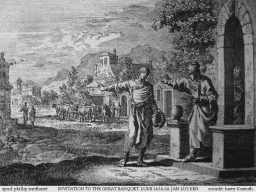
AGreat Supper-Jan Lukyen-Bowyer Biblepologies to readers/viewers for the incorrect attribution of a scene in Episode Two of Trinitytide: The Teaching Season.  The credit line for Jan Luyken’s etching of the Invitation to the Great Supper should have read:

Invitation to the Great Supper  Late 17th-early 18th C. etching by Dutch artist Jan Luyken, The Bowyer Bible, Bolton Library, Bolton, England, published, London, 1840 A.D. Public Domain photography by Harry Kossuth and text by Phillip Medhurst, Early Life of Christ in the Bowyer Bible, 2018 A.D. electronic edition.

There are several other examples from The Bowyer Bible which will be used in remaining episodes in the series.  These will bear the correct credit line.   Again, thanks for your interest and support.


Trinitytide – Episode Two

Somehow, with all the other issues which needed attention this week, I completed and uploaded Episode Two in the AIC Seasonal Video series, Trinitytide: The Teaching Season.  This episode is focused on the Collects and readings for Trinity Sunday, First Sunday after Trinity and Second Sunday after Trinity, plus seasonal music.

As a teaching season it should be no surprise that major doctrinal issues are covered through both the Collects and the Epistle-Gospel combinations.  The season starts with a rare liturgical reading from Revelation (Revelation 4:1-11), with the heavenly voice like a trumpet inviting St. John to “come up here” for a view of events to come from a heavenly perspective and the iconic pericope from the Gospel of St. John (John 3:1-15) recounting the nighttime visit of Nicodemus.

Rich Man and Lazarus-Codex_Aureus
Codex Aureus of Echternach, Folio 78, 1035-1040 A.D., Benedictine Abbey, Reichenau Island, Lake Constance, Germany; National Library of Germany, Nuremberg, Germany.  Public domain.

Week Two moves along to St. John’s essay on Love (Greek: agape) (1 John 4:7-21), which is paired with St. Luke’s account of the Parable of the Rich Man and Lazarus.  For the latter I chose a strikingly Byzantine-style representation painted in three panels at the Benedictine Monastery on Reichenau Island in southern Germany during the mid-11th C.   The dinner is shown in the top row; the fate of Lazarus (in the “Bosom of Abraham”) in the second; and the Rich Man in, fittingly, the lower tier.


In week three, the final set of readings are another of St. John’s essays on love, plus the need for putting it into action, and St. Luke’s version of the Parable of the Great Supper, delivered much earlier that the Wedding Supper account in St. Matthew’s Gospel.

I’ve also included mention of the first three of 11 hymns to the Holy Trinity in The St. Chrysostom Hymnal which are not in the venerable 1940 Hymnal.  The remaining hymns will be mentioned in remaining episodes in the series.

The series continues in Episode Three with discussion of the next three Sundays after Trinity.

As always, thank you for your interest and support.  May God bless you in all that you do in His Name.  Amen!  Glory be to God for all things!  Amen!

Why We Do It

I’ve been reviewing reader/viewer comments and various email message concerning the Anglican Internet Church, particularly its various presences on the Web.  Two common threads, not actually spoken, are Why the Seasonal Videos; Why the Focus on the 1928 B.C.P.?; and Why No Actual Video of the author?   I hope the following provides readers/viewer with acceptable answers.

Seasonal Videos:  One of the original objectives of the AIC, when it was just the broadcast arm of St. John Chrysostom Anglican Church at St. Joseph’s Villa Chapel, Richmond, VA, was to extend the reach of traditional homilies and traditional local doctrinal teaching and Bible Study.  Today, the AIC reaches a broad audience in many parts of the world.  The Seasonal Videos, which will eventually include programs on the entire Church Calendar, offer viewers and listeners through the Podcast version, are a way of providing traditional teaching, easily-available, without either going over the heads of the viewers or insulting their intelligence — and giving them a glimpse of the treasures of Church art from both the Western and Eastern Church.

Why the B.C.P. Focus:  The greatest treasure left to Anglicans by the English Reformation is the American 1928 Book of Common Prayer (as amended in the 1940s).  The liturgies provided, especially for Holy Communion, provide a valuable link backwards in time to the early Church both at Rome and at Constantinople and at Antioch, Alexandria, Jerusalem and the many Christian communities throughout Asia Minor.  Every time an Anglican hears a Collect read he or she is reminded of the continuity of the Christian heritage which came down from the Apostles through the clergy, bishops, and archbishops who defended the Nicene Creed in the face of “reform” movements.  The Seasonal Videos, with their focus on how the Calendar is brought to life in Holy Communion or Morning Prayer, help Anglicans understand exactly where these beliefs came from, including the source of the Collects; provide the short summaries of the Epistle and Gospel readings, with appropriate religious art; and enrich the experience with commentary on appropriate Seasonal Music from The St. Chrysostom Hymnal, which is offered as a supplement to the 1940 Hymnal.

Why No Actual Videos of the Author:   All our video series, whether in the Bible Study, Seasonal, or Christian Education categories, are intended to keep the focus on the content.   Nothing would be gained by watching the author while he narrates a video.  In fact, I believe, such video content would take time away from both the Script and the extensive archive of icons, frescoes, mosaics, engravings, paintings, watercolors, illuminated manuscripts, bas reliefs, statues, monuments, and church buildings, all of which, I hope, leave the viewer reminded that 21st C. Christians are not alone!  We are part of a continuing legacy begun by the teaching, healing, preaching, Nativity, Crucifixion, and Resurrection of Jesus Christ and by the untiring work of His Apostles, whether of the 1st C., or the 4th when the Nicene  Creed was written; or the 5th-6th-7th-8th C. when most of the Collects were composed; or in all the intervening years until the 21st C.  That legacy remains alive, vibrant, and threatening to the secular world as long as modern day Christians continue to worship God the Father, God the Son and God the Holy Spirit, constantly reminded by the words of the liturgies spoken by millions of Christians who have come before us.

As always, thank you for your interest and support.  May God continue to bless you in all that you do in His Name!  Amen!

Glory be to God for all things!  Amen!
Trinitytide: the Teaching Season – Episode One

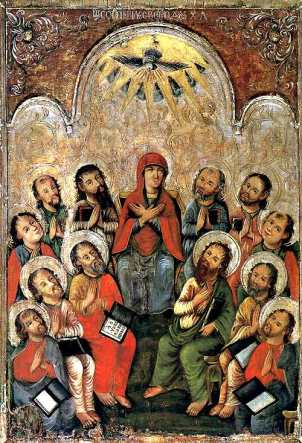
Holy_Spirit-Descent-Belarussian-18thC
Descent of the Holy Spirit, Russian Orthodox tempera and gilt on panel icon, 18th C., National Arts Museum of the Republic of Belarus, Minsk, Belarus.  Public Domain.

At last!  Glitches overcome (or fixed), on Wednesday morning I completed and uploaded Part 1 and Part 2 of Episode One in the newest AIC Season Video series, Trinitytide: the Teaching Season.  As noted in a previous blog posting, the episode ran too long and was split into two parts.  There is only a transition slide between the end of Part 1 and the start of Part 2 so viewers will need to watch Part 2 to hear the discussion of seasonal music for Whitsunday and Whitsun Week.

For thematic focus (after all, this is a teaching video series) I included a discussion of Whitsunday and a short history of Trinity season and its relationship to Pentecost in the new Trinitytide series.   Viewers will find an outstanding collection of illustrations in Episode One, with 15 of them on the first Pentecost.  Many are rarely seen in the Western Church, except among religious scholars and art historians.  The oldest Pentecost illustration was made in 586 A.D.  The most recent example was prepared near the end of the 19th or early in the 20th C.   Viewers will also learn about the 14th person in the Byzantine icons of Pentecost (12 Apostles, the Blessed Virgin, and — watch and find out).

Watch Episode One-Part 1.     Listen to the Podcast of Episode One-Part 1

Watch Episode One-Part 2.     Listen to the Podcast of Episode One-Part 2

Episode Two in the series will be focused on Trinity Sunday, First Sunday after Trinity and Second Sunday after Trinity, plus more seasonal music from The St. Chrysostom Hymnal.  I expect to have the episode ready next week or the following week.

As always, thanks for your interest in and support for this Internet-based ministry which seeks to teach traditional Christian doctrine and practice to the faithful wherever they live — and make it available 24/7.

May God bless you in all that you do in His Name!

Glory be to God for all things!  Amen!

Glitches & Other Issues

Last week I avowed to finish production of Episode One in Trinitytide; The Teaching Season.  Alas, glitches, several of them, caused me to delay production by one week.  In addition to typographical errors, difficulties with sentence structure, there is the fact that the final recording ran over 40 minutes.

The problem will be resolved by splitting the episode into two parts, with a transition slide at the end of Part One and a new opening slide for Part Two.   Part One will contain all the introductory material on Trinity Season as well as the B.C.P. readings for Whitsunday.  Part Two will not have a separate introduction but will continue where the first episode left off (with a new opening slide only) and include discussion of Monday and Tuesday in Whitsun Week plus seasonal music for Whitsuntide and Trinity season from The St. Chrysostom Hymnal.

All the changes have been made to both script and slides and I anticipate being able to record both Part One and Part Two on Monday.  Unless there are other glitches, I expect to complete and upload the finished programs before the end of next week, well ahead of Whitsunday.

Thanks for your patience, continued interest, and on-going support.

May God bless you in all that you do in His Name! Amen.  Glory be to God for all things! Amen!

Next Week: Trinitytide Series Begins

Next week I expect to post Episode One in the newest AIC Seasonal Video series, Trinitytide: The Teaching Season.  I have completed the script and slides.  There will be 20 illustrations, 15 of them of the first Pentecost.  The oldest dates to 586 A.D.; then a selection from the 9th C. and another from the early 11th C.  The “new” one is a fresco in Israel from the late 19th C.-early 20th C.    There is also a selection of seasonal music for Whitsuntide from The St. Chrysostom Hymnal.

For the sake of clarity of focus, I’ve included Whitsunday, or Pentecost to nearly everyone but Anglicans, in the opening episode.  The decision was based upon a desire to accommodate viewers from other denominations and make it clearer to them, and to Anglicans, how to adjust the labelling to the post-Vatican II system of celebrating Pentecost and virtually abandoning the centuries-old celebration of Trinity Sunday and the following season.  Western Christians have been celebrating Trinity since about the time of the Holy Roman Emperor Charlesmagne in Western Europe.

The pictures are, in my opinion, stunning and inspiring, both in the choice of detail in content and in the artistic and spiritual aspects of the style.  With the little research on my part I was able to have a better understanding of the intent of the Byzantine Church in its choice of both how and what to include.  Join me next week for a fuller explanation and links to the episode.

As always, thank you for your interest in and support for this Internet-based ministry.  May God continue to bless you in all that you do in His glorious Name!  Amen.  Glory be to God for all things! Amen!

Eastertide-2018-Episode Three

Christ-Ascension-Novgprod-14thC
The Ascension in the Novgorod style, painted in the 14th C., now in the Museum and Gallery, Bob Jones University, Greenville, S.C.  Public domain.

Last week I was so busy getting the garden ready for Spring and with issues related to my secular occupation that I just couldn’t put together my usual Weekly Update nor, owing to technical glitches with the Script/slide pairings, was I able to complete the final episode in Eastertide 2018 series.   This afternoon, I completed and uploaded Episode Three, which is focused on Fourth Sunday after Easter, Fifth Sunday after Easter (Rogation Sunday), Ascension Day and Sunday after Ascension. Not counting book covers and episode graphics, there are 15 illustrations, from the oldest surviving illustration of the Ascension, drawn in Northern Mesopotamia around 586 A.D. to an illumination for Ascension Day from the Bamberg Apocalypse, painted in the early 11th C., to several splendid Russian Orthodox icons of the Ascension by unknown artists and by the renowned Andrei Rublev from the 15th to the 17th C., to a relatively new stained glass window of the Resurrection from the 2nd quarter of the 20th C.  Note that all the traditional representations of the Ascension show the Blessed Virgin in the foreground plus the two men in white mentioned by St. Luke shown as angels, and a representation of the Glory of the Lord, usually a blue oval surrounding Jesus.  In one of the illustrations, by Italian artist Andrea Mantegna circa 1423-1424 and now at the Uffizi in Florence, Italy, the blue oval is formed by several angels.

Episode Three completes the series on Easter.  For thematic emphasis, I included Ascension Day and Sunday after Ascension in the discussion, which has the effect of completing the cycle begun with the Resurrection on Easter Day.   Similarly, I will touch upon Whitsunday/Pentecost at the start of the next series, Trinitytide: the Teaching Season, which should be available on or before May 20th, Trinity Sunday in 2018 A.D. The juggling for the Trinity series to include Whitsunday/Pentecost is necessary owing to the non-Anglican way, prevalent since Vatican II in 1969 A.D., of ignoring Trinity Sunday and counting the Sundays as being after Pentecost.   By making these adjustments, viewers will be able to follow the entire Church Calendar from Advent to Sunday next Before Advent in our Christian Education video series without missing any of the Collect-Epistle-Gospel pairings or missing any of the other changes (special verses or canticles and seasonal Propers).

Watch the video.    Listen to the Podcast version

Trinity-Title-miniI’ve begun work on the series for Trinitytide A.D. 2018, with a series graphic using Andrei Rublev’s c. 1420 A.D. icon in which the three visitors to Abraham under the Oak of Mamre represent the Holy Trinity.  Until the Renaissance, any representation of God the Father was forbidden, which they still are in the Eastern Church, which uses only images of Christ, who was seen by mankind.   The Holy Spirit is always the Dove described in the Gospels or a flame of fire described by St. Luke in Acts 2.  The type face is a new one I bought from a vendor for use with the series.  Each episode will include a small logo in the upper left of each slide without the icon.

Thanks for all the support, especially the viewing of the Good Friday videos.  May God bless you in all that you do in His Name.  Glory be to God for all things!  Amen!