The final Great “O” Antiphon episode is here, with O Emmanuel for Dec. 24th. Many of Christianity’s problems in the modern world are owed to the Church’s reluctance to teach the kind of faith that generated the Great “O” Antiphons in the 12th C. The hymn for today is, of course, O Come, O Come, Emmanuel, sung by soloist Jared Haselbarth. Mr. Haselbarth’s music is available in a boxed set of DVDs from nab audio.com.
For this occasion, I’ve integrated the Christmas Eve program from my former parish into the traditional wording. For interested listeners/viewers the hauntingly evocative theme music for the series was purchased from a vendor who identifies the artist as Ricky Theory.
Watch the Video. Listen to the Podcast
Later today I will post Lessons & Carols for Christmas Eve, an electronic version of the classic Christmas Eve service offered by nearly every Anglican parish everywhere but made available here for a wider audience. The program leads into another series, The Twelve Days of Christmas, with a theme word or phrase for each day from Christmas Day to Epiphany Eve.
 Join us for today’s Great “O” Antiphons observation for December 23rd, when the key words are O Rex Gentium, or King of Nations. This presentation was adapted, with illustrations and music, from the original 12th C. office.
 For December 22nd the key words are O Orien (Dayspring) in the 12th C. devotions known as the Great “O” Antiphons. The hymn for today is Wake, Awake, the Night is Dying (Anglican translation is Awake, the Night is Flying), sung by Mr. Jared Haselbarth. You can access all his beautiful Christian music at
  The Great “O” Antiphon for December 21st is O Clavis David (Key of David). This evocation from our joint Hebrew-Christian past is part of the 12th C. celebration of the last 7 days of Advent, The hymn for the occasion is Come, Thou Long-expected Jesus, sung by soloist Jared Haselbarth. The hymn was composed by Charles Wesley and is sung to the German-inspired tune, Stuttgart. You can access much of Mr. Haselbarth’s Christian music at
  The key phrase for Dec. 20th in the 12th C. observation, The Great “O” Antiphons, is O Radix Jesse, or Key of Jesse. It’s such a shame that the modern Church rarely uses these great teaching assets, but you can still enjoy and, hopefully, learn from them here.
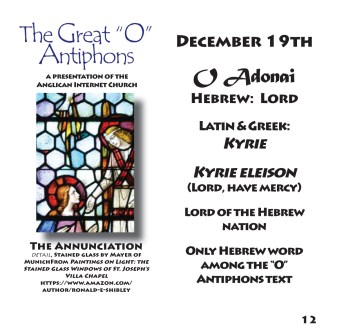 The key word for December 19th is Adonai, the Hebrew word for Lord, for which the Latin and Greek equivalent is Kyrie. This is the second of seven presentations leading up to Christmas Eve based on the 12th C. celebration of the Roman Catholic Church augmented with pictures, music and Scripture readings. It was recorded in 2015 A.D.
 I’m very pleased to announce that initial problems with producing The St. Chrysostom Hymnal in a single volume are being resolved this month. The first effort resulted in a volume far to large to transmit to our printer unless the book was separated into two volumes. The problem was resolved using file compression technology and by making the file compatible only with the most recent versions of Adobe Acrobat.
 One viewer raised a question concerning the current episode, Episode Five, in AIC’s Christian Education video series, The War on Christianity. The question indicates the need for a clarification for those who my have not seen Episode One through Episode Four. For those who have just joined in watching series, let me repeat some of the points I made in that first episode.
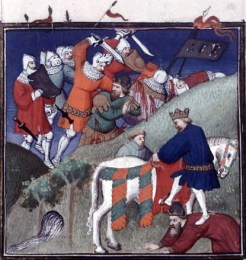 To Western minds, so filled with confidence that the whole world constantly progresses, this episode demonstrates how three pivotal events which happened up to a millennium ago had consequence that are still being felt in the second decade of the 21st C. The three events are the Battle of Manzikert in 1071 A.D.; the capture of Constantinople by misguided Crusaders, led astray by the ambitions of the Venetian Republic, in 1204 A.D.; and the Fall of Constantinople in the Spring of 1453 A.D. The illustration is a 15th C. a miniature of the Battle of Manzikert in the National Library of France.
 Anglican Internet Church