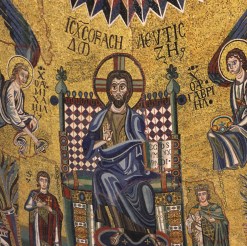
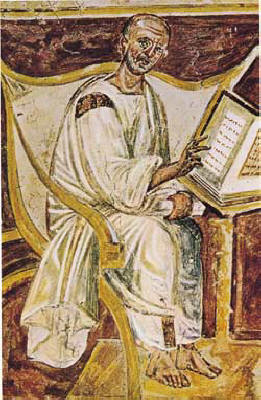
Episode Four in the revised New Testament: Gospels Bible Study Video series, delayed last week owing to technical issues, is now online. The focus continues on the Life of Christ as fulfillment of Old Testament prophecy. The episode begins with the coming of John the Baptist fulfilling prophecies of Isaiah and Malachi and ends with the Triumphal Entry into Jerusalem. The featured illustration for this post is miniature fresco of scenes in the Life of Christ by Italian artist Giotto di Bondoni from his series of frescoes on the north wall, Scrovegni Chapel, Padua, Italy.


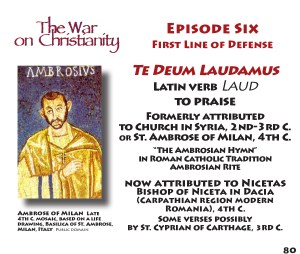 The long-delayed Episode Six in the AIC Christian Education video series The War on Christianity is now online in both video and podcast versions. Subtitled “The First Line of Defense,” the episode is focused on Part One of the Te Deum Laudamus canticle (from the opening sentence to “also the Holy Ghost, the Comforter”). The episode includes a summary of the canticle’s history and a verse-by-verse commentary on its meaning and Scriptural warrant, with illustrations from the 6th through the 21st C. This powerful and inspiring Canticle is the first suggested Canticle (or “Hymn” in the rubric in page 10) following the First Lesson in Morning Prayer.
 Episode Two in the AIC Seasonal Video series, Lent A.D. 2018, is now available on our YouTube channel. The subjects of Episode Two are other commemorations of Lent (Lenten meals, prayers and music) and the Collects, Epistle and Gospel readings, and suggested seasonal music, for First Sunday in Lent through and including the Fourth Sunday in Lent. I’ve found some additional illustrations, including a stained glass window of St. Paul in East Anglia, England (above, left), to which I applied perspective correction. I used this one because, since all four epistle readings are from the writings of St. Paul, I was running out of images not previously used (either in Episode One or in other AIC Video series). Also in the episode is a Russian Orthodox icon of St. Paul in flowing robes from the 18th C., from the iconostasis at the Church of the Transfiguration, Kizhi Monastery, Karelia, Russia. The music suggestions come from the AIC Bookstore publication, The St. Chrysostom Hymnal, which include hymns either not in the 1940 Hymnal or which are in it but set to different tunes.
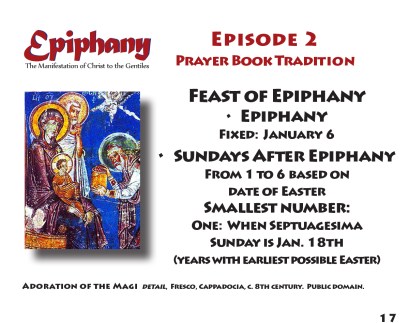 Episode Two in the revised 2018 A.D. edition of Epiphany: the Manifestation of Christ to the Gentiles is now available both on our YouTube channel and through the episode links on the Digital Library page. The focus of Episode Two has been changed since last week’s blog post. The topics are Epiphany Eve, Epiphany (Day) and the First Sunday after Epiphany, including appropriate Scripture readings from the 1928 Book of Common Prayer, the Proper for the Feast, the timeline of how and when St. Matthew’s “wise men” acquired a number and names, and seasonal music for Epiphany in The St. Chrysostom Hymnal (now available in a single volume paperback edition).
 What a busy week! Phone conversations and site visits with clients, in town and out of town, and meeting with a potential singer/chanter for The War on Christianity series Episode Six and Episode Seven. Plus putting up the family Christmas tree after Church on Sunday – and then nearly all day Monday as well. But it was truly worth it on all fronts!