
Episode Three in our newest Seasonal Video series, Trinitytide: The Teaching Season is now available in both video and podcast version. There are thirteen illustrations which, I hope, help increase understanding of the Collect, Epistle and Gospel reading for Third Fourth and Fifth Sundays after Trinity. The one chosen for this Blog entry is from the late Ottonian Empire, successor to the revived Holy Roman Empire started by Charlesmagne. AIC regulars will remember that Otto III was responsible for the production of the Bamberg Apocalypse, now at the Bamberg State Library, Bamberg, Germany and used in the AIC Bookstore publication, Revelation: An Idealist Interpretation.
The episode includes the only two readings from the writings of St. Peter during Trinity Season. The Gospel readings jump back and forth on the historical timeline and include the Parables of the Lost Sheep and Lost Coin (Luke 15:1-10); the Parable of the Blind Leading the Blind (Luke 6:36-42); and the calling of the first four Disciples (Luke 5:1-11). In my related Podcast Homily (linked from the Podcast Homilies page) for Fifth Sunday after Trinity I explain the early Church understanding of why Jesus was seated while the people stood and the spiritual meaning of “Launch out into the deep” (Luke 5:4). For those who like a dose of Church history, I offer an interesting observation on a change in wording of the Collect for the same Sunday made in the 1662 B.C.P.
I also include mention the next three of 11 Trinitarian hymns not in the venerable 1940 Hymnal from the AIC Bookstore publication, The St. Chrysostom Hymnal. The theme music for the video is again Holy, Holy, Holy, Lord God Almighty, played by Richard M. S. Irwin from his dedicated web page: https://play.hymnswithoutwords.com. I thank Richard for granting permission of its use. The hymn is always inspirational, but played by Richard on his church organ, it truly represents the majesty of Reginald Huber’s original scoring.
I have started work on Episode Four in the series, which will be available in late June, will feature the Collect, Epistle and Gospel readings for the Sixth, Seventh and Eighth Sundays after Trinity and the next three of 11 hymns to the Trinity. The readings will require more research in suitable illustrations readers/viewers might not have seen.
As always, thank you for your interest in and support of this online ministry dedicated to traditional teaching of the ancient Christian Faith. Please consider clicking the “Follow Anglican Internet Church” tab in the far right column. You’ll be asked to enter your email address if you wish to receive notice of each new posting.
May God bless you in all that you do in His Name. Amen! Glory be to God for all things! Amen!
;
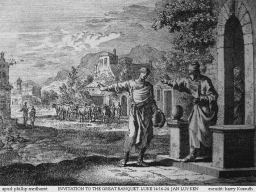 pologies to readers/viewers for the incorrect attribution of a scene in Episode Two of Trinitytide: The Teaching Season. The credit line for Jan Luyken’s etching of the Invitation to the Great Supper should have read:

 I’ve begun work on the series for Trinitytide A.D. 2018, with a series graphic using Andrei Rublev’s c. 1420 A.D. icon in which the three visitors to Abraham under the Oak of Mamre represent the Holy Trinity. Until the Renaissance, any representation of God the Father was forbidden, which they still are in the Eastern Church, which uses only images of Christ, who was seen by mankind. The Holy Spirit is always the Dove described in the Gospels or a flame of fire described by St. Luke in Acts 2. The type face is a new one I bought from a vendor for use with the series. Each episode will include a small logo in the upper left of each slide without the icon.
 Episode Two in the AIC Seasonal Video series, Eastertide: From Resurrection to Ascension, is now available in both video and podcast versions. Subjects are services for Easter Monday and Easter Tuesday, each commemorating a post-Resurrection appearance of Christ, and the First, Second and Third Sundays after Easter. There are 16 illustrations from the 11th, 12th, 14th, 15th, 16th, 17th, 18th and 19th C., including the tempera on panel work, Jesus on the Road to Emmaus, by Duccio di Buoninsegna in the Byzantine style at the Museo dell’Opera del Duomo (Siena), Siena, Italy, painted between 1308 and 1311 A.D. (Public domain: Yorck Project, 10,000 Masterwerke).
 This morning I uploaded Episode One in our newest Seasonal Video series, Eastertide: From Resurrection to Ascension. The episode includes 17 illustrations from the 13th to the 19th C. (with a photograph from the 21st C.), mostly Resurrection imagery. Artists include, in order of use, fresco-makers at Constantinople, James Tissot, William Holman Hunt, Giotto, fresco-makers at Milan, Byzantine icon-painters, and Russian Orthodox icon painters, including the celebrated Andrei Rublev, from the 15th to the 18th C. Regular viewers will have noticed the change in the series graphic from Portrait to Landscape orientation. This became necessary when I switched production of videos from the version of iMovie on my iPad to the enhanced version on my Mac. The “Ken Burns effect” program on the Mac, which has many additional features, especially in the area of multi-source soundtracks, is strongly biased toward Landscape imagery. Viewers will easily see the difference in the way the images scan during the video. For those especially fond of icons: the image in the title graphic is one of the best, most carefully drawn representations of the classic “Harrowing of Hades” depiction of Christ, standing on the destroyed gates of Hades and the pit with the “keys to Hades and Death,” lifting Adam (in white) and Eve (in red) from Hades. The figure with halo at left center (near the tip of Jesus’ right hand) is John the Baptist, observing in his status as the Last Prophet of the Old Testament. The blue oval is a classic representation of the Glory of the Lord, sheckinah in Hebrew.
 Anglican Internet Church