
I’ve gotten ahead on the production schedule and have now uploaded Episode Twenty-eight in The Lives of the Saints – Second Series, which honors the English Martyrs who were burned at the stake. They are also widely known as The Oxford Martyrs, owing to the plain fact that they were tried, convicted and executed at Oxford in 1555 A.D. (Latimer and Ridley, with Cranmer forced to watch) and 1556 A.D.(Cranmer’s death).
The illustration is a recent professional-quality photograph by Jeremy West of the Martyrs Memorial at the intersection of St. Giles, Magdalen and Beaumont near Balliol College. The monument was designed by George Gilbert Scott and was completed in 1843 A.D. The steady deterioration of the monument was brought to an end by a refurbishing in 2003 A.D.
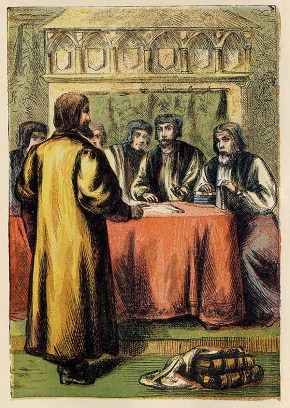 The episode features a short introduction placing the events in the historical context of the history of the Church of England from the 1620s through the accession of Elizabeth, with one picture each of Henry VIII, Edward VI, Mary I and Elizabeth I. After that is a brief biography of Hugh Latimer, Nicholas Ridley, and Thomas Cranmer. The very popular work, commonly called John Foxe’s Book of Martyrs but officially titled Acts and Monuments, is the source for many of the illustrations of the trial and executions. I’ve left the gruesome details out of this Blog entry, instead posting the attached colorized illustration by Joseph Martin Kronheim of Plate V, Latimer Before the Council, taken from an 1887 A.D. edition of Foxe’s famous work
The three remaining episodes are finished and ready to upload to YouTube prior to the Feasts of Leo the Great (Nov. 10), Clement of Rome (Nov. 23) and Catherine of Alexandria (Nov. 29).
As always, thank you for your interest in the Internet ministry of the Anglican Internet Church. May the Lord bless you in all that you do in His Name. Amen.
Glory be to God for all things! Amen!
 St. Francis of Assisi, celebrated on October 4th (Episode Twenty-five), is one of the most popular, or at least one whose name is widely recognized, among the Western Church saints. No matter what you think about him, you can say without reservation that he was unique. He anticipated by many centuries the environmentalist movement, wrote a poem which was turned into a hymn in the 20th C. in the Church of England tradition, (All Creatures of Our God and King. trans. William R. Draper, 1925 A.D.; and he can be found in many gardens, both public and private, in the form of a diminutive statue. I’m unconvinced that he would have appreciated becoming a small garden ornament! The illustration is the central detail I extracted from a larger work showing scenes in his life. The source provided no details about either the artists, but I suspect it was not long after St. Francis’ lifetime, probably in the 13th C St. Francis’ poem is the basis for Hymn No. 777 in the AIC Bookstore publication, The St. Chrysostom Hymnal, in which Draper’s translation is set to the arrangement of the German/Lutheran hymn, Lasst uns erfreuen. He lives on in the memory of the Western Church in the Blessing of the Animals service, usually celebrated on his feast day in October each year.
 recognition than he receives in the modern world. He is called “the blessed” because the modern Anglican world no longer designates faithful Christians as “saints,” probably thinking it is too Roman Catholic. Such denial of the right to celebrate the men and women who have done remarkable work in the service of the Lord and of the Church is one of those regrettable shortcomings of the modern Western Church. William Tynedale, pursued all across Europe until he was betrayed by a friend, was strangled, then burned at the state in Belgium on October 6th, 1536 A.D. for producing his New Testament in the English language, a violation of edicts of the Bishop of Rome. The identity of his persecutors and executioners is long gone from human memory, but the work of the Blessed William Tynedale lives on in the King James Version and New King James Versions of the Bible, which are largely based upon his pioneering translations of both the Old and New Testaments. Rather than post the gruesome depiction of his death, which is in the video, I post here Page One from Chapter 1 of his Gospel of St. John from either the 1525 or 1526 A;D. edition of his New Testament. Many people, myself included, believe he deserves the credit that William Shakespeare generally receives for the creation of the English language. His pioneering translation was adapted by his associate Miles Coverdale for the Great Bible of 1539 A.D. the first complete Bible in the English language (with credit also due to Archbishop Thomas Cranmer, who purchased copies for placement in all the churches of the Church of England, a goal ever achieved in his lifetime) and, a half-century later, without a word of recognition, provides the vast majority of the wording in the King James Version and its successor, the New King James Version. For more on which words and phrases were unique to the Blessed William Tynedale watch the video or listen to the Podcast. You’ll probably be surprised to learn how much of the Bible you know is the result of the Blessed William Tynedale’s creation of English prose phrasing.

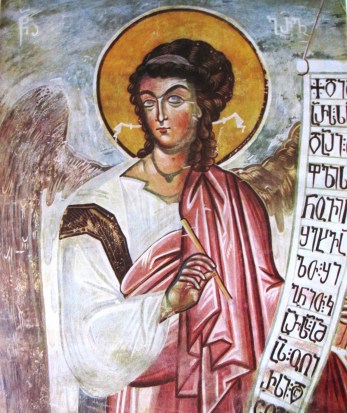

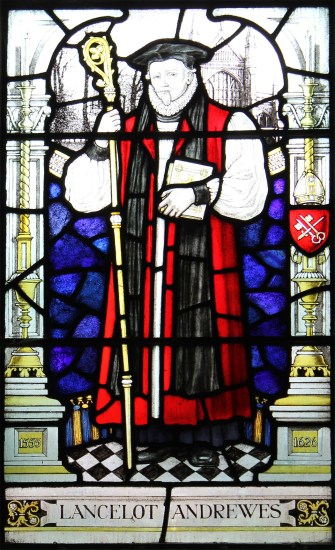 Episode Twenty-two, also published today, celebrates the life and contributions of one of the greatest of the 16th-17th Anglican divines, the Blessed Lancelot Andrewes, whose Feast Day is September 25th. Andrewes is one of my personal favorites. I suspect that he was one of those rumored to have desired placing the Church of England under the jurisdiction of the Patriarch/Archbishop of Constantinople. The illustration is a memorial window in the Cloister at Chester Cathedral, Chester, England. The picture is public domain through Wikipedia Commons. I applied perspective correction using Photoshop to the original file.
 UPDATED VERSION – 08/25/2017
 Next week (week of 8/28) I will release Episode Twenty-one in The Lives of the Saints – Second Series. Episode Twenty-one celebrates the life of St. Cyprian of Carthage, whose Feast Day is September 12. The illustration is a detail which I lifted from a 6th C. Byzantine mosaic frieze at the Basilica of St. Apollinare, Ravenna, Italy (image copyright RibieroAntonio/Can Stock Photo, Inc.). In the frieze the martyred saints stand in line to give their crowns to Jesus Christ, who is seated as Christ Pantokrator flanked by angels. In the original, St. Cyprian stands between St. Cornelius, Bishop of Rome when Cyprian was Bishop of Carthage, and St. John Cassian, one of the earliest Western Church chroniclers of the early Church.
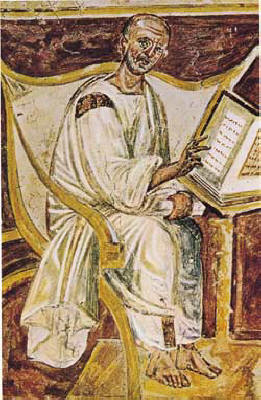 Episode Twenty includes four images of the great saint, including the oldest known representation of him, a late 6th C. fresco in a chapel on the lower level of the Lateran Palace, Rome (left, public domain), and Jaime Huguet’s egg tempera on wood panel, The Consecration of St. Augustine, painted for the Spanish monarchy in 1462 A.D. and now in the Catalan National Museum of Art, Barcelona, Spain. Another Huguet painting included in the episode is one of a collection of paintings of famous men in the Louvre Museum, Paris. There is also an illuminated letter from an 13th or 14th C. edition of his The City of God printed in Avignon, France, from a collection in the Episcopal Museum, Vic, Spain. and a color photograph of his tomb in the Basilica San Pietro d’Oro (St. Peter of the Golden Ceiling), Pavia, Italy. I tell the story of his wandering remains and how they ended up in Pavia (twice).
 Episode 19 in The Lives of the Saints – Second Series, focused on the life of St. Joseph of Arimathea is now available in both video and podcast versions. Finding a good graphic for St. Joseph was a challenge, since there are so few icons, mosaics or paintings of him. The Byzantine icon, Descent from the Cross (14th C., Agia Marina, Kalapanagiotis, Cyprus shows the scene well. But the most striking is Lamentation Over the Dead Christ, painted in oil on canvas by Pietro Perugino in 1495 A.D. and which is now displayed at the Pitta Palace, Florence, Italy, provides the most famous depiction. From it many have extracted the head of St. Joseph, who kneels at the feet of Jesus.
 Another image of Joseph of Arimathea is from the Life of Christ series of sketches in charcoal and watercolor by French artist James Tissot, now in the collection of the Brooklyn Museum, which has made them available in the public domain. In Tissot’s work the subject is much more clearly of Semetic origins (compared to the Europeanized image painted by Perugino and typical of Western Church art).
 This week I offer three new videos and one new podcast from the AIC’s digital library.
 Anglican Internet Church