Stir-Up Sunday & the War on Christianity (continued)

My wife and I have just returned from a week’s vacation on Hatteras Island, so I thought to catch up with the various AIC web presences, including reading all the many email messages.

WOC-Title1-RevOne viewer raised a question concerning the current episode, Episode Five, in AIC’s Christian Education video series, The War on Christianity.   The question indicates the need for a clarification for those who my have not seen Episode One through Episode Four.   For those who have just joined in watching series, let me repeat some of the points I made in that first episode.
First, there is a vigorous War on Christianity that is literally going on each and every day all around the world.  In Episode One I included data about how many physical assaults there have been and highlighted five such events in 2016 and 2017 A.D.

Second, the ultimate objective of those leading, and/or encouraging, the War on Christianity is to eliminate Christianity from the public and private sphere.   The War on Christianity has nothing to do with fairness doctrines or equal treatment of all religions or cultural prejudices.   It is a fight for the survival of Christian belief, although many modern Christians are in a state of denial.  The objective is, just as it was for those who successfully suppressed the Church in the 2nd through the 15th C, is to make Christianity irrelevant in public, and, in my opinion, in private worship.

Third, the five incidents are a warning sign that, in spite of those who deny reality, the loss of majority status “can’t happen here,” such a loss has happened before and is happening now right before our eyes.

Self-imposed Limitations on the Format:  Because AIC video series usually are presented in episodes of under 25 minutes. I cannot summarize in each episode all that has been said in previous episodes.  The first effort to produce such a summary caused the initial version of Episode Two, the Summary History of the Church from Pentecost Until Nowto run about 34 minutes.  I retreated and instead presented the subject matter in two episodes.   The same problem reappeared in the first version of Episode Four, which ran even longer, with all three case studies of regional declines in a single episode.  As with the previous example, I retreated and rewrote the material into two episodes, with important events in the Holy Land and North Africa treated in one episode, leaving Asia Minor to be treated in its own separate episode.

I made many of the same points that I made in Episode One in Episode Five, but perhaps I did not make the following point strongly enough in the section on Lessons Learned.  Let me make it clearer now:  many of the players in the decline of Christianity in the Holy Land, North Africa, and Asia Minor still exist today.  They are Islamic fundamentalism plus international and Church politics. Additionally, in place of the greedy merchants of the Republic of Venice in the 13th through 15th C., whose objective was to destroy the Byzantine Empire and reap the benefits for themselves, are the international corporations and rich individuals with limitless wallets and atheistic values.

In future episodes I will offer ideas and practices which I think will make any Christian more able to defend the Christian Faith.  In Episode Six, subtitled The First Line of Defense, I will discuss how important it is for any Christian to understand traditional Christian doctrine.  Currently, I anticipate a total of 12 to 15 episodes.

All episodes of The War on Christianity series are linked from the Digital Library page (for the videos) and the Podcast Archive page (for the MP3 podcast versions.  Use the appropriate tabs above and below to reach these pages.

Sunday Next Before Advent:  On another topic of current interest:  If you attended Church today and did not hear a homily/sermon on what the concept of “stir-up” means, where it came from, and how important it is to the coming Advent celebration, you can listen to a my Homily for Sunday Next Before Advent on the Podcast Homilies page of this site.

As always, thank you for your interest and support.  You can help make our material more widely available by subscribing to this Blog or to our YouTube or Podbean pages.

May God bless you in all that you do in His Name!  Glory be to God for all things!  Amen!


The War on Christianity: Episode Five

I’ve just uploaded Episode Five in The War on Christianity to both our Podbean and YouTube channels.  Episode Five, focused on Asia Minor, completes the three case studies on areas of the world where Christianity has lost its majority status: Holy Land, North Africa and Asia Minor.   I offer Episodes Four and Five as a cautionary tale about overconfidence that the current anti-Christian campaign in Europe can’t lead to long-term consequences, or, in popular language, the idea the “it can’t happen here.”

Watch Episode Five.     Listen to Episode Five

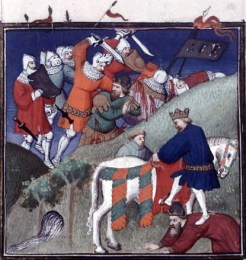
Battle of Manzikert-1071-15th CTo Western minds, so filled with confidence that the whole world constantly progresses, this episode demonstrates how three pivotal events which happened up to a millennium ago had consequence that are still being felt in the second decade of the 21st C.  The three events are the Battle of Manzikert in 1071 A.D.; the capture of Constantinople by misguided Crusaders, led astray by the ambitions of the Venetian Republic, in 1204 A.D.; and the Fall of Constantinople in the Spring of 1453 A.D.   The illustration is a 15th C. a miniature of the Battle of Manzikert in the National Library of France.
The first event, which I call the beginning of the end, led inevitably toward  the third and final event, the aftermath of which meant the end of Christianity as a significant force in Asia Minor.  As I show in the text, Christians in Asia Minor are still living with the very real cost of the loss of Constantinople in the 15th C.

In the next episode, Episode Six: The First Line of Defense, I begin a multi-episode discussion of techniques and strategies which any Christian can, and should, employ in their daily lives to protect both themselves and the Church from the anti-Christian ravages of governments, wealthy and powerful individuals and corporations, and other religions determined to eliminate Christian influence in the modern (or no-so-modern after all) world.

In next week’s Blog I hope to have positive news about a new development at the AIC Bookstore.

As always, thank you for your interest in and support for the Anglican Internet Church’s online ministry.  You can help by spreading the word to friends, neighbors and family about the resources available through links on our Web Site.

Glory be to God for all things! Amen!

The War on Christianity – Episode Four

Earlier this week I completed and uploaded Episode Four in The War on Christianity series.  Episode Four is Part 1 of 2 in Three Case Studies, an account of the decline of Christianity in regions of the world where it had once been the dominant religion.  To keep the episodes under 25 minutes, Episode Four is focused on two regions only, the Holy Land (Middle East to the secular world) and North Africa.  Next week I will upload Episode Five, which carries the story into the decline of Christianity in Asia Minor.

Watch the Video of Episode Four       Listen to the Podcast of Episode Four

canstockphoto11394994-Detail1.jpg
By This Sign Conquer, Statue of Constantine the Great by sculptor Philip Jackson installed in 1998 A.D. at York Minster, England.

Because the story traces the Church over 19 centuries, in Episode Four, and later in Episode Five, I have used the Pivotal Events device to explain only the most critical moments in the Church’s transition from majority to minority status, with applicable and, I hope, interesting illustrations from the religious art of both the Eastern and Western Christian traditions.  The fate of Christianity in both areas is intricately and inseparably intertwined with the rise and decline of the Byzantine Empire and the rise of a new religion, Islam, in the 7th C. A.D.   The first Christian emperor, Constantine the Great, and his mother, St. Helen, played major parts in the story.   He for his bold decisions and her for her patronage of the Church in the Holy Land.  The illustration is statue of Constantine the Great, bearing the legend “by this sign conquer,” in front of York Minister, England, where Constantine declared himself emperor in 306 A.D.  The interconnection with the fate of the Byzantine Empire comes back into focus in Episode Five, with my account of the decline of Christianity in Asia Minor (now generally known as Anatolia, part of eastern Turkey), between the 11th C. and the present day.

Even though Christianity lost its influence over civil government in the Holy Land and North Africa in the spread of Islam in the 7th C., culminating in absolute control over North Africa by the time of the Ummayad Moslem conquest of Algeria in 698 A.D., Christians were allowed to practice their religion, albeit under stringent controls, between the end of the 7th C. and the 14th C.  In fact, they remained the majority religion in Egypt all the way to the 14th C.   The final decline to under 10% of the population of Egypt is owed to the rise of a political side of Islam after the fall of the Byzantine Empire in 1453 A.D.

Cyprian of Carthage-Basilica-ruins3-1915
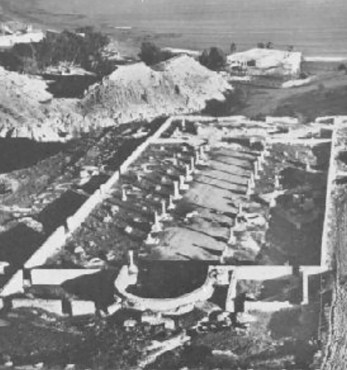
Remains of Basilica of St. Cyprian of Carthage, 6th C., in the early 20th C.  Public domain.

Silent testimony to the absolute decline of Christianity in North Africa is the early 20th C. photograph of the remains of the Basilica of St. Cyprian of Carthage, built in the 6th C. under the patronage of the Byzantine Emperor Justinian, who also sponsored the Monastery of St. Catherine at Sinai and commissioned the monastery’s Christ Pantokrator icon, the oldest known icon of Jesus Christ.  In the 4th C., the height of Christian influence in Algeria and the rest of North Africa, there were said to be over 160 Christian churches near Carthage.  Today, there are only a handful in the whole country and the former Roman Catholic Cathedral of St. Louis, built by France in the late 1880s A.D., is now a “cultural center,” featuring live performances where devout Catholics once prayed.  Will Christianity become a quaint reminder of cultural history in Europe at the end of the 21st C., like the remains of the Basilica of St. Cyprian of Carthage were in the early 20th C.?

Next week, I will upload Episode Five, completing the Three Case Studies, and also bring you news of a new development in the AIC Bookstore publications, just in time for Christmas.

As always, thank you for your interest and support.  Please help spread the word of the availability of the AIC’s videos, podcasts and publications by clicking the “Follow Anglican Internet Church” tab in the right column and letting friends, family and others know where to find the AIC.

Glory be to God for all things! Amen!

The War on Christianity – Episode Three

Early this week I uploaded Episode Three in the AIC Christian Education video series, The War on Christianity.  Episode Three is Part Two (of Two) in A Summary History of the Church from Pentecost Until Now.  The episode takes up the narrative with the story of the Church in North Africa, Sub-Saharan Africa, the Western Hemisphere, plus Asia and the Pacific Islands; a quick summary of the impact of the Protestant Reformation, English Reformation and the Catholic Counter-Reformation; and the growth of new denominations around the world.  The final one-third of the episode is focused on a census of the Christian population worldwide, as of 2010 A.D., and discussion of that population, region-by-region, with emphasis on where the largest concentrations of Christian populations exist.

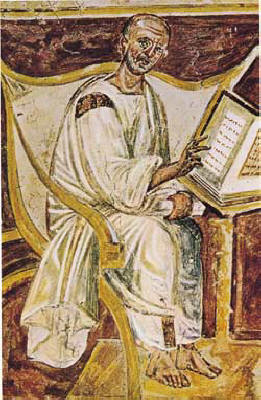
Augustine_Lateran
Late 6th C. fresco of St. Augustine of Hippo, Lateran Palace, Rome.  Public Domain.

Given the media’s lack of attention to actual facts versus opinions, two such actual facts pointed out in Episode Three may surprise many readers.

First, if we exclude Russia, which is not really European, from the census for Europe, there are far more Christians, by a large margin, in the United States (246,780,000), Brazil (175,770,000), Mexico (107,780,000), the Philippines (89,790,000) and Nigeria (80,510,000) than in any country in Europe.  To be fair, the census estimate says that Russia is home to 105,220,000 Christians.

Second, a fact extrapolated from the data, there are almost twice as many Christians in Nigeria as there are in the United Kingdom, the home country of the Church of England, and the Protestant population in the home country of Martin Luther has declined, in percentage terms, by approximately 30% since the start of World War II, while the Roman Catholic population (again, as a percentage) has remained largely unchanged during the same time frame.  During the balance of the series I intend to discuss the implications of this data.

[Data Source: Regional Distribution of Christians, Pew Research Center, December 19, 2011 A.D.  http://www.PewForum.org/2011/12/19/global-christianity-regions]

Watch Episode Four          Listen to the Podcast version

Next time, in Episode Four, I will discuss Three Case Studies of regions in which Christianity has been marginalized in both absolute and percentage terms: the Holy Land (or Middle East), North Africa, and Asia Minor, the latter being the region in which the greatest growth of the early Church happened.

Please help us spread the news of the availability of the prayer, teaching, Bible Study and historical resources made available on-demand via the AIC Web site, and through our Virtual Bookstores (accessed using links at the bottom of our Home Page).  Further, you can “follow” this blog by clicking the “Follow Anglican Internet Church” tab in the right hand column.  And you can similarly subscribe to our YouTube videos and the Podcast versions (via our PodBean channel).

As always, thank you for your interest in and support of the Internet-based ministry of The Anglican Internet Church.  May God bless you in all that you do in His Name.  Amen.  Glory be to God for all things! Amen!


The War on Christianity – Episode Two

Early this week I uploaded Episode Two in our new video and podcast series, The War on Christianity.   This episode is part one (of 2) in A Summary History of the Church from the Day of Pentecost Until Now, in which I review the growth of the Church from its birthday at Pentecost (Acts 2) through its spread into Northern Europe in the 12th C.  There are 17 illustrations from the 6th to the 20th C.   The episode attempts to put the expansion of Christianity into context, giving credit to the major saints along the way, including the original Apostles and the bishops, archbishops, clergy and scholars who were the driving force, even in the face of the risk of death.

Ignatius of Antioch-Fresco-1870s-Macedonia.jpg
Public domain

One of the most interesting illustrations is a 19th C. fresco depicting the martyr’s death of St. Ignatius of Antioch from the Monastery of Elijah in Melnica, Republic of Macedonia.  It is attributed to artist Avram Dichov and was created in 1872 A.D. following the two-year-long construction of the building.   Viewers also get glimpses of later saints, such as Cyril and Methodius (7th C.) and the Venerable Bede (8th C.), plus a recent photograph of the Monastery of St. Michael, Kiev, Ukraine, opened in 1999 A.D. to replace the early 12th C. original building which was destroyed by the Soviet Union under Stalin’s rule in the late 1930s.  Both the Elijah Monastery and the rebuilt St. Michael’s are a tribute to Eastern Church Christians who maintained their faith through the terrible anti-Christian persecution after the Bolshevik Revolution in 1917 A.D. and the spread of Soviet-style Communism across eastern and southeastern Europe.   The survival or restoration of both buildings demonstrates the benefits derived when modern Christians stand up to the anti-religious forces from within and from outside their communities, a message which underpins The War on Christianity series.

Watch Episode Two      Listen to Episode Two

Early next week I will upload the completed Episode Three in which the Summary History is carried from the spread of the Church across North Africa, into Africa below the Sahara, across the Atlantic into the Western Hemisphere, and, since the 17th C. across the Pacific, extending the reach of Christianity to an estimated 2 billion-plus people worldwide (as of 2010 A.D.).

I thank those who have subscribed to this Blog and who follow the AIC on our YouTube and Podbean channels (links to which are always found on the Home page at http://www.AnglicanInternetChurch.net.  You can help us reach more people by letting others know how to find us on the Web.

As always, thank you for your interest in and support for The Anglican Internet Church electronic ministry.  May God bless you in all that you do in His Name.  Glory be to God for all things! Amen!

What’s Happening This Week

Last week I completed and uploaded to the AIC’s You Tube and Podbean channels all the remaining episodes in The Lives of the Saints – Second Series.   All thirty-one episodes are now linked from the Digital Library (for the videos) and the Podcast Archive (for the podcasts) pages at www.anglicaninternetchurch.net.   I’ve made several changes to the appearance and organization of the site, hopefully making it easier to find the electronic and print resources visitors are looking for.

Getting the project to completion allows me to focus the rest of A.D. 2017 and most of A.D. 2018 on our The War on Christianity series of videos and podcast; on updating several episodes from the New Testament Bible Study videos of a few years ago; and developing a marketing plan for the AIC Bookstore Publications.

WOC-Slide22-smallThe War on Christianity series has been reorganized, with the addition of at least two and  possible three new episodes that will provide a better bridge between Episode One, which examined the nature of the threat using actual examples of violence from around the world in A.D. 2016 and 2017, and the teaching episodes intended to offer self-defense through knowledge of Church doctrine and through the actual application of traditional teachings.

The slides and script for Episode Two are almost complete.  In them, I put the on-going “War on Christianity” into the historical perspective of the spread of the Church Universal from the day of Pentecost up until now, emphasizing the meaning of the Nicene Creed’s statement that the Church is “one Catholic and Apostolic.”  I pay tribute to the original Apostles named in Scripture and to the second, third and fourth (and later) generations of Bishops, Priests, Deacons, scholars, and theologians who, many times forfeiting their lives in the process, organized and spread the Christian Faith from the Holy Land literally across the world.  As always, the slides are illustrated with icons, frescoes, mosaics, paintings and photographs intended to enrich the viewing experience.  The episode ends with a series of slides on the membership and region-by-region and, sometimes, country-by-country distribution of its membership.  I suspect the data will surprise many.

As always, I thank you for your interest in and support for the online ministry of The Anglican Internet Church.  May the Lord bless you in all that you do in His Name.

Glory be to God for all things!  Amen!

Leo the Great, Clement of Rome, & Catherine of Alexandria

After thirteen months of research, including the often-frustrating search for suitable illustrations, I have come to the end of The Lives of the Saints – Second Series.  Earlier this week I uploaded the final three episodes to You Tube and this morning approved their release to the public and uploaded the podcast versions to our PodBean channel.  Purchase of images used here and in the AIC Bookstore publications is made possible by donations and from royalties generated by sale of our twelve books.

G1HAFR.jpg
St. Clement of Rome (left) and St. Leo the Great (right).  19th C. stained glass window, Basilica of St. Peter and St. Paul, Vysehrad Castle (Upper Castle), Prague, Czech Republic.  Image copyright Aurelian Images/Alamy Stock Photos.

Episode Twenty-nine celebrates St. Leo the Great, the first Roman Catholic pope of the many who took the name Leo to be called “Great.”  He presided at Rome from 440 A.D., when he was elected by acclamation. until his death in 460 A.D.  A very strong supporter of the decisions of the Councils of Nicea and Constantinople (First meeting), he regarded the doctrinal rulings of the Councils as having equality with Scripture, since they were based upon Scripture.  He did not attend, but did write a letter which was read at Chalcedon supporting the dual nature of Christ decision of that Ecumenical Council. His remains are enshrined in an altar inside St. Peter’s Basilica, Rome.

Episode Thirty celebrates St. Clement of Rome, claimed by the Roman Catholic Church as the second Pope.  Other accounts place two, and in some cases, three, men between St. Peter and St. Clement.  St. Clement enjoys the distinction of having had his Epistle to the Corinthians (late 1st C.) considered in the first five centuries of the Church Universal as canonical, that is, equivalent to Scripture.  I quote from the his epistle several times in hopes to helping bring his work to the attention of modern listeners and readers, most of whom have never heard of Clement of Rome (or Clement I).  He presided at Rome from about 88 A.D. to around 99 A.D., when he died a martyr’s death on the Black Sea near southern tip of present-day Crimea.  The episode includes a 6th C. image of St. Clement which I extracted from a much larger frieze at the Basilica of St. Apollinare at Ravenna, Italy, one of the finest surviving examples of Byzantine art and architecture in the Western Church.  St. Clement is the Patron Saint of mariners and is often depicted with an anchor.

Watch the Leo Video          Listen to the Leo Podcast

Watch the Clement Video       Listen to the Clement Podcast

Catherine_of_Alexandria_Detail1(Menologion_of_Basil_II).jpgEpisode Thirty-one, the last episode in the Second Series, celebrates St. Catherine of Alexandria, formerly a favorite saint but in the last 300 or so years relegated to near fictional status.  Among the saints of the early 2nd millennium, largely as the result of the Crusades in the Holy Land and the Western discovery of her story, she was widely popular.  Her name endures today in various colleges, islands, and mountain ranges named in her honor.  A strong tradition in the Eastern Church is that her remains are interred at the Monastery of St. Catherine, Sinai, built in the 6th C. under orders by, and sponsorship of, Emperor Justinian.   There are many schools named after her, including St. Catherine’s here in Richmond, Va.  She is the Patron Saint of Virgins and all young women.  She met her death by beheading around 305 A.D.   The illustration is a detail in tempera and gilt on velum of the death of St. Catherine which I extracted from a larger work from the Menologion of Basil II, a form of service book with a Synaxarion of over 400 martyrs prepared for the incumbent Archbishop of Constantinople in the late 10th C.  The original is in the Vatican Library.  The illustration and the larger work from which it was extracted are included in the video.

Watch the Catherine Video     Listen to the Catherine Podcast

Now that The Lives of the Saints series is over, I turn my attention to The War on Christianity series of videos and podcasts.  I have reformatted the series to include at least two transition episodes between the opening video and the more teaching-oriented episodes which will follow.  The new material offers a summary history of the Church from the Day of Pentecost to Now, with data on Church enrollment around the world (Episode Two) and a separate episode (Episode Three) on three parts of the world where the Christian Faith was once the predominant religion: the Holy Land; Asia Minor; North Africa.

As regular viewers of this Blog and the AIC Web Site will have noticed, I have introduced a number of changes at the Web Site.  These are intended to improve the ease of use of the site’s unique video, print and podcast resources.   The changes include

  • New messages on the two pages at the original host site at WordPress, referring all visitors to the Home Page at our official Web Site, also hosted by WordPress.com.
  • Resetting and rewording of type and text for the Video, Podcast, and Virtual Library sections at the bottom of the Home Page.
  • Visual changes in the links pages on the Digital Library page (host to Christian Education and Seasonal Videos) and to the new Podcast Archive page (host to the podcast versions of all three video series).

As always, I thank viewers for their interest in the site and encourage them to click the “Follow Anglican Internet Church” link, which will give notice of all new postings on Fr. Ron’s Blog.

Glory be to God for all things!  Amen!


The English Martyrs: Latimer, Ridley & Cranmer – Oct. 16th

dreamstime_xl_20656379
Oxford Martyr’s Memorial Image copyright Jeremy West|Dreamstime.com.

I’ve gotten ahead on the production schedule and have now uploaded Episode Twenty-eight in The Lives of the Saints – Second Series, which honors the English Martyrs who were burned at the stake.  They are also widely known as The Oxford Martyrs, owing to the plain fact that they were tried, convicted and executed at Oxford in 1555 A.D. (Latimer and Ridley, with Cranmer forced to watch) and 1556 A.D.(Cranmer’s death).

The illustration is a recent professional-quality photograph by Jeremy West of the Martyrs Memorial at the intersection of St. Giles, Magdalen and Beaumont near Balliol College.  The monument was designed by George Gilbert Scott and was completed in 1843 A.D.  The steady deterioration of the monument was brought to an end by a refurbishing in 2003 A.D.

Latimer-Hugh-B4Council-Color-1887The episode features a short introduction placing the events in the historical context of the history of the Church of England from the 1620s through the accession of Elizabeth, with one picture each of Henry VIII, Edward VI, Mary I and Elizabeth I.  After that is a brief biography of Hugh Latimer, Nicholas Ridley, and Thomas Cranmer.  The very popular work, commonly called John Foxe’s Book of Martyrs but officially titled Acts and Monuments, is the source for many of the illustrations of the trial and executions.  I’ve left the gruesome details out of this Blog entry, instead posting the attached colorized illustration by Joseph Martin Kronheim of Plate V, Latimer Before the Council, taken from an 1887 A.D. edition of Foxe’s famous work

Watch the video

Listen to the Podcast

The three remaining episodes are finished and ready to upload to YouTube prior to the Feasts of Leo the Great (Nov. 10), Clement of Rome (Nov. 23) and Catherine of Alexandria (Nov. 29).

As always, thank you for your interest in the Internet ministry of the Anglican Internet Church.  May the Lord bless you in all that you do in His Name. Amen.

Glory be to God for all things! Amen!

Francis of Assisi; William Tynedale & Vincent de Paul

A very productive week for the final days of summer.  To take advantage of the nice dry weather, I’ve been painting the outside of my house, but have worked in completion of three new episodes in The Lives of the Saints Second Series, celebrating two saints in the Roman Catholic tradition and one from the Anglican collective memory.

Francis of Assisi-Icon-Central Figure-13thC.jpgSt. Francis of Assisi, celebrated on October 4th (Episode Twenty-five),  is one of the most popular, or at least one whose name is widely recognized, among the Western Church saints.  No matter what you think about him, you can say without reservation that he was unique.  He anticipated by many centuries the environmentalist movement, wrote a poem which was turned into a hymn in the 20th C. in the Church of England tradition, (All Creatures of Our God and King. trans. William R. Draper, 1925 A.D.; and he can be found in many gardens, both public and private, in the form of a diminutive statue.  I’m unconvinced that he would have appreciated becoming a small garden ornament!  The illustration is the central detail I extracted from a larger work showing scenes in his life.  The source provided no details about either the artists, but I suspect it was not long after St. Francis’ lifetime, probably in the 13th C   St. Francis’ poem is the basis for Hymn No. 777 in the AIC Bookstore publication, The St. Chrysostom Hymnal, in which Draper’s translation is set to the arrangement of the German/Lutheran hymn, Lasst uns erfreuen.  He lives on in the memory of the Western Church in the Blessing of the Animals service, usually celebrated on his feast day in October each year.

Watch the Assisi Video
Listen to the Assisi Podcast

Learn more about the Hymnal.  Volume I.   Volume II

The Blessed William Tynedale, also celebrated on October 6th (Episode Twenty-six), deserves far more Tyndale_Bible_-_Gospel_of_John.jpgrecognition than he receives in the modern world.   He is called “the blessed” because the modern Anglican world no longer designates faithful Christians as “saints,” probably thinking it is too Roman Catholic.   Such denial of the right to celebrate the men and women who have done remarkable work in the service of the Lord and of the Church is one of those regrettable shortcomings of the modern Western Church.  William Tynedale, pursued all across Europe until he was betrayed by a friend, was strangled, then burned at the state in Belgium on October 6th, 1536 A.D. for producing his New Testament in the English language, a violation of edicts of the Bishop of Rome.    The identity of his persecutors and executioners is long gone from human memory, but the work of the Blessed William Tynedale lives on in the King James Version and New King James Versions of the Bible, which are largely based upon his pioneering translations of both the Old and New Testaments.  Rather than post the gruesome depiction of his death, which is in the video, I post here Page One from Chapter 1 of his Gospel of St. John from either the 1525 or 1526 A;D. edition of his New Testament.  Many people, myself included, believe he deserves the credit that William Shakespeare generally receives for the creation of the English language.  His pioneering translation was adapted by his associate Miles Coverdale for the Great Bible of 1539 A.D. the first complete Bible in the English language (with credit also due to Archbishop Thomas Cranmer, who purchased copies for placement in all the churches of the Church of England, a goal ever achieved in his lifetime) and, a half-century later, without a word of recognition, provides the vast majority of the wording in the King James Version and its successor, the New King James Version.  For more on which words and phrases were unique to the Blessed William Tynedale watch the video or listen to the Podcast.  You’ll probably be surprised to learn how much of the Bible you know is the result of the Blessed William Tynedale’s creation of English prose phrasing.

Watch the Tynedale Video       Listen to the Tynedale Podcast

SJVC-9-StVincentDePaul-Detail4.jpg
Detail, Window No. 9.  Copyright Ronald E. Shibley.  All rights reserved.  From Paintings on Light: the Stained Glass Windows of St. Joseph’s Villa Chapel.

The third an final episode (Episode Twenty-seven) celebrates St. Vincent de Paul.  I’ve immodestly included my photograph of the stained glass window by Mayer of Munich at St. Joseph’s Villa Chapel, Richmond, VA (from the AIC Publication Paintings on Light: the Strained Glass Windows of St. Joseph’s Villa Chapel.).     St. Vincent’s memory lives on today, four centuries after his death, in the work of the Daughters of Charity of St. Vincent de Paul and the other organizations which are dedicated to continuing his charitable work.

Watch the de Paul video

Listen to the de Paul podcast.

In other news, I have completed the slides, script and recorded the sound track for Episodes Twenty-eight and Twenty-nine (The English Martyr: Latimer, Ridley and Cranmer & St. Leo the Great, respectively) and the script and slides for Episode Thirty (St. Clement of Rome) and Episode Thirty-one (St. Catherine of Alexandria), the latter the final episode in the series.  Episode Twenty-eight will be released next week in time for the Feast Day of the English Martyrs, October 16th.   The recording of the remaining two episodes will be done on Monday, October 2nd, but will not be released until early November.

I’ve found some good sources of data on the history of the early Church and the story of the decline of Christianity in regions where it once was dominant, including the Holy Land, Asia Minor, and North Africa.  The material will appear in slide and script form in Episode Two and Episode Three of The War on Christianity, to be released late in October.

As always, thank you for your interest in and support of the Anglican Internet Church.  Glory be to God for all things!  Amen!

Jerome of Jerusalem

Jerome-detail-Ghirlandaio-1480
Public domain

The entire Second Series of The Lives of the Saints is drawing closer to its final episode.  Early on Thursday, Sep 21, I uploaded Episode Twenty-four, focused on St. Jerome of Jerusalem, whose Feast Day is Sep 30.

Watch the Video

Listen to the Podcast

It was difficult to find good illustrations for St. Jerome.  Nearly everything, including the photographs of statues, is from the artistic traditions of the Western Church.  Most of these tend to show historical figures like St. Jerome dressed in papal outfits that did not exist until well into the 2nd millennium.   For this episode I used a public domain work, a circa 1480 A.D. fresco from Chiesa Ognissanti (Church of All Saints), Venice, by Italian artist Domenico Ghirlandaio, from which I extracted the detail shown at above left.

St. Jerome is nearly always depicted in a scholarly setting.  In this case, he is seated, looking straight at the viewer, working, pen in hand, at his writing desk.  Among the interesting details are his glasses, set aside for the occasion, scissors, a Bible manuscript, and, on the shelf above his head a Cardinal’s hat.  The position of Cardinal was not actually created in the Roman Church until the 13th C., just a hundred years before the fresco was completed.   Alas, artistic license at work.  The rendering is vivid, clear in its detail.  So clear that I think it suggests a St Jerome annoyed at the interruption to his work.

As always, I don’t comment on the relative value of each saint’s work, in this case St. Jerome’s primary accomplishment, the Vulgate Bible.  Viewers will get the opportunity to learn about an alternative version in Episode Twenty-six, which celebrates the work of the Blessed William Tynedale, who produced a quite different version of the New Testament in 1524, 1525 and 1534 A.D., and for his effort was garroted, then burned at the stake, in 1536 A.D.  Tynedale’s Feast Day is Oct 6.  That episode is complete and ready for uploading.

All remaining episodes in the series are finished.  Episodes Twenty-five (St. Francis of Assisi) and Twenty-six (Blessed William Tynedale) have been recorded and transferred to my Mac, ready for uploading to You Tube..  Episodes Twenty-seven through Episode Thirty-one (St. Vincent de Paul, The English Martyrs (Latimer, Ridley & Cranmer), St. Leo the Great, St. Clement of Rome, & St. Catherine of Alexandria, respectively) are finished and need only the voice and music track and correlation of voice to picture.  I expect to get two of those five recorded later this today.

Two projects like ahead.  First, The War on Christianity, with Episode Two scheduled for completion following the wrap-up of The Lives of the Saints.  Second, development of a marketing plan using Google, Facebook and Amazon resources to increase public exposure to the AIC Bookstore.  You might be seeing something of it sooner than you think when you search the Web.

As always, thank you for your support and your interest in this Internet-based ministry.  May the Lord bless you in all that you do in his name.

Glory be to God for all things!  Amen!