The new video preview of our Bookstore catalogue, produced on the new Mac in the expanded version of iMovie, is now available. It runs just over 18 minutes and includes information and picture glimpses of pages in every currently available book. The new program has more choices in pages transitions and themes.
Late Spring-Summer Events
I thought to share with readers my plans for the Blog and Web Site for the rest of Spring and also for the coming Summer.
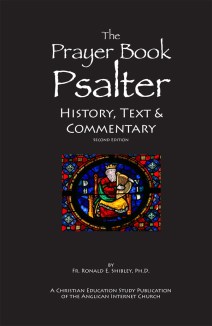 This coming week I expect to finish the first video produced on our new iMac laptop using the more advanced version of iMovie. It is a short preview with page images for the AIC Bookstore – Spring A.D. 2017 Preview. You’ll see the stylistic differences right away, with new page transitions not available in the iPad version used for all earlier videos. There will be information about all publications, including the pending revised edition of The Prayer Book Psalter. The revised version includes some design changes to type faces and content. Some of these include the first line in Latin for each Psalm and additional focus in the commentaries on how the same issues and verses are addressed in other AIC Publications, including books, videos and podcasts. The publication date depends upon completion of the proof-reading, but I hope it can be finished by early summer.
In June there will be new episodes on The Lives of the Saints – Second Series, including one of my favorite saints, Basil of Caesarea (Jun 14th). Later in the summer will be Cyril and Methodius (Jul 11th);Joseph of Arimethea (Jul 25th); and Augustine of Hippo (Aug 28th).
As always, thank you for your interest and support. The sales of our books have been very encouraging, with 100% of all royalties donated to the AIC.
May God bless you in all that you do in His Name. Glory be to God for all things! Amen!
Good Friday Podcasts
Again this year for Good Friday I’ve included the links to the AIC’s series for Good Friday, In the Cross of Christ I Glory. The program was written for use at my former parish from Noon to 3 PM on Good Friday, based on a version of the Seven Words from the Cross which was first read in 1946 A.D. The original author relied upon a homily written in 1904 A.D. To their work I added prayers and quotations from the Holy Fathers of the 4th Century and later.
The format is an opening address followed by seven sets of prayers and meditations for the seven words from the Cross and a closing address. The entire text is found on pages 75-101 of the AIC Bookstore Publication, Occasional Services for Anglican Worship, now available in paperback and Kindle editions using the links in the Virtual Bookstore section at the bottom of the home page of the AIC Web Site where you found this Blog.
- Part One: Introduction
- Part Two: First Word
- Part Three: Second Word
- Part Four: Third Word
- Part Five: Fourth Word
- Part Six: Fifth Word
- Part Seven: Sixth Word
- Part Eight: Seventh Word & Conclusion
I hope each of you was able to attend a Good Friday service in your area and will attend at your local parish on Easter Sunday.
Glory be to God for all things! Amen!
Saints 2 – Athanasius of Alexandria
 Episode Sixteen in The Lives of the Saints, Second Series, celebrating the life and remarkable contributions to the Church Universal of St. Athanasius of Alexandria, is now on line at our Web Site and through our You Tube channel. St. Athanasius is celebrated in the Western Church on May 2nd, the date of his death.
Regular readers of his blog will notice the familiar black, while and gold on blue in the accompanying 12th C. fresco from Macedonia. There’s nothing like that shade of blue in western religious art.
Athanasius is also called Athanasius the Great to distinguish him from the many Eastern saints of the same name. He’s also known as the Father of the Canon; the Father of Orthodoxy, and was recognized among the first four men named “Doctors of the Church” in the Roman Catholic tradition (with St. John Chrysostom, St. Basil of Caesarea, St. Basil the Great, and St. Gregory Nazianzen). For five decades in the middle of the 4th C. he defended Nicene Christianity against Arians and others, even at the risk of persecution and expulsion from office. Today, his accusers are long gone, most of their names forgotten, but Athanasius the Great remains among the most-revered figures in the Church in both the Eastern and Western traditions.
The episode runs just over 18 minutes and includes many other works of art viewers might not have seen before.
Watch the Video Listen to the Podcast.
As always, thanks for your interest and support of the Anglican Internet Church ministry. Glory be to God of all things! Amen!
Saints2 – John Climacus
Epi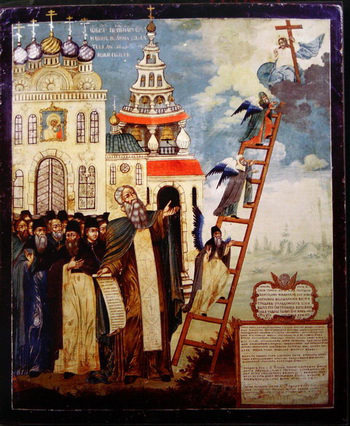 sode Fifteen in The Lives of the Saints – Second Series was uploaded to the Web last week. It celebrates the life of St. John Climacus, 7th C. abbot of St. Catherine’s Monastery in Sinai, and includes many colorful illustrations on the author of The Ladder of Divine Ascent, one of the most important books of the early church in the realm of Christian Spirituality.
Not generally well-known in the Western Church tradition, The Ladder, is quite famous in the Eastern Church. The episode includes a reading of St. John’s text on the 30th step on the ladder. The illustration is a Russian Orthodox icon of unknown date.and which is in the public domain.
Watch Episode Fifteen Listen to the Podcast
As always, thank you for your interest and support. Glory be to God for all things! Amen!
St. Thomas Aquinas & St. Gregory the Great
 I got a little behind in my production schedule and neglected to upload two new episodes in The Lives of the Saints – Second Series. The first is focused on St. Thomas Aquinas, whose Feast Day is March 8th. The episode includes five illustrations, from the 15th, 17th and 20th Centuries. St. Thomas is best known for his Summa Theologica. In the series I avoided comment on whether systematic theology has been a plus or a minus for Christianity.
The illustration at left is one of nine scenes in the Valle Romita polyptych in tempera and gold on panel by the Renaissance artist Gentile da Fabriano from the collection of the Pinacoteca di Brera, Milan, Italy, painted circa 1400 A.D. In the original, there are eight scenes in two rows surrounding a larger ninth central image of the Blessed Virgin and Holy Child. St. Thomas appears in the far right side of the top row.
Watch Episode 13 Listen to Episode 13
The second presentation celebrates the life of St. Gregory the Great,

Bishop of Rome, 590-604 A.D. I include three illustrations, one of which is a 19th C. stained glass window at Stabroek, Belgium. Gregory’s accomplishments are almost legendary in scope: ambassador to Constantinople; first monastic to be Pope; sponsor of revised liturgies, including the Presanctified Gifts still in use; founder of monastery; author of one of the earliest lists of Christian virtues in the Western Church; and advocate of the style of chanting of the Psalms at Alexandria, now known as the Gregorian chant. The illustration is the top section of the 19th C. stained glass window referenced above, showing the Holy Spirit, depicted as a dove, whispering into Gregory’s ear as the wrote his Dialogues. The image is based on the contemporary account by Deacon Peter of Rome.
Watch Episode 14 Listen to Episode 14
The next episode in the series, Episode 15, celebrating St. John Climacus, whose Feast Day is March 30th, will be uploaded next week. The newest AIC Bookstore publication, The Writing Prophets of the Old Testament is now available in both paperback and Kindle editions. Use the Virtual Bookstore links at the bottom of our Home Page at http://www.AnglicanInternetChurch.net.
As always, thank you for your intestest and support.
The Writing Prophets of the Old Testament
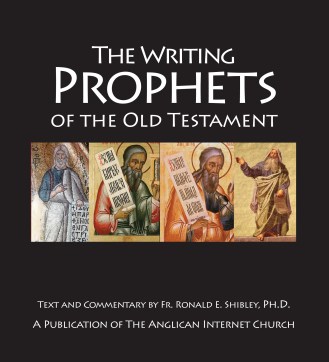 The newest AIC Bookstore Publication, The Writing Prophets of the Old Testament, is now available through our Virtual Bookstore at CreateSpace.com and, by special order, from retail bookstores. A Kindle edition will be available in the coming weeks.
The finished version includes 128 pages in soft cover, 8.5″ x 8.5″ format. There are 62 full-color illustrations from the 3rd through the 21st Centuries, including manuscripts, icons, mosaics, frescoes, stained glass windows, paintings, photographs, and engravings from the artistic and religious traditions of both the Eastern and Western Churches.
Order your copy now 100% of all book royalties are contributed to the AIC ministry.
In Part I, I discuss the traditional division of the Old Testament into the Books of Moses, or Pentateuch; the Histories; the Poetic Books; and the Prophets. In Part II are separate chapters on each of the four “major” prophets (depicted on the cover, from the left, Isaiah, Jeremiah, Ezekiel and Daniel) and on each of the twelve “minor” prophets. For each books, I offer a brief history as well as a summary of the major themes, followed by a series of selected major quotations. The Scripture text uses the New King James Version, except for select quotations from the King James Version which appear in the 1928 Book of Common Prayer. All cross references to the Book of Psalms use the prayer book text, which is based on the version used in the Great Bible of 1539 A.D.
As a bonus feature for readers unfamiliar with the Septuagint text of the Old Testament, I have included at the end of the chapter on Daniel the full text of five Deuterocanonical works. These are Susanna, the Prayer of Azariah, the Song of the Three Children, Bel and the Dragon, plus Daniel and Habakkuk in the Lion’s Den. The text is based upon either the St. Andrew’s Theological Seminary Septuagint (SAAS) or older, online translations identified in the text.
In the commentary, special text boxes demonstrate the influence of many of these sixteen prophets on the Christian worship tradition, especially as practiced by Anglicans using the 1928 Book of Common Prayer, and also their influence upon the development of Christian theology. The AIC’s Service Book edition of the prayer book is also available through CreateSpace.com;
The publication of The Writing Prophets of the Old Testament concludes our series of Christian Education Study Publications, Prayers Collections, and Other Publications which have been produced by the AIC since 2014 A.D. I hope readers will find them useful in broadening their knowledge of and understanding of traditional Christian doctrine and worship.
As always, thank you for your interest and support. May God bless you in all that you do in His Name. Glory be to God for all things! Amen!
Saints2 – Simeon of Jerusalem
 Saturday, February 18th, is the Feast Day of St. Simeon of Jerusalem. Episode Twelve in The Lives of the Saints – Second Series honors his devoted work in leading the church in the 1st Century. The illustration is a Russian Orthodox icon showing him in bishop’s garb against gold background. The location and date was not specified by the public domain source. This is a short episode, owing to the lack of material about St. Simeon.
Watch the Video Listen to the Podcast
I’ve finished the script and slides for several additional episodes in the series, including St. Thomas Aquinas (Mar 8); St. Gregory the Great (Mar 12), St. John Climacus (Mar 30), and St. Athanasius of Alexandria (May 2) and am trying to wrap up the text and slides for St. Basil of Caesarea (June 14). I’ve bought additional royalty-free photographs for several of these episodes. The ones for the St. Athanasius episode are remarkable, with the wonderful blues and whites used by the Byzantine and Greek artists in the 9th C. and later.
On the AIC Bookstore front there is excellent news this week. My proofreader has finished with The Writing Prophets of the Old Testament. Those readers who have used page designing software will be familiar with the problem of text continuation into later pages. Well, in the section on Daniel the continuation went haywire, with several pages out of correct order, making reading a challenge. Also, there was insufficient clarity on my part about exactly where the non-canonical verses fit into the chronology in the canonical version of Daniel. All these problems were fixed and the chapter on Daniel returned for further checking. I am hopeful the second proofing will be completed by early next week, making publication possible before the end of February.
I remain hopeful that the proofing of 2nd Edition of The Prayer Book Psalter: History, Text & Commentary will be finished this month as well. The proofreader is a different person than the one who is working on the Prophets book. There are many more source citations to be checked, since the book is so much longer. For the second edition I changed type faces and sizes and added cross references to other AIC Bookstore publications which have been produced since the original book was finished in 2014. The book also has a new cover using the white lettering on black background which I introduced last year for other books.
In this era when the beliefs of Christianity are under assault by other religions, politicians, social theorists, Marxists, and Nihilists, and many other “ists” I continue to work to produce books for lay people seeking to understand the teachings of traditional Christianity. I thank you for your support and interest and urge you to continue to share the blog posts with others. If you’d like to receive my Weekly Update, which goes out on Fridays (usually), please send an email request to me at frron.stjohnanglican@earthlink.net.
Glory be to God for all things! Amen!
What’s a Gesima?
The newest AIC video series, currently in production, “Gesima” Season, explains the name of the Church season that isn’t used as much as it once was. Even many Anglican jurisdictions have followed the lead of the Roman Catholic Church in eliminating the season. Those who worship using the venerable 1928 Book of Common Prayer still the pre-Lenten Sundays by their ancient names: Septuagesima Sunday, Sexagesima Sunday, and Quinquagesima Sunday. These three Sundays are intended to provide a transition between the celebratory tone of Epiphany, which honors the several “manifestations” of Jesus Christ to the world, and the penitential season of Lent, which, in the Western Church begins on Ash Wednesday. This year it falls on March 1st. I hope your local parish continues to honor the old traditions.
The series, in two episodes, will explain the history of the season and the meaning of the name, and the earliest and latest dates on which each Sunday can fall. Look for it to be completed before the end of February.
Meanwhile, I’ve been busy trying to get ahead with episodes in The Lives of the Saints – Second Series. The next episode honors St. Simeon of Jerusalem on February 18th. St Simeon is remembered for his dedicated, unwavering leadership of the See of Jerusalem for about a half century until his crucifixion around 107 A.D. during the reign of the Emperor Trajan.
The next episodes don’t appear until March, during which there are three celebrations: St. Thomas Aquinas (Mar. 8); St. Gregory the Great (Mar. 12); and ST. John Climacus (Mar. 30). I will illustrate the series with a collection of oil paintings, drawings on parchment, icons, statuary, altarpieces, and stained glass windows from both the Western Church and Eastern Church traditions.
A final note is just a reminder that the War on Christianity continues on nearly every continent. People continue to die, be burned out or otherwise driven out of their homes or churches, and, deprived of fair treatment by the courts both in Europe and the United States. Please remember these modern martyrs in your prayers.
As always, thanks for your interest and support. Glory be to God for all things! Amen!
Saints2-Cornelius the Centurion
 I have uploaded two new videos this week. The first, Episode Ten, is Part Two of the celebration of the remarkable life of St. John Chrysostom, 4th-5th C. Bishop of Antioch, then Constantinople. Episode Ten includes a reading of the Seven Nocturne Prayers which caused so much distress among the Constantinople clergy called to return for evening worship instead of sumptuous dinners! In addition to the Nocturnes are four quotations from his writings.
Watch Episode 10 Listen to Episode 10
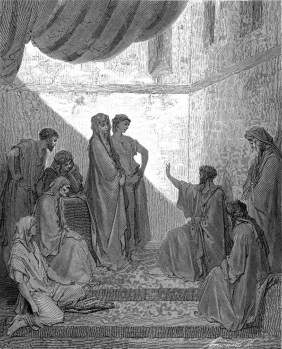
Episode Eleven celebrates the life of St. Cornelius the Centurion, whose Feast Day is Feb. 4th. Little is known about him beyond the account in Acts 10. The illustration is Cornelius in the House of St. Peter, an engraving by Gustav Dore’ from the popular 19th C. illustrated work, Dore’s English Bible, published around 1866 A.D. The work is public domain courtesy of the high quality scan provided by http://www.creationism.org.
Watch Episode 11 Listen to Episode 11
Thanks for your interest and support. The next Episode, celebrating St. Simeon of Jerusalem will appear on or before February 18th.
 Anglican Internet Church