
Today is December 18th, the first day of the seven-day cycle of The Great “O” Antiphons, which date from the Roman Catholic Church in the 12th Century.
Today’s key word is O Sapienta, Latin for wisdom. Episodes in the series run approximately 12 minutes each. Both video and podcast versions are available. Includes appropriate Scripture and music. On this episode, On Jordan’s Bank the Baptist’s Cry is sung by Mr. Jared Haselbarth. His music is also available at http://www.nabaudio.com. The song was written by Charles Coffin in 1736 A.D. and is still sung world-wide during Advent (as it was on Advent 3 at the Anglican Church I attended yesterday). This version was recorded in 2015 A.D.
 What a busy week! Phone conversations and site visits with clients, in town and out of town, and meeting with a potential singer/chanter for The War on Christianity series Episode Six and Episode Seven. Plus putting up the family Christmas tree after Church on Sunday – and then nearly all day Monday as well. But it was truly worth it on all fronts!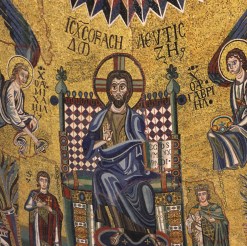
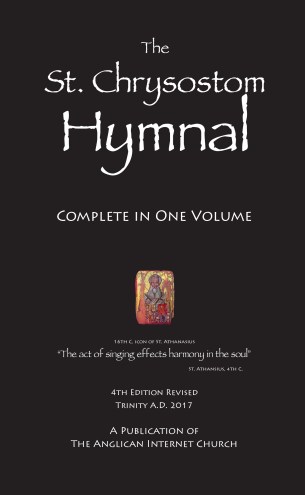 I’m very pleased to announce that initial problems with producing The St. Chrysostom Hymnal in a single volume are being resolved this month. The first effort resulted in a volume far to large to transmit to our printer unless the book was separated into two volumes. The problem was resolved using file compression technology and by making the file compatible only with the most recent versions of Adobe Acrobat.
 One viewer raised a question concerning the current episode, Episode Five, in AIC’s Christian Education video series, The War on Christianity. The question indicates the need for a clarification for those who my have not seen Episode One through Episode Four. For those who have just joined in watching series, let me repeat some of the points I made in that first episode.
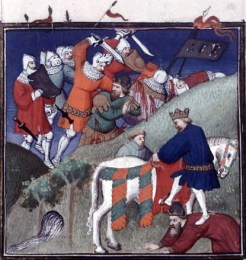 To Western minds, so filled with confidence that the whole world constantly progresses, this episode demonstrates how three pivotal events which happened up to a millennium ago had consequence that are still being felt in the second decade of the 21st C. The three events are the Battle of Manzikert in 1071 A.D.; the capture of Constantinople by misguided Crusaders, led astray by the ambitions of the Venetian Republic, in 1204 A.D.; and the Fall of Constantinople in the Spring of 1453 A.D. The illustration is a 15th C. a miniature of the Battle of Manzikert in the National Library of France.
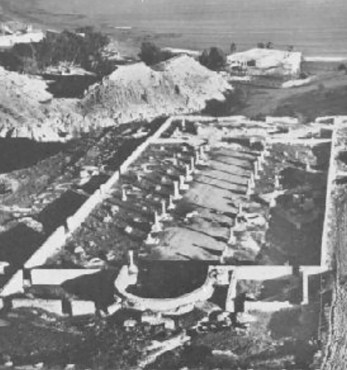

 The War on Christianity series has been reorganized, with the addition of at least two and possible three new episodes that will provide a better bridge between Episode One, which examined the nature of the threat using actual examples of violence from around the world in A.D. 2016 and 2017, and the teaching episodes intended to offer self-defense through knowledge of Church doctrine and through the actual application of traditional teachings.
 Episode Thirty-one, the last episode in the Second Series, celebrates St. Catherine of Alexandria, formerly a favorite saint but in the last 300 or so years relegated to near fictional status. Among the saints of the early 2nd millennium, largely as the result of the Crusades in the Holy Land and the Western discovery of her story, she was widely popular. Her name endures today in various colleges, islands, and mountain ranges named in her honor. A strong tradition in the Eastern Church is that her remains are interred at the Monastery of St. Catherine, Sinai, built in the 6th C. under orders by, and sponsorship of, Emperor Justinian. There are many schools named after her, including St. Catherine’s here in Richmond, Va. She is the Patron Saint of Virgins and all young women. She met her death by beheading around 305 A.D. The illustration is a detail in tempera and gilt on velum of the death of St. Catherine which I extracted from a larger work from the Menologion of Basil II, a form of service book with a Synaxarion of over 400 martyrs prepared for the incumbent Archbishop of Constantinople in the late 10th C. The original is in the Vatican Library. The illustration and the larger work from which it was extracted are included in the video.
 Anglican Internet Church