The newest AIC video series, currently in production, “Gesima” Season, explains the name of the Church season that isn’t used as much as it once was. Even many Anglican jurisdictions have followed the lead of the Roman Catholic Church in eliminating the season. Those who worship using the venerable 1928 Book of Common Prayer still the pre-Lenten Sundays by their ancient names: Septuagesima Sunday, Sexagesima Sunday, and Quinquagesima Sunday. These three Sundays are intended to provide a transition between the celebratory tone of Epiphany, which honors the several “manifestations” of Jesus Christ to the world, and the penitential season of Lent, which, in the Western Church begins on Ash Wednesday. This year it falls on March 1st. I hope your local parish continues to honor the old traditions.
The series, in two episodes, will explain the history of the season and the meaning of the name, and the earliest and latest dates on which each Sunday can fall. Look for it to be completed before the end of February.
Meanwhile, I’ve been busy trying to get ahead with episodes in The Lives of the Saints – Second Series. The next episode honors St. Simeon of Jerusalem on February 18th. St Simeon is remembered for his dedicated, unwavering leadership of the See of Jerusalem for about a half century until his crucifixion around 107 A.D. during the reign of the Emperor Trajan.
The next episodes don’t appear until March, during which there are three celebrations: St. Thomas Aquinas (Mar. 8); St. Gregory the Great (Mar. 12); and ST. John Climacus (Mar. 30). I will illustrate the series with a collection of oil paintings, drawings on parchment, icons, statuary, altarpieces, and stained glass windows from both the Western Church and Eastern Church traditions.
A final note is just a reminder that the War on Christianity continues on nearly every continent. People continue to die, be burned out or otherwise driven out of their homes or churches, and, deprived of fair treatment by the courts both in Europe and the United States. Please remember these modern martyrs in your prayers.
As always, thanks for your interest and support. Glory be to God for all things! Amen!
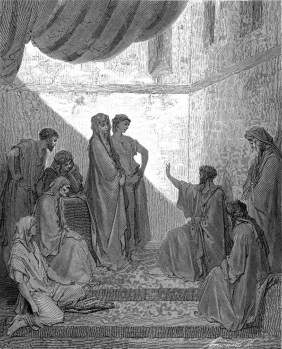 I have uploaded two new videos this week. The first, Episode Ten, is Part Two of the celebration of the remarkable life of St. John Chrysostom, 4th-5th C. Bishop of Antioch, then Constantinople. Episode Ten includes a reading of the Seven Nocturne Prayers which caused so much distress among the Constantinople clergy called to return for evening worship instead of sumptuous dinners! In addition to the Nocturnes are four quotations from his writings.
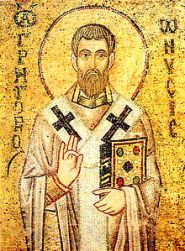
 Two new episodes in The Lives of the Saints (Second Series) were uploaded this week. Episode Nine celebrates the life and contributions to the Church Universal of St. Gregory Nazianzen, whose Feast Day is Jan. 25th. St. Gregory is also known by two other names: St. Gregory the Theologian and Gregory Nazianzus, which recognizes the name of his jurisdiction as Bishop in Asia Minor (now southeastern Turkey).
 Episode Nine celebrates the life of the AIC’s patron saint, John Chrysostom, which literally means John the Golden Mouth. He was perhaps the most gifted pulpit orator of the Church in the first 1,000 years of Christianity. He left behind an enormous legacy of homilies on Genesis and the Psalms as well as the Gospels of Matthew and Luke, all the epistles of St. Paul, and St. Luke’s Acts of the Apostles. He served the Church first at Antioch, the second See of the early Church, and later as the 12th Bishop of Constantinople, the last of the five early Sees of the Church. St. John was forced from office by Empress Eudoxia in 403 A.D. He returned briefly, owing to the strong public outcry against his expulsion, but was exiled a second and final time around 405 A.D. He died in exile in 407 A.D. HIs last words were: “Glory be to God for all things!” His remains, along with those of Gregory Nazainzen, were stolen in 1204 A.D. during the Fourth Crusade. For centuries, they remained in St. Peter’s Basilica (first the old one and then the current one). They were returned by Pope Benedict XVI in time for the Feast of St. Andrew in November 2006 A.D.

 For Christmas Eve, a modern version of the evocative traditional English style of carols and lessons can be watched using the link below. It picks up where the Great “O” Antiphons ended with a series of prayers and responses for Christmas Eve:
 One of the best programs the AIC has created is the series devoted to key theme words for each of the days from Christmas Day to Epiphany Eve. Below are the links for Dec. 25th through December 31st. Next week I will post the remaining links. The series has nothing whatsoever to do with the silly song of the same name.
 It’s that time again. Tomorrow, December 18th, marks the first of seven presentations in the 12th C. classic The Great “O” Antiphons, based upon the seven key words in the Advent hymn, O Come, O Come, Emmanuel. I updated all seven programs in A.D. 2015 using the piano version of the hymn performed by English artist Rob Stroh as the program theme. For each of the seven programs, the music solo is performed by Mr. Jared Haselbarth.
 I also invite you to watch or listen to Lessons and Carols for Christmas Eve, a virtual carol program with for Christmas Eve. It begins where the final program in the Great “O” Antiphons series ended, with the Christmas Eve Antiphons.
 This week I have uploaded two new episodes in The Lives of the Saints – Second Series. Both series are linked from the Digital Library page at the AIC’s newly-redesigned Web Site. (use the link at the bottom of the page). The music for the series was created for us by Richard Irwin at hymnswithoutwords.com.
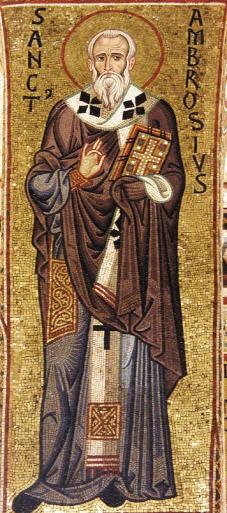 Episode 4 celebrates one of the most under-appreciated saints in the Western Church’s list of saints: Ambrose of Milan, whose Feast Day is Dec. 7th. St. Ambrose was one of the most spiritually-minded of the early leaders of the Church in the West. He was also a gifted writer of hymns. The newly-published St. Chrysostom Hymnal includes ten hymns attributed to him, including my personal favorite, Come, Holy Ghost, Who Ever One, which I read in the video with the tune Lasst uns erfreuen, best known for its use with All Creatures of Our God and King, in the background. The illustration is an 11th C. mosaic of Ambrose at the Capella Palatina, or royal palace chapel of the Norman kings of Sicily, Palermo, Sicily. I revere Ambrose for many other reasons, primarily because, of the saints recognized in the Western Church, he was the last whose theology was not significantly different from that of his contemporary bishops in Constantinople, Antioch, Jerusalem and Alexandria, the other great Sees of the early Church. He is best known to most Western Christians as the mentor of St. Augustine of Hippo, whose fame far eclipsed that of Ambrose in later years.
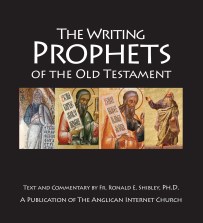 n The Writing Prophets of the Old Testament, a companion book to a new series of Bible Study videos on the Major and Minor Prophets which will start appearing via our YouTube channel around the middle of February 2017 A.D. The graphic offers a glimpse of the revised version of the proposed cover. The images on the cover are, from left to right, an 11th C. mosaic of Isaiah at Neo-Moni Monastery, Chios, Greece; 18th C. icons of Jeremiah and Ezekiel at the summer chapel, Kizhi Monastery, Karelia, Russia; and a 19th C. fresco of Daniel at the Basilica of St. Paul Outside the Walls, Rome, Italy. I have completed the text and pictures for Isaiah, Jeremiah and Ezekiel, am working on the Daniel section, and have roughed out the design, text and illustrations for the twelve Minor Prophets. There will be about 50-60 illustrations from the 11th through the 20th Century.
 The first two episodes in The Lives of the Saints – Second Series have been uploaded to our YouTube channel, with Podcast versions also available. St. Clement of Alexandria and St. John of Damascus are both celebrated on December 4th. Once again, the theme music was provided by Richard Irwin at
 Anglican Internet Church