A.D. 2026 is one of those years with a long Trinity season. There will be 24 Sundays after Trinity, followed by Sunday next before Advent on November 22nd. Since, for reasons unrecalled now, I did not post commentary on the Collect, Epistle and Gospel readings for Eighteenth Sunday after Trinity in A.D. 2025 and A.D. 2023, I take this opportunity to do so in A.D. 2026. The Collect for Eighteenth Sunday after Trinity is a modified version which Archbishop Cranmer derived from the Gelasian Sacramentary for the 1549 Book of Common Prayer, with the addition of the phrase, “the world, the flesh and the devil” which was added with the 1662 Book of Common Prayer. The Gelasian Sacramentary is named after Pope Gelasius, who ruled at Rome from 492 A.D. to 496 A.D.. The Gelasian document appeared for the first time at Paris, France, in the mid-8th C. In the English tradition the Gelasian Sacramentary was widely used in the English Church before the separation from Rome during the reign of Henry XVIII in the third decade of the 16th C. As I did in A.D. 2024, I share with viewers an image of the cover cover and first page of an edition of the Gelasian Sacramentary printed in the 8th C. It is not clear whether this is an image of the first edition of the Gelasian document. It is one of the many historic documents shared and entered into the public domain from the enormous collection found in the Yorck Project. The original of the Gelasian Sacramentary is at the Vatican Library, Rome, Italy,.
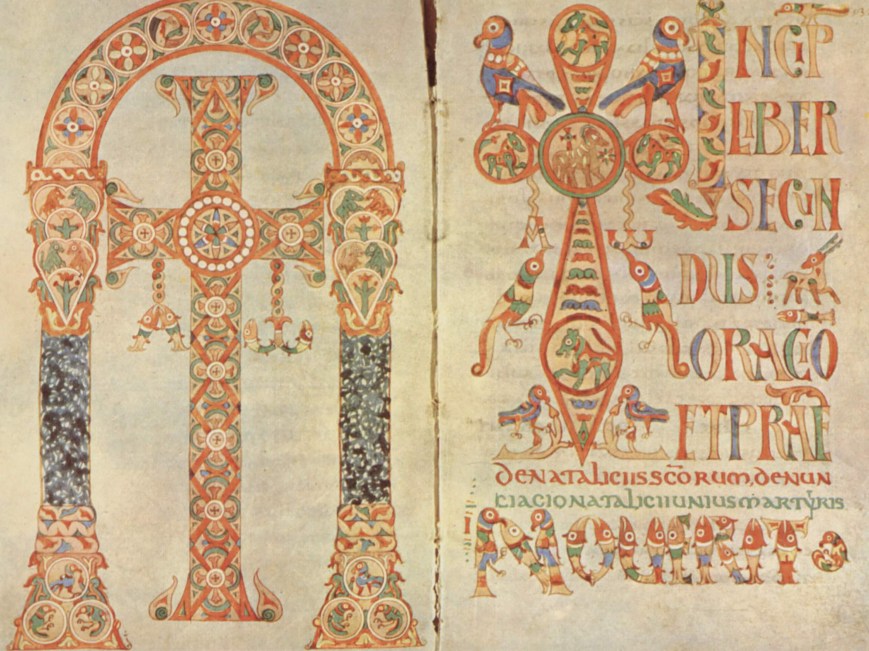
Gelasian Sacramentary, Title page (left) and 1st page (right), colors and gold on parchment, 8th C.,
The Yorck Project, commonly called 10,000 Masterworks, published in a DVD in 2002 A.D.. Public Domain.
Themes of the Collect are mankind’s long struggle against the “temptations of the world, the flesh, and the devil” and the need for humanity to “follow thee, the only God.” The phrase, “world, the flesh and devil,” was derived from the petitions for deliverance (“deceits of the world, the flesh, and the devil”) in the Litany (B.C.P. p. 54). The Epistle reading, 1 Corinthians 1:4-9, is a reminder by St. Paul to the constantly-wavering congregation he established at Corinth that faith in Jesus Christ and His teachings, was, is and remains always for mankind the only path to being “blameless in the day of our Lord Jesus Christ. The Gospel reading, Matthew 22:34-46, is St. Matthew’s account of Jesus’ lesson to the Pharisees on two questions: “which is the great commandment in the law” and the identity of Jesus Christ: “what think ye of Christ? whose son is he?” This encounter happened on the Tuesday following Palm Sunday in 30 A.D.. (Tuesday before Easter in the B.C.P.). The reading should be seen in the context that the Pharisees had calculated that there were 613 commandments in Scripture and that the authors of the Book of Common Prayer included Jesus’ answer following the Ten Commandments in the Holy Communion liturgy (B.C.P. page 69). The Collect and the two readings from Scripture are powerful reminders of the absolute need of all the faithful to rely upon the Christian truth, as opposed to the many and varied temptations offered constantly in newspapers, radio, television and the Internet to follow the fickle teachings of men (and women). I have never found, through many web searches, an illustration that is not a modern cartoon-like interpretation. If anyone knows of one, I would like to hear detailed information.
This week’s Collect, Epistle and Gospel lessons are an enduring lesson in the need for paying attention to traditional Christian teachings. This point of view seems completely alien to those who go so far as rewriting the New Testament to fit their beliefs. Take heart. This kind of variation has been with the Church Universal from the beginning. There is more on this subject in the episodes of our Christian Education Video Series, The War on Christianity, linked from the Digital Library page.
As always, thank you for your interest and support. Glory be to God for all things! Amen!

