All Saints Day & Twenty-second Sunday after Trinity, A.D. 2026

This coming Sunday, November 1st, A.D. 2026, is observed in two Church calendars, that of regular Sunday worship and that of the Holy Days, or Feast Days. In his expansive work on the 1928 Book of Common Prayer, Church historian Massey Shepherd explains that the schedule of Holy Days, created by Archbishop Cranmer for the 1549 Book of Common Prayer, honors the “feasts of our Lord and His Apostles, the Evangelists, St. Stephen, Michaelmas and All Saints,” following the precedent of the prayers and readings in the old Latin Missal in use in England at the time of the separation of the Church of England from Roman jurisdiction under the Act of Separation, 1535.

The first Holy Day on the Archbishop’s new calendar honors St. Andrew, whose Holy Day also determines the start of Advent. Advent always begins on the Sunday closest to the Feast of St. Andrew (Nov. 30). Archbishop Cranmer also made Advent season the start of each new Church Year in the new Anglican Church. That change from the Roman Catholic calendar remains in effect in the modern Church. See the final paragraph in this Blog post for more AIC resources in which St. Andrew and the three other Disciples named in the Gospel reading (Peter and Andrew, James and John) are featured.
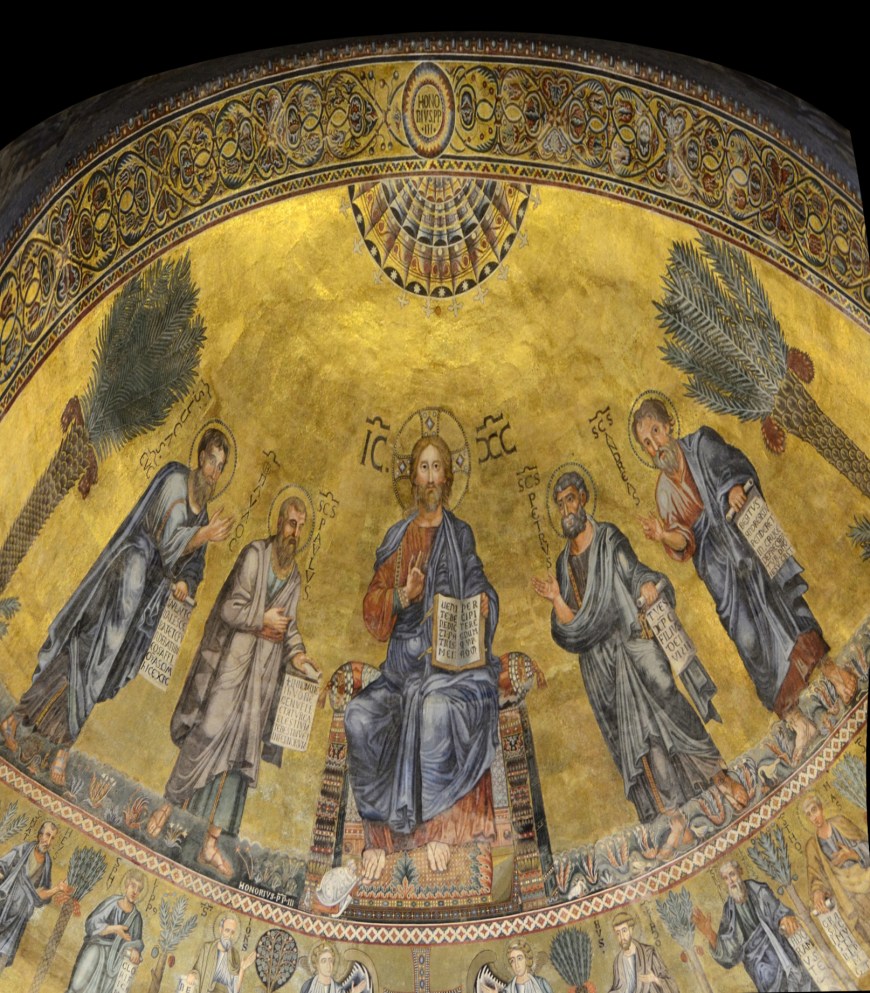
A golden mosaic depicting Christ seated in the center, surrounded by four figures, in a domed ceiling design.

Christ in Majesty with Four Apostles and Saints, Apse mosaic, Basilica of St. Paul Outside the Walls, Rome, circa 1220. Christ makes the traditional sign of blessing with His third finger touching His thumb and the other fingers curled, together symbolizing the letters ICXC. St. Peter stands at Christ’s left and St. Paul at His right. St. Andrew is the figure at the far right side (Christ’s left side). In the band of figures below Christ, partially visible in the image above, includes ten saints, six to each side of the Archangels, Gabriel and Michael, placed at the center. Perspective correction was applied to the original image. In the Eastern Church tradition the image is known as Christ Pantokator. © Jjfarq|Dreamstime.com

Archbishop Cranmer composed a new Collect for St. Andrew’s Holy Day for the 1549 Book of Common Prayer. The Archbishop’s original new Collect was revised in the 1552 Book of Common Prayer, also prepared by the Archbishop. Instead of the original collect’s reliance upon the tradition concerning St. Andrew’s death on a cross, the new collect is based upon the account in the Gospel lesson for the day (Matthew 4:18-22). Here I rely upon Shepherd’s own words (shown below at the end of this paragraph) in describing the significance of the revised Advent Collect. The strong influence upon the Archbishop of the Christian warfare imagery in the Epistle reading from St. Paul for Twenty-first Sunday after Trinity (Ephesians 6:10-20) is evident. The subject is discussed in more detail in last week’s Blog post). Massey Shepherd notes in his classic study of the Book. of Common Prayer (also referenced with a link in last week’s Blog post), the historical connection between the life and history of St. Andrew and the expansion of the Church into England . He explains that the first missionaries to England were sent from the monastery founded by Pope Gregory the Great (540 A.D.-604 A.D., Pope from 590-604 A.D.). In the Leonine Sacramentary, the earliest version of which was published in the 7th C., there were four masses honoring St. Andrew. Gregory the Great was featured in my Blog post for 9/20/2024 (Trinity 17).

Massey Shepherd on the Collect for the Feast of St. Andrew:

“The weight of evidence given here on the immediacy of the Apostle’s response (cf. “and they straightaway left their nets” in the Gospel) underscores the Advent theme — “give us grace that we may cast away the works of darkness, and put upon us the armour of light, now.

The Epistle reading is Romans 10:9-21, noting that Abp. Cranmer’s original version cited verses 8-18). Massey Shepherd’s commentary on the reading gives great importance to St. Paul’s rhetorical questions asked in verses 14 and 15. The two verses are a summary of the role of the Apostles played in spreading the Gospel to the Gentiles: “How then shall they call on Him in whom they have not believed? And how shall they believe in Him of whom they have not heard? And how shall they hear without a preacher? And how shall they preach unless they are sent?” (NKJV text).
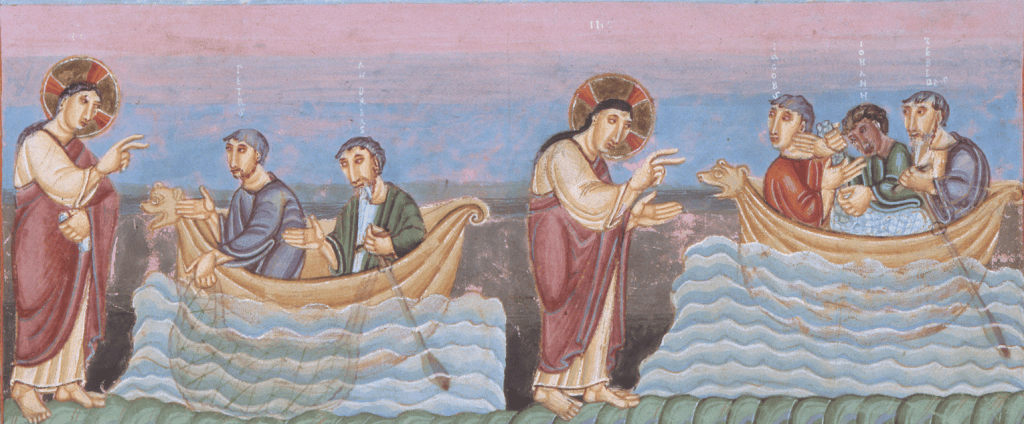
A biblical scene depicting Jesus interacting with fishermen in two boats on water, teaching and guiding them.
Calling the First Disciples, illumination in tempera and gold on parchment, Codex Aureus of Echternach, Germanisches National Museum, Hs 156142, Folio 20r, Nurnberg, Germany. The volume was produced at the Benedictine Abbey of St. Willabord, Echternach, Germany, now Luxembourg, 1030-1050 A.D.. CC-by-NC-SA 4.0. A higher quality version of this image was used in our Bible Study video on the life of St. John.

The Gospel reading (Matthew 4:18-22) is an account of the calling of the first four Apostles, which were the two pair of brothers, Peter and Andrew and James and John, the latter being the two sons of the fisherman Zebedee. In the full version of the illustration, the image above is the center of three, with the Temptations of Christ shown in the Upper Row and Driving the Money-changers from the Temple in the Bottom Row. As noted above in the commentary by Massey Shepherd, the chosen four “straightaway” left their fishing nets and entered upon their new responsibilities in service to the Lord Jesus Christ.

On this occasion celebrating four individual saints as well as the readings for one of the last Sundays in Trinitytide, there are many other AIC Resources related to the lives and works of Saints Andrew and Peter, James and John. These include material in videos, podcasts and in print in the WATCH/LISTEN/READ formats discussed on the lower half of the Home page. The Collect, Epistle and Gospel readings for Twenty-second Sunday after Trinity are discussed and illustrated in Episode Eight in the AIC Christian Education Video series, Trinitytide: The Teaching Season. The audio-only version in MP3 format is linked from the Podcast Archive page. The Gospel of St. Matthew is discussed and illustrated in Episode One through Episode Four in the AIC Bible Study video series, The New Testament: Gospels, linked from the Bible Study page. The audio-only versions in MP3 format are linked from the Podcast Archive page. The life and writings of St. Matthew are also explored and illustrated in the AIC Bookstore Publication, The Gospel of Matthew: Annotated & Illustrated, available through my Amazon Author Central page. A summary of the book is linked from the AIC Bookstore page. St. Andrew is the featured saint in Episode One, St. John in Episode Four, St. Matthew in Episode Six, and St. Peter in Episode Eleven in the AIC Christian Education video series, The Lives of the Saints, First Series, linked from the Digital Library page. This video series is focused on the lives of the eighteen saints with Holy Days in the 1928 Book of Common Prayer. The audio-only versions of each episode in MP3 format are linked from the Podcast Archive page. My Podcast Homily for Twenty-second Sunday after Trinity is linked from the Podcast Homilies page. A related Podcast Homily for Twenty-second Sunday after Trinity, based on the Psalm reading for Morning Prayer for the day, is linked from the Podcast Homilies-Morning Prayer page.

Next week, I focus on the Collect, Epistle and Gospel lessons for Twenty-third Sunday after Trinity. As always, thank you for your interest and support. Glory be to God for all things! Amen!
Twenty-first Sunday after Trinity, A.D. 2026

I last commented upon the Collect and readings for Twenty-first Sunday after Trinity in A.D. 2024. In that posting I focused a lot of attention on the importance of key words in the Collect for the day in the 1928 Book of Common Prayer. First, here’s the text only:

GRANT, we beseech thee, merciful Lord, to thy faithful people pardon and peace,
that they may be cleansed from all their sins, and serve thee with a quiet mind;
through Jesus Christ our Lord. Amen.

The Collect for Twenty-first Sunday after Trinity is another adaptation by Archbishop Cranmer for the 1549 Book of Common Prayer. It is based upon the Gelasian Sacramentary (Rome, circa 750 A.D.). In spite of its name, the Gelasian Sacramentary does have any actual connection to Pope Gelasius I, who was Bishop of Rome from 492 to 496 A.D. Its official name was Liber sacramentorum Romanae ecclesiae, literally The Book of Sacraments of the Church of Rome. In the 8th C. A.D., there were two sacramentaries in liturgies within the Western Church: the Gelasian, used by the Church at Rome, and another, known as the Gallican Rite, widely used in the northern half of Italy and in parts of the rest of Western Europe. The Gelasian rite was replaced across the Holy Roman Empire during the reign of Holy Roman Emperor Charlemagne, the first Holy Roman Emperor since the sacking of Rome in the 5th C. Viewers of this blog will already know that the most important contributor to the worship practices of the Western Church at the time of Charlemagne and his successors was the Blessed Alcuin of York. Alcuin was tutor to the household of the Frankish monarch who adopted the name Charlemagne. Alcuin’s most famous prayer, commonly known as the Collect for Purity, follows the Lord’s Prayer in Anglican Holy Communion in the 1928 Book of Common Prayer (American edition). For more about Alcuin’s interesting history and an image of him, see my Blog post for March 16, A.D. 2024 and an earlier Blog post about Alcuin and his background in northern England on March 9, A.D. 2024

Back to the Collect’s key phrases mentioned above. The Collect for Twenty-first Sunday after Trinity includes a two iconic phrases written by Archbishop Cranmer, “pardon and peace” and “a quiet mind.” These changes are important for Anglican worship in that the word “pardon” was substituted by Abp. Cranmer in the 1549 Book of Common Prayer for the medieval Latin word “indulgence.” Archbishop Cranmer considered “indulgence” as too closely allied to the Roman Catholic practice of selling indulgences, one of the contributing factors which precipitated the Protestant Reformation and the separation of the Church in England from the Roman Church. The word “quiet” in Archbishop Cranmer’s phrase “a quiet mind” replaced the Latin word “secure.” In Cranmer’s thinking, and likely his spiritual advisor Alcuin’s, “a quiet mind” implies unshakeable faith in the face of adversity. Archbishop Cranmer’s Collect for Twenty-first Sunday after Trinity, as amended into its present form, is often used by non-ordained Church leadership as a closing prayer in the Anglican Morning Prayer. The prayer offers the hope of forgiveness without the official sanction of the rite of Absolution, which only an ordained clergyman can dispense. The Collect for Twenty-first Sunday after Trinity is the last of sixteen from the Gelasian Sacramentary in Trinity season (noting that one was changed by Archbishop Cranmer in the 1549 B.C.P., five changed in the 1662 edition, and one changed for the American prayer book in 1789.

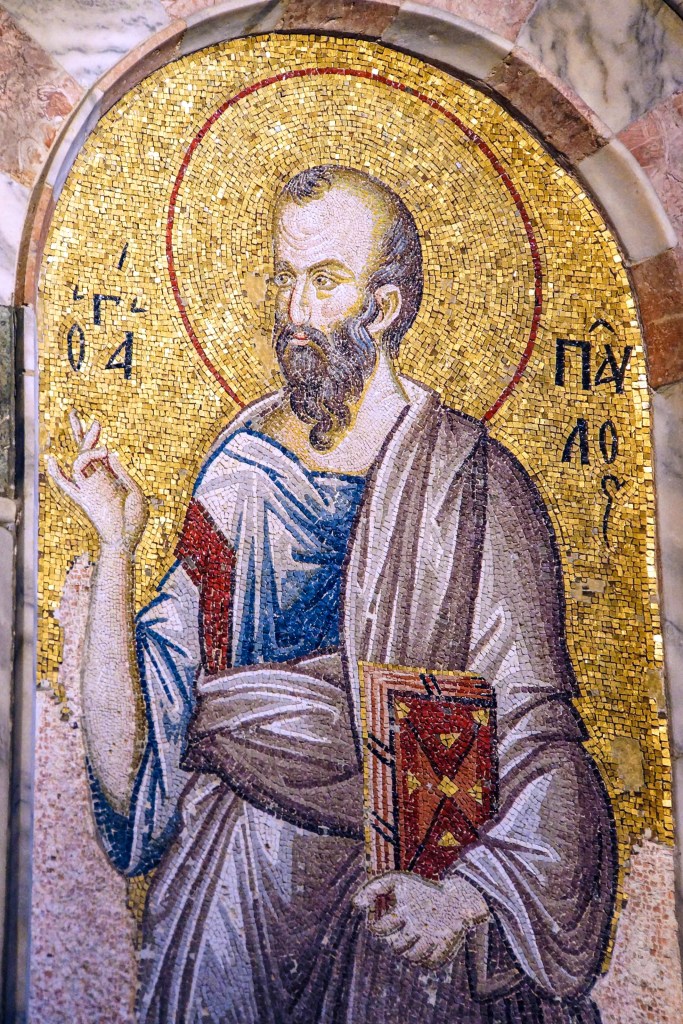
Mosaic of a figure with a beard and halo, wearing a robe, gesturing with one hand while holding a book in the other.
St. Paul, mosaic, Inner Narthex, south wall to right of entry arch into the Naos, Chora Church (Church of the Holy Saviour in Chora), 1315-1321 A.D. under administration of Isaac Comnenus, Constantinople/Istanbul. The finger position of the thumb against the tip of the third finger forming the letter “C:” is the Byzantine sign of a blessing offered by a priest. Together the position, with raised first and fourth fingers, form the letters ICXC, which stands for Jesus Christ. In the Byzantine tradition, carried into the modern world by the Orthodox Church, many icons of Christ include the legend ICXC NIKA, which means Jesus Christ, Victor (over death). © Steve Estvank|Dreamstime.com.

The Epistle reading, Ephesians 6:10-20, is St. Paul’s classic explanation of the Christian faith expressed in distinctly martial terms and other meaningful phrases, including: “the whole armor of God,” “spiritual wickedness in high places,” “principalities….powers…rulers of darkness,” “breastplate of righteousness,” “shield of faith,” “helmet of salvation,” “sword of the Spirit.” I explore this kind of imagery in the AIC Bookstore Publication, Christian Spirituality: an Anglican Perspective.” St. Paul’s reference to “against principalities, against powers…spiritual wickedness in heavenly places” is the Scriptural source of the Christian understanding that there are nine ranks, or orders, of angels. In another AIC Bookstore Publication, Layman’s Lexicon, I explore Angels/Archangels on pages 10-13. Both volumes are available exclusively through my Amazon Author Central page. A summary of both books is available on the AIC Bookstore page. Layman’s Lexicon was the featured book in my Blog post for October 18, A.D. 2025. In other AIC resources, the traditional understanding of angels is discussed, with fourteen illustrations of angels, in Episode Nine (Ninth Day of Christmas, Jan. 2nd) of the AIC Christian Education Video series, The Twelve Days of Christmas. All twelve episodes are linked from the Digital Library page and with their audio-only soundtracks in MP3 format linked from the Podcast Archive page.

The Gospel reading, John 4:46-54, is John the Evangelist’s unique account of Jesus’ Healing of the Nobleman’s Son, described as the “second sign Jesus did when he had come out of Judea into Galilee.” The “signs” to which St. John are the Water into Wine account at the Wedding at Cana (John 2:1-12); Healing at the Pool of Bethesda (John 5:1-15); Feeding the 5,000 (John 6:5-14): Walking of the Sea of Galilee (John 6:16-21); Healing the Man Born Blind (John 9:1-7) and the Raising of Lazarus (John 11:1-45). The healing is not often depicted in Christian art. This is probably because the healing was done at a distance and not with Jesus at the man’s side. For one of the few such images, a mid-19th C. engraving from the Bowyer Bible, see my Blog Post for October 19, A.D. 2024.

There are other resources in several media formats on this site related to Twenty-first Sunday after Trinity. The Collect, Epistle and Gospel readings for Twenty-first Sunday after Trinity are discussed and illustrated in Episode Eight in our Seasonal Video series, Trinitytide: the Teaching Season. An audio-only version in MP3 format is available on the Podcast Archive page. My Podcast Homily for Twenty-first Sunday after Trinity is linked from the Podcast Homilies page. A related Podcast Homily, based upon the Psalm reading for Twenty-first Sunday after Trinity is linked from the Podcast Homilies-Morning Prayer page. Angels are the subject of another AIC Bookstore Publication, Angels: In Scripture, Art & Christian Tradition, with 152 illustrations from the 3rd through the 20th C., with the cover illustration being one of the mosaics of angels, presented in five tiers, at the Baptistery of Saint John, Florence, Italy. Like the earlier reference to Layman’s Lexicon, a summary of the volume is linked from the AIC Bookstore page. The volume was the featured book in my Blog post for November 11, A.D. 2025.

As always, thank you for your interest and support. In our immediacy-driven world of the Twenty-first Century in which anti-Christian sentiment is widespread in the media and in political discourse. Your viewership and support for the multimedia resources offered through this site is even more important and is greatly appreciated. On this Twenty-first Sunday after Trinity, A.D. 2026, I hope and pray that these resources, which now include nearly 3,000 historic images, help you maintain “a quiet mind” and that you remain steadfast in your beliefs. Glory be to God for all things! Amen!
Twentieth Sunday after Trinity, A.D. 2026

For the Twentieth Sunday after Trinity in A.D. 2026 the worship calendar shifts from the weekly schedule in the 1928 Book of Common Prayer to the appointed readings for a Saints Day, or Holy Day, with the full list found on B.C.P. pages 226-259. The readings for Twentieth Sunday after Trinity honor the Feast Day of “thy servant St. Luke the Physician,” which is always celebrated on October 18th. The Feast can be moved backward or forward to the nearest Sunday at the discretion of the local minister. St. Luke is the subject of Episode Fifteen in the AIC Christian Education Video series, The Lives of the Saints – First Series, the 1928 B.C.P. Saints. The audio-only version in MP3 format is linked from the Podcast Archives page.

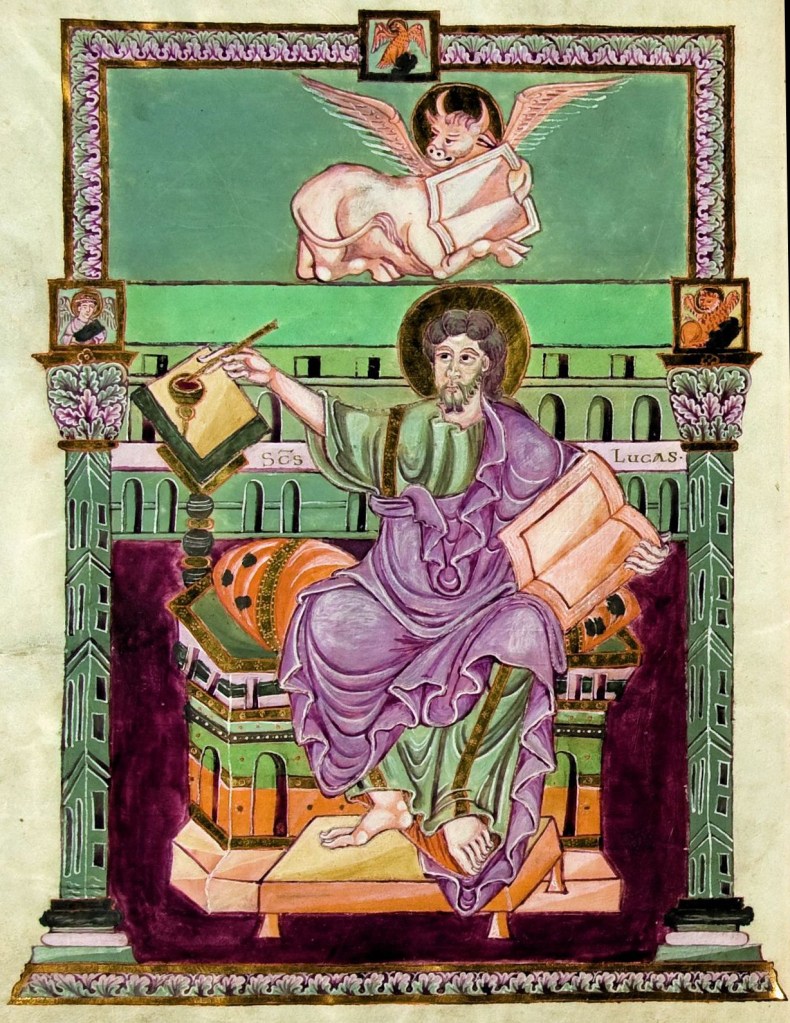
An illuminated manuscript page featuring Saint Luke, depicted seated and holding a book, wearing a purple robe, with his feet bare. Above him is an angel and a winged calf. The background includes ornate architectural elements.
Luke Writing His Gospel, illumination in colors and gold on parchment, Codex Wittekindeus, circa 970-980, Fulda Abbey, Fulda, Germany. Ms. Theo. Lat.fol1, Folio 67v, Staatsbibliothek zu Berlin/Preussische Kulturbesitz, Berlin, Germany. The style is typical of the school of illuminations during and after the reign of Holy Roman Emperor Charlemagne, who was crowned as Holy Roman Emperor at Rome on Christmas Day, 800 A.D.. Even for that school of illumination the use of vivid green is unusual. The image of an ox is the traditional symbol for St. Luke, based on the vision of the four living creatures in Ezekiel. 1:14.

More details about each of the eighteen canonical saints honored on sixteen feast days in the B.C.P. is discussed and illustrated in the AIC Christian Education Video series, The Lives of the Saints, linked from the Digital Library page. The episode focused on St. Luke, with 322 slides, is found in Episode Fifteen. Audio-only versions in MP3 format are linked from the Podcast Archive page. A second series, focused on thirty-five non-1928 B.C.P. saints in both the Western and Eastern Churches, is linked from the Digital Library and Podcast Archive pages.

Collect for the Feast Day of St. Luke is original to the American 1928 Book of Common Prayer. Ir was written by the Rev. Dr. Charles Morris Addison (1846-1947), a member of the Revision Committee which prepared the 1928 B.C.P. It replaced an original composition from the 1549 Book of Common Prayer written by Archbishop Thomas Cranmer. Church historian Massey Shepherd notes that where Abp. Cranmer’s original collect was focused on the effects of Christian doctrine on the soul, the Rev. Dr. Addison added the phrase “power and love” referring to Christian ministry as extending not only to the well-being of the body but also the soul. For more commentary on the readings for the Feast Day, or Holy Day, of St. Luke, and any Sunday or Feast Day in the B.C.P., see Shepherd’s landmark volume, The Oxford American Prayer Book Commentary, available online in pdf format. The Rev. Addison was also coauthor, with John Wallace Suter, of A Book of Offices and Prayers for Priest and People (1914) and, with Charles Morris Addison, John Wallace Suter, Wallace Suter and Charles Morris Addi, The People’s Book of Worship: a Study of the Book of Common Prayer (1919); and two books on mysticism (referring specifically to mankind’s search for the presence of God) originally published in 1918 and again in 1923.

Since there are no epistles credited to St. Luke, the authors of the 1928 B.C.P. chose a selection from the canonical epistles, 2 Timothy 4:5-15. St. Paul wrote in verse 11 that, when this letter was written, many others had fallen away and that “only Luke is with me.” St. Paul’s epistle refers frequently and vividly to the suffering of Christ’s ministers as they spread the word of the Gospel from the Holy Land, across Asia Minor and farther west to Rome. In the late 1st and early 2nd C., Church historian Hippolytus of Rome, a disciple of St. John, created a list of the Seventy. His list included Mark, Luke, Stephen the Protomartyr, Polycarp of Smyrna (one of the earliest martyrs, Philemon and Irenaeus of Lyon.. The Eastern Church produced a full list of the Seventy, including Barnabus and Titus, all of whom are considered as saints. Their Feast Day is January 4th. There is no comparable Feast Day/Holy Day in the Western Church tradition. The reading from 2 Timothy includes a unique reference to the Christian blessing, “Peace be to this house,” (verse 5). Christ directed the Seventy to declare these words to every household which received them.

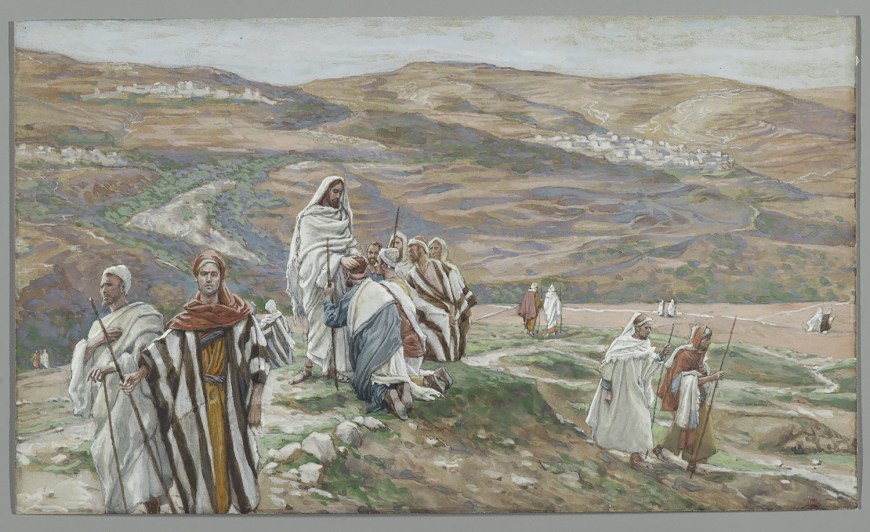
A group of people dressed in historical garments on a hillside, with a vast landscape of rolling hills and a distant village in the background.
He Sent Them Out Two by Two, opaque watercolor over graphite on gray wove paper, James Tissot, 1886-1894, Brooklyn Museum, Brooklyn, NY. Public domain.

The Gospel reading, Luke 10:1-7a, is St. Luke’s account of the calling of the Seventy, who are sent “two by two.” They were to go forth in advance of Jesus’ intended visits “into every city and place, whither he himself would come.” (verse 1). I used the above watercolor of the event painted by James Tissot on the opening page of Chapter 10 in the AIC Bookstore Publication, The Gospel of Luke: Annotated & Illustrated. The illustration of St. Luke at the top of this page also appears in Chapter 10 as Illustration 15. The book is available exclusively through my Amazon Author Central page. St. Luke’s account offers a unique glimpse into the manner in which the Gospel was spread, including the difficulties faced by the Apostles. No salaries or other compensation are paid in the operation of this site. All royalties from the sale of AIC Bookstore Publications are donated to the AIC ministry, an IRS recognized 501(c)(3) charitable organization.

As always, thank you for your interest and support of this online ministry.

Nineteenth Sunday after Trinity, A.D. 2026

For the Nineteenth Sunday after Trinity Archbishop Cranmer adapted a collect from the Gelasian Sacramentary, a document much favored in the England in the years before the separation of the English Church from Rome. The Archbishop’s adaptation was altered for the 1662 B.C.P. by the addition of the reference to the Holy Spirit. The collect addresses clearly understandings that are under attack in the 21st C.: God the Father as mankind’s ultimate protector and His Holy Spirit as His agent in His Creation (vs. the concept that mankind can save itself through self-awareness and good works).

O GOD, forasmuch as without thee we are not able to please thee; mercifully grant that thy Holy Spirit may in all things direct and rule our hearts; through Jesus Christ our Lord. Amen.

The Epistle reading, Ephesians 4:17-32, is one of the longest pericopes, or quotations from Scripture used in Christian liturgies, in the 1928 Book of Common Prayer. Trinity is, as I call it, The Teaching Season, so there should be no surprise that in these verses St. Paul continues his teachings of the subject of what is now known as the Christian Virtues. In the 6th, 7th and 8th C. these concepts were more fully developed by saints and theologians in both the Eastern and Western Church traditions. St. Paul refers to what modern writers refer to as “passions” or “lusts.” In his writings, mostly from the period of his confinement at Rome before his martyrdom, St. Paul widens the definition into more than sexual passions into the subjects of excessive desire for material things, greed and corrupt language. The closing verse refers to forgiveness, urging Christians to forgive others as God, through Christ, forgives the shortcomings of mankind. For more on the concept of the Christian virtues, you can read the Virtue(s) entry in the AIC Bookstore Publication, Layman’s Lexicon, available through my Amazon Author Central page.

A detailed mosaic depicting a biblical scene with figures, including two central characters, a seated woman, and several other figures around them, set against a textured background.
Christ Healing the Paralytic Man at Capernaum, Byzantine mosaic, early 14th C., east wall, far south end, Outer Narthex, Chora Church, Constantinople/Istanbul. © Zzvet/Dreamstime.com.

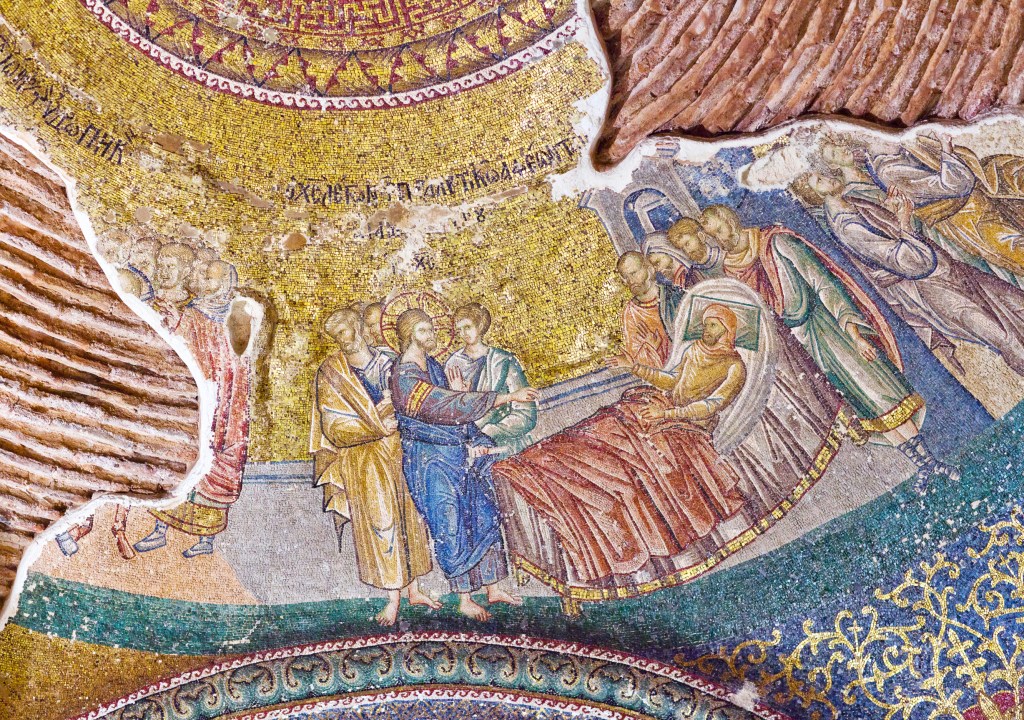
The Gospel reading, Matthew 9:1-8, an account of the healing of a paralytic man in the region of Capernaum, on the western shore of the Sea of Galilee late in 27 A.D. near the start of Jesus’ earthly ministry. The most interesting aspect of the account is Jesus’ statement that he man’s healing at His hand was, in part, the result of the faith of the man’s friends. As I noted in Episode Seven in our Bible Study Video series, Trinitytide: The Teaching Season, Jesus follows the healing with three demonstrations of His divinity (knowing the thoughts of men in verse 4; the power given Him by God the Father to forgive sins in verse 4b; and the healing by His word only in verse 6). The audio-only version is linked from the Podcast Archive page. I discussed the Collect, Epistle and Gospel readings, with two illustrations, in my Blog post for 10/4/24, which is also linked from the Archives page in the righthand column.

As always, thank you for your interest and support. Glory be to God for all things! Amen!