Sunday next before Advent, A.D. 2026

The celebration of Sunday next before Advent marks the end of the long season of Trinitytide for A.D. 2026. The occasion is traditionally called “Stir-up Sunday,” owing to the opening words of the Collect for the Day. I commented upon the Collect, Epistle and Gospel readings for Sunday next before Advent in my Blog post for November 21, A.D. 2024. The post included a 4th Qtr., 19th C. watercolor by James Tissot, using both a full size version and a detail. Tissot’s collection of 350 images was purchased by public subscription in the early 1900s by the Brooklyn Museum, Brooklyn, NY. The museum made them available online in the public domain. Many of them have appeared in one or more of the AIC Bookstore’s illuminated and illustrated volumes one the four Gospels.

The Collect for Sunday next before Advent was derived by Archbishop Cranmer from the Gregorian Sacramentary (10th C.). Church historian Massey Shepherd notes that the first words, “Stir up,” come from the Latin excita. He further explains that in the English Book of Common Prayer and the first American version in 1789, the day was labelled ”Twenty-fifth Sunday after Trinity” and, further, that the name was changed to its present form, based on the usage in the Sarum Missal, in the American 1892 Book of Common Prayer. One other notable observation by Shepherd is that this asked for “stirring up” refers both to applications of God’s power and of man’s will.

STIR up, we beseech thee, O Lord, the wills of thy faithful people; that they, plenteously bringing forth the fruit of good works, may by thee be plenteously rewarded, through Jesus Christ our Lord. Amen.
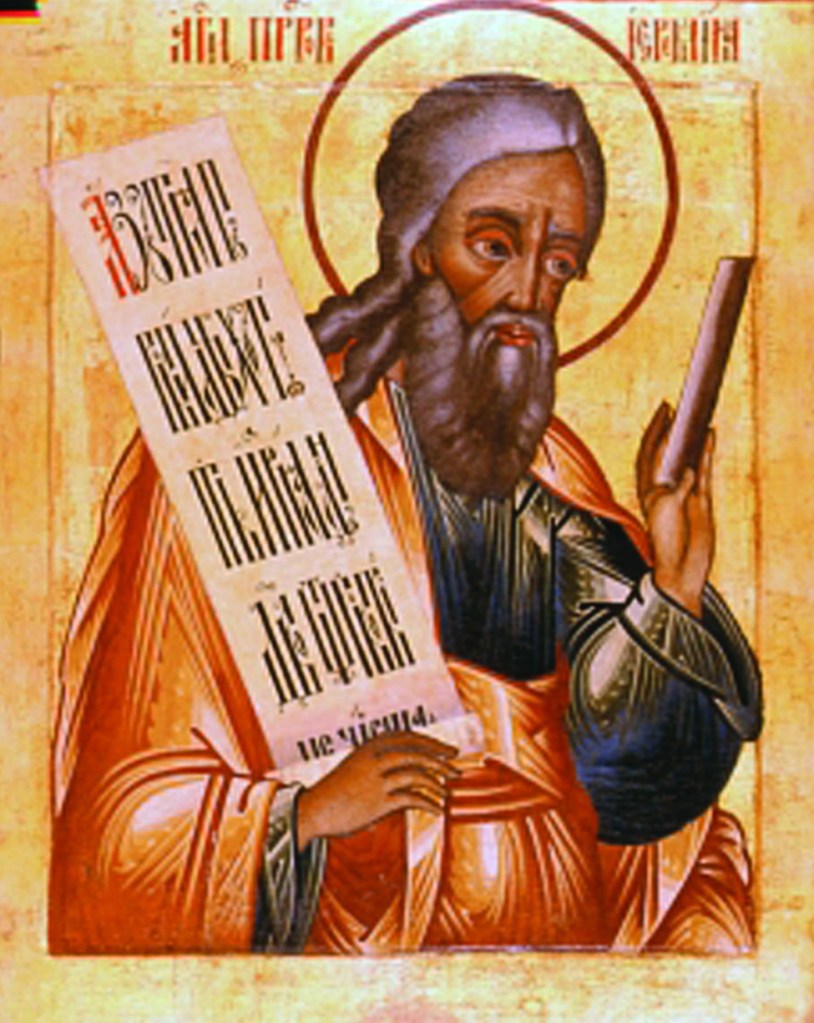
Orthodox Christian icon of the prophet Isaiah holding a scroll and staff
Jeremiah, Russian Orthodox icon on wood panel, early 18th C., iconostasis, top row of four, Church of the Transfiguration, Kizhi Monastery, Karelia region, Russia. Public Domain.

The “For the Epistle” reading, Jeremiah 23:5-8, includes Jeremiah’s messianic prophecy of the coming in the line of David of “a righteous Branch” whose name “shall be called THE LORD OF OUR RIGHTEOUSNESS” (verse 6) and ends with reference to a return of the Israelites to their “own land” (verse 8). The title “for the Epistle” is used on the rare occasions when the first Scripture reading is from an Old Testament book or from The Acts of the Apostles and not from one of the canonical epistles of Paul, Peter, John and James in the New Testament. Other such occasions with a “For the Epistle” reading are Ash Wednesday, Monday and Tuesday before Easter, Monday and Tuesday in Easter Week, Whitsunday, Monday and Tuesday in Whitsun Week, and Trinity Sunday (when the reading is from Revelation, one of the few liturgical use of Revelation in Holy Communion.
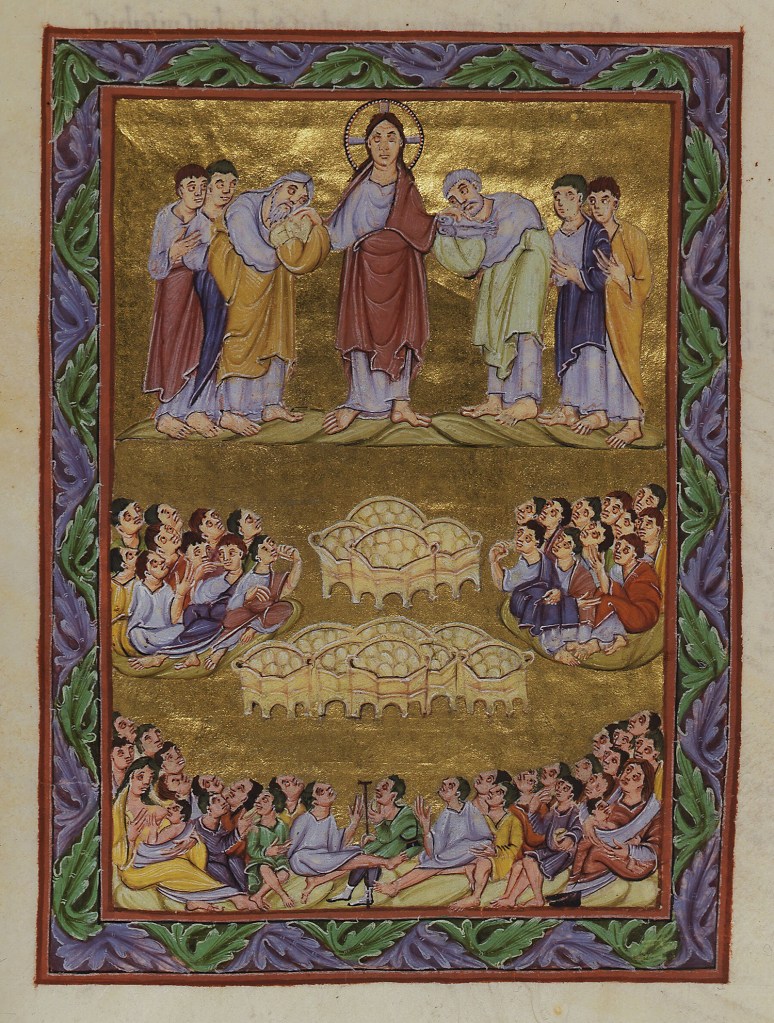
Medieval illuminated manuscript depicting Christ surrounded by disciples above groups of seated people and empty banquet tables, framed by ornate foliage.
Feeding the 5,000, illumination in tempera and gold on parchment, Gospels of Otto III, circa 998 A.D., produced in the Scriptorium, Reichenau Monastery, Reichenau, Germany, circa 998 A.D., Bayerische Staatsbibliothek, Munich, Germany, Clm 4453-Image 72. CC-by-NC-SA 4.0. This and nearly three dozen other scenes was produced under the supervision of the Monk Liuthar.

The Gospel lesson, John 6:5-14, records the miraculous Feeding of the 5,000. On the Fourth Sunday after Trinity the same Chapter of the Gospel of John is read but with verses 1 through 4 added. The illustration used above appears in association with the account in Luke 8:10-17. The Scriptural account of the Feeding of the 5,000, also known as the Miracle of the Loaves and Fishes, is told in all three Synoptic Gospels (Matthew 14:13-21; Mark 6:30-44; Luke 8:10-17). In St. John’s Gospel, the Feeding of the 5,000 is treated as the fourth of the seven “signs” of Jesus’ divinity (from the Greek semeion, translated as “miracle” in the King James Version). A special text box, The Seven ‘Signs’ in the Gospel of John” is found on page 25 in the AIC Bookstore Publication, The Gospel of John: Annotated & Illustrated. Church historian Massey Shepherd records the theory that this lesson from the Gospel of John may have been chosen because of the reference to St. Andrew, whose Holy Day/Feast Day is Nov. 30. The topic of “signs” is discussed and illustrated in Episode Thirty-six, Episode Thirty-seven, Episode Thirty-eight and Episode Thirty-nine in the AIC Bible Study Video series, The New Testament: Gospels, linked from the Bible Study page. The audio-only versions of all four episodes in MP3 format are linked from the Podcast Archive page.
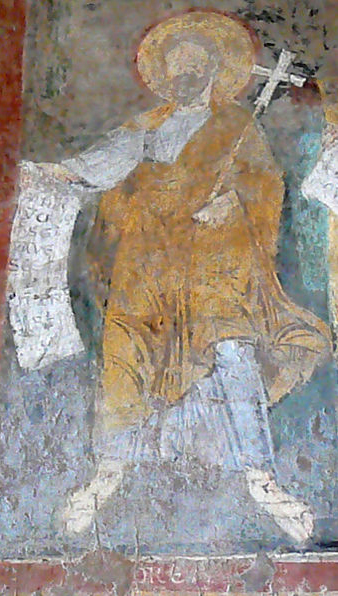
Faded religious fresco depicting a haloed saint in an ochre robe holding a cross and scroll.
St. Andrew, apse mosaic, 5th C., Basilica of St. Paul Outside the Walls, Rome, Italy. Public Domain.

Episode Thirty-nine also includes discussion of the only instance in which St. Andrew is quoted in the Gospels. In John 6:9, John quotes St. Andrew directly: “There is a lad here who has five barley loaves and two small fish, but what are they among so many.” The audio only version in MP3 format is linked from the Podcast Archive page. St. Andrew with his brother Peter and another two brothers, James and John, were the first four called into the ministry of Jesus Christ. The calling of Peter and Andrew is celebrated on Nov. 30, the Feast of St. Andrew, based on the account in Matthew 4:18-22. St. Andrew is celebrated in Episode One, St. Peter in Episode Eleven, St. John in Episode Four and St. James in Episode Twelve in the AIC Christian Education Video series, The Lives of the Saints: First Series. The video series honors the eighteen saints with Holy Days/Feast Days in the 1928 Book of Common Prayer. The audio-only versions of all four episodes in MP3 format are linked from the Podcast Archive page.

Other AIC Resources on topics in this post and not mentioned above: The readings for Sunday Next Before Advent are discussed and illustrated in Episode Nine in the AIC Christian Education Video series, Trinitytide: The Teaching Season, linked from the Digital Library page. The audio-only version in MP3 format is linked from the Podcast Archive page. The image above from the Gospels of Otto III is Illustration No. 63 in the AIC Bookstore Publication, The Gospel of Luke: Annotated & Illustrated. Like all the AIC Bookstore Publications, both the volume on the Gospel of Luke and the volume on the Gospel of John, are available exclusively through my Amazon Author Central page. The first full sentence in the “For the Epistle” reading from the Prophet Jeremiah is the Third Chapter (referring to the third of five Scripture verses read in each hour) in the Third Hour office (for 9 A.M.) in Hear Us, O Lord: Daily Prayers for the Laity. My Podcast Homily for Sunday Next Before Advent is linked from the Podcast Archive page. Another Podcast Homily, this one based upon the Psalm reading in Morning Prayer, is linked from the Podcast Homilies-Morning Prayer page. Hear Us, O Lord, like the AIC Bookstore Publications mentioned above is available exclusively through my Amazon Author Central page. F.Y.I.: The use of Amazon as the vendor keeps down our costs and tax-reporting. All royalties from the sale of AIC Bookstore Publications are donated to the AIC as they received monthly.

Next unday, Nov. 29th, the First Sunday in Advent, will mark the start of a new Church Year, according to the calendar established by Archbishop Cranmer in 1549. Since I have not recently offered commentary and images on the Collect, Epistle and Gospels readings for the four Sundays in Advent, I will do so this year on 11/29, 12/6, 12/13 and 12/20. The post for 11/29 will also include cross-references to the Holy Day/Feast Day of St. Andrew, 11/30. Since the 1549 Book of Common Prayer, the start of Advent is always the Sunday closest to Nov. 30th. My Blog post for 11/29 will include references to AIC resources related to the celebration of St. Andrew’s Holy Day, 11/30.

As always, thank you for your interest and support. Glory be to God for all things! Amen!
Twenty-fourth Sunday after Trinity, A.D. 2026

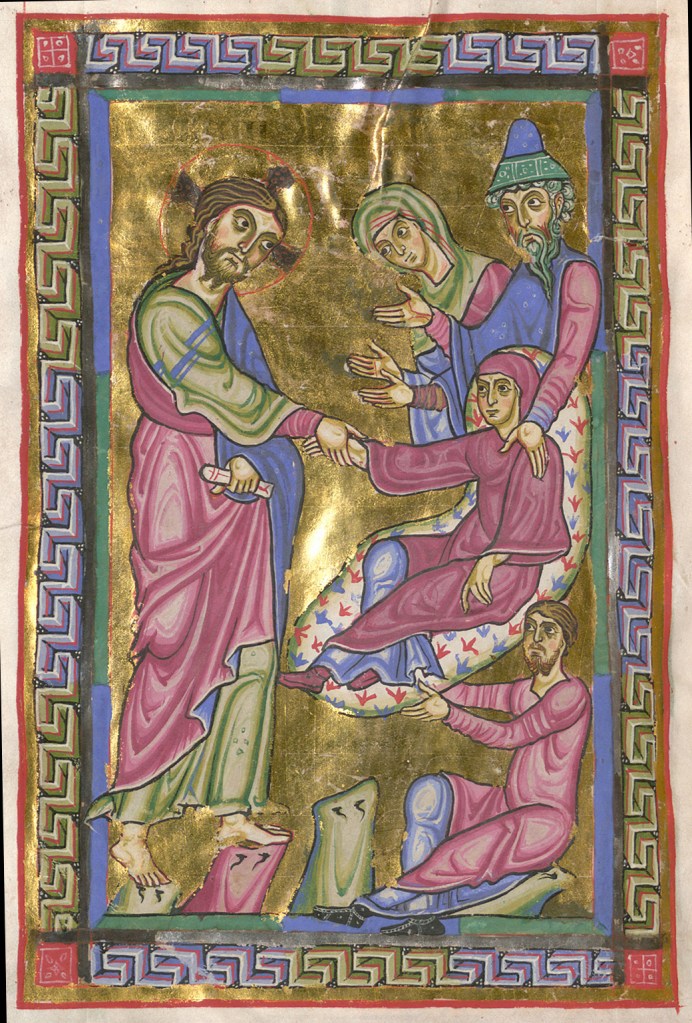
Twenty-fourth Sunday after Trinity, observed on 11/15 in A.D. 2026, is the last numbered Sunday after Trinity in A.D. 2026. In my earlier Blog post for Trinity 24 (11/24/24), I illustrated the Gospel reading with a watercolor by James Tissot, from his collection of images of scenes in the life of Christ now at the Brooklyn Museum. For A.D. 2026, I offer below a much earlier illumination from a lesser-known volume which was produced in the 2nd Qtr, 12th C. The design, workmanship and range of colors is typical of the illuminations produced during the reign of the Ottonian emperors who were heirs to the crown of Charlemagne, the first Holy Roman Emperor in Western Europe since the sacking of Rome in 476 A.D. Charlemagne was crowned at Rome on Christmas Day, 800 A.D., by Pope Leo III. Images of, and information about, Charlemagne and his religious advisor, the Blessed Alcuin of York, are found in my Blog post for 3/24/24 A.D.

Medieval illuminated manuscript depicting Christ healing several people, surrounded by a colorful geometric border and gold background.
Raising the Daughter of Jairus, illumination in tempera and gold on parchment, Pericope Book of St. Erentrud at Salzburg, circa 1140 A.D., Clm 15903. Image 15b, Bayerische Staatsbibliothek, Munich, Germany. CC-by NC-SA 4.0

The Collect for Twenty-fourth Sunday after Trinity is an original written by Archbishop Cranmer for the 1549 Book of Common Prayer. It is based on a selection of Morning and Evening prayers found in the Leonine and Gregorian Sacramentaries, two of the three primary sacramentaries of the Roman Catholic tradition (the third being the Gelasian). As noted in several earlier posts, neither collection has a direct connection with the two famous Roman Catholic popes, with dates of their rule: Leo the Great (440-461) and Gregory the Great (590-604). These two sacramentaries do reflect the teachings of one or both men, especially the “bountiful” goodness of the Lord God and the frailty of mankind, His creation.

LORD, we beseech thee, absolve thy people from their offences;
that through thy bountiful goodness we may all be delivered from the bands of those sins,
which by our frailty we have committed. Grant this O heavenly Father,
for the sake of Jesus Christ, our blessed Lord and Saviour. Amen.

The Epistle reading, Colossians 1:3-12, is another Pauline composition addressed to one of the churches in Asia Minor. The congregation was in the earthquake-prone part of Asia Minor, the Phrygia region of Turkey, which lies a few hundred miles southeast of Ephesus. The closest companion church was at Laodicea, one of seven churches named by St. John in Revelation. There are no remains of a church at Colossae nor is there a record of any excavation of such a church in that region. Historical evidence suggests that St. Paul never actually visited Colossae. St. Paul refers in his epistle to “Epaphras,” who is thought to have been the founder of that same new Christian community in Asia Minor. In his epistle to the Colossians, St. Paul used words and phrases representative of his evangelical teachings, including “spiritual understanding” and “patience and long-suffering with joyfulness” (verse 11); a reference to giving thanks “unto the Father” and, famously, the offer to be “partakers of the inheritance of the saints in light” (both in verse 12).

The Gospel reading, Matthew 9:18-26, is the evangelist’s account of two healings in the region of Capernaum. The first is of the woman “with an issue of blood twelve years” (verse 20) and, second, of the 12-year-old daughter of an unnamed ruler, who is identified as Jairus in St. Mark’s account (Mark 5:21-24; 35-43). The story is also told by St. Luke (Luke 8:40-56). Jesus comforted Jairus with the assurance that the girl “is not dead but sleeping” (Matthew 9:24; Mark 5:39; Luke 8:52). The story is not told by St. John in his Gospel, although he was one of those allowed to enter the house of Jairus. In his commentary on this reading, Church historian Massey Shepherd observes that “the woman represents the sinner who through faith in Him finds wholeness given to both body and soul. The close relation between physical healing and spiritual restoration is characteristic of the gospel tradition in miracles of this sort.”

Other AIC Resources in print, audio or video formats referring to the Collect and/or the readings for Twenty-fourth Sunday after Trinity include Episode Nine in our Christian Education Video series, Trinitytide: the Teaching Season, linked from the Digital Library page. The audio-only version in MP3 format is linked from the Podcast Archive page. My Podcast Homily for Twenty-fourth Sunday after Trinity is linked from the Podcast Homilies page. Another podcast homily for Twenty-fourth Sunday after Trinity, this latter one based upon the Lectionary’s third Psalm reading for the day, Psalm 136, which is paired with Luke 13:1-9, is linked from the Podcast Homilies-Morning Prayer page.

Other famous illustrations of the Raising of the Daughter of Jairus are featured in several AIC Bookstore Publications. The watercolor by James Tissot mentioned above is Illustration No. 60 in The Gospel of Matthew: Annotated & Illustrated. An illumination from the Gospels of Otto III (circa 998 A.D.), based on Luke 8:40-56, is Illustration No. 60 in The Gospel of Luke: Annotated & Illustrated. A 2nd Quarter 20th C. stained glass window by Franz Mayer of Munich is Illustration No. 61 in the Luke volume and Illustration No. 34 in The Gospel of Mark: Annotated & Illustrated. It is also Illustration No. 46 and on the front cover of Paintings on Light: The Stained Glass Windows of St. Joseph’s Villa Chapel. The illumination above from the Pericope Book of St. Erentrud of Salzburg is Illustration No. 33 in The Gospel of Mark: Annotated & Illustrated. Finally, an illumination of Psalm 136 from the famous and spectacular illuminated volume known as the Stuttgart Psalter (circa 820 A.D.) is printed on page 382 in The Prayer Book Psalter: Picture Book Edition. The Picture Book Edition also includes images from eighteen other illuminated Psalters and breviaries from the 10th to the 16th C. All these and the other AIC Bookstore Publications are available exclusively through my Amazon Author Central page. Details of each book, and a copy of its cover, are available on the AIC Bookstore page.

Our goal since the first Fr. Ron’s Blog in August 2014 A.D. remains online access to Christian resources in visual, audio and print formats (the former free of charge and the latter at reasonable prices), to the faithful no matter where there are in the world. Royalties for all AIC Bookstore Publications are donated as received to the AIC.

As always, thank you for your interest and support. Glory be to God for all things! Amen!
A Prayer for Ninth Hour, Sunday, 11/8 A.D. 2026

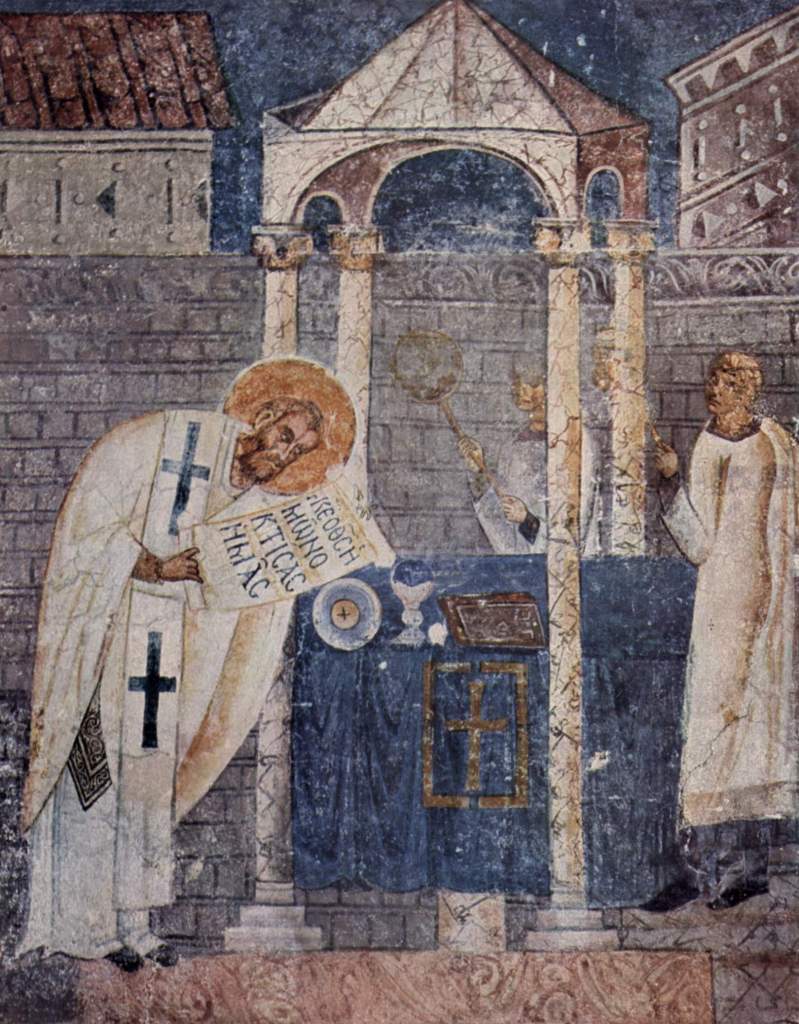
In our troubled and unsettled worldd there are prayers which are helpful. Among the finest is this instructive, teaching prayer adapted from the Eastern Orthodox liturgy of the great and influential 4th C. saint, Basil the Great (of Caesarea), the oldest of the three Cappodocian Fathers of the Eastern Church. The prayer is offered at Ninth Hour in our Bookstore Publication, Hear Us, O Lord: Daily Prayers for the Laity.

Religious fresco depicting a bishop holding a Greek-inscribed scroll beside an altar and another cleric.
St. Basil of Caesarea Consecrating the Elements, Byzantine Orthodox icon, St. Sophia Cathedral, Ohrid. Macedonia, 9th C. Public Domain.

O MASTER, Lord Jesus Christ our God, who art long-suffering toward our sins, and who hast led us even to the present hour, who didst hang upon the life-giving Tree and didst make a way unto Paradise for the penitent thief, and by death didst destroy death; Cleanse us sinners and unworthy servants, for we have sinned and have dealt iniquitously toward thee. Inasmuch as we have departed from the path of thy righteousness, and have walked after the desires of our own hearts, we are not worthy to lift up our eyes and look upon the heights of heaven; Yet we implore of thy boundless goodness: Spare us, O Lord, according to the multitude of thy mercies, and save us, for thy holy Name’s sake. Amen.

St. Basil was one of the most influential Holy Fathers whose thinking influenced the revisions to the original Nicene Creed at the Council of Constantinople in 381 A.D., concerning the Holy Spirit. He is the featured saint in Episode Seventeen in our video series, The Lives of the Saints: Second Series, focused on 35 saints from both the Western and Eastern Church who do not have Feast Days/Holy Days in the 1928 Book of Common Prayer. An audio-only version in MP3 format is linked from the Podcast Archive page. Hear Us, O Lord: Daily Prayers for the Laity is available exclusively through my Amazon Author Central page. A summary of the book is available on the AIC Bookstore page. St. Basil’s influence at the Council of Constantinople is discussed in Episode Seven in our video series, The Nicene Creed. An audio-only version in MP3 format is linked from the Podcast Archive page.

Glory be to God for all things! Amen.

Twenty-third Sunday after Trinity, A.D. 2026

For Twenty-third Sunday after Trinity Archbishop Thomas Cranmer chose a Collect from the Gregorian Sacramentary, in the version first published in the 10th Century honoring the teachings of Gregory the Great. The Collect is one of seven in the Gregorian Sacramentary used during Trinitytide and also one of three that were used in the final weeks of Trinitytide. Church historian Massey Shepherd notes in his commentary on the Collect that the opening sentence paraphrases Psalm 46:1: God is our hope and strength, * a very present help in trouble.” Importantly, he also notes that not all prayers have equal weight, only those offered “faithfully.”

O GOD, our refuge and strength, who art the author of all godliness; Be ready, we beseech thee, to hear the devout prayers of thy Church; and grant that those things which we ask faithfully we may obtain effectually; through Jesus Christ our Lord. Amen.

The Epistle reading, Philippians 3:17-21, is another Trinitytide reading from the pen of St. Paul the Apostle. Here it is useful to recall Paul’s rejection in verses 1, 3 and 5, not included in the reading, that all seeking admission into the new Church must be circumcised, a practice insisted upon by the group commonly called the Judaizers. St. Paul’s most essential point is found in verse 18: “For our citizenship is in heaven, from which we also eagerly wait for the Savior, the Lord Jesus Christ” (NKJV text). In the Orthodox Study Bible: New Testament and Psalms,” the editors expand beyond the KJV text used in the 1928 Book of Common Prayer by including the first verse of Chapter 4: “Therefore, my beloved and longed-for brethren, my joy and crown, so stand fast in the Lord, beloved.” In Episode One in the AIC Bible Study Video series, The New Testament: Gospels, I discussed the division of the Holy Bible into numbered chapters and numbered verses, with Upper and Lower Case letters, a 13th C. innovation credited to Stephen Langton, who later served as Archbishop of Canterbury. The audio-only version in MP3 format is linked from the Podcast Archive page.

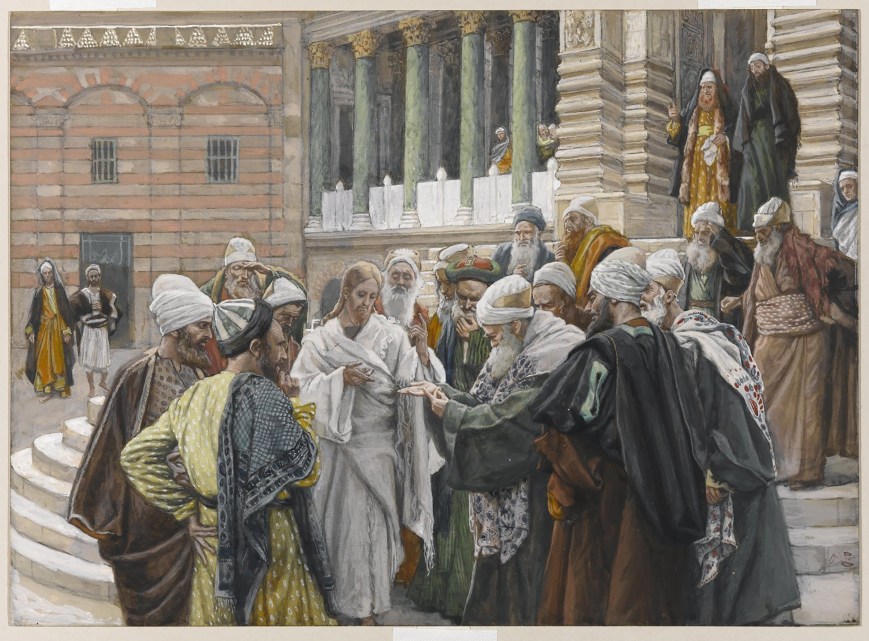
A historical scene depicting a group of men, including a central figure in white robes, engaged in a serious discussion. They stand on the steps of a grand building with columns, illustrating a moment of tension and importance in a biblical context.
The Tribute Money, opaque watercolor over graphite on gray wove paper, Scenes in the Life of Christ series, James Tissot, 1886-1894, Brooklyn Museum, Brooklyn, NY. Public Domain.

The Gospel reading, Matthew 22:15-22, is the 8th of 9 citations from the Gospel of Matthew and the third from Matthew printed at the end of the numbered Sundays after Trinity (Trinity 22, 23 & 24). The reading is St. Matthew’s version of Jesus’ encounter with a group of Pharisees and “Herodians” (verse 16) who attempt to trap Jesus into an answer to the question: “Is it lawful to pay taxes to Caesar, or not?” The encounter is also recorded in Mark 12:13-17 and Luke 20:20-26. They were certain that however Jesus answered the question they could use it against Him. The last verse of His Jesus’ reply silenced them: “Render therefore unto Caesar the things that are Caesar’s; and unto God the things that are God’s.” The text ends with this: “When they had heard these words, they marveled, and left him, and went their way.”

Other AIC Resources on this site touching upon the Collect, Epistle and Gospel readings and that are available in audio, video or print formats, include my Podcast Homily for Twenty-third Sunday after Trinity, linked from the Podcast Homilies page. A related Podcast Homily in MP3 format, this one based upon the Psalm reading in Morning Prayer for Twenty-third Sunday after Trinity, is linked from the Podcast Homilies-Morning prayer page. In full color video format, Episode Eight in our Christian Education Video series, Trinitytide: the Teaching Season, is linked from the Digital Library page. The audio-only version in MP3 format is linked from the Podcast Archive page. In color paperback form, with 117 illustrations, The Gospel of Matthew: Annotated & Illustrated, includes fourteen images of St. Matthew from the 8th to the 15th C. In another AIC Bookstore Publication, The Prayer Book Psalter – Picture Book Edition, Psalm 46 is illustrated by two images from the Stuttgart Psalter, produced circa 820 A.D. in the Scriptorium at the Abbey of Saint-Germain-des-Pres, Paris, France. In that volume the opening letters for each Psalm are displayed with a colorful scroll and initial capital letters designed by Corinne M. Shibley. Both books are available exclusively through my Amazon Author Central page. Pope Gregory the Great, whose Feast Day is March 12th and whose life and teaching are celebrated in the Gregorian Sacramentary and who instituted Ash Wednesday and made it the start of Lent in the Western Church, is honored in Episode Fourteen in the AIC Christian Education Video series, The Lives of the Saints, Second Series, linked from the Digital Library page, The audio-only version in MP3 format is linked from the Podcast Archive page. The Second Series honors the life and contributions of 35 saints, from both the Western and Eastern Churches and without Holy Days in the 1928 Book of Common Prayer. St. Gregory is also featured in two earlier Fr. Ron’s Blog posts: 3/3/2025 (Ash Wednesday) and 3/18/2017 (Honoring both St. Thomas Aquinas and St. Gregory the Great).

As always, thank you for your interest and support. Glory be to God for all things! Amen!