All Saints Day & Twenty-second Sunday after Trinity, A.D. 2026

This coming Sunday, November 1st, A.D. 2026, is observed in two Church calendars, that of regular Sunday worship and that of the Holy Days, or Feast Days. In his expansive work on the 1928 Book of Common Prayer, Church historian Massey Shepherd explains that the schedule of Holy Days, created by Archbishop Cranmer for the 1549 Book of Common Prayer, honors the “feasts of our Lord and His Apostles, the Evangelists, St. Stephen, Michaelmas and All Saints,” following the precedent of the prayers and readings in the old Latin Missal in use in England at the time of the separation of the Church of England from Roman jurisdiction under the Act of Separation, 1535.

The first Holy Day on the Archbishop’s new calendar honors St. Andrew, whose Holy Day also determines the start of Advent. Advent always begins on the Sunday closest to the Feast of St. Andrew (Nov. 30). Archbishop Cranmer also made Advent season the start of each new Church Year in the new Anglican Church. That change from the Roman Catholic calendar remains in effect in the modern Church. See the final paragraph in this Blog post for more AIC resources in which St. Andrew and the three other Disciples named in the Gospel reading (Peter and Andrew, James and John) are featured.
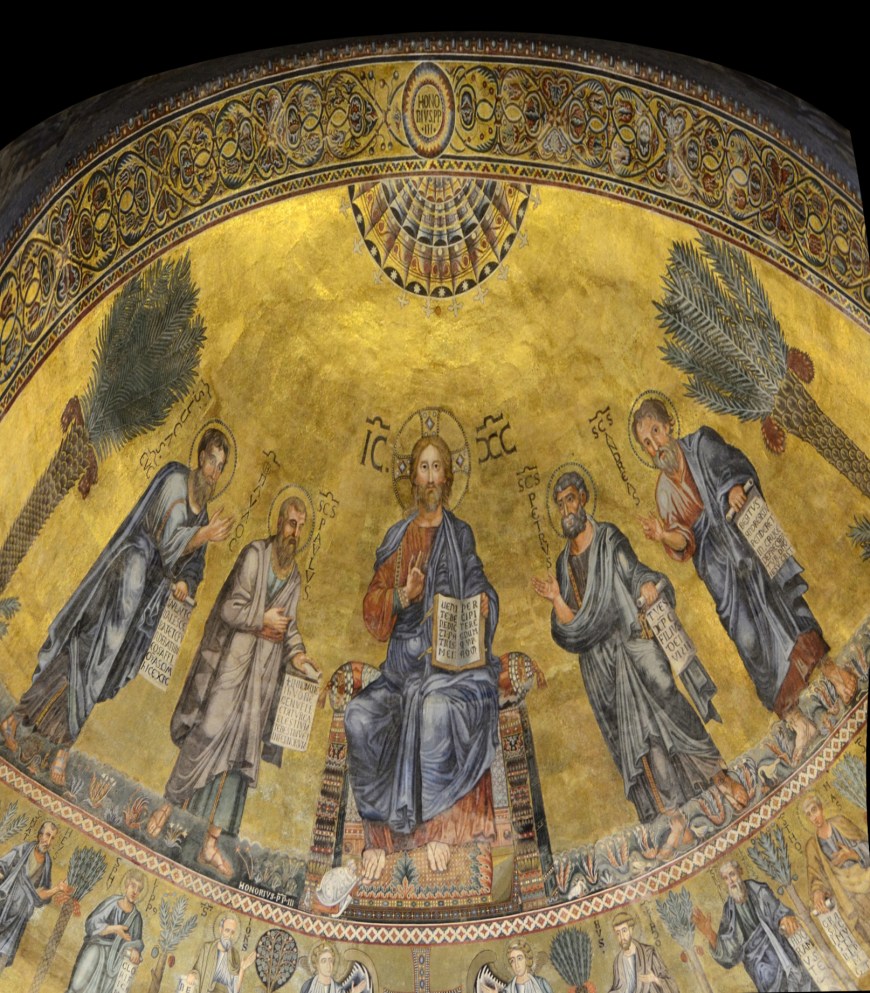
A golden mosaic depicting Christ seated in the center, surrounded by four figures, in a domed ceiling design.

Christ in Majesty with Four Apostles and Saints, Apse mosaic, Basilica of St. Paul Outside the Walls, Rome, circa 1220. Christ makes the traditional sign of blessing with His third finger touching His thumb and the other fingers curled, together symbolizing the letters ICXC. St. Peter stands at Christ’s left and St. Paul at His right. St. Andrew is the figure at the far right side (Christ’s left side). In the band of figures below Christ, partially visible in the image above, includes ten saints, six to each side of the Archangels, Gabriel and Michael, placed at the center. Perspective correction was applied to the original image. In the Eastern Church tradition the image is known as Christ Pantokator. © Jjfarq|Dreamstime.com

Archbishop Cranmer composed a new Collect for St. Andrew’s Holy Day for the 1549 Book of Common Prayer. The Archbishop’s original new Collect was revised in the 1552 Book of Common Prayer, also prepared by the Archbishop. Instead of the original collect’s reliance upon the tradition concerning St. Andrew’s death on a cross, the new collect is based upon the account in the Gospel lesson for the day (Matthew 4:18-22). Here I rely upon Shepherd’s own words (shown below at the end of this paragraph) in describing the significance of the revised Advent Collect. The strong influence upon the Archbishop of the Christian warfare imagery in the Epistle reading from St. Paul for Twenty-first Sunday after Trinity (Ephesians 6:10-20) is evident. The subject is discussed in more detail in last week’s Blog post). Massey Shepherd notes in his classic study of the Book. of Common Prayer (also referenced with a link in last week’s Blog post), the historical connection between the life and history of St. Andrew and the expansion of the Church into England . He explains that the first missionaries to England were sent from the monastery founded by Pope Gregory the Great (540 A.D.-604 A.D., Pope from 590-604 A.D.). In the Leonine Sacramentary, the earliest version of which was published in the 7th C., there were four masses honoring St. Andrew. Gregory the Great was featured in my Blog post for 9/20/2024 (Trinity 17).

Massey Shepherd on the Collect for the Feast of St. Andrew:

“The weight of evidence given here on the immediacy of the Apostle’s response (cf. “and they straightaway left their nets” in the Gospel) underscores the Advent theme — “give us grace that we may cast away the works of darkness, and put upon us the armour of light, now.

The Epistle reading is Romans 10:9-21, noting that Abp. Cranmer’s original version cited verses 8-18). Massey Shepherd’s commentary on the reading gives great importance to St. Paul’s rhetorical questions asked in verses 14 and 15. The two verses are a summary of the role of the Apostles played in spreading the Gospel to the Gentiles: “How then shall they call on Him in whom they have not believed? And how shall they believe in Him of whom they have not heard? And how shall they hear without a preacher? And how shall they preach unless they are sent?” (NKJV text).
A biblical scene depicting Jesus interacting with fishermen in two boats on water, teaching and guiding them.
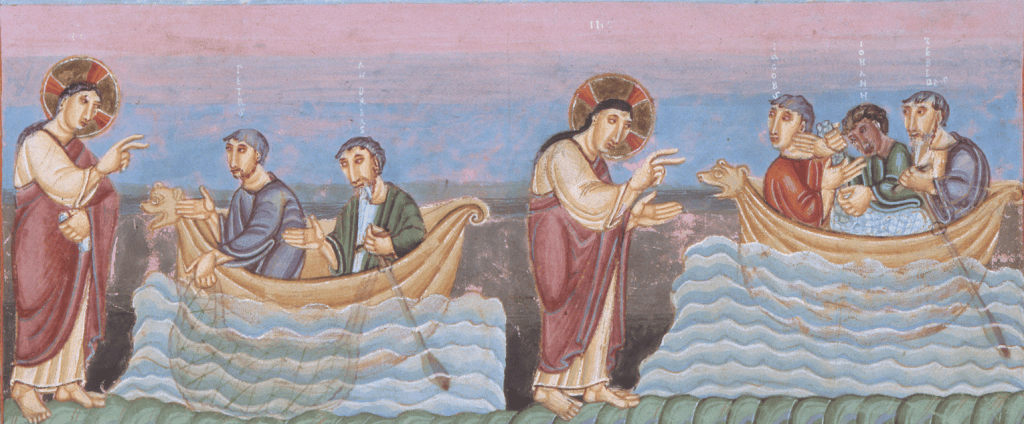
Calling the First Disciples, illumination in tempera and gold on parchment, Codex Aureus of Echternach, Germanisches National Museum, Hs 156142, Folio 20r, Nurnberg, Germany. The volume was produced at the Benedictine Abbey of St. Willabord, Echternach, Germany, now Luxembourg, 1030-1050 A.D.. CC-by-NC-SA 4.0. A higher quality version of this image was used in our Bible Study video on the life of St. John.

The Gospel reading (Matthew 4:18-22) is an account of the calling of the first four Apostles, which were the two pair of brothers, Peter and Andrew and James and John, the latter being the two sons of the fisherman Zebedee. In the full version of the illustration, the image above is the center of three, with the Temptations of Christ shown in the Upper Row and Driving the Money-changers from the Temple in the Bottom Row. As noted above in the commentary by Massey Shepherd, the chosen four “straightaway” left their fishing nets and entered upon their new responsibilities in service to the Lord Jesus Christ.

On this occasion celebrating four individual saints as well as the readings for one of the last Sundays in Trinitytide, there are many other AIC Resources related to the lives and works of Saints Andrew and Peter, James and John. These include material in videos, podcasts and in print in the WATCH/LISTEN/READ formats discussed on the lower half of the Home page. The Collect, Epistle and Gospel readings for Twenty-second Sunday after Trinity are discussed and illustrated in Episode Eight in the AIC Christian Education Video series, Trinitytide: The Teaching Season. The audio-only version in MP3 format is linked from the Podcast Archive page. The Gospel of St. Matthew is discussed and illustrated in Episode One through Episode Four in the AIC Bible Study video series, The New Testament: Gospels, linked from the Bible Study page. The audio-only versions in MP3 format are linked from the Podcast Archive page. The life and writings of St. Matthew are also explored and illustrated in the AIC Bookstore Publication, The Gospel of Matthew: Annotated & Illustrated, available through my Amazon Author Central page. A summary of the book is linked from the AIC Bookstore page. St. Andrew is the featured saint in Episode One, St. John in Episode Four, St. Matthew in Episode Six, and St. Peter in Episode Eleven in the AIC Christian Education video series, The Lives of the Saints, First Series, linked from the Digital Library page. This video series is focused on the lives of the eighteen saints with Holy Days in the 1928 Book of Common Prayer. The audio-only versions of each episode in MP3 format are linked from the Podcast Archive page. My Podcast Homily for Twenty-second Sunday after Trinity is linked from the Podcast Homilies page. A related Podcast Homily for Twenty-second Sunday after Trinity, based on the Psalm reading for Morning Prayer for the day, is linked from the Podcast Homilies-Morning Prayer page.

Next week, I focus on the Collect, Epistle and Gospel lessons for Twenty-third Sunday after Trinity. As always, thank you for your interest and support. Glory be to God for all things! Amen!
Septuagesima Sunday

As I pointed out in my Blog posting for Septuagesima Sunday in A.D. 2024, posted on Jan. 24th, Septuagesima Sunday is now largely unique to the Anglican worship traditions. It is the first of three Sundays the names of which end in “gesima.” “Gesima” is derived from a Latin word meaning “days,” which itself is derived from Quadragesima, which means Forty Days, specifically, the Forty Days before Easter. In some Anglican usage the three days are called “Pre-Lent.” In the first millennium of Christianity in the Western Church, these forty days were known as Septuagesima Season. In all AIC Publications I call them the “Gesima” season, pronouncing it the American way (Jes-i-mah) rather than the English manner (Guess-eh-muh). The Roman Catholic Church, in a move followed by many Protestant liturgical denominations, did away with the season in the reforms begun in the late 1960s. The Church of England now calls the three Sundays the Third-, Second- and Sunday next- before Lent. In the Eastern Church tradition there is no comparable season except that the Sunday before the First Sunday in Lent is celebrated as Forgiveness Sunday. The Easter Church service includes a unique chant based on Psalm 69:18 and 19: “Turn not away thy face from thy child, for I am afflicted. Hear me speedily: Draw near unto my soul and deliver me.” (1928 B.C.P. text, based on the Septuagint translation prepared by the Blessed Alcuin of York during the reign of the Holy Roman Emperor Charlemagne. For more on the relationship between Alcuin and Charlemagne, see my Blog posting for March 16, A.D. 2024). For a longer, more detailed and documented discussion of “Gesima” season, including its liturgical colors and the tradition of suspending singing the Gloria, watch Episode One in Gesima: the Pre-Lenten Season. Another resource is my Podcast homily for Septuagesima Sunday, which is also linked from the Podcast Homilies page.

The Collect for Septuagesima Sunday is an adaptation by Archbishop Cranmer from the Gregorian Sacramentary (10th C. based on collects attributed to, or which express doctrine interpreted by, Pope Gregory the Great (A.D. 590-604), especially the doctrines of the Holy Trinity and of Christ as our Saviour.

O LORD, we beseech thee favorably to hear the prayers of thy people;
that we, who are justly punished for our offenses, may be mercifully delivered by thy goodness,
for the glory of thy Name, through Jesus Christ our Saviour, who liveth
and reigneth, with thee and the Holy Ghost ever, one God, world without end. Amen.

The Epistle reading, 1 Corinthians 9:24-27, continues the teachings of St. Paul which were read in Epiphany season concerning the Christian virtues, here including diligence and temperance. As with the other Pauline epistles, the reading provided the Scriptural foundations which were later consolidated into Western Church doctrine during the 6th, 7th and 8th C. The Christian Virtues were also propounded by many theologians and writers in the Eastern Church. In the reading, St. Paul refers to the greater wisdom of the pursuit of heavenly (“imperishable”) values instead of earthly (perishable) values. The “imperishable” crown in verse 25 refers to salvation in the heavenly kingdom. Many of these ideas later formed the basis for the study discipline known as Christian Spirituality. The concept is discussed and illustrated in Christian Spirituality: An Anglican Perspective, available through my Amazon Author Central page. Full information about the volume is found on the AIC Bookstore page.

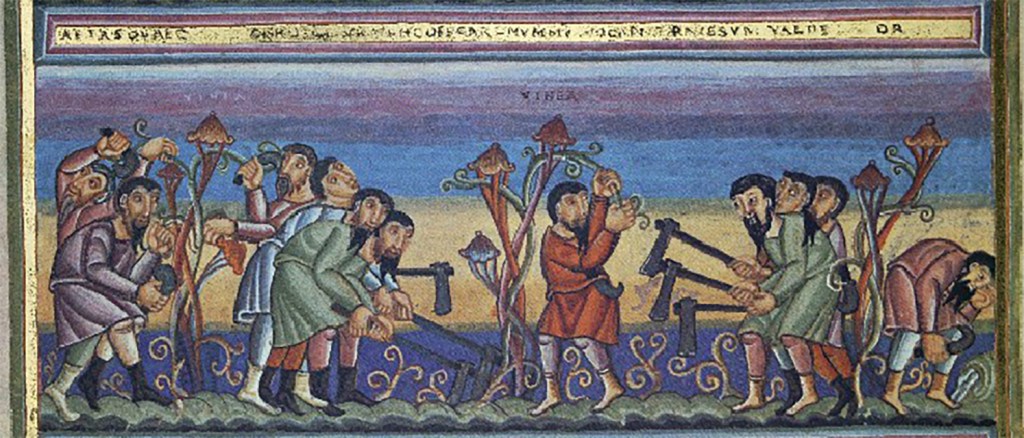
Parable of the Workers in the Vineyard, center panel of three, from an illumination in tempera and gold on parchment, Codex Aureus of Echternach, produced at Echternach, then Germany, now Luxembourg, circa 1030-1050, Hs. 156142, folio 76r, Germanische Nationmuseum, Nuremberg, Germany. This image is from the version reproduced in the York Project’s DVD, 10,000 Masterworks, Public Domain.

The Gospel reading, Matthew 20:1-16, is St. Matthew’s unique account of the Parable of the Laborers in the Vineyard, also known as the Parable of the First and the Last. Each of the men in the story agreed upon a fixed payment, a denarius, a Greek coin which is the equivalent of about $50 today. The same payment was promised by the vineyard owners no matter what time of day the person started, whether at Third Hour (or 9 A.M. in verse 3), or Sixth Hour and Ninth Hour (Noon and 3 P.M., respectively, in verse 5) or Eleventh Hour (5 P.M. in verse 6). At the end of the day, certain of those who were hired first raised the objection that those who worked only an hour got the same pay as those who started at daybreak. In verse 13, Jesus silenced the most vocal critics: “Friend, I am doing you no wrong. Did you not agree with them [the landowners] for a denarius?” (NKJV text). In the final verse is the most important lesson is taught: “the last will be first and the first last. For many are called but few chosen.” This has been interpreted as a caution against self-righteousness. In practical terms, it teaches us that we should regard those who come late to the Church as just a valuable as lifelong members. The image above appears as Illustration No. 92 in our Bookstore Publication, The Gospel of Matthew: Annotated & Illustrated, available through my Amazon Author Central page. Details of the book are available on the AIC Bookstore page. My Podcast Homily for Septuagesima Sunday is linked from the Podcast Homilies page.

As always, thank you for your interest and support. Glory be to God for all things! Amen!

Fifth Sunday after Epiphany

For the Fifth Sunday after Epiphany, Archbishop Thomas Cranmer adapted a Collect from the Gregorian Sacramentary. The Gregorian Sacramentary dates from about the 10th C. and is named in honor of Pope Gregory the Great (590-604 A.D.), one of the most influential Popes of the early Church in the Roman Catholic tradition. It is also known as the Sacramentary of Adrian I. To the many earlier petitions in the Collects for Epiphany season, Archbishop Cranmer’s Collect adds the Church Universal to the list of those for whom prayers are sought (which is the meaning of “beseech” in the opening line). The Collect also refers to certain divine attributes of God the Father incorporated into Christian doctrine, including “grace” and “power” (in other places called “might”).

O LORD, we beseech thee to keep thy Church and household continually in thy true religion;
that they who do lean only upon the hope of thy heavenly grace may evermore be defended by thy mighty power;
through Jesus Christ our Lord. Amen.

The Epistle reading, Colossians 3:12-17, is another from the epistles of St. Paul in which the Christian virtues are listed, in this reading adding compassion, kindness, humility, “long suffering,” forebearance, forgiveness and love (charity in the KJV text) and thankfulness for the Lord’s blessings upon mankind. In this reading, St. Paul uniquely refers to the spiritual and other benefits of “psalms and hymns and spiritual songs.” Another prominent leader in the early Church, Athanasius of Alexandria, echoed the sentiment slightly differently in the 4th C.: “The act of singing affects harmony in the soul.” The Christian virtues, which were summarized in more or less final form by the 7th and 8th C. in both the Eastern and Western Church traditions, are discussed in the “Virtue(s)” entry in our Bookstore publication, Layman’s Lexicon: a Handbook of Scriptural, Theological and Liturgical Terms, available through my Amazon Author Central Page.

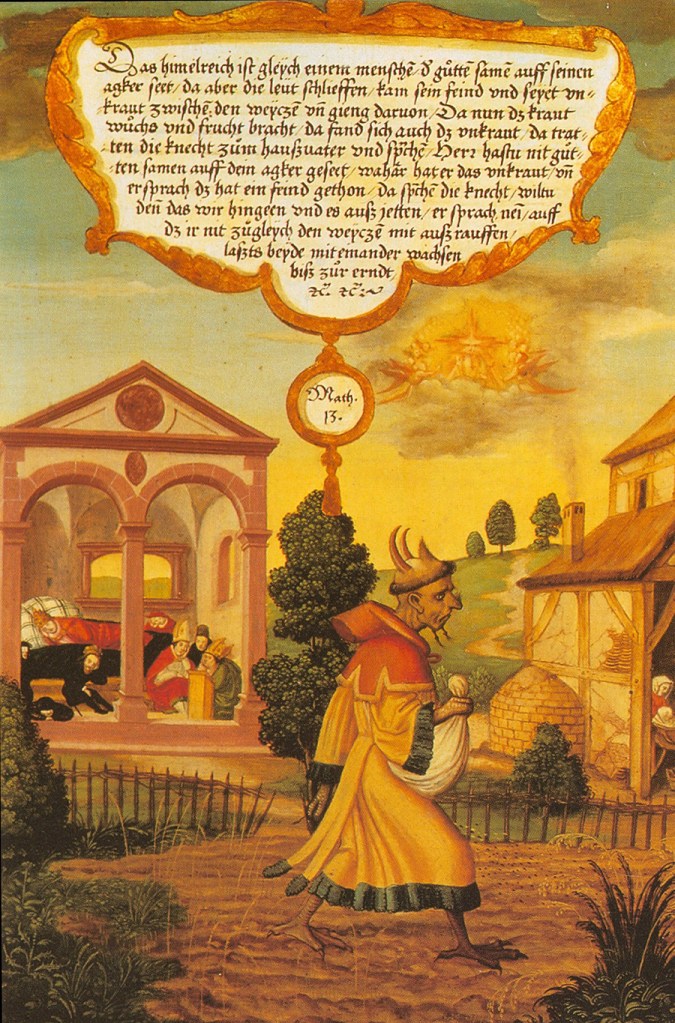
Parable of the Evil Enemy, oil on spruce panel altarpiece, Mompelgarder Altar, circa 1540, made for a Lutheran church in Mombeliard, France by Heinrich Fullmauer, based on Luther’s translation into German of the New Testament. Gemaldagalerie 870, Kunsthistorisches Museum, Vienna, Austria. Public Domain.

The Gospel reading, Matthew 13:24-30, includes the Parable of the Wheat and the Tares, which is also known as the Parable of the Evil Enemy in the German/Lutheran tradition. The illustration was used as Illustrati0n No. 72 in our Bookstore Publication, The Gospel of Matthew: Annotated & Illustrated, also available through my Amazon Author Central page. For full information about this volume and previously mentioned Bookstore Publications, visit the AIC Bookstore page. For more on Fifth Sunday after Epiphany, watch Episode Three in our video series, Epiphany: the Manifestation of Christ to the Gentiles. The Podcast Homily for Fifth Sunday after Epiphany is linked from the Podcast Archive page. My Podcast Homily based on the Psalm reading for Fifth Sunday after Epiphany, Psalms 112 and 113 is linked from the Podcast Homilies-Morning Prayer page.

Since Fifth Sunday after Epiphany is the final Sunday in the season in 2025 A.D., there will be no post for the Sixth Sunday after Epiphany. The next Blog post will be focused on Septuagesima Sunday, the first of the three “Gesima” Sundays.

As always, thank you for your interest and support. Glory be to God for all things! Amen!