This coming Sunday, November 1st, A.D. 2026, is observed in two Church calendars, that of regular Sunday worship and that of the Holy Days, or Feast Days. In his expansive work on the 1928 Book of Common Prayer, Church historian Massey Shepherd explains that the schedule of Holy Days, created by Archbishop Cranmer for the 1549 Book of Common Prayer, honors the “feasts of our Lord and His Apostles, the Evangelists, St. Stephen, Michaelmas and All Saints,” following the precedent of the prayers and readings in the old Latin Missal in use in England at the time of the separation of the Church of England from Roman jurisdiction under the Act of Separation, 1535.
The first Holy Day on the Archbishop’s new calendar honors St. Andrew, whose Holy Day also determines the start of Advent. Advent always begins on the Sunday closest to the Feast of St. Andrew (Nov. 30). Archbishop Cranmer also made Advent season the start of each new Church Year in the new Anglican Church. That change from the Roman Catholic calendar remains in effect in the modern Church. See the final paragraph in this Blog post for more AIC resources in which St. Andrew and the three other Disciples named in the Gospel reading (Peter and Andrew, James and John) are featured.
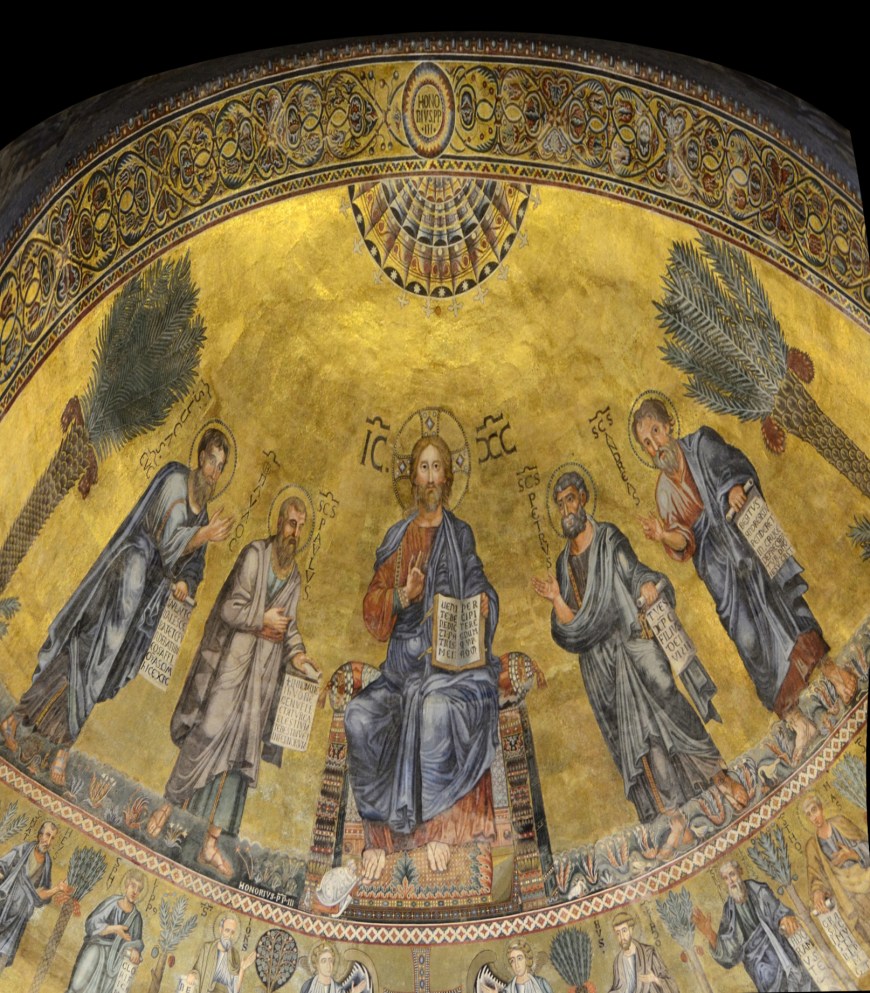
Christ in Majesty with Four Apostles and Saints, Apse mosaic, Basilica of St. Paul Outside the Walls, Rome, circa 1220. Christ makes the traditional sign of blessing with His third finger touching His thumb and the other fingers curled, together symbolizing the letters ICXC. St. Peter stands at Christ’s left and St. Paul at His right. St. Andrew is the figure at the far right side (Christ’s left side). In the band of figures below Christ, partially visible in the image above, includes ten saints, six to each side of the Archangels, Gabriel and Michael, placed at the center. Perspective correction was applied to the original image. In the Eastern Church tradition the image is known as Christ Pantokator. © Jjfarq|Dreamstime.com
Archbishop Cranmer composed a new Collect for St. Andrew’s Holy Day for the 1549 Book of Common Prayer. The Archbishop’s original new Collect was revised in the 1552 Book of Common Prayer, also prepared by the Archbishop. Instead of the original collect’s reliance upon the tradition concerning St. Andrew’s death on a cross, the new collect is based upon the account in the Gospel lesson for the day (Matthew 4:18-22). Here I rely upon Shepherd’s own words (shown below at the end of this paragraph) in describing the significance of the revised Advent Collect. The strong influence upon the Archbishop of the Christian warfare imagery in the Epistle reading from St. Paul for Twenty-first Sunday after Trinity (Ephesians 6:10-20) is evident. The subject is discussed in more detail in last week’s Blog post). Massey Shepherd notes in his classic study of the Book. of Common Prayer (also referenced with a link in last week’s Blog post), the historical connection between the life and history of St. Andrew and the expansion of the Church into England . He explains that the first missionaries to England were sent from the monastery founded by Pope Gregory the Great (540 A.D.-604 A.D., Pope from 590-604 A.D.). In the Leonine Sacramentary, the earliest version of which was published in the 7th C., there were four masses honoring St. Andrew. Gregory the Great was featured in my Blog post for 9/20/2024 (Trinity 17).
Massey Shepherd on the Collect for the Feast of St. Andrew:
“The weight of evidence given here on the immediacy of the Apostle’s response (cf. “and they straightaway left their nets” in the Gospel) underscores the Advent theme — “give us grace that we may cast away the works of darkness, and put upon us the armour of light, now.
The Epistle reading is Romans 10:9-21, noting that Abp. Cranmer’s original version cited verses 8-18). Massey Shepherd’s commentary on the reading gives great importance to St. Paul’s rhetorical questions asked in verses 14 and 15. The two verses are a summary of the role of the Apostles played in spreading the Gospel to the Gentiles: “How then shall they call on Him in whom they have not believed? And how shall they believe in Him of whom they have not heard? And how shall they hear without a preacher? And how shall they preach unless they are sent?” (NKJV text).
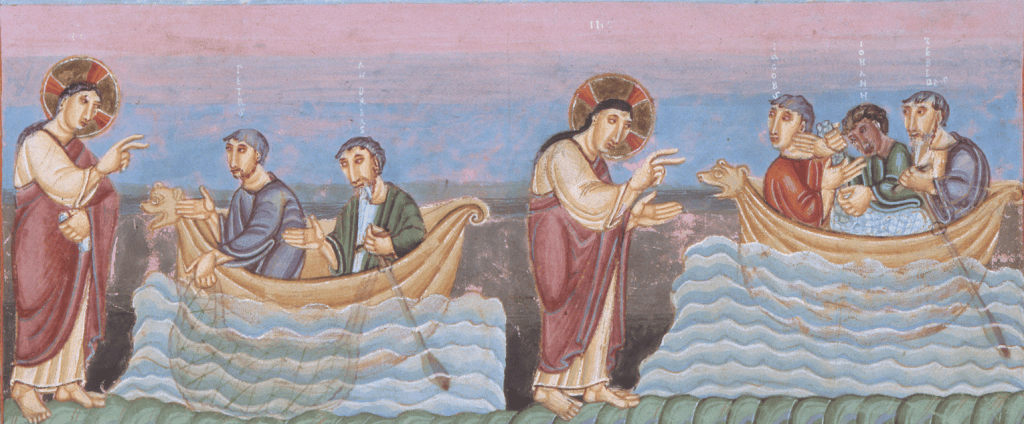
The Gospel reading (Matthew 4:18-22) is an account of the calling of the first four Apostles, which were the two pair of brothers, Peter and Andrew and James and John, the latter being the two sons of the fisherman Zebedee. In the full version of the illustration, the image above is the center of three, with the Temptations of Christ shown in the Upper Row and Driving the Money-changers from the Temple in the Bottom Row. As noted above in the commentary by Massey Shepherd, the chosen four “straightaway” left their fishing nets and entered upon their new responsibilities in service to the Lord Jesus Christ.
On this occasion celebrating four individual saints as well as the readings for one of the last Sundays in Trinitytide, there are many other AIC Resources related to the lives and works of Saints Andrew and Peter, James and John. These include material in videos, podcasts and in print in the WATCH/LISTEN/READ formats discussed on the lower half of the Home page. The Collect, Epistle and Gospel readings for Twenty-second Sunday after Trinity are discussed and illustrated in Episode Eight in the AIC Christian Education Video series, Trinitytide: The Teaching Season. The audio-only version in MP3 format is linked from the Podcast Archive page. The Gospel of St. Matthew is discussed and illustrated in Episode One through Episode Four in the AIC Bible Study video series, The New Testament: Gospels, linked from the Bible Study page. The audio-only versions in MP3 format are linked from the Podcast Archive page. The life and writings of St. Matthew are also explored and illustrated in the AIC Bookstore Publication, The Gospel of Matthew: Annotated & Illustrated, available through my Amazon Author Central page. A summary of the book is linked from the AIC Bookstore page. St. Andrew is the featured saint in Episode One, St. John in Episode Four, St. Matthew in Episode Six, and St. Peter in Episode Eleven in the AIC Christian Education video series, The Lives of the Saints, First Series, linked from the Digital Library page. This video series is focused on the lives of the eighteen saints with Holy Days in the 1928 Book of Common Prayer. The audio-only versions of each episode in MP3 format are linked from the Podcast Archive page. My Podcast Homily for Twenty-second Sunday after Trinity is linked from the Podcast Homilies page. A related Podcast Homily for Twenty-second Sunday after Trinity, based on the Psalm reading for Morning Prayer for the day, is linked from the Podcast Homilies-Morning Prayer page.
Next week, I focus on the Collect, Epistle and Gospel lessons for Twenty-third Sunday after Trinity. As always, thank you for your interest and support. Glory be to God for all things! Amen!

