I last commented upon the Collect and readings for Twenty-first Sunday after Trinity in A.D. 2024. In that posting I focused a lot of attention on the importance of key words in the Collect for the day in the 1928 Book of Common Prayer. First, here’s the text only:
GRANT, we beseech thee, merciful Lord, to thy faithful people pardon and peace,
that they may be cleansed from all their sins, and serve thee with a quiet mind;
through Jesus Christ our Lord. Amen.
The Collect for Twenty-first Sunday after Trinity is another adaptation by Archbishop Cranmer for the 1549 Book of Common Prayer. It is based upon the Gelasian Sacramentary (Rome, circa 750 A.D.). In spite of its name, the Gelasian Sacramentary does have any actual connection to Pope Gelasius I, who was Bishop of Rome from 492 to 496 A.D. Its official name was Liber sacramentorum Romanae ecclesiae, literally The Book of Sacraments of the Church of Rome. In the 8th C. A.D., there were two sacramentaries in liturgies within the Western Church: the Gelasian, used by the Church at Rome, and another, known as the Gallican Rite, widely used in the northern half of Italy and in parts of the rest of Western Europe. The Gelasian rite was replaced across the Holy Roman Empire during the reign of Holy Roman Emperor Charlemagne, the first Holy Roman Emperor since the sacking of Rome in the 5th C. Viewers of this blog will already know that the most important contributor to the worship practices of the Western Church at the time of Charlemagne and his successors was the Blessed Alcuin of York. Alcuin was tutor to the household of the Frankish monarch who adopted the name Charlemagne. Alcuin’s most famous prayer, commonly known as the Collect for Purity, follows the Lord’s Prayer in Anglican Holy Communion in the 1928 Book of Common Prayer (American edition). For more about Alcuin’s interesting history and an image of him, see my Blog post for March 16, A.D. 2024 and an earlier Blog post about Alcuin and his background in northern England on March 9, A.D. 2024
Back to the Collect’s key phrases mentioned above. The Collect for Twenty-first Sunday after Trinity includes a two iconic phrases written by Archbishop Cranmer, “pardon and peace” and “a quiet mind.” These changes are important for Anglican worship in that the word “pardon” was substituted by Abp. Cranmer in the 1549 Book of Common Prayer for the medieval Latin word “indulgence.” Archbishop Cranmer considered “indulgence” as too closely allied to the Roman Catholic practice of selling indulgences, one of the contributing factors which precipitated the Protestant Reformation and the separation of the Church in England from the Roman Church. The word “quiet” in Archbishop Cranmer’s phrase “a quiet mind” replaced the Latin word “secure.” In Cranmer’s thinking, and likely his spiritual advisor Alcuin’s, “a quiet mind” implies unshakeable faith in the face of adversity. Archbishop Cranmer’s Collect for Twenty-first Sunday after Trinity, as amended into its present form, is often used by non-ordained Church leadership as a closing prayer in the Anglican Morning Prayer. The prayer offers the hope of forgiveness without the official sanction of the rite of Absolution, which only an ordained clergyman can dispense. The Collect for Twenty-first Sunday after Trinity is the last of sixteen from the Gelasian Sacramentary in Trinity season (noting that one was changed by Archbishop Cranmer in the 1549 B.C.P., five changed in the 1662 edition, and one changed for the American prayer book in 1789.
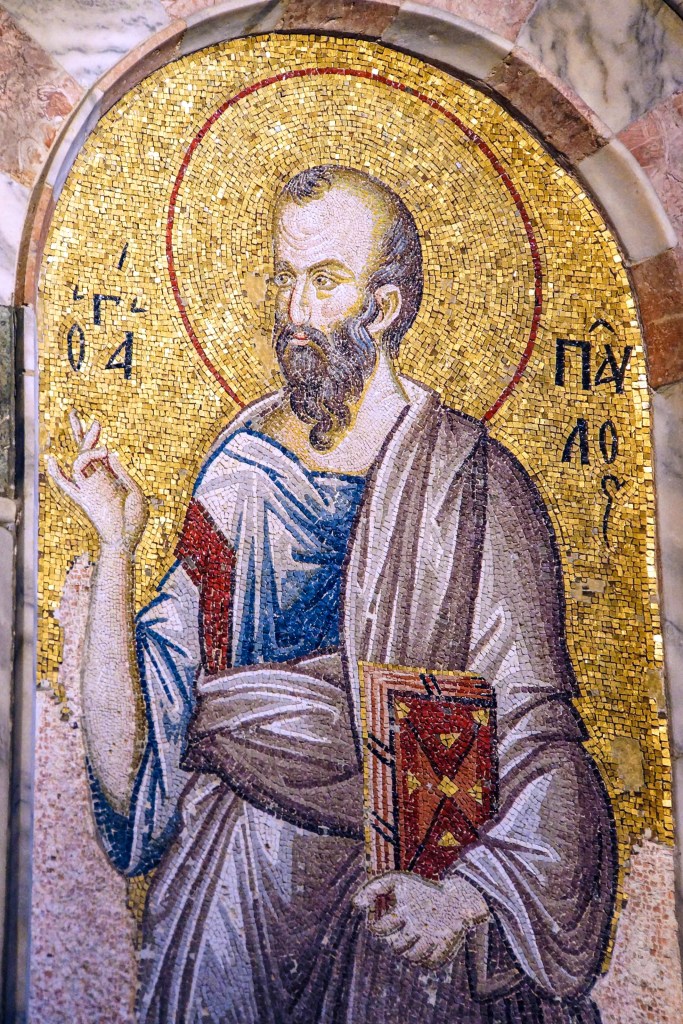
The Epistle reading, Ephesians 6:10-20, is St. Paul’s classic explanation of the Christian faith expressed in distinctly martial terms and other meaningful phrases, including: “the whole armor of God,” “spiritual wickedness in high places,” “principalities….powers…rulers of darkness,” “breastplate of righteousness,” “shield of faith,” “helmet of salvation,” “sword of the Spirit.” I explore this kind of imagery in the AIC Bookstore Publication, Christian Spirituality: an Anglican Perspective.” St. Paul’s reference to “against principalities, against powers…spiritual wickedness in heavenly places” is the Scriptural source of the Christian understanding that there are nine ranks, or orders, of angels. In another AIC Bookstore Publication, Layman’s Lexicon, I explore Angels/Archangels on pages 10-13. Both volumes are available exclusively through my Amazon Author Central page. A summary of both books is available on the AIC Bookstore page. Layman’s Lexicon was the featured book in my Blog post for October 18, A.D. 2025. In other AIC resources, the traditional understanding of angels is discussed, with fourteen illustrations of angels, in Episode Nine (Ninth Day of Christmas, Jan. 2nd) of the AIC Christian Education Video series, The Twelve Days of Christmas. All twelve episodes are linked from the Digital Library page and with their audio-only soundtracks in MP3 format linked from the Podcast Archive page.
The Gospel reading, John 4:46-54, is John the Evangelist’s unique account of Jesus’ Healing of the Nobleman’s Son, described as the “second sign Jesus did when he had come out of Judea into Galilee.” The “signs” to which St. John are the Water into Wine account at the Wedding at Cana (John 2:1-12); Healing at the Pool of Bethesda (John 5:1-15); Feeding the 5,000 (John 6:5-14): Walking of the Sea of Galilee (John 6:16-21); Healing the Man Born Blind (John 9:1-7) and the Raising of Lazarus (John 11:1-45). The healing is not often depicted in Christian art. This is probably because the healing was done at a distance and not with Jesus at the man’s side. For one of the few such images, a mid-19th C. engraving from the Bowyer Bible, see my Blog Post for October 19, A.D. 2024.
There are other resources in several media formats on this site related to Twenty-first Sunday after Trinity. The Collect, Epistle and Gospel readings for Twenty-first Sunday after Trinity are discussed and illustrated in Episode Eight in our Seasonal Video series, Trinitytide: the Teaching Season. An audio-only version in MP3 format is available on the Podcast Archive page. My Podcast Homily for Twenty-first Sunday after Trinity is linked from the Podcast Homilies page. A related Podcast Homily, based upon the Psalm reading for Twenty-first Sunday after Trinity is linked from the Podcast Homilies-Morning Prayer page. Angels are the subject of another AIC Bookstore Publication, Angels: In Scripture, Art & Christian Tradition, with 152 illustrations from the 3rd through the 20th C., with the cover illustration being one of the mosaics of angels, presented in five tiers, at the Baptistery of Saint John, Florence, Italy. Like the earlier reference to Layman’s Lexicon, a summary of the volume is linked from the AIC Bookstore page. The volume was the featured book in my Blog post for November 11, A.D. 2025.
As always, thank you for your interest and support. In our immediacy-driven world of the Twenty-first Century in which anti-Christian sentiment is widespread in the media and in political discourse. Your viewership and support for the multimedia resources offered through this site is even more important and is greatly appreciated. On this Twenty-first Sunday after Trinity, A.D. 2026, I hope and pray that these resources, which now include nearly 3,000 historic images, help you maintain “a quiet mind” and that you remain steadfast in your beliefs. Glory be to God for all things! Amen!

