For the Twentieth Sunday after Trinity in A.D. 2026 the worship calendar shifts from the weekly schedule in the 1928 Book of Common Prayer to the appointed readings for a Saints Day, or Holy Day, with the full list found on B.C.P. pages 226-259. The readings for Twentieth Sunday after Trinity honor the Feast Day of “thy servant St. Luke the Physician,” which is always celebrated on October 18th. The Feast can be moved backward or forward to the nearest Sunday at the discretion of the local minister.
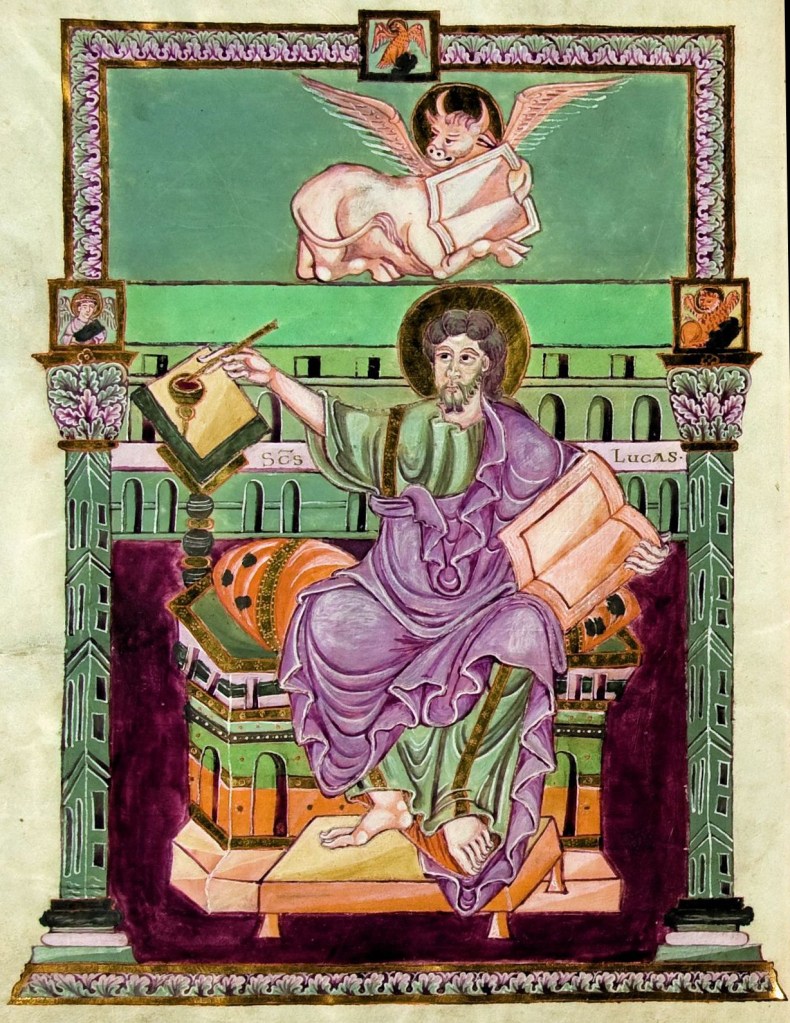
More details about each of the eighteen canonical saints honored on sixteen feast days in the B.C.P. is discussed and illustrated in the AIC Christian Education Video series, The Lives of the Saints, linked from the Digital Library page. The episode focused on St. Luke, with 322 slides, is found in Episode Fifteen. Audio-only versions in MP3 format are linked from the Podcast Archive page. A second series, focused on thirty-five non-1928 B.C.P. saints in both the Western and Eastern Churches, is linked from the Digital Library and Podcast Archive pages.
Collect for the Feast Day of St. Luke is original to the American 1928 Book of Common Prayer. Ir was written by the Rev. Dr. Charles Morris Addison (1846-1947), a member of the Revision Committee which prepared the 1928 B.C.P. It replaced an original composition from the 1549 Book of Common Prayer written by Archbishop Thomas Cranmer. Church historian Massey Shepherd notes that where Abp. Cranmer’s original collect was focused on the effects of Christian doctrine on the soul, the Rev. Dr. Addison added the phrase “power and love” referring to Christian ministry as extending not only to the well-being of the body but also the soul. For more commentary on the readings for the Feast Day, or Holy Day, of St. Luke, and any Sunday or Feast Day in the B.C.P., see Shepherd’s landmark volume, The Oxford American Prayer Book Commentary, available online in pdf format. The Rev. Addison was also coauthor, with John Wallace Suter, of A Book of Offices and Prayers for Priest and People (1914) and, with Charles Morris Addison, John Wallace Suter, Wallace Suter and Charles Morris Addi, The People’s Book of Worship: a Study of the Book of Common Prayer (1919); and two books on mysticism (referring specifically to mankind’s search for the presence of God) originally published in 1918 and again in 1923.
Since there are no epistles credited to St. Luke, the authors of the 1928 B.C.P. chose a selection from the canonical epistles, 2 Timothy 4:5-15. St. Paul wrote in verse 11 that, when this letter was written, many others had fallen away and that “only Luke is with me.” St. Paul’s epistle refers frequently and vividly to the suffering of Christ’s ministers as they spread the word of the Gospel from the Holy Land, across Asia Minor and farther west to Rome. In the late 1st and early 2nd C., Church historian Hippolytus of Rome, a disciple of St. John, created a list of the Seventy. His list included Mark, Luke, Stephen the Protomartyr, Polycarp of Smyrna (one of the earliest martyrs, Philemon and Irenaeus of Lyon.. The Eastern Church produced a full list of the Seventy, including Barnabus and Titus, all of whom are considered as saints. Their Feast Day is January 4th. There is no comparable Feast Day/Holy Day in the Western Church tradition. The reading from 2 Timothy includes a unique reference to the Christian blessing, “Peace be to this house,” (verse 5). Christ directed the Seventy to declare these words to every household which received them.
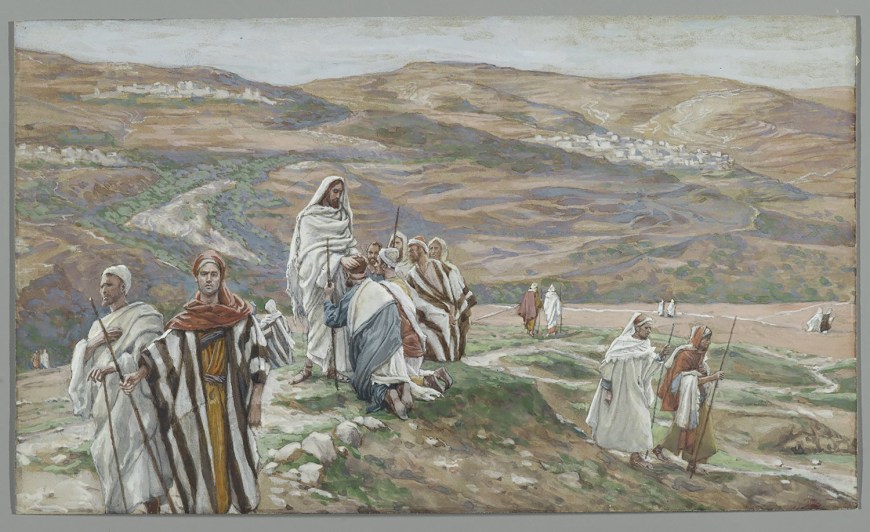
The Gospel reading, Luke 10:1-7a, is St. Luke’s account of the calling of the Seventy, who are sent “two by two.” They were to go forth in advance of Jesus’ intended visits “into every city and place, whither he himself would come.” (verse 1). I used the above watercolor of the event painted by James Tissot on the opening page of Chapter 10 in the AIC Bookstore Publication, The Gospel of Luke: Annotated & Illustrated. The illustration of St. Luke at the top of this page also appears in Chapter 10 as Illustration 15. The book is available exclusively through my Amazon Author Central page. St. Luke’s account offers a unique glimpse into the manner in which the Gospel was spread, including the difficulties faced by the Apostles. No salaries or other compensation are paid in the operation of this site. All royalties from the sale of AIC Bookstore Publications are donated to the AIC ministry, an IRS recognized 501(c)(3) charitable organization.
As always, thank you for your interest and support of this online ministry.


Published by