Trinity 22 & AIC Bookstore – Pt. 5

My Fr. Ron’s Blog post for Trinity 22 was posted on October 25th, A.D. 2024. The episode is linked from the Archives column at the right side of the page. I discussed the Collect, based on the late Gregorian Sacramentary (10th C.), St. Paul’s epistle to the congregation at Phillipi (Philippians 1:3-11) and St. Matthew’s account of Jesus’ lesson on the Unforgiving Servant (Matthew 18:21-35) with first half, 17th C. art work by Claude Vignon. These readings were also discussed in Episode Eight in our Christian Education video series, Trinitytide: the Teaching Season. The podcast version of Episode Eight is linked from the Podcast Archive page. Additionally, the Podcast Homily for Morning Prayer on the Twenty-second Sunday after Trinity is also available.

This week’s post continues my focus on the unique books available in the AIC Bookstore, on this occasion focusing on the first of two books on the Church’s two major seasons, Easter and Christmas. Here, near the start of Advent in A.D. 2025, I present more about Christmas: The Nativity of Our Lord in Scripture, Art & Christian Tradition. This resource would be a great gift to any Christian this year. The volume is available only through my Amazon Author Central page.

Cover image, a stained glass interpretation at an unspecified location, copyright Waamel|Dreamstime.com.

The book was first published at Christmas, A.D. 2023. Art work includes 113 illustrations from the 5th to the early 20th C., including mosaics, icons, frescoes, stained glass, paintings, watercolors and two maps: Palestine in the Time of Christ and an 1835 Plan of Jerusalem. This 173-page high-quality paperback is divided into five parts. Part One includes text and commentary on St. Luke’s unique pre-Nativity account (Luke 1). Part Two continues with text and commentary on St. Luke’s version of the actual Nativity and his transition to post-Nativity events (Luke 2). Part Three includes text and commentary on St. Matthew’s version of the Nativity through the flight to and return from Egypt (Matthew 1 & 2). Part Four is focused on two pre-and post-Nativity traditions with art related to The Great “O” Antiphons (for Dec. 18th to 24th) and The Twelve Days of Christmas (with a theme words or phrases for Dec. 25th to Jan 5th). Part Four includes examples from the AIC’s two video and podcast series of the same name. Part Five, Christmas Traditions from around the World, includes discussion and illustrations of gift-giving, Dickens’ A Christmas Carol, Christmas cards, the Three Kings tradition, Christmas music and foods, including Corkie Shibley’s recipe for my grandmother’s Sugar Cookies.
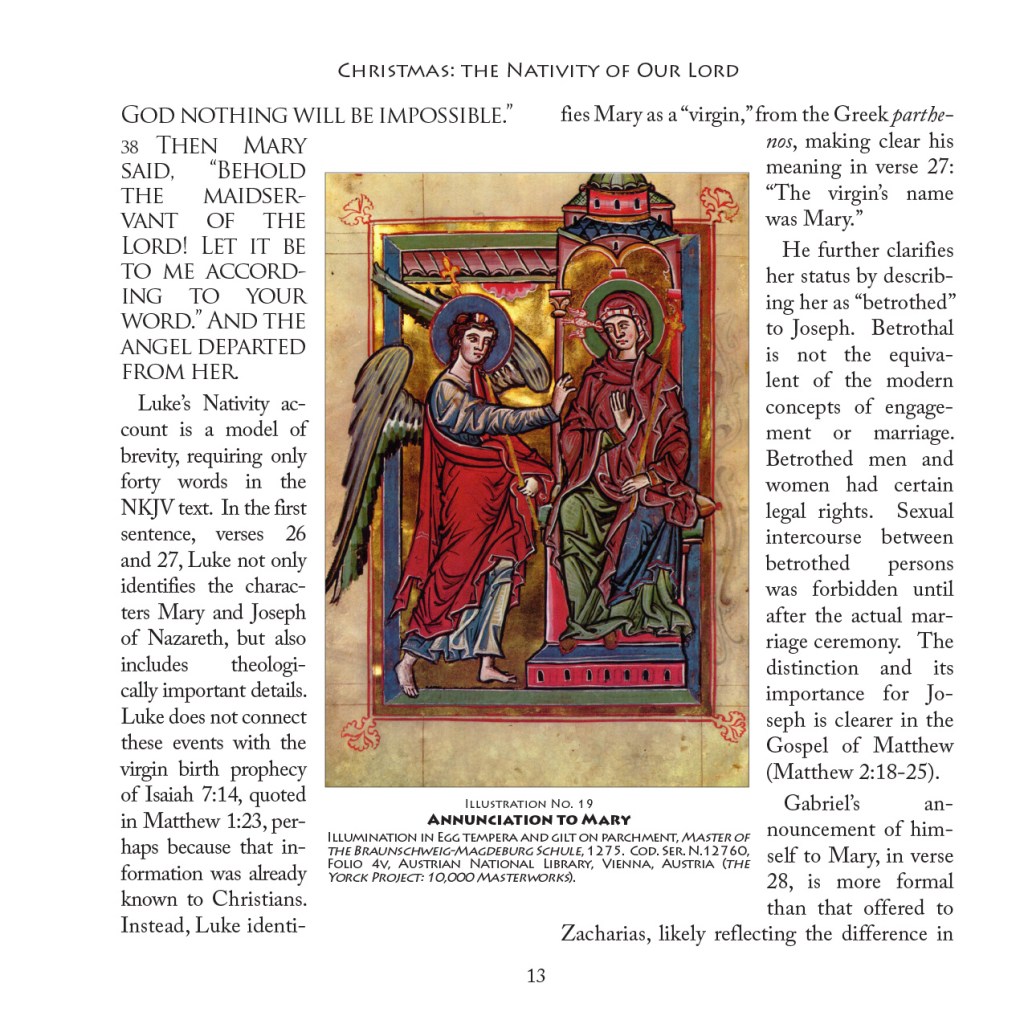
With its unique format and content, this volume will enhance anyone’s personal library of Christian resources. Next time, my focus will be on Easter: The Resurrection of Our Lord in Scripture, Prayer & Christian Tradition.

As always, thank you for your interest and support. Sales of these volumes help keep the Anglican Internet Church’s unique resources available online, mostly free of charge. All book royalties are donated, as received, to the AIC. Glory be to God for all things! Amen!

Liturgical Worship: Scripture-based – Part 2

This week I continue my discussion about Liturgical Worship in the Anglican tradition using the 1928 Book of Common Prayer. The illustration below shows clergy officiating at Holy Communion using the Sarum Rite. Sarum is modern day Salisbury, England. The Sarum Rite in England is a predecessor of the 1549 Book of Common Prayer, the first England language liturgical prayer book produced under the supervision of Archbishop Thomas Cranmer.

Priests Celebrating at Altar, using the Sarum Rite, illumination, Book of Hours, circa 1400, Ms. Richardson 5-92, Folio 44v, Houghton Library, Harvard University, Cambridge, MA. Public Domain.

One of the best commentaries on the 1928 Book of Common Prayer was written by Massey Shepherd. It includes an introductory commentary plus section-by-section commentary on the entire BCP. On the Holy Communion liturgy, pages 67-89, he observes that the words to be spoken by clergy and people before an after the Gospel reading (“Glory be to thee, O Lord” and “Praise be to thee, O Christ”) are “a reminder that liturgical worship is a corporate action of both minister and congregation, conducted under the inspirational judgment of the Lord.”

Shepherd also notes that the Sanctus prayer, spoken during the Preface, is a paraphrase which is derived from the prophet Isaiah’s vision of the heavenly throne, in which the seraphim sing (Isaiah 6:1-3). Holy, holy, holy, Lord God of hosts, Heaven and earth are full of thy glory: Glory be to thee, O Lord most high.”

Another interesting observation by Massey Shepherd concerns the opening words of the Prayer for the Whole State of Christ’s Church (BCP p. 74) is evidence of the Church’s acceptance of the understanding that God listens of the prayers/petitions of His faithful people and, further, that the text affirms that the people/congregation, in hearing the remainder of the prayer, acknowledge the obligation to be obedient unto His divine will: “all those who do confess thy holy Name may agree in the truth of thy holy Word, and live in unity and godly love.” This understanding is more directly addressed in the preface to the General Confession (p. 75).

As always, thank you for your interest and support. Glory be to God in all things! Amen!


Third Sunday after Easter

For Third Sunday after Easter the Collect was adapted by Archbishop Cranmer from the Leonine Sacramentary, one of the three primary sources in the Roman Catholic tradition. It is the oldest Collect in the 1928 Book of Common Prayer. Instead of the more commonly used phrase, Church Universal, the collect refers to “Christ’s Religion.” It reflects the Christian belief concerning the merciful nature of God the Father in offering His creation a path to return to “the way of righteousness.” This understanding was incorporated into the Sacrament of Confession.

ALMIGHTY God, who showest to them that are in error the light of truth,
that they may return unto the way of righteousness: Grant unto all those
who are admitted into the fellowship of Christ’s Religion, that they may avoid
those things which are contrary to their profession, and follow all such things
as are agreeable to the same; through Jesus Christ our Lord. Amen.

The Epistle reading, 1 Peter 2:11-17, actually comes before the reading for last week’s reading for the Second Sunday after Easter. In the closing verse, St. Peter urges Christians to “love the brotherhood. Fear God. Honour the King.” The phrase is part of the basis for the Prayer for the President of the United States and all in Civil Authority in the Anglican Evening Prayer office.

The Last Supper, illumination in tempera and gold on parchment, upper scene of two scenes on Maundy Thursday, Codex Bruchsal, circa 1220 A.D., which was produced for use at Speyer Cathedral in the Roman Catholic Diocese of Speyer, Germany. Ms. Codex Bruchsal 1, Folio 28r, Badische Landesbibliothek, Karlsruhe, Germany. CC by NC 3.0.

The Gospel reading, John 16:16-22, is one of six readings in Easter from the Gospel of John. It is the first of three readings from Chapter 16. The three readings are not presented in sequence. Verses 16-22 are presented before verses 5-11 (Fourth Sunday after Easter), with verses 23-33 presented on Fifth Sunday after Easter. The verses, which were spoken on the evening of Maundy Thursday, include one of Jesus’ several references to concepts of time. Here it is based on the Greek word, mikron (Strong’s Greek word # 3397), translated in the King James Version as “in a little while.” I discussed these verses and Jesus’ other uses of words focused on unique details in the Gospel of John, on this occasion concerning concepts of time, in Episode Forty-four in our Bible Study video series, New Testament: Gospels. The episode is linked from the Digital Library page, with the Podcast version linked from the Podcast Archive page. St. John records in verse 17 that his fellow Disciples were puzzled: “What is this that He says: ‘a little while?’ We do now know what He is saying” (NKJV text). In the reading for Fifth Sunday after Easter from John 16:23-33, Jesus uses another Greek word referring to time: “hora,” meaning “hour” (Strong’s Greek word # 5610), which refers to a specific amount of time or occasion when something will happen. The image above is part of Illustration No. 67 in our Bookstore publication, The Gospel of John: Annotated & Illustrated, available through my Amazon Author Central page, with summary information on the AIC Bookstore page.

As always, thank you for your interest and support. Glory be to God for all things! Amen!
Fifth Sunday in Lent (Passion Sunday)

For the Fifth Sunday in Lent, commonly known as Passion Sunday, the Collect is the fourth of five in Lent which Archbishop Cranmer adapted from the Gregorian Sacramentary, one of the three major collections of prayers in the Roman Catholic tradition. It is another in which God is given the title Almighty God. Passion Sunday marks a change in tone from the penitential focus of the season toward preparation for the Church’s celebration of the Resurrection on Easter Sunday.

WE beseech thee, Almighty God, mercifully to look upon thy people;
that by thy great goodness they may be governed and preserved evermore in body and soul;
through Jesus Christ our Lord. Amen.

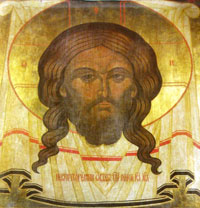
Not Made with Hands, tempera and gold on panel icon in the Russian Orthodox tradition. Public Domain.

The Epistle lesson, Hebrews 9:11-15 is the only quotation in Lent from Hebrews, traditionally credited to the Apostle Paul. In the reading, Jesus is called “High priest of good things to come,” in verse 11, an allusion to the mysterious Melchizedek (Genesis 14:18, “King of Salem” and Psalm 110:4) and “Mediator of the new covenant” in verse 15. In the Anglican worship tradition Jesus is “our only Mediator and advocate” in the prayer for the whole state of Christ’s Church in Communion liturgy in the 1928 Book of Common Prayer. The author of Hebrews adds another title for Christ in verse 11: “more perfect tabernacle not made with hands.” The illustration is a “Not Made with Hands” icon of Christ that became popular in the early Church in Syria around the 4th C. or 5th C. and continued in the Russian Orthodox worship tradition.

The Gospel lesson, John 8:46-49, is the second and last from the Gospel of John in Lent. It includes one of the best-known examples of the several “I Am” declarations which are unique to the Gospel of John: “Before Abraham was, I Am” (John 8:58), based on the Greek ego emi (Strong’s Greek words #1473 and #1510). The I AM declaration is the climax of a conflict between Jesus and a group of Temple leaders on the meaning of the word “Father.” The incident, as well as the Collect and Epistle reading is discussed in Episode Three in our video series, Lent: A Season of Penitence. All the “I AM” sayings are discussed in Episode Twenty-nine to Episode Thirty-five in our video series, The New Testament: Gospels. Episodes of both series are linked from the Digital Library page. The text box, “I Am in the Gospel of John” is printed on page 83 in The Gospel of John: Annotated & Illustrated, available through my Amazon Author Central page. A summary of the volume is included on the AIC Bookstore page. In the box is a quotation from the writings of the Venerable Bede equating the “I AM” in verse 58 with the words God spoke to Moses in Genesis 3:14.

As always, thank you for your interest and support. Glory be to God for all things! Amen!

Fourth Sunday in Lent

For the Fourth Sunday in Lent Archbishop Thomas Cranmer again relied upon the Gregorian Sacramentary as the source for the Collect. It is the third of five Collects in Lent to come from that source. This adaptation even more strongly than other collects in the season points toward the redemptive sacrifice of Jesus Christ for the many sins of God’s creation, mankind. In the Western Church, the word or title “Almighty,’ affirms that God is the Supreme authority over all things. In the Eastern Church tradition, especially as understood in the Russian language, His Name in this capacity is Bozhe, which literally translates as the One who can do anything He wishes. It is one of several different Russian words referring to God the Father. Strong’s Exhaustive Concordance defines the title as meaning “sufficient or all-powerful. It is used 48 times, the first in Genesis 17:1 and the last in Joel 1:15, in the King James Version of the Old Testament. The title is derived from the Hebrew Shaddah (Strong’s Hebrew word # 7706). In the New Testament, there are only nine uses, eight of which are from Revelation, based on the Greek word Pantokrator (Strong’s Greek word # 3841). In the Eastern Church tradition, the image of Christ as “Pantokrator” is commonly used in icons, mosaics and frescoes. A common colloquial translation of the title into English is “Ruler of the Universe.” An image of Christ as Pantokrator as used in the Deesis mosaic in the Hagia Sophia at Constantinople/Istanbul, appears in the blog post for First Sunday after Easter, posted on 4/6/2024.

In the English language, one of the clearest example of the meaning of Pantokrator, in the late 17th C., Bible scholar, Bishop, and spiritual advisor to Queen Elizabeth I and King James I, the Blessed Lancelot Andrewes compiled a set of prayers based on Scripture. Since there was no single English word to convey the meaning, he used this all-encompassing phrase, “Blessed, praised,. celebrated, magnified, exalted, glorified and hallowed be thy Name, O Lord; Great and marvelous are Thy works, Lord God Almighty,” which is part of the Second Antiphon in the Sixth Hour office in our publication, Hear Us, O Lord: Daily Prayers for the Laity. More of Andrewes’ writings are printed in the Introduction to Christian Spirituality: An Anglican Perspective. Both books are available through my Amazon Author Central page. A summary of each is found on the AIC Bookstore page.

GRANT, we beseech thee, Almighty God, that we, who for our evil deeds do worthily deserve to be punished,
by the comfort of thy grace may mercifully be relieved; through Jesus Christ our Lord. Amen.

The Epistle reading, Galatians 4:21-31, is part of St. Paul’s explanation of the difference between the Old Covenant and the New Covenant. This epistle was addressed in verse 2 to the several churches in the region of Galatia in Asia Minor, but St. Paul does not name any particular city. In the reading, in symbolic language St. Paul explains the important difference between the descendants of the two sons of Abraham, one born of a “bondmaid” (Hagar, or Agar in the KJV, symbolizing bondage under the law, in verses 22, 24, 25; called a “bondwoman in the NKJV text) and one born of a “freewoman” (Sarah, referred to but not named in verses 22 and 23). He uses the phrase “children of promise” (verse 28), which refers to Christians guided by the Holy Spirit under the New Covenant.

The Miracle of the Loaves and the Fishes, opaque watercolor over graphite on gray wove paper, James Tissot, 1886-1894, Brooklyn Museum, Brooklyn, NY. Public Domain.

The Gospel reading, John 6:1-14, is the first of two readings from St. John’s Gospel in Lent. The subject, with great detail including the talk of Philip and Andrew, is the miracle of the Feeding of the 5,000, which is the fourth of the seven “signs” in the Gospel of John. Discussed in detail in Episode Thirty-nine in our video series, The New Testament: The Gospel of John. The image, also commonly known as The Feeding of the 5,000, is Illustration No. 37 in The Gospel of John: Annotated & Illustrated, like the other AIC Bookstore Publications cited above, linked from my Amazon Author Central page. Full information about the book is found on the AIC Bookstore page. Tissot’s image, like his other Bible illustrations, includes great detail and a visual expression of the scale and the setting, including an extensive variety of clothing commonly worn in the 1st C.

As always, thank you for your interest and support. Glory be to God for all things! Amen!
Third Sunday in Lent

Archbishop Thomas Cranmer’s choice for the Collect for Third Sunday in Lent is the second five Collects in Lent which he sourced from the Gregorian Sacramentary, one of the three primary sacramentaries in the Roman Catholic tradition. Its most memorable phrase, “the right hand of Thy majesty,” is based on the Hebrew understanding of the “right hand” of God being the most honored position. The understanding was incorporated into Christian theology at the Council of Nicea in 325 A.D. In the Nicene Creed, written at that First Ecumenical Council and amended at the Council of Constantinople in 381 A.D. (Second Ecumenical Council, Jesus Christ sits at the right hand of the the Father. There is much more information about the Creeds of the Church in our eight-episode video series, The Nicene Creed, linked from the Digital Library page.

WE beseech thee, Almighty God, look upon the hearty desires of thy humble servants,
and stretch forth the right hand of thy Majesty, to be our defense against all our enemies;
through Jesus Christ our Lord.

The Epistle reading, Ephesians 5:1-14, continues past practice in Lent with another Pauline epistle focused on the concept of guidance for leading a Christian life, later known as the Christian Virtues. These virtues were fully developed by in the 6th through 8th C. in the Western Church. In this reading, the subject is the need for the mastery of passions, here meaning both physical and emotional. These include sexual impropriety and covetousness (verses 3 & 5); intemperate language (verse 4); and idolatry (verse 5). Other themes in the reading include “light” vs. “darkness,” with Christ as the symbol of light who countered the “darkness” of the world before His coming as Saviour. In verse 14, based on Isaiah 60:1, the Evangelist to the Gentiles calls out: “Awake, you who sleep, arise from the dead, and Christ will give you light.” The phrase was immortalized into a hymn, Sleepers Awake!, written in 1599 A.D. by German composer, Philipp Nicolai, and later a cantata of the same name by Johann Sebastian Bach. Bach’s cantata was sung for the first time at Leipzig in 1731 for the Twenty-seventh Sunday after Trinity.

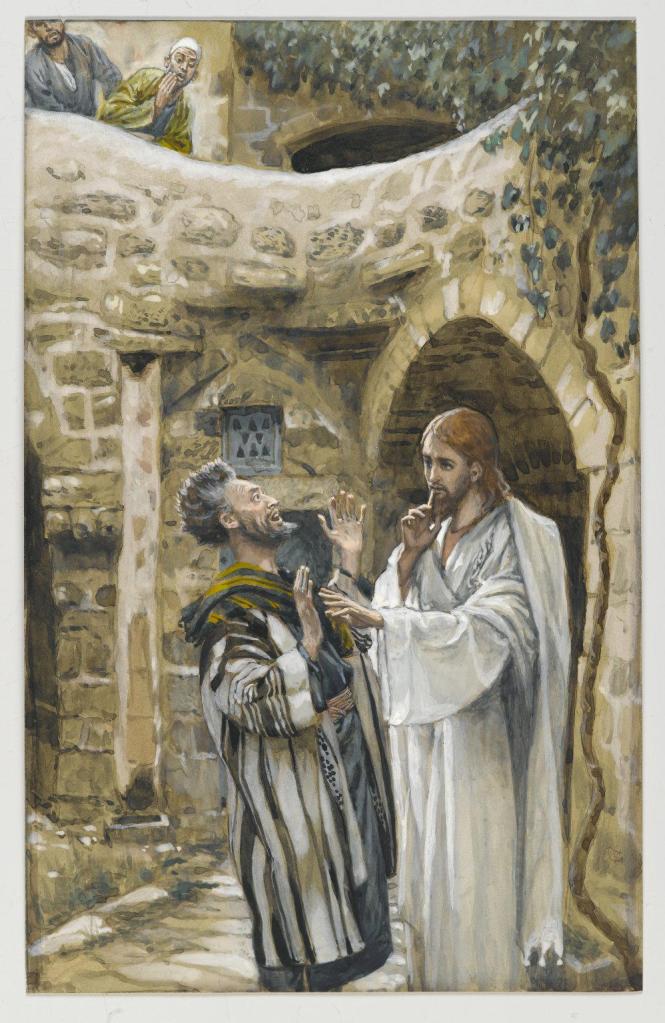
Christ Healing the Mute Man, opaque watercolor over graphite on gray wove paper, James Tissot, 1886-1894, Brooklyn Museum, Brooklyn, NY. Image based upon the less-detailed account in Matthew 12:22-24. Public Domain.

The Gospel reading, Luke 11:14-28, is the first and only reading from St. Luke’s Gospel in Lent. For whatever reason, probably its complexity of its imagery, this encounter was not often illustrated in mosaics, frescoes or icons in the first millennium of Christianity. Numerous commercial examples were produced in the 20th and 21st C. As noted above, the reading is complex. I have divided it into four parts. The first (verse 14) is St. Luke’s brief record of Jesus driving out a demon, or evil spirit, from a mute man and the result: an immediate healing. The event is pictured above as interpreted by French artist James Tissot based on St. Matthew’s account (Matthew 12:22-24). In part two (verse 15) St. Luke records the criticism of Jesus by Temple authorities that He has used “demonic” powers in the manner of Beelzebub. The name roughly means “Lord of the Flies” in Hebrew. In part three (verses 17-26), Jesus offers a demonstration of His divinity: proving that He knew their thoughts (verse 17a) and offers a short sermon on spiritual warfare (verses 17b-26), referring to the possible return of demons that are driven out. Here Jesus uses the Hebrew magical number 7, referring to their return with seven other, even more powerful, spirits. In the final section, part four (verses 27-28), St. Luke offers an account of a woman from the crowd of observers, quoting her beatitude concerning the Blessed Virgin Mary: “Blessed is the womb that bore You, and the breasts which nursed You” (NKJV text). Jesus replied: “Rather, blessed are they that hear the word of God, a keep it” (NKJV text). Eastern Church scholars contend that Jesus is here stating a principle and is not commenting upon the relative worthiness of His mother. For an approximately 15 minute discussion of the important Greek words which appear in this dialogue, listen to my Podcast Homily for Third Sunday in Lent, which is linked from the Podcast Homilies page. One of these important words is “menounge” (Strong’s Greek word # 3304 in verse 28), which the King James Version translates as “rather” and the New King James Version renders as “more than that.” In The Gospel of Luke: Annotated & Illustrated I noted that Jesus made a similar declaration to the Pharisees in John 8:47. Like all our AIC Bookstore Publications, the book is available through my Amazon Author Central page. A summary of the volume is found on the AIC Bookstore page.

F.Y.I: The previously-promised soundtracks for the two new episodes in our video series, The War on Christianity, have not been recorded. Tax-filing preparation, getting my garden ready for Spring, and many other items competing for time have gotten in the way. The new target date is early April. Apologies for the delay.

As always, thank you for your interest and support. Glory be to God for all things! Amen!
Quinquagesima Sunday

Last week I let readers know of the on-going work on new episodes in The War on Christianity, a video series that began in A.D. 2020 as part of what became a continuing celebration of the AIC’s tenth year on the Web. In Episode One of the series I offered a glimpse of news coverage of attacks upon Christianity in the United States and Europe. In Episode Two and Episode Three I offered “A Summary History of the Church from the Day of Pentecost until Now.” The subject of Episodes Four and Five included three case studies of the decline of Christianity in three parts of the world where it had once been dominant: the Holy Land, North Africa and Asia Minor. Which brings us to the episodes-in-progress: Episode Six and Episode Seven. I have now completed and uploaded to iMovie all the slides for both episodes under the heading “The First Line of Defense: the Te Deum Laudamus.” My plan is to record the voice track in the next two weeks, with the objective of uploading completed episodes in mid-to-late March. Episodes Eight and Nine will continue the focus on the “First Line of Defense” theme with discussion and illustration of the Creeds of the Church. Links to Episode One through Episode Five are found on the Digital Library page.

The name of the last of the three Sundays in the season, Quinquasesima Sunday, always celebrated on the seventh Sunday before Easter, is derived from a Latin word meaning “fifty.” It is actually forty-nine days before Easter and not fifty; I discuss the reasons for the disparity in Episode One of our video series, Gesima: the Pre-Lenten Season. In England, Quinquagesima Sunday is also known as Shrove Sunday, presumably because it is the last Sunday before Shrove Tuesday, the day before Ash Wednesday. For the Collect, composed by Archbishop Cranmer for the 1549 Book of Common Prayer, Archbishop Thomas Cranmer did not adapt something from the historic prayers in the Roman Catholic tradition, as printed in the Leonine, Gregorian, and Gelasian models, but turned, as he did for other Sundays in the Church Year, to the Epistles of St. Paul. The source is 1 Corinthians 13:11, part of the Epistle reading for the day. The themes are grace, faith and love. In the King James Version a key word is “charity,” which is translated in the New King James Version and other modern translations as “love,” from the Greek agape (Strong’s Greek word # 26), which was translated in Jerome’s Vulgate Bible using the Latin, caritas.

O LORD, who hast taught us our doings without charity are nothing worth;
Send thy Holy Ghost and pour into our hearts that most excellent gift of charity,
the very bond of peace and of all virtues, without which whomsoever liveth it counted dead before thee.
Grant this to thine only Son Jesus Christ’s sake. Amen.

The Epistle reading, 1 Corinthians 13:1-13, is one of the most-quoted lines among all the writings of the Apostle to the Gentiles. St. Paul’s lessons clearly states that agape/love/charity is superior to either the gift of prophecy or the hypothetical ability to move mountains. For more on all the Greek words which can be translated as “love,” See the Love/Loving entry in Layman’s Lexicon: a Handbook of Scriptural, Theological & Liturgical Terms, available through my Amazon Author Central page. Full information about the book can be found on the AIC Bookstore page.

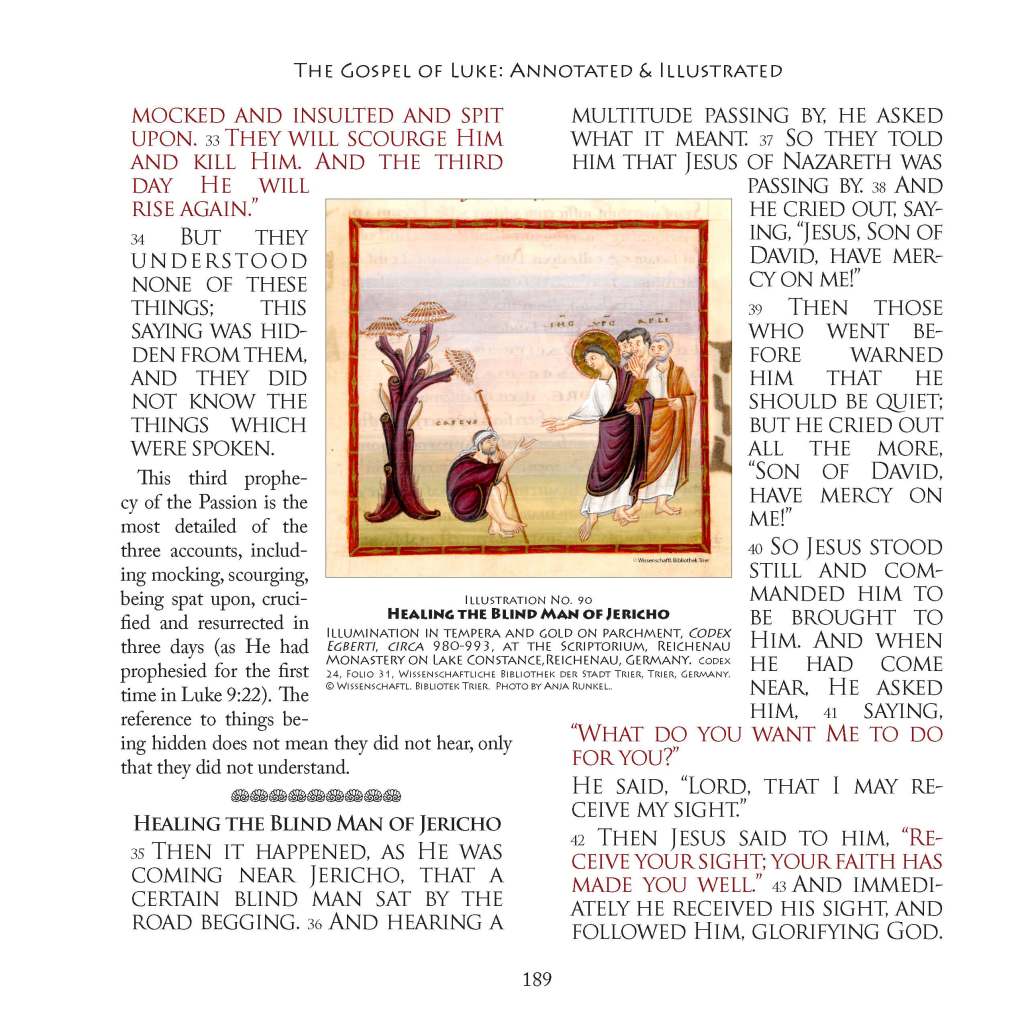
The Gospel reading, Luke 18:31-43, has two parts. The first, verses 31b-33, includes Jesus’ prophecy of His own death and resurrection in three days. The second part is a record of the Healing of the Blind Man of Jericho. My Podcast Homily for Quinquagesima Sunday is linked from the Podcast Homilies page. The illustration is a page from our Bookstore Publication, The Gospel of Luke: Annotated & Illustrated, available through my Amazon Author Central page. A summary of the content of the book and pricing is found on the AIC Bookstore page.

As always, thank you for your interest and support. Glory be to God for all things! Amen!
Sexagesima Sunday

Sexagesima Sunday is the second of three pre-Lent Sundays, which are now unique to the Anglican worship tradition. For more historical and other detail on the season watch Episode One in our video series. Gesima: the Pre-Lenten Season or listen to the audio Podcast version, which its linked from the Podcast Archive page. This week I offer site visitors two remarkable examples from our nearly 3000-item library of historic art.

The Collect for Sexagesima Sunday was adapted by Archbishop Cranmer from the Gregorian Sacramentary, which was also the source for the Collect for Septuagesima Sunday. It was used for the first time in the 1549 Book of Common Prayer and was read by Archbishop Cranmer himself on Whitsunday/Pentecost, June 9, A.D. 1549. The prayer book also may have been used earlier in the same year at St. Paul’s Cathedral, London. Like the Epistle and Gospel reading for the day, the themes are the “mercies” of God and the Christian virtues. Sexagesima Sunday is actually 57 days before Easter and not the sixty which its name suggests. Readers should remember that the Greek word for God, Theos, (Strong’s Greek Word #2316) is often translated as The One Who Sees.

O LORD God, who sees that we put not our trust in any thing that we do;
Mercifully grant that by thy power we may be defended against all adversity;
through Jesus Christ our Lord. Amen.

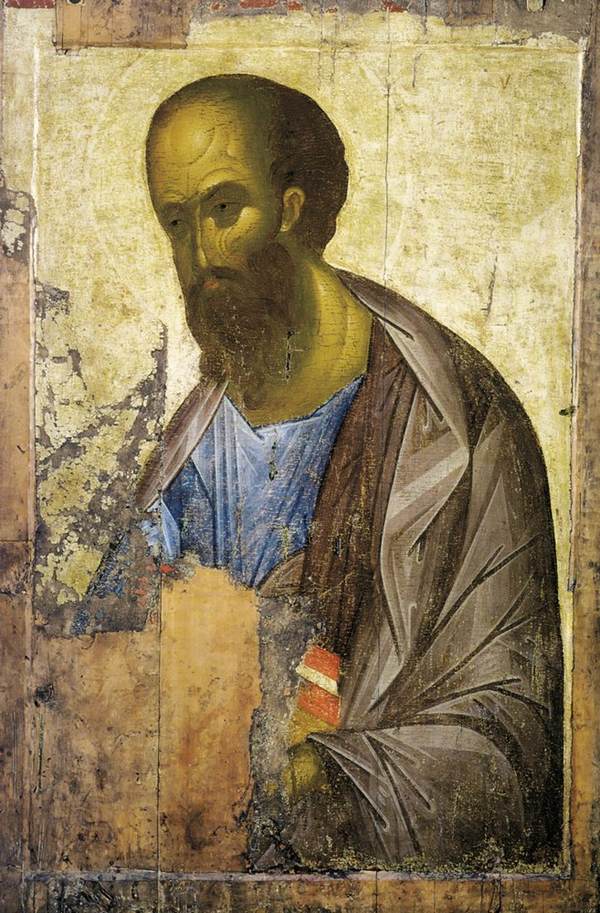
St. Paul, unfinished icon in tempera and gold on wood panel, Andre Rublev, circa 1410-1420, made for the Deesis tier in a Russian church at Zvenigorod, 33 miles west of Moscow, Tretyakov Gallery, Moscow, Russia. Wikipedia Commons/Public Domain.

The Epistle reading, 2nd Corinthians 11:13-21, St. Paul’s letter to the formerly pagan congregation he established at Corinth on his Second Missionary Journey accompanied by Silas. The verses are discussed and illustrated in Episode Two of our video series, Gesima: the Pre-Lenten Season, linked from the Digital Library page and in audio form from the Podcast Homilies page. In this epistle to congregation most resistant to his teachings, he mentions the Christian virtue of diligence and names forms of suffering he endured on his journey, including stoning, beatings, shipwreck, followed by a list of more general adversities, including hunger, thirst and robbery. The image of St. Paul was painted by one of the world’s most gifted icon painters. As the credit line suggests, the image is no longer mounted in the church for which it was being made, having become an “historic” object rather than a religious one. Even in its unfinished form it is an exceptional example of art put to use for Christian purposes. Frequent visitors to this site may have noticed that another image of this icon has a blue background, which was the result of studio lighting. This one is the real thing and will be used in all future AIC Publications and updates to existing books and videos.

The Sower, opaque watercolor over graphite on gray wove paper, James Tissot, 1886-1894, Brooklyn Museum, Brooklyn, NY. Public Domain.

The Gospel reading, Luke 8:4-15, is the evangelist’s account of the Parable of the Sower. The watercolor above appears as Illustration No. 71 in our publication, The Gospel of Matthew: Annotated and Illustrated and Illustration 71 in The Gospel of Mark: Annotated and Illustrated. In the comparable volume on the Gospel of Luke I used an oil on canvas by Vincent Van Gogh. These books are available through my Amazon Author Central page. A summary of the book, including price and pagination, is found on the AIC Bookstore page. The image is from a collection of around 300 images in James Tissot’s Life of Christ series, the largest collection of which is now held at the Brooklyn Museum.

As noted in previous posts late last year, I am working on Episode Six and Episode Seven in our video series, The War on Christianity. I expect to finish the text and slides before the end of this weekend. Each of the 24 slides in Episode Six and 33 in Episode Seven is produced by clipping from a sheet with six slides each and some single image pages in Adobe Photoshop. Afterward, each slide must be inset into a video and the sound track recorded using Apple’s iMovie software. The completed episodes probably will not be ready for publication before the middle to the end of March. It will be linked from the Digital Library page and the voice track, converted into an MP3 file, linked from the Podcast Archive page. In other news, I’ve had.a request from an Anglican clergyman in northern Italy to use some material from this site. I have given permission with the condition that the material contains a link to this site.

As always, thank you for your interest and support. Glory be to God for all things! Amen!

A Correction & Plans for A.D. 2025

Sharp-eyed readers will have noticed the error in the entry for the final Sunday in Christmastide. I did not see it myself until I sat down in church on Sunday. I suspending writing on Dec. 26th. Call it a “senior moment” that when writing was resumed for the last Sunday in the season it was the Collect, Epistle and Gospel readings for First Sunday after Christmas Day that were posted instead of the later Second Sunday after Christmas Day. Apologies.

Following review of all the blog posts for 2024 A.D., for the new year 2025 A.D. I’ve decided to continue with the old style of commentary on the Collect, Epistle and Gospel (C/E/G) readings for the seasons of Epiphany, Gesima, Lent & Easter and for Whitsunday. That will take readers/site visitors to the point in which C/E/G commentaries were begun in 2024 A.D. with the start of Trinitytide.

During these cold winter days of late December and early January, I have updated the AIC image database, now totaling over 2800 entries. All the uses in this Blog have now been noted in the Excel file. Later this month I expect to start work on the two remaining videos in the War on Christianity series. These two episodes will be focused on practical solutions for Christians living in an anti-Christian world.

Thanks as always for your interest and support. Glory be to God for all things! Amen!
Third Sunday in Advent

Unlike the Collects for the first two Sundays in Advent, the Collect for Third Sunday in Advent is not an original composition by Archbishop Thomas Cranmer for the 1549 Book of Common Prayer. Just in case readers might not have seen it, here is the Archbishop’s unusually short original composition.peosu

LORD, we beseech thee, give ear to our prayers,
and by thy gracious visitation lighten the darkness
of our heart, by our Lord Jesus Christ.

For the 1662 Book of Common Prayer, published after the restoration of the monarchy, a new Collect was produced with a clearer focus on the primary themes of Advent. It places greatly emphasis on words derived from the appointed Epistle reading and the second major theme of Cranmer’s first two Collects for Advent, that is, the promised Second Coming in Christ in judgment. In a nod toward the innovations of Archbishop Cranmer, the revisers introduced a theme from his responses to the first nine Commandments in the Decalogue in the 1549 B.C.P. Holy Communion liturgy: “incline our hearts…” and the response to the Tenth Commandment: “write all these thy laws in our hearts…” Prayer Book scholar Massey Shepherd notes that the preamble includes a rare for the B.C.P. example of direct address to the Lord Jesus Christ and that the “ministers and stewards of thy mysteries” refers to the clergy and bishops of the Church in the role of custodians of the heritage handed down from the Apostles.

O LORD Jesus Christ, who at thy first coming didst send thy messenger to prepare thy way before thee;
Grant that the ministers and stewards of thy mysteries may likewise so prepare and make ready thy way,
by turning the hearts of the disobedient to the wisdom of the just, that at thy second coming to judge the
world we may be found an acceptable people in thy sight, who livest and reignest with the Father and the
Holy Spirit ever,* one God, world without end. Amen.

The Epistle reading, 1 Corinthians 4:1-5, repeats the phrase “mysteries” from the Collect. It includes St. Paul defense of himself against accusations from some members of the congregation at Corinth. St. Paul also mentions “mysteries” in Romans 16:25.

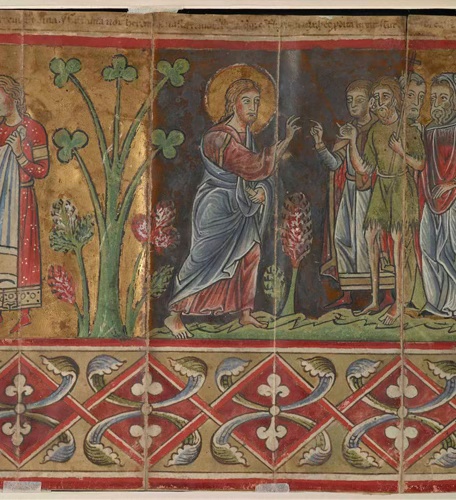
Christ Meets John the Baptist and His Followers, illumination in colors and gold on parchment, the fourth of five scenes on the front (Recto) side of a parchment frieze, with four additional scenes on the reverse (Vers0) side, 4th Qtr., 12th C.; Ms. Additional 42497, Recto, British Library, London, England. The images at the left are part of the second scene, illustrating the naming of Elizabeth. John the Baptist is depicted in a humble, crude green garment quite different from the costume of his followers. The document was acquired by the British Library in 1931 from a private collection in Paris, France.

The Gospel reading, Matthew 11:2-10, goes backward in time to about 28 A.D., being St. Matthew’s account of Jesus’ earliest references to John the Baptist. Followers of John want to know “Are you the Coming One or do we look for another?” (Matthew 1:3). Jesus refers to John in the context of the prophecy of Malachi 3:1. One of the major themes of St. Matthew’s Gospel is that Christ is the fulfillment of Old Testament prophecy.

Other AIC Resources on the topics in the Blog post are: The Collect, Epistle and Gospel readings for Third Sunday in Advent, commonly known as Gaudete Sunday, from the Latin gaudere (rejoice), are discussed and illustrated in Episode Two of our Christian Education Video series, Advent: A Season of Penitence and Preparation. My Podcast Homily on the theme, Rejoice in the Love of God, is linked here and from the Podcast Homilies page. Archbishop Cranmer’s understanding of the concept of taking the Commandents and the teachings of the Church Universal into the heart is explored further in our Bookstore Publication, Christian Spirituality: an Anglican Perspective, pp. 8-13, and the Gospel reading for Third Sunday in Advent is discussed and illustrated in The Gospel of Matthew: Annotated & Illustrated, both available through my Amazon Author Central page.

Additional AIC Resources for days during the week following Third Sunday in Advent include the first four of seven episodes in our Seasonal Video series, The Great “O” Antiphons, based on a 12th C. hymn, with one episode for each of the days from Dec. 18th through Dec. 24th.

December 18th – O Sapientia
December 19th – O Adonai
December 20th – O Radix Jesse
December 21st – O Clavis David

As ever, thank you for your interest and support. The AIC web site remains a reliable resource for teaching and study materials based on traditional understanding of Christian doctrine. Glory be to God for all things! Amen!