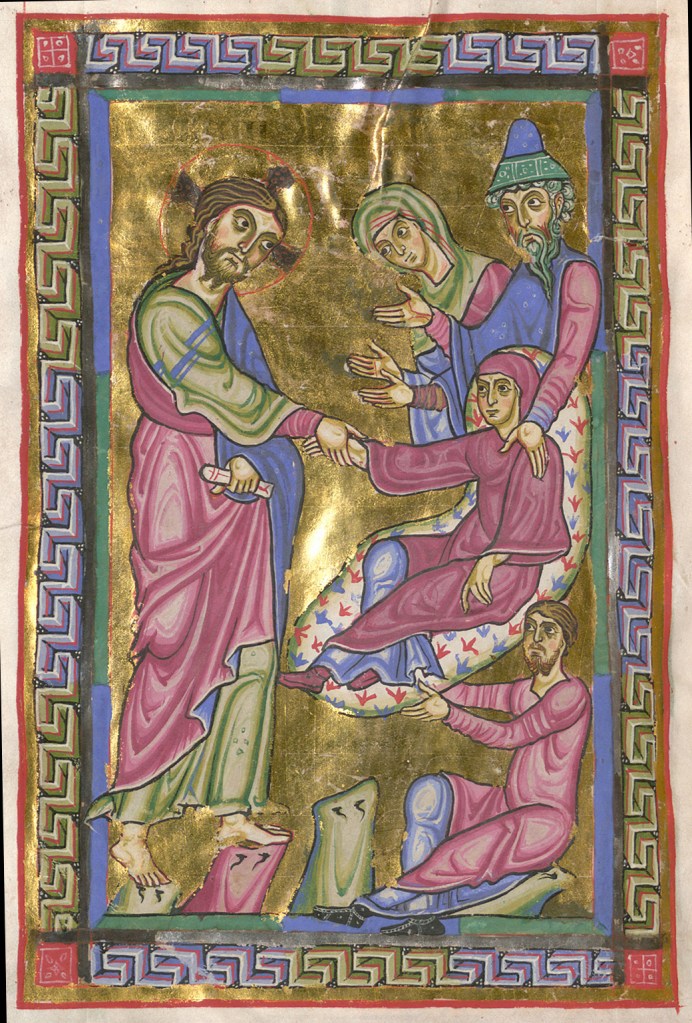
Twenty-fourth Sunday after Trinity, observed on 11/15 in A.D. 2026, is the last numbered Sunday after Trinity in A.D. 2026. In my earlier Blog post for Trinity 24 (11/24/24), I illustrated the Gospel reading with a watercolor by James Tissot, from his collection of images of scenes in the life of Christ now at the Brooklyn Museum. For A.D. 2026, I offer below a much earlier illumination from a lesser-known volume which was produced in the 2nd Qtr, 12th C. The design, workmanship and range of colors is typical of the illuminations produced during the reign of the Ottonian emperors who were heirs to the crown of Charlemagne, the first Holy Roman Emperor in Western Europe since the sacking of Rome in 476 A.D. Charlemagne was crowned at Rome on Christmas Day, 800 A.D., by Pope Leo III. Images of, and information about, Charlemagne and his religious advisor, the Blessed Alcuin of York, are found in my Blog post for 3/24/24 A.D.
The Collect for Twenty-fourth Sunday after Trinity is an original written by Archbishop Cranmer for the 1549 Book of Common Prayer. It is based on a selection of Morning and Evening prayers found in the Leonine and Gregorian Sacramentaries, two of the three primary sacramentaries of the Roman Catholic tradition (the third being the Gelasian). As noted in several earlier posts, neither collection has a direct connection with the two famous Roman Catholic popes, with dates of their rule: Leo the Great (440-461) and Gregory the Great (590-604). These two sacramentaries do reflect the teachings of one or both men, especially the “bountiful” goodness of the Lord God and the frailty of mankind, His creation.
LORD, we beseech thee, absolve thy people from their offences;
that through thy bountiful goodness we may all be delivered from the bands of those sins,
which by our frailty we have committed. Grant this O heavenly Father,
for the sake of Jesus Christ, our blessed Lord and Saviour. Amen.
The Epistle reading, Colossians 1:3-12, is another Pauline composition addressed to one of the churches in Asia Minor. The congregation was in the earthquake-prone part of Asia Minor, the Phrygia region of Turkey, which lies a few hundred miles southeast of Ephesus. The closest companion church was at Laodicea, one of seven churches named by St. John in Revelation. There are no remains of a church at Colossae nor is there a record of any excavation of such a church in that region. Historical evidence suggests that St. Paul never actually visited Colossae. St. Paul refers in his epistle to “Epaphras,” who is thought to have been the founder of that same new Christian community in Asia Minor. In his epistle to the Colossians, St. Paul used words and phrases representative of his evangelical teachings, including “spiritual understanding” and “patience and long-suffering with joyfulness” (verse 11); a reference to giving thanks “unto the Father” and, famously, the offer to be “partakers of the inheritance of the saints in light” (both in verse 12).
The Gospel reading, Matthew 9:18-26, is the evangelist’s account of two healings in the region of Capernaum. The first is of the woman “with an issue of blood twelve years” (verse 20) and, second, of the 12-year-old daughter of an unnamed ruler, who is identified as Jairus in St. Mark’s account (Mark 5:21-24; 35-43). The story is also told by St. Luke (Luke 8:40-56). Jesus comforted Jairus with the assurance that the girl “is not dead but sleeping” (Matthew 9:24; Mark 5:39; Luke 8:52). The story is not told by St. John in his Gospel, although he was one of those allowed to enter the house of Jairus. In his commentary on this reading, Church historian Massey Shepherd observes that “the woman represents the sinner who through faith in Him finds wholeness given to both body and soul. The close relation between physical healing and spiritual restoration is characteristic of the gospel tradition in miracles of this sort.”
Other AIC Resources in print, audio or video formats referring to the Collect and/or the readings for Twenty-fourth Sunday after Trinity include Episode Nine in our Christian Education Video series, Trinitytide: the Teaching Season, linked from the Digital Library page. The audio-only version in MP3 format is linked from the Podcast Archive page. My Podcast Homily for Twenty-fourth Sunday after Trinity is linked from the Podcast Homilies page. Another podcast homily for Twenty-fourth Sunday after Trinity, this latter one based upon the Lectionary’s third Psalm reading for the day, Psalm 136, which is paired with Luke 13:1-9, is linked from the Podcast Homilies-Morning Prayer page.
Other famous illustrations of the Raising of the Daughter of Jairus are featured in several AIC Bookstore Publications. The watercolor by James Tissot mentioned above is Illustration No. 60 in The Gospel of Matthew: Annotated & Illustrated. An illumination from the Gospels of Otto III (circa 998 A.D.), based on Luke 8:40-56, is Illustration No. 60 in The Gospel of Luke: Annotated & Illustrated. A 2nd Quarter 20th C. stained glass window by Franz Mayer of Munich is Illustration No. 61 in the Luke volume and Illustration No. 34 in The Gospel of Mark: Annotated & Illustrated. It is also Illustration No. 46 and on the front cover of Paintings on Light: The Stained Glass Windows of St. Joseph’s Villa Chapel. The illumination above from the Pericope Book of St. Erentrud of Salzburg is Illustration No. 33 in The Gospel of Mark: Annotated & Illustrated. Finally, an illumination of Psalm 136 from the famous and spectacular illuminated volume known as the Stuttgart Psalter (circa 820 A.D.) is printed on page 382 in The Prayer Book Psalter: Picture Book Edition. The Picture Book Edition also includes images from eighteen other illuminated Psalters and breviaries from the 10th to the 16th C. All these and the other AIC Bookstore Publications are available exclusively through my Amazon Author Central page. Details of each book, and a copy of its cover, are available on the AIC Bookstore page.
Our goal since the first Fr. Ron’s Blog in August 2014 A.D. remains online access to Christian resources in visual, audio and print formats (the former free of charge and the latter at reasonable prices), to the faithful no matter where there are in the world. Royalties for all AIC Bookstore Publications are donated as received to the AIC.
As always, thank you for your interest and support. Glory be to God for all things! Amen!


Published by