For Twenty-third Sunday after Trinity Archbishop Thomas Cranmer chose a Collect from the Gregorian Sacramentary, in the version first published in the 10th Century honoring the teachings of Gregory the Great. The Collect is one of seven in the Gregorian Sacramentary used during Trinitytide and also one of three that were used in the final weeks of Trinitytide. Church historian Massey Shepherd notes in his commentary on the Collect that the opening sentence paraphrases Psalm 46:1: God is our hope and strength, * a very present help in trouble.” Importantly, he also notes that not all prayers have equal weight, only those offered “faithfully.”
O GOD, our refuge and strength, who art the author of all godliness; Be ready, we beseech thee, to hear the devout prayers of thy Church; and grant that those things which we ask faithfully we may obtain effectually; through Jesus Christ our Lord. Amen.
The Epistle reading, Philippians 3:17-21, is another Trinitytide reading from the pen of St. Paul the Apostle. Here it is useful to recall Paul’s rejection in verses 1, 3 and 5, not included in the reading, that all seeking admission into the new Church must be circumcised, a practice insisted upon by the group commonly called the Judaizers. St. Paul’s most essential point is found in verse 18: “For our citizenship is in heaven, from which we also eagerly wait for the Savior, the Lord Jesus Christ” (NKJV text). In the Orthodox Study Bible: New Testament and Psalms,” the editors expand beyond the KJV text used in the 1928 Book of Common Prayer by including the first verse of Chapter 4: “Therefore, my beloved and longed-for brethren, my joy and crown, so stand fast in the Lord, beloved.” In Episode One in the AIC Bible Study Video series, The New Testament: Gospels, I discussed the division of the Holy Bible into numbered chapters and numbered verses, with Upper and Lower Case letters, a 13th C. innovation credited to Stephen Langton, who later served as Archbishop of Canterbury. The audio-only version in MP3 format is linked from the Podcast Archive page.
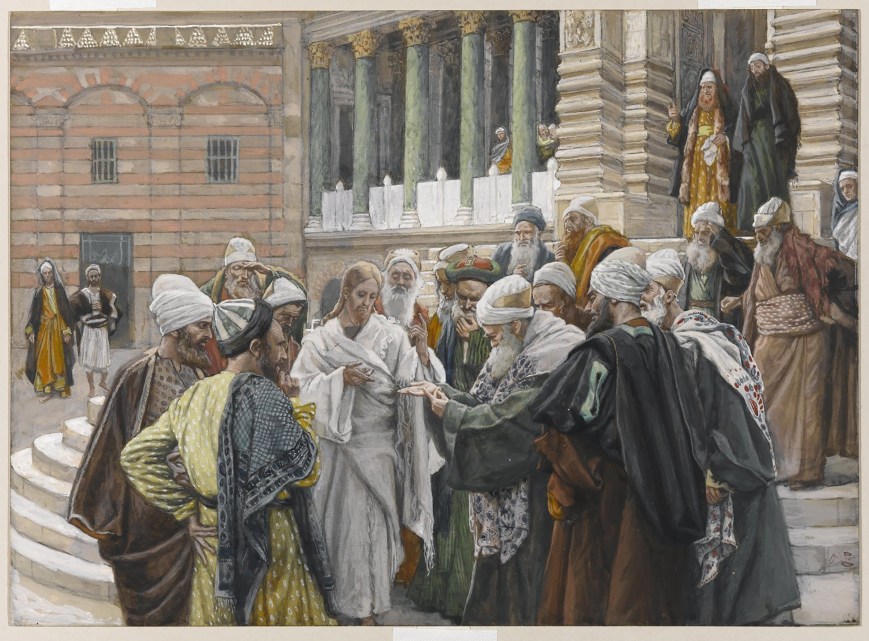
The Gospel reading, Matthew 22:15-22, is the 8th of 9 citations from the Gospel of Matthew and the third from Matthew printed at the end of the numbered Sundays after Trinity (Trinity 22, 23 & 24). The reading is St. Matthew’s version of Jesus’ encounter with a group of Pharisees and “Herodians” (verse 16) who attempt to trap Jesus into an answer to the question: “Is it lawful to pay taxes to Caesar, or not?” The encounter is also recorded in Mark 12:13-17 and Luke 20:20-26. They were certain that however Jesus answered the question they could use it against Him. The last verse of His Jesus’ reply silenced them: “Render therefore unto Caesar the things that are Caesar’s; and unto God the things that are God’s.” The text ends with this: “When they had heard these words, they marveled, and left him, and went their way.”
Other AIC Resources on this site touching upon the Collect, Epistle and Gospel readings and that are available in audio, video or print formats, include my Podcast Homily for Twenty-third Sunday after Trinity, linked from the Podcast Homilies page. A related Podcast Homily in MP3 format, this one based upon the Psalm reading in Morning Prayer for Twenty-third Sunday after Trinity, is linked from the Podcast Homilies-Morning prayer page. In full color video format, Episode Eight in our Christian Education Video series, Trinitytide: the Teaching Season, is linked from the Digital Library page. The audio-only version in MP3 format is linked from the Podcast Archive page. In color paperback form, with 117 illustrations, The Gospel of Matthew: Annotated & Illustrated, includes fourteen images of St. Matthew from the 8th to the 15th C. In another AIC Bookstore Publication, The Prayer Book Psalter – Picture Book Edition, Psalm 46 is illustrated by two images from the Stuttgart Psalter, produced circa 820 A.D. in the Scriptorium at the Abbey of Saint-Germain-des-Pres, Paris, France. In that volume the opening letters for each Psalm are displayed with a colorful scroll and initial capital letters designed by Corinne M. Shibley. Both books are available exclusively through my Amazon Author Central page. Pope Gregory the Great, whose Feast Day is March 12th and whose life and teaching are celebrated in the Gregorian Sacramentary and who instituted Ash Wednesday and made it the start of Lent in the Western Church, is honored in Episode Fourteen in the AIC Christian Education Video series, The Lives of the Saints, Second Series, linked from the Digital Library page, The audio-only version in MP3 format is linked from the Podcast Archive page. The Second Series honors the life and contributions of 35 saints, from both the Western and Eastern Churches and without Holy Days in the 1928 Book of Common Prayer. St. Gregory is also featured in two earlier Fr. Ron’s Blog posts: 3/3/2025 (Ash Wednesday) and 3/18/2017 (Honoring both St. Thomas Aquinas and St. Gregory the Great).
As always, thank you for your interest and support. Glory be to God for all things! Amen!


Published by